
Abstract
Introduction
Universities and colleges aspire to equip students for leadership in their professions, and institutions frequently include leadership education in their statements of mission and purpose. According to Susan Komives and Matthew Sowcik (2020a), integrating leadership education into the majors of academic disciplines is a crucial step toward achieving institutional goals for widespread student leadership development. Furthermore, music students need leadership skills to navigate increasingly entrepreneurial careers, as shown by interviews with music alumni (Haddon and Burnard 2015; Miller, Dumford, and Johnson 2017; Branscome 2022). Despite the importance of leadership skills for music students, heavy curricular demands may prevent these students from undertaking formal leadership training (Laitz 2016). Some music students may have opportunities to develop leadership skills by serving as ensemble section leaders, teaching private lessons, or becoming music theory tutors; however, these opportunities are relatively few and tend to be reserved for high-achieving students.
I argue that music theory and aural skills courses can provide scaffolded leadership opportunities for undergraduate and graduate students of all achievement levels. Following a review of the leadership development literature, I address two questions. First, which specific leadership competencies do music students need in order to succeed professionally? And second, how can instructors help students develop these competencies in the context of music theory and aural skills? I outline several categories of activities to build students’ leadership skills, provide tips for instructors, and share responses from my students who participated in these activities.
Leadership Development Literature
The field of leadership development is extensive and burgeoning (Day et al. 2014; Vogel et al. 2021). Many styles and models of leadership have emerged in the related field of leadership studies, and a comprehensive review of these approaches is beyond the scope of this article.[1] Komives and Sowcik (2020a, 12) describe the field of leadership studies as “the examination of leadership as a multidisciplinary field of study,” while leadership development denotes “leadership education programs that intentionally develop skill, build leadership capacity, and inform a leadership identity in students.” However, a brief introduction will set the stage for a discussion of student leadership development.
Leadership Capacities: Innate or Learned?
A fundamental question in leadership studies is whether capacities for leadership are innate, relying on predisposed traits, or if they are based in skills and behaviors that can be learned (Zaccaro 2007). Corey Seemiller and Thomas Murray (2013) describe this as a trait theory perspective versus a behavioral theory perspective, the latter of which grew into the competency movement. Integrating these seemingly dichotomous perspectives, Scott DeRue and colleagues (2011) propose a model of leadership effectiveness that includes both traits and behaviors. In this article, I favor a behavioral approach and explore ways that students of all achievement levels can develop competencies to increase their capacity for effective leadership.
Leadership Development in Higher Education
Research by Christine Cress and colleagues (2001, 23) supports the conclusion that “leadership potential exists in every student” and that this potential can develop through leadership programs and activities in higher education. John Dugan and Susan Komives (2007, 14), co-principal investigators of the Multi-Institutional Study for Leadership that spanned fifty-two campuses with 63,000 student participants, concur that “purposeful interventions can make a difference in the developmental process of college students.”[2] The Multi-Institutional Study for Leadership continues to collect data as it approaches its twentieth anniversary. For more information, see https://expandingleadership.org/msl/. Although students’ leadership skills can benefit from serving in positional roles (e.g., officer in a college organization, leader in a musical ensemble or athletic team), many students do not have a chance to serve in these roles. Out of more than 14,000 college seniors surveyed by Dugan and Komives (2007), 46% had never had the opportunity to hold a positional leadership role during their time in college. It is therefore important to provide students with opportunities to develop leadership skills in other contexts.
A variety of formal programs, ranging from one-day seminars to semester-length courses and leadership degrees, serve as avenues to develop students’ leadership skills. These programs can be quite effective. For example, a longitudinal study with students from ten institutions found that students who participated in leadership programs experienced greater increases in their development of “social and personal values, leadership ability and skills, civic responsibility, multicultural awareness and community orientation, and leadership understanding and commitment” from their first to their senior years in college than students who did not participate in leadership programs (Cress et al. 2001, 19). Similarly, Krista Soria and colleagues (2019) found connections between students’ enrollment in a strengths-focused leadership minor course and heightened social, academic, and psychological thriving. Even short-term programs can help—David Rosch and Arran Caza (2012) discovered that well-structured programs can have a lasting impact on student leadership practices.
Students view effective leadership training as “active, engaging, interactive, experiential and practical,” sometimes in contrast to what they perceive as a traditional classroom environment (Karagianni, Lainidi, and Montgomery 2023, 215). Factors that increase the effectiveness of leadership training for students include peer learning (Karagianni, Lainidi, and Montgomery 2023), guided reflection (Roberts 2008), and connections between the content covered in leadership training and other related leadership skills (Rosch and Caza 2012), as well as connections to aspects of students’ lives outside of class (Roberts 2008). Such connections enable students to transfer the leadership skills they acquire into new contexts (Karagianni, Lainidi, and Montgomery 2023).
Learning environments that do not focus on leadership-related content can still incorporate elements of effective leadership training. According to research by Cress and colleagues (2001, 23), “[s]tudents who volunteer, intern, or work collaboratively in class are more likely to develop their leadership potential whether or not they participate in a formal leadership development program.” Active, experiential learning with opportunities for reflection and clear relevance to students’ future careers is germane to the training of music students (Allen 2025) and is well suited to courses in music theory and aural skills.
The leadership competencies that undergraduate and graduate students acquire can simultaneously equip students to succeed in academic courses and enhance their future employability (Seemiller and Murray 2013; Komives and Sowcik 2020a). Jane Skalicky and colleagues (2020, 108) argue that academic programs—regardless of their subject matter—ought to incorporate “purposeful and explicit” student leadership development. Komives and Sowcik (2020a, 19) concur, stating that “[i]ntentional leadership education belongs everywhere it can be offered to enact institutional mission and reach the range of enrolled students’ needs and interests.” While grounding student leadership in disciplinary contexts is desirable, interdisciplinary communication is also essential (Komives and Sowcik 2020b). To communicate clearly across disciplinary boundaries, faculty and administrators need a shared understanding of what leadership means (Skalicky et al. 2020) and a common vocabulary pertaining to student leadership development (Seemiller and Murray 2013).
When facilitating opportunities for student leadership development, it is important to consider students’ pre-existing beliefs about leadership (Haber 2012; Caza and Rosch 2014), some of which are rooted in students’ pre-college activities and family experiences (McCarron et al. 2022). David Rosch and Kevin Wilson (2022) explain that students’ learning in leadership development programs depends not only on the impact of the training itself but also on external factors such as students’ motivation and any prior experiences they have with leadership-focused activities. To work effectively with these external factors, faculty can build learning environments that support students’ need for a “sense of psychological safety and control” (Karagianni, Lainidi, and Montgomery 2023, 214). Ideally, the leadership skills students cultivate during college will prepare them to become life-long learners and practitioners of leadership (Liu et al. 2021).
NASM Learning Outcomes
To determine the specific leadership competencies needed by music students, I consulted the Handbook published by the National Association of Schools of Music (NASM), the accrediting body for music programs at many institutions. For students pursuing professional undergraduate degrees in music, NASM (2026, 113) recommends “[a]cquisition of skills necessary to assist in the development and advancement of the careers of students, normally including basic competency development in communication, presentation, business, and leadership, all with particular regard to professional practices in their major field.” Leadership skills are also vital to graduate student preparation: “Students should be encouraged to acquire the career development and entrepreneurial techniques, become aware of the attributes and characteristics associated with leadership, and develop connections and records of achievement necessary to (1) advance themselves consistent with expectations and practices in their area of specialization, and (2) fulfill their own career objectives” (NASM 2026, 139).
I examined the sections of the Handbook that outline learning outcomes for students and recorded each statement that was related to leadership. By grouping similar statements, I discovered twelve themes: administration, collaboration, communication, creativity, ensemble leadership, ethics, evaluation and persuasion, independence, problem solving, public presentation and performance, self-development, and teaching. Some themes are quite specific (e.g., ensemble leadership), while others are broad (e.g., creativity).
To illustrate the kinds of statements that appear in the Handbook, we can look at problem solving. According to NASM (2026, 113), students pursuing undergraduate professional degrees in music need the “capability to produce work and solve professional problems independently.” Problem-solving is also highlighted in the context of several other majors; for instance, students in liberal-arts music industry programs are encouraged to develop “the capacity to pose, analyze, and solve problems with an understanding of the interrelationships and interdependencies of various interests in and influences on the music industry” (NASM 2026, 208). Master’s students in music education “develop graduate-level perspectives on contemporary issues and problems in music education,” while doctoral students in music theory need “the ability to clarify issues of musical structure” (NASM 2026, 148, 153). Representative statements for all twelve themes appear in Appendix A.
After identifying the twelve themes, I considered them further to see if any groupings would emerge. As shown in Figure 1, I ultimately classified these themes into five overlapping skill domains: interpersonal, intrapersonal, intellectual, musical, and leadership.[3] While all five domains contribute to music students’ effectiveness as leaders, the leadership skills domain focuses on public-facing and administrative work.
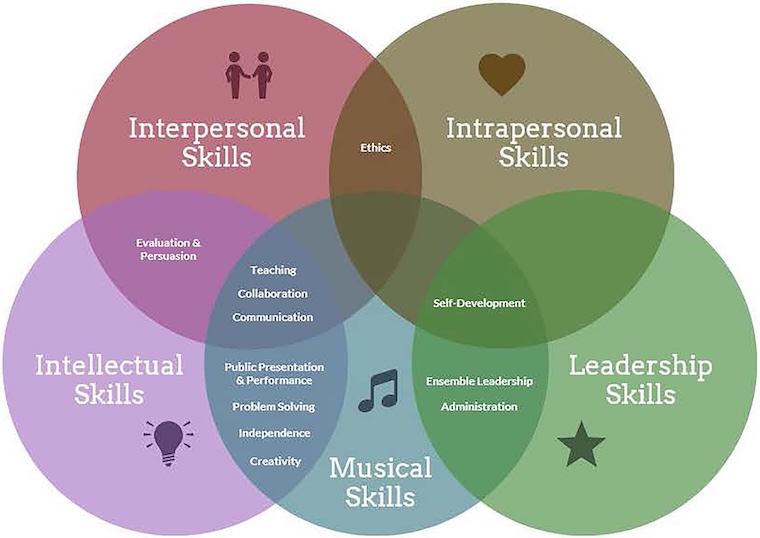
Figure 1: Themes and domains found in the NASM Handbook
Each theme straddles at least two domains, as shown by themes’ placement in overlapping regions of the diagram. For example, tasks related to collaboration draw on interpersonal, intellectual, and musical skills.
Student Leadership Competencies (SLCs)
Corey Seemiller conducted a quantitative text analysis of learning outcomes from 605 accredited academic programs in many disciplines, including the programs accredited by NASM (Seemiller and Murray 2013; Seemiller 2021). She found a total of sixty student leadership competencies, or SLCs, that provide faculty in disparate fields with a shared vocabulary for planning and assessment.[4] Seemiller’s SLCs are informed by relationally focused leadership models including the Relational Leadership Model (Komives, Lucas, and McMahon 2013), the Social Change Model of Leadership Development (Higher Education Research Institute 1996), and the Five Practices of Exemplary Leadership (Kouzes and Posner 2011). In the context of leadership, Seemiller and Murray (2013, 35) define the term competency as the “knowledge, value, ability (skill or motivation), and behavior that lead to the outcome of effective leadership.” The thirty SLCs that Seemiller’s searchable database identifies in the NASM Handbook appear in Table 1, and definitions for these SLCs—drawn from Seemiller’s (2020) Student Leadership Competencies Resource Guide—appear in Appendix B.[5] http://database.studentleadershipcompetencies.com. To view SLCs in music, select the performance career field and then filter through the results for dance and theatre to find the music programs.
Table 1: Student leadership competencies in the NASM Handbook
|
Advocating for a Point of View |
Idea Generation |
Receiving Feedback |
|
Analysis |
Listening |
Research |
|
Appropriate Interaction |
Motivation |
Responding to Ambiguity |
|
Collaboration |
Nonverbal Communication |
Self-Development |
|
Decision Making |
Organization |
Self-Understanding |
|
Empathy |
Other Perspectives |
Supervision |
|
Ethics |
Plan |
Synthesis |
|
Evaluation |
Positive Attitude |
Systems Thinking |
|
Follow-Through |
Problem Solving |
Verbal Communication |
|
Goals |
Productive Relationships |
Writing |
Combining all academic disciplines, Seemiller (2021) notes that the three most prevalent competencies are evaluation, verbal communication, and ethics. However, restricting results from her searchable database to competencies included in the NASM Handbook reveals that the competencies most frequently mentioned in music differ from these multidisciplinary results. Considering all degree levels in music, the competencies of analysis and writing tie for the largest number of mentions. Idea generation is a close second, while verbal communication—the only competency that coincides with the most prevalent multidisciplinary competencies—holds third place. Additional competencies that are frequently mentioned in music programs include advocating for a point of view, other perspectives, synthesis, collaboration, and problem solving. Table 2 shows the number of times each SLC appears in learning outcomes for the four levels of music degrees.
Table 2: Number of appearances of SLCs at each degree level in music
|
Student Leadership Competency (SLC) |
Associate’s |
Bachelor’s |
Master’s |
Doctoral |
Total |
|---|---|---|---|---|---|
|
Analysis |
1 |
19 |
|
3 |
23 |
|
Writing |
|
19 |
2 |
2 |
23 |
|
Idea Generation |
1 |
19 |
1 |
1 |
22 |
|
Verbal Communication |
|
19 |
|
1 |
20 |
|
Advocating for a Point of View |
|
18 |
|
|
18 |
|
Other Perspectives |
|
18 |
|
|
18 |
|
Synthesis |
|
17 |
|
|
17 |
|
Collaboration |
|
16 |
|
|
16 |
|
Problem Solving |
|
14 |
1 |
|
15 |
|
Evaluation |
|
14 |
|
|
14 |
|
Goals |
1 |
13 |
|
|
14 |
|
Positive Attitude |
|
14 |
|
|
14 |
|
Research |
|
4 |
4 |
3 |
11 |
|
Ethics |
|
7 |
|
|
7 |
|
Decision Making |
|
2 |
|
|
2 |
|
Organization |
|
2 |
|
|
2 |
|
Receiving Feedback |
|
2 |
|
|
2 |
|
Responding to Ambiguity |
|
2 |
|
|
2 |
|
Appropriate Interaction |
|
1 |
|
|
1 |
|
Empathy |
|
1 |
|
|
1 |
|
Follow-Through |
|
|
1 |
|
1 |
|
Listening |
|
1 |
|
|
1 |
|
Motivation |
|
1 |
|
|
1 |
|
Nonverbal Communication |
|
1 |
|
|
1 |
|
Plan |
|
1 |
|
|
1 |
|
Productive Relationships |
|
1 |
|
|
1 |
|
Self-Development |
|
1 |
|
|
1 |
|
Self-Understanding |
|
|
1 |
|
1 |
|
Supervision |
|
1 |
|
|
1 |
|
Systems Thinking |
|
1 |
|
|
1 |
I connect the twelve broad themes from my independent analysis of the NASM learning outcomes with Seemiller’s more granular SLCs in Table 3. Some SLCs appear more than once because they fit multiple themes. In order to foster clear communication among faculty in different disciplines, I adopt Seemiller’s SLCs in tandem with the NASM themes I discovered when describing my approach to cultivating student leadership skills.
Table 3: Themes from NASM Handbook with corresponding SLCs. *Denotes SLC not found in NASM Handbook through Seemiller’s searchable database.
|
NASM Theme |
Student Leadership Competencies (SLCs) |
|---|---|
|
Administration |
Decision Making |
|
Collaboration |
Appropriate Interaction |
|
Communication |
Listening |
|
Creativity |
Idea Generation |
|
Ensemble Leadership |
Decision Making |
|
Ethics |
Ethics |
|
Evaluation and Persuasion |
Advocating for a Point of View |
|
Independence |
Evaluation |
|
Problem Solving |
Follow-Through |
|
Public Presentation and Performance |
Nonverbal Communication |
|
Self-Development |
Positive Attitude |
|
Teaching |
Appropriate Interaction |
Developing SLCs in Music Theory and Aural Skills
Having considered the leadership competencies that music students need, I will now address the question of how faculty can help students develop these competencies in music theory and aural skills. Several sources from the music theory pedagogy literature explore topics related to student leadership. For instance, Anna Ferenc (2015) helps students become disciplinary practitioners through writing and peer-editing in a sophomore-level course. Student panel discussions enhance classroom community (Lumsden 2018), and writing assignments woven throughout the core theory sequence culminate in a capstone with public presentations of undergraduate analysis projects at a “miniconference” (Attas 2016). Emphasizing transferable teaching skills and music-theoretical relevance, Anna Stephan-Robinson (2018) incorporates five-minute “mini-lessons” in which undergraduate students teach their peers through self-selected repertoire. In a similar vein, Allison Wente (2019) invites aural skills students to guide classmates through the process of learning to sing challenging melodies. Community-engaged learning and public music theory present additional opportunities for students to apply what they learn in meaningful contexts (Bourne 2017; Jenkins 2017; Grant 2021).
The active-learning approach I present in this article features class activities led by enrolled students of all achievement levels. Leadership activities serve the dual purpose of engaging students as disciplinary practitioners and equipping them with transferable skills. These activities also harness the motivational power of self-determination theory as students embrace autonomy, pursue competence, and cultivate a sense of belonging through peer learning and classroom leadership (Ryan and Deci 2020). I have developed seven activity categories, as shown in Table 4. The categories include 1) explaining answers to homework exercises, 2) teaching from provided resources, 3) leading class activities, 4) composing and performing new musical examples, 5) participating in panel discussions, 6) giving class presentations with related audience-engagement activities, and 7) planning conference-style events and presenting scholarly work to audiences beyond the class. For each category, I list my course learning objectives and identify related NASM themes and student leadership competencies.
Table 4: Activity categories with related course learning objectives, NASM themes, and SLCs. *Denotes SLC not found in NASM Handbook through Seemiller’s searchable database.
|
Activity Category |
Course Learning Objectives |
NASM Themes |
Student Leadership Competencies (SLCs) |
|---|---|---|---|
|
Share and explain answers to selected homework exercises |
|
Collaboration |
Collaboration |
|
Practice teaching, given specific assignments and resources |
|
Communication |
Analysis |
|
Lead class activity |
|
Communication |
Idea Generation |
|
Compose and perform new musical examples |
|
Collaboration |
Collaboration |
|
Participate in panel discussion |
|
Collaboration |
Advocating for a Point of View |
|
Give individual or group presentation (with activities
|
Individual presentation:
|
Communication |
Advocating for a Point of View |
|
Group presentation:
|
Administration |
Advocating for a Point of View |
|
|
Plan conference-style event and present scholarly work to an audience beyond the class |
|
Administration |
Advocating for a Point of View |
I primarily view student leadership activities as opportunities for formative, not summative, assessment. Except for activities that require substantial student preparation time, I either refrain from grading leadership activities or simply assign participation points. Pedagogical benefits of student leadership activities include positive leadership modeling by the instructor, exposing students to multiple perspectives and diverse leadership styles, and ensuring that the voices of all students are heard and valued.
Examples of Student Leadership Activities
To illustrate each category, I will now present sample activities that I have designed and used successfully at several institutions. These institutions include medium and large public universities, a large private university, and a small liberal arts college.
Explain Homework Answers
Exercises in this category provide a low threshold for practicing leadership skills, so they are especially helpful for first- or second-semester students. For instance, I divide a Theory I homework assignment that focuses on music fundamentals (e.g., writing intervals) into segments equal to the number of students enrolled in the course. Students do the full assignment in advance, and I check their work for completion at the beginning of class. To determine which exercises they will present, each student draws a slip of paper listing the tasks out of a hat. Knowing they will share homework answers with the class motivates students to complete assignments on time. Additionally, the random assignment of exercises to present reveals misconceptions that might not emerge if students volunteered to share the exercises for which they felt most confident. Students write answers on the board and take turns explaining their answers and the process used to determine them. Hearing processes used by their classmates exposes students to multiple approaches to finding the correct answers for music theory exercises. I provide clarification as needed and encourage students to ask related questions. If time allows, I sometimes extend the activity by asking students to work in groups of two or three to design additional practice exercises for the class.
A modified version of this activity works well near the end of Aural Skills I. Students complete a homework assignment with several melodic dictation exercises. When students come to class, I check their work for completion before asking them to discuss their answers in small groups. Each group discusses a different melody. Once groups reach a consensus, they notate their melodies on the board and take turns presenting their answers and leading the class in singing each melody on solfège syllables. The entire class remains standing while students present answers and lead the singing. This informal presentation style reduces pressure on students, who move around the room to see each other’s answers as though they were walking through an art gallery.
Practice Teaching
Students can practice teaching from their earliest semesters of music theory. To conclude a unit on species counterpoint, for instance, Theory I students work together in groups of four to six to review topics such as dissonance, melodic characteristics, and harmonic characteristics. Each group focuses on a single topic, comparing treatments of that topic across multiple species of counterpoint. Representatives from each group provide verbal summaries of their findings and collaboratively construct a chart for students to review as they prepare to write counterpoint on the next exam.
Following an introduction to period form, Theory II students work individually or in pairs to learn about specific types of periods (e.g., parallel interrupted period). Referring to examples from the textbook, students draw generic diagrams of their assigned period types on the board. Students then use these diagrams as visual aids while they explain melodic and harmonic features of their period types and respond to questions from their classmates. In small classes, the entire teaching exercise fits within a single fifty-minute class period, with approximately ten minutes for students to prepare and three to five minutes for each informal presentation.
As seen in these examples from Theory I and II, students’ teaching activities are often at least partially lecture based. Dividing what could be a long lecture by the instructor into bite-sized student presentations helps keep students engaged while exposing them to different presentation styles. For a more substantial teaching opportunity, Theory III students work in groups of three to teach the class about modal mixture and chromatic mediants and to review tonicization. Each group leads a fifteen- to twenty-minute segment of class. I provide specific guidelines and suggest resources to help students prepare, as shown in Table 5.[6] The textbook and workbook mentioned in Table 5 refer to Clendinning and Marvin’s (2020) The Musician’s Guide to Theory and Analysis, 4th ed.
Table 5: Assignments for Theory III teaching activities
|
Group |
Assignment |
|---|---|
|
Group 1 |
Provide an overview of modal mixture, as discussed in Chapter 26 of the textbook. Briefly explain what modal mixture is and give examples of commonly used mixture chords in major and minor keys. Explain how to reflect mixture in Roman numeral analysis. |
|
Group 2 |
Develop an activity that covers identification and writing of individual mixture chords, using exercises selected from workbook p. 315, A and B (or writing your own similar exercises). Provide a brief demonstration, then lead the class in hands-on practice. |
|
Group 3 |
Lead the class in analyzing a score that uses modal mixture (workbook pp. 317–18, II). Play a recording or perform the excerpt so the class can hear it. To provide more time to focus on the mixture chords, you may wish to provide a (partial) analysis of the diatonic chords in this excerpt. |
|
Group 4 |
Review and explain the voice-leading guidelines for part-writing with modal mixture, as indicated in Chapter 26. Lead the class in practicing brief progressions from workbook p. 316, II, or develop your own similar exercises. |
|
Group 5 |
Lead the class in analysis and part-writing with modal mixture in figured bass, using an example from workbook p. 323. Involve the class in hands-on practice, providing guidance throughout the activity and being prepared to show a good, complete solution at the end of the activity. |
|
Group 6 |
Provide an overview of chromatic mediants, as discussed in Chapter 26 of the textbook. Help the class practice finding chromatic mediants for a given tonic—develop exercises similar to the ones in Try It #3 (textbook p. 573). |
|
Group 7 |
Lead the class in spelling a variety of chromatic chords, using selected exercises from workbook p. 319, I (or develop your own similar exercises). For each chord, ask the class whether the chord represents modal mixture, a secondary dominant, or a secondary leading-tone chord. |
Assignments for some groups feature lecture-based explanation (e.g., Group 1), while others emphasize practice activities for the class (e.g., Group 2). Students begin preparing during class and continue working with their groupmates outside of class. I assign a homework grade for this exercise in recognition of students’ preparation time.
Lead Class Activity
In my Aural Skills II course, students lead the class in a harmonic-singing and analysis exercise. I distribute index cards that specify Roman numerals for three-chord progressions, each of which includes a passing, pedal, cadential, or arpeggiated six-four chord (second-inversion triad). The type of six-four chord is also indicated. Notation for a sample progression with a passing six-four chord appears in Figure 2.
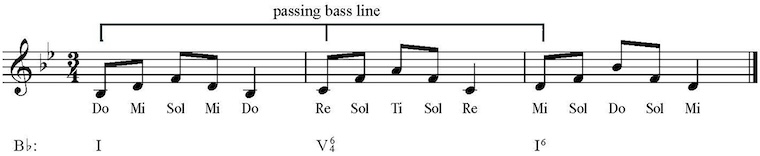
Figure 2: Harmonic-singing exercise for Aural Skills II
Students work individually or in pairs to determine the solfège for the arpeggiated chords in their assigned progression. Pointing to solfège written on the board in scalar fashion, students take turns leading the class in singing each arpeggiated chord progression without revealing the Roman numerals in advance. After the class sings each progression, student leaders invite classmates to share their chord analyses and to identify the featured type of six-four chord.
A similar approach informs a build-a-melody activity in Aural Skills IV that culminates in singing the opening twelve-tone row from Anton Webern’s Symphonie, opus 21, movement 2 (see Figure 3).
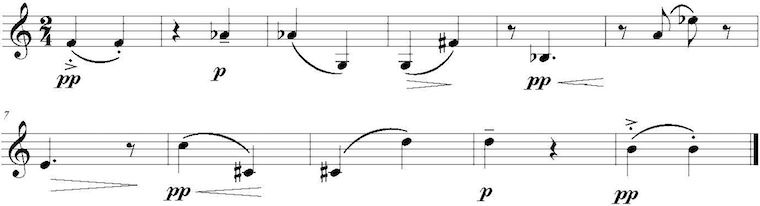
Figure 3: Opening twelve-tone row from Anton Webern’s Symphonie, Op. 21, ii, mm. 1–11
To determine the performance order, students receive numbered slips of paper with directions for singing specific intervals (e.g., “Starting on 5, go up a m3 to 8”). Pointing to integer notation on the board, each student leads the class in singing one new interval and reviewing the previous intervals until the pitches for this twelve-tone melody are complete. Subsequent score study connects the build-a-melody activity to Webern’s composition. This activity helps students hone their skills in aural error detection and practice effective rehearsal techniques, such as breaking a minor ninth into a minor second plus a perfect octave. The incremental process of navigating this challenging melody models a possible approach to learning difficult applied repertoire.
Although student-led class activities are especially well suited to aural skills courses, they can also be effective in the music theory classroom. For example, I occasionally appoint student scribes who notate the answers provided by peers during in-class practice exercises. Since scribes can invite voluntary contributions or call on classmates to provide answers, there is less pressure for the scribe to know all the answers. Additionally, students are often more willing to answer questions posed by their peers than by the instructor.
Compose and Perform New Music
One of the best ways I have found to increase student engagement is inviting students to compose and perform new musical examples. While formal composition projects are ably discussed in the music theory pedagogy literature (e.g., Campbell 2010; Rogers 2013; Harbinson 2015; Myler and Bernstein 2023), I emphasize composition activities that take place during class. I frequently have students work in pairs to provide peer support and streamline the time needed to perform the finished compositions. When Theory III students study common-chord modulation, for instance, I have them compose progressions that begin in the key of their choice and modulate via pivot chord to a key with a specific relationship to the tonic (e.g., start in any minor key and modulate to the key of the submediant). Each pair of students explores a different relationship between keys. The finished chorale-style compositions are performed at sight by a quartet of students who bring their instruments to class.
Composition activities also work well in aural skills courses, as demonstrated by an activity from Aural Skills IV. This activity unfolds during two consecutive days of class. On the first day, students work in pairs to compose rhythms that are six to eight measures long and feature changing meters. I recommend that students choose a beat division that remains constant throughout their rhythms so they can easily switch between simple and compound meters. Once rhythms are complete, students draw the names of diatonic modes out of a hat to determine which mode they will use as they turn their rhythmic compositions into modal melodies. At the beginning of the next class, students speak briefly about the modal and rhythmic features of their compositions before performing them on their primary instruments. I find that most students are delighted to bring their instruments to class and welcome opportunities to integrate what they learn in music theory and aural skills with their applied music making. On a practical note, I try to dismiss students a few minutes early so they have time to return instruments to lockers before proceeding to their next class.
Synthesizing Multiple Categories
While I propose seven distinct categories of leadership activities, effective combinations of categories are also possible. For instance, an activity from Aural Skills II combines three categories: practicing teaching, leading a class activity, and composing and performing new musical examples. The topic for the class is rhythmic subdivisions in compound meters. After reviewing common beat-length patterns, I invite pairs of students to compose four-measure rhythms that include subdivisions in the compound meter of their choice. When students finish writing and practicing their compositions, they take turns coming up to the front of the room, where they announce the meter, set the tempo, and clap their rhythm two or three times. Meanwhile, the rest of the class transcribes the compositions via rhythmic dictation. My transcription of one student composition appears in Figure 4.

Figure 4: Student-composed rhythm for Aural Skills II
As students lead the rhythmic dictation activity, I encourage them to practice their teaching skills by learning to read the room—looking around to see how many people are still writing and noticing when their classmates look up to signal that they are ready to hear the rhythm again. To conclude this activity, students perform their compositions using rhythmic syllables so the rest of the class can check their transcriptions for accuracy.
Contribute to Panel Discussion
When students in my post-tonal theory class explore timbre, they form panels of performance-area experts to discuss their experience using extended techniques—we have a brass panel, a voice panel, and so forth. Panelists sit together at the front of the room, facing the rest of the class. Ideally, each panel consists of three to five students, but the exact number depends on the balance of instruments played by students in the class. Participating in panels after reading about post-tonal timbre gives students opportunities to serve as experts, connect their performance areas to music theory, engage in a respectful dialogue with fellow panelists, and answer questions from an audience of their peers. This activity can also link the instructor’s performance area to the theory classroom; for instance, I join the strings panel as a violinist if our class does not have enough student players for a robust panel. Students tend to be more at ease when participating in a panel discussion than when giving a formal presentation—even a group presentation—in class. This distinction is partially due to the physical arrangement of the room. Because everyone (including the instructor) is seated, the ensuing conversation takes place on a level playing field. Moreover, the close connection between course material and students’ primary instruments enables students to join the discussion from a position of strength.
The “fishbowl” learning activity described outside the field of music provides a similar venue for productive class discussions (Barkley, Major, and Cross 2014). For this activity, a small number of students sit in the middle of the room with the rest of the class in a surrounding circle. The students in the center discuss a designated topic while the others listen and take notes. Students from the outer circle can pose questions for the discussants, and students periodically migrate between circles to keep the conversation flowing. I have used the fishbowl technique in a graduate theory review course to help students engage with professional music-theoretical discourse via a reading assignment with related questions to spark the discussion.
Give Class Presentation
For an innovative twist on a traditional assignment, I encourage students to add audience-engagement activities to their class presentations. In my post-tonal theory class, for example, students collaboratively read and present chapters they select from Miguel Roig-Francolí’s (2008) Understanding Post-Tonal Music. During their presentations, students have approximately twenty minutes to share a brief synopsis of their chapter and lead the class in a related activity. Activities designed by my students include a customized crossword puzzle, a game of Kahoot!, and an improvised class performance of minimalist music with phase shifting. Students also prepare concise handouts and answer questions from the class and the instructor. Finally, students reflect on their presentations by completing self- and peer-evaluation forms.[7] Ferenc (2016) highlights the role of reflection in increasing the effectiveness of students’ learning through metacognition. Because this leadership activity requires extensive preparation outside of class, I assign a higher weight to the projects when grading students’ work with the rubric in Table 6.
Table 6: Rubric for collaborative student presentations
|
Criteria |
Excellent |
Competent |
Not Yet Competent |
|---|---|---|---|
|
Participation by each group member |
|
|
|
|
Clarity of presentation |
|
|
|
|
Accuracy of content |
|
|
|
|
Time management |
|
|
|
|
Handout |
|
|
|
|
Audience-engagement activity |
|
|
|
|
Ability to respond to questions |
|
|
|
|
Self-evaluation |
|
|
|
|
Peer-evaluation |
|
|
|
Plan and Present at Conference-Style Event
In graduate courses at two institutions, I converted students’ final analysis project into a paper and presentation at a conference-style event. Each event, which was held during our final exam time, was open to an audience of faculty and student guests. One course was a survey of analytical techniques; the other was a seminar on Sonata Theory (Hepokoski and Darcy 2006). The students enrolled in each course applied analytical methods from Sonata Theory, topic theory, and Neo-Riemannian theory to pieces from their performance repertoire or other pieces they found intriguing. Presentation time depended on the number of students enrolled and the length of the final exam period—a class of six students presented their projects via fifteen-minute papers or lecture-recitals, while a class of nineteen students shared highlights of their projects via five-minute lightning talks. Opportunities for questions from the audience followed students’ presentations. Students also engaged in professional practices by writing conference proposals; preparing abstracts, biographies, and handouts for their presentations; and helping plan the program, publicity, and local arrangements for the event. A list of responsibilities for student committees planning the Sonata Theory Forum appears in Table 7.
Table 7: Student committee responsibilities for Sonata Theory Forum
|
Committee |
Responsibilities |
Timing |
|---|---|---|
|
Sonata Theory Background |
|
Before Sonata Theory Forum (STF) |
|
Program |
|
Before STF |
|
Publicity |
|
Before STF |
|
Hospitality |
|
Before and during STF (arrive early) |
|
Registration |
|
Before and during STF (arrive early) |
|
Technology |
|
Before and during STF (arrive early) |
|
Session Chairs |
|
During STF (with some preparation before) |
|
Logistics |
|
During STF (arrive early; stay late) |
Most students who participated in these events were not music theory majors. For these students, framing presentations as part of a conference-style event increased their understanding of the field of music theory beyond their course work. On the other hand, students pursuing degrees in music theory had an opportunity to practice professional tasks in a safe, local environment before encountering the pressures of actual conferences and the academic job market. Students received instructor and peer feedback as they developed their projects, and the final project grade reflected their written materials, verbal presentation, and timely engagement throughout the process.
Troubleshooting Student Leadership Activities
Several potential issues may arise when implementing student leadership activities. Based on my experience incorporating student leadership activities into multiple levels of music theory and aural skills courses, I propose solutions to help interested instructors navigate these issues successfully.
Limited Class Time
When facing the perennial challenge of covering a large quantity of material in a limited amount of time, some instructors may deem it impractical to devote class time to student leadership activities. Part of this concern is a matter of perspective. I encourage instructors to bear in mind that student leadership activities are not interruptions to students’ learning; rather, students learn course concepts through leadership activities. Essentially, students receive double the learning benefit from the time spent in class—increased understanding of music theory or aural skills, plus progress toward acquiring leadership competencies for professional success.
However, it can be challenging to manage the schedule for student leadership activities, especially in classes with high enrollment. My goal is for each student to participate in at least one leadership activity per semester. Leadership roles rotate, and students can lead during different class periods, thus accommodating any number of enrolled students. To make efficient use of class time, instructors can tailor activity types to students’ level of experience and can have students lead collaboratively in pairs or small groups. Benefits of student leadership that can also maximize the effectiveness of class time include greater student engagement due to the novelty of seeing peers lead activities as well as increased accountability for students who realize they may be called on at any time to help illustrate a concept, lead an activity, or share their thoughts with the class.
Reluctance to Participate
There are two primary reasons that students may not want to take part in leadership activities during class. Either students seek to avoid what they perceive as extra work, or—more frequently—they feel anxious about some aspect of the activity. In the first scenario, providing grades for activities that require student preparation outside of class helps students feel that their work is recognized and worthwhile. For classes that include a substantial leadership assignment, such as presenting a paper at a conference-style event, I inform students of this course requirement at the beginning of the term so they know what to expect. Using student leadership activities early in the term also helps establish these activities as integral elements of the course.
For students who are anxious about speaking or performing in front of their peers, I find that emphasizing the relevance of leadership competencies to students’ future careers and creating a supportive classroom environment go a long way toward helping students become willing to take appropriate risks and learn from their mistakes. For instance, students in my first-semester aural skills course were initially hesitant to lead a singing activity during class. However, several students volunteered once I explained that because many of them would teach in some capacity, whether in the classroom or in private lessons, it was important for them to have opportunities to practice standing in front of the class and leading their peers. After each student improvised a warm-up for the class to sing, I provided positive feedback that praised effective aspects of that student’s activity. I prioritize giving positive, specific feedback when commenting publicly on student-led activities. Constructive criticism can be delivered privately, but I am sensitive to students’ fear of being embarrassed in front of their peers, especially when students are engaging in leadership activities for the first time. To foster a supportive classroom community, I encourage students to clap for their peers when they lead activities or perform during class. Another way to reduce pressure on individuals is to have students lead activities in pairs. So far, the combination of peer support and positive framing has enabled my students, including those with accommodations for disabilities, to participate in leadership activities. If, however, students are unable to lead class activities in person because of mental health concerns, I recommend that instructors choose a type of leadership activity that can be delivered via pre-recorded video. Making this option available to all students in the class helps protect the privacy of any students with disabilities.
Accuracy of Information
Since student leaders are still learning the material that they present, errors or inefficiencies sometimes diminish the effectiveness of their leadership. To mitigate this problem, instructors can communicate clear expectations for leadership assignments and provide students with resources (e.g., handouts or textbook pages) to support their preparation. I find it helpful to give students a few minutes to begin preparations during class; students can ask for clarification early in the process, increasing the likelihood that they will develop high-quality work. Peer review and collaboration among students can also help resolve misunderstandings for students who struggle with the course material. During student-led activities, I regularly open the floor for questions from the rest of the class. This gives student leaders experience thinking on their feet and responding to questions from their peers. If the student leaders convey inaccurate information, I help correct misconceptions by commenting in my role as a member of the class instead of as a professor grading their work.
I advise instructors to select topics for student leadership activities judiciously. For example, I often have students present additional applications of a course topic that has already been introduced, and I avoid asking student leaders to cover topics that are particularly difficult to grasp. Instructors can also think strategically when planning the schedule for student leadership activities—students can prepare for leadership activities while the instructor attends a conference, and student-led activities can lighten instructors’ class preparation load during periods that are extremely busy with grading or other professional duties. In general, I find that students’ sense of responsibility to their peers and the anticipation of speaking in public motivate them to take leadership activities seriously and put forth a good-faith effort. By creating an environment in which all students’ voices are heard and valued, I model a welcoming, collaborative leadership style that I hope students will consider incorporating into their own emerging styles of leadership.
Student Responses
The novelty of student-led activities piques students’ interest, sometimes leading to spontaneous verbal comments such as, “This is fun!” Students often exhibit heightened energy and focus during leadership activities, both when leading and when participating in activities led by their peers. After participating in a collaborative composition activity, a Theory III student indicated that the activity was fun and concluded, “You had me thinking. I’ve never thought that hard before.” Thoughtful reflections also appear in course evaluations and written comments by graduate students who presented their work during conference-style events. In an anonymous course evaluation, one master’s student explained, “The ‘local symposium’ was a great success, empowering us and motivating us to succeed while giving us experience in participating in academic conferences.”
Comments from a questionnaire completed after the Sonata Theory Forum indicate the effectiveness of this event for students’ learning. Figure 5 presents a word cloud of responses from these master’s and doctoral students. Font sizes reflect the number of times each word appeared.
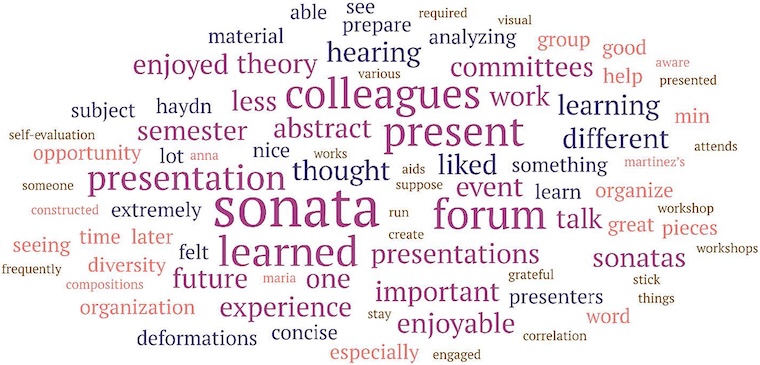
Figure 5: Word cloud of student responses to Sonata Theory Forum
Significantly, one of the most prominent words is “colleagues,” reflecting the professionalism and community that students built with their classmates by planning and participating in this event. Representative comments, shared with students’ permission, appear in Table 8.
Table 8: Student comments on Sonata Theory Forum
|
Briefly describe something you learned by participating in the Sonata Theory Forum: |
|
|
What did you find most enjoyable about participating in the Sonata Theory Forum? |
|
When asked to describe something they learned by participating in the Sonata Theory Forum, students emphasized the importance of learning to write and speak concisely, as well as their increased understanding of the planning necessary to host a conference-style event. When asked what they found most enjoyable about participating in the event, students highlighted the variety of repertoire and presentation styles, the opportunity to hear their colleagues present, and the process of working in committees to plan the event. Responses from faculty guests who attended conference-style events were also enthusiastic, complimenting both the innovative approach to a final course project and the professionalism students demonstrated during the events. A full semester after participating in a conference-style event, two of my students commented that out of all the theory courses they had taken, they learned and retained the most from the previous semester’s course because of the variety of ways students engaged with the material.
Conclusion
It is my hope that the strategies shared in this article will inspire and equip faculty to cultivate student leadership through pedagogical interventions that are easy to implement without placing excessive demands on instructors’ busy schedules. I therefore suggest several categories of student leadership activities in the spirit of “small teaching,” which James Lang (2016, 5) describes as “an approach that seeks to spark positive change in higher education through small but powerful modifications to our course design and teaching practices.” For instructors who already include similar activities in their teaching, I recommend reviewing the student leadership competencies and NASM themes that correspond to each type of activity, as previously shown in Table 4. Framing class activities as stepping stones for future leaders can help faculty convey their teaching effectiveness in conversations regarding curriculum design and accreditation.
In conclusion, participating in leadership opportunities tailored to their levels of experience can increase music students’ confidence in their ability to teach, lead ensembles, and communicate with classmates and future colleagues. Actively engaging with course content—such as learning material to teach it to someone else—can lead to deeper learning than simply studying concepts to prepare for an exam (Rogers 2004). Students demonstrate increased energy and focus during leadership activities, and they describe leadership activities as “fun” and “empowering” in their verbal comments and course evaluations. Propelled by constructive peer pressure, students take responsibility for their learning as they hone their leadership skills in a supportive environment.
[1] Komives and Sowcik (2020a, 12) describe the field of leadership studies as “the examination of leadership as a multidisciplinary field of study,” while leadership development denotes “leadership education programs that intentionally develop skill, build leadership capacity, and inform a leadership identity in students.”
[2] The Multi-Institutional Study for Leadership continues to collect data as it approaches its twentieth anniversary. For more information, see https://expandingleadership.org/msl/.
[3] While all five domains contribute to music students’ effectiveness as leaders, the leadership skills domain focuses on public-facing and administrative work.
[4] Seemiller’s SLCs are informed by relationally focused leadership models including the Relational Leadership Model (Komives, Lucas, and McMahon 2013), the Social Change Model of Leadership Development (Higher Education Research Institute 1996), and the Five Practices of Exemplary Leadership (Kouzes and Posner 2011).
[5] http://database.studentleadershipcompetencies.com. To view SLCs in music, select the performance career field and then filter through the results for dance and theatre to find the music programs.
[6] The textbook and workbook mentioned in Table 5 refer to Clendinning and Marvin’s (2020) The Musician’s Guide to Theory and Analysis, 4th ed.
[7] Ferenc (2016) highlights the role of reflection in increasing the effectiveness of students’ learning through metacognition.
References
- “Active Learning in the Music School: Seizing the Zeitgeist.” College Music Symposium 65 (1).
- “Teaching What We Do and How We Do It: Using a Miniconference Assignment to Dig Deep into Musical Analysis.” Journal of Music Theory Pedagogy 30: 5–22.
- Collaborative Learning Techniques: A Handbook for College Faculty. 2nd ed. The Jossey-Bass Higher and Adult Education Series. San Francisco, CA: Jossey-Bass.
- “Outside the Classroom: Community-Engaged Learning Projects in Music Theory.” Engaging Students: Essays in Music Pedagogy 5.
- “Interviews with Music Alumni to Inform Curriculum and Practice: A Case Study.” College Music Symposium 62 (2).
- “‘Model Composition’ Revisited: The Ragtime Project.” Journal of Music Theory Pedagogy 24: 69–98.
- “An Exploratory Examination of Students’ Pre-Existing Beliefs About Leadership.” Studies in Higher Education 39 (9): 1586–98.
- The Musician’s Guide to Theory and Analysis. 4th ed. New York: W. W. Norton & Company.
- “Developmental Outcomes of College Students’ Involvement in Leadership Activities.” Journal of College Student Development 42 (1): 15–27.
- “Advances in Leader and Leadership Development: A Review of 25 Years of Research and Theory.” The Leadership Quarterly 25 (1): 63–82.
- “Trait and Behavioral Theories of Leadership: An Integration and Meta-Analytic Test of Their Relative Validity.” Personnel Psychology 64: 7–52.
- Developing Leadership Capacity in College Students: Findings from a National Study. A Report from the Multi-Institutional Study of Leadership. College Park, MD: National Clearinghouse for Leadership Programs.
- “Engaging Students as Disciplinary Practitioners in an Introductory Theory Course.” Engaging Students: Essays in Music Pedagogy 3.
- “Promoting Metacognitive Reflection in Music Theory Instruction.” Journal of Music Theory Pedagogy 30: 23–86.
- “Cultivating Career Skills Through Public Music Theory and Community Engaged Learning.” Journal of Music Theory Pedagogy 35: 109–38.
- “Perceptions of Leadership: An Examination of College Students’ Understandings of the Concept of Leadership.” Journal of Leadership Education 11 (2): 26–51.
- “Conclusion: Musical Creativities and Entrepreneurship in Higher Music Education: Activating New Possibilities.” In Activating Diverse Musical Creativities: Teaching and Learning in Higher Music Education, ed. Pamela Burnard and Elizabeth Haddon, 261–81. New York: Bloomsbury Publishing.
- “Progressive Composition Assignments.” Journal of Music Theory Pedagogy 29: 1–6.
- Elements of Sonata Theory: Norms, Types, and Deformations in the Late-Eighteenth-Century Sonata. New York: Oxford University Press.
- Higher Education Research Institute (HERI). 1996. A Social Change Model of Leadership Development: Guidebook Version III. College Park, MD: National Clearinghouse for Leadership Programs.
- “Towards a Curriculum in Public Music Theory.” Engaging Students: Essays in Music Pedagogy 5.
- “Charting the Journey of Young Leaders: A New Model of Transferability of Skills.” Merits 3 (1): 206–29.
- Exploring Leadership: For College Students Who Want to Make a Difference. 3rd ed. San Francisco, CA: Jossey-Bass.
- “How Academic Disciplines Approach Leadership Development.” New Directions for Student Leadership 2020 (165): 11–21.
- “The Status and Scope of Leadership Education in Higher Education.” New Directions for Student Leadership 2020 (165): 23–36.
- The Five Practices of Exemplary Leadership. Hoboken, NJ: John Wiley & Sons.
- “Current Pressure Points, Curriculum, and Moving Forward.” College Music Symposium 56.
- Small Teaching: Everyday Lessons from the Science of Learning. San Francisco, CA: Jossey-Bass.
- “Leader Development Across the Lifespan: A Dynamic Experiences-Grounded Approach.” The Leadership Quarterly 32 (5): 1–21.
- “Enriching Classroom Discussions: Some Strategies from Feminist Pedagogy.” In The Norton Guide to Teaching Music Theory, ed. Rachel Lumsden and Jeffrey Swinkin, 313–30. New York: W. W. Norton & Company.
- “We’re Not Working with a Blank Slate: Students’ Pre-College Leadership Activities and Perceived Parenting Behavior as Predictors of College-Based Leader Emergence and Leader Self-Efficacy.” Journal of Leadership Education 21 (1): 33–52.
- “Music Alumni Play a Different Tune: Reflections on Acquired Skills and Career Outcomes.” International Journal of Education & the Arts 18 (29): 1–21.
- “Model Composition in the Post-Tonal Classroom: Three Templates and Sample Realizations.” Journal of Music Theory Pedagogy 37: 1–14.
- National Association of Schools of Music. 2026. Handbook 2025–26. https://nasm.arts-accredit.org/accreditation/standards-guidelines/handbook/.
- “Developing Future Leaders: The Role of Reflection in the Classroom.” Journal of Leadership Education 7 (1): 116–30.
- Teaching Approaches in Music Theory: An Overview of Pedagogical Philosophies. 2nd ed. Carbondale, IL: Southern Illinois University Press.
- “Modernizing the Minuet Composition Project.” Journal of Music Theory Pedagogy 27: 79–110.
- Understanding Post-Tonal Music. New York: McGraw-Hill Higher Education.
- “The Durable Effects of Short-Term Programs on Student Leadership Development.” Journal of Leadership Education 11 (1): 28–48.
- “Addressing the Known Unknowns in Student Leader Development.” New Directions for Student Leadership 175: 9–19.
- “Intrinsic and Extrinsic Motivation from a Self-Determination Theory Perspective: Definitions, Theory, Practices, and Future Directions.” Contemporary Educational Psychology 61: 1–11.
- The Student Leadership Competencies Resource Guide. Las Vegas, NV: printed by the author.
- “Preparing Leaders of Tomorrow: An Analysis of Leadership Competencies within Accredited Academic Program Learning Outcomes.” Journal of Leadership Studies 15 (1): 6–27.
- “The Common Language of Leadership.” Journal of Leadership Studies 7 (1): 33–45.
- “A Framework for Developing and Supporting Student Leadership in Higher Education.” Studies in Higher Education 45 (1): 100–16.
- “Strengths-Based Approaches in Co-Curricular and Curricular Leadership: Opportunities to Magnify Students’ Thriving.” Journal of Leadership Education 18 (1): 116–32.
- “The Mini-lesson: Active Learning and Engagement in the Undergraduate Classroom.” Journal of Music Theory Pedagogy 32: 111–30.
- “A Bibliometric Review of the Leadership Development Field: How We Got Here, Where We Are, and Where We Are Headed.” The Leadership Quarterly 32 (5): 1–19.
- “Search-Solve-Sing: A Group Presentation Model to Strengthen Practice and Performance Techniques in Upper-Level Aural Skills.” Journal of Music Theory Pedagogy 33: 233–52.
- “Trait-Based Perspectives of Leadership.” American Psychologist 62 (1): 6–16.
Appendix A
|
Administration |
|
|
Music, Business, Music Industry |
Administration or management indicates a responsibility for leadership, direction, or decisions over an entire enterprise or a component part of an enterprise. Administration or management skills imply overall strategic planning, the setting of objectives, and the marshalling of resources to meet objectives. (198, Appendix I.E.2.A.3.b) |
|
Sacred Music |
An understanding of musical religious practice including…music administrative structures, practices, and procedures. (125, IX.H.3.b) |
|
Music Therapy+ |
Clinical administration (e.g., laws and regulations governing the provision of education and health services, the roles of a clinical administrator in institutions and clinical settings). (149, XIV.F.1.b.3) |
|
Collaboration |
|
|
Music Technology |
Experiences should include working together in teams that replicate, insofar as possible, professional working patterns associated with the application. (122, IX.G.2.b.3) |
|
Music Education |
The ability to maintain positive relationships with individuals of various social and ethnic groups, and be empathetic with students and colleagues of differing backgrounds. (131, IX.O.3.a.6) |
|
Accompanying, Chamber Music, or Collaborative Keyboard+ |
Students demonstrate advanced competencies in vocal and/or instrumental collaboration. (143, XIV.B.1.a) |
|
Communication |
|
|
Liberal Arts |
The ability to think, speak, and write clearly and effectively, and to communicate with precision, cogency, and rhetorical force. (108, VII.D.1.a.1) |
|
General+ |
The ability to speak and write cogently is critical for all professional musicians. (138, X.A.6.a) |
|
Music History and Literature, Musicology, or Ethnomusicology+ |
[T]he student must submit a final project that demonstrates advanced competence in research and writing in music history, musicology, or ethnomusicology. (147, XIV.C.1.d) |
|
Creativity |
|
|
General |
Continue to develop improvisational skills whether as an aspect of composition, musicianship, or performance studies. (113, VIII.D.4) |
|
General+ |
Competency to practice in one or more fields of specialization includes the ability to conduct the types of creative work, inquiry, and investigation normally associated with the specialization(s) chosen. (137, X.A.4.a) |
|
Composition+ |
The doctoral degree program in composition stresses creative activity emphasizing the development of a personal aesthetic expressible in sound. Competencies also include a broad knowledge of historical and contemporary compositional practices, music theory, history and criticism, and creative approaches to relationships of these to the compositional process. (152, XVI.D.4.a) |
|
Ensemble Leadership |
|
|
General |
Knowledge and skills sufficient to work as a leader and in collaboration on matters of musical interpretation. Rehearsal and conducting skills are required as appropriate to the particular music concentration. (112, VIII.B.1.d) |
|
Sacred Music |
Lead ensembles and congregations. (125, IX.H.3.a.1) |
|
Music Education |
The prospective music teacher must be a competent conductor…. (132, IX.O.3.b.1) |
|
Ethics |
|
|
General |
Awareness that multiple disciplinary perspectives and techniques are available to consider all issues and responsibilities including, but not limited to history, culture, moral and ethical issues, and decision-making. (111, VIII.A.6.a.4) |
|
Music Education |
The ability to understand, apply, and practice principles of professional ethics. (131, IX.O.3.a.7) |
|
Music Therapy |
Knowledge of professional standards of clinical practice; professional role and ethics; interdisciplinary collaboration in designing and implementing treatment programs; supervision and administration. (129, IX.N.3.l) |
|
Evaluation and Persuasion |
|
|
General |
Students are expected to have the ability to form and defend value judgments about music, and to communicate musical ideas, concepts, and requirements to professionals and laypersons related to the practice of the major field. (113, VIII.C.2) |
|
Music Education |
The ability to evaluate ideas, methods, and policies in the arts, the humanities, and in arts education for their impact on the musical and cultural development of students. (131, IX.O.3.a.8) |
|
Music Education |
The ability to articulate logical rationales for music as a basic component of general education, and to present the goals and objectives of a music program effectively to parents/guardians, professional colleagues, and administrators. (131, IX.O.3.a.4) |
|
Independence |
|
|
Performance |
[T]he ability to work independently to prepare performances at the highest possible level…. (115, IX.A.3.a) |
|
Music Theory |
Advanced capabilities in musical analysis including the ability to produce and discuss analytical work from an independent perspective. This includes the ability to compare and evaluate the results of various analytical procedures. (115, IX.B.3.a) |
|
General+ |
Develop advanced capacities to work independently and make effective artistic and intellectual judgments and professional decisions in the area of specialization. (143, XIV.A.1) |
|
Problem Solving |
|
|
Music, Business, Music Industry |
Developing the capacity to pose, analyze, and solve problems with an understanding of the interrelationships and interdependencies of various interests in and influences on the music industry. (208, Appendix I.E.2.F.4.f.3) |
|
Music Technology |
Ability to solve music technology problems, including (a) problem identification, information gathering, solution development, and testing, and (b) knowledge and skill to produce case-specific decisions about what is useful, usable, effective, and desirable during the course of music technology project development and production. (121, IX.G.2.a.3) |
|
Music Education+ |
Students develop graduate-level perspectives on contemporary issues and problems in music education. (148, XIV.E.3) |
|
Public Presentation and Performance |
|
|
Performance |
Solo and ensemble performance in a variety of formal and informal settings. A senior recital is essential, and a junior recital is recommended. (115, IX.A.3.c) |
|
Composition |
Opportunities to hear fully realized performances of the student’s original compositions. Public presentation and critical assessment is an essential experience. (116, IX.C.3.c) |
|
General+ |
Demonstrate professional competence in the area of specialization before peers and faculty. (143, XIV.A.2) |
|
Self-Development |
|
|
General |
Acquisition of skills necessary to assist in the development and advancement of the careers of students, normally including basic competency development in communication, presentation, business, and leadership, all with particular regard to professional practices in their major field. (113, VIII.D.2) |
|
General+ |
Students should be encouraged to acquire the career development and entrepreneurial techniques, become aware of the attributes and characteristics associated with leadership, and develop connections and records of achievement necessary to (1) advance themselves consistent with expectations and practices in their area of specialization, and (2) fulfill their own career objectives. (139, X.A.7.a) |
|
Music Therapy+ |
Musical development and personal growth (e.g., leadership skills, self-awareness, music skills, improvisation skills in various musical styles, music technology). (148, XIV.F.1.b.2) |
|
Teaching |
|
|
General |
Since almost all musicians serve as teachers, attention should be given to developing appropriate pedagogical techniques for discovering new ways of understanding and introducing music. (258, Appendix II.A.4.B.8) |
|
Music Education |
The capability to inspire others and to excite the imagination of students, engendering a respect for music and a desire for musical knowledge and experiences. (131, IX.O.3.a.3) |
|
General+ |
Most of those who are in graduate degrees in music are or will be engaged in music teaching of some type during the course of their professional careers. Institutions are therefore strongly encouraged to give attention to the preparation of graduate students as teachers. Whenever possible, experiences should include teaching music to both music majors and non-music majors. (139, X.A.7.b) |
Appendix A: Themes with selected statements from NASM Handbook. Concentrations appear in the left column, with quoted statements in the right column. “General” refers to statements that apply to multiple concentrations. Page numbers and section locators refer to the 2025–26 Handbook; section locators usually remain the same, even when page numbers change in subsequent editions. Graduate level is denoted by a plus sign (+).
Appendix B
|
Student Leadership Competency |
Definition |
|---|---|
|
Advocating for a Point of View |
Delivering information in an influential, yet respectful manner, in order to convey an opinion or stance (101) |
|
Analysis |
Examining information in detail for a more comprehensive understanding (141) |
|
Appropriate Interaction |
Engaging in interactions that respect the boundaries, needs, and styles of others (63) |
|
Collaboration |
Working effectively with others toward a common objective (61) |
|
Decision Making |
Making the most effective, productive, and sustainable decision appropriate for a particular situation (147) |
|
Empathy |
Attempting to experience the feelings and thoughts of others in a particular situation (65) |
|
Ethics |
Acting in ways that align with standards of conduct acceptable for a specific context (49) |
|
Evaluation |
Determining the use and importance of specific information (139) |
|
Follow-Through |
Seeing something through to the end even when presented with challenges (39) |
|
Functioning Independently* |
Completing a task without relying on input, answers, or follow-up from others (45) |
|
Goals |
Creating measurable objectives situated within a time frame for completion (123) |
|
Idea Generation |
Generating new ideas to effectively address issues in an ever-changing landscape (135) |
|
Listening |
Accurately interpreting a message another person conveys through verbal communication (93) |
|
Motivation |
Moving others to action using strategies most effective for each person (73) |
|
Nonverbal Communication |
Effectively using body language, gestures, and other cues to convey meaning (95) |
|
Organization |
Creating systems and structures to most effectively manage, monitor, and utilize information and materials (125) |
|
Other Perspectives |
Considering other opinions, experiences, and outlooks to inform one’s worldview (137) |
|
Plan |
Specifying a course of action with specific tasks and deadlines so as to meet a set objective (127) |
|
Positive Attitude |
Exuding a sense of optimism, hope, inspiration, and enthusiasm even during difficult times (37) |
|
Problem Solving |
Identifying an issue and enacting the most appropriate solution to address that issue (145) |
|
Productive Relationships |
Cultivating productive, mutually beneficial relationships with others (67) |
|
Providing Feedback* |
Offering critiques, confirmations, and/or advice to help others (77) |
|
Receiving Feedback |
Considering thoughts and opinions from others in order to develop competencies and increase effectiveness (31) |
|
Research |
Finding and distinguishing useful, legitimate information most applicable to a particular context (149) |
|
Responding to Ambiguity |
Moving forward during a time of unpredictability or in which not all information is known (55) |
|
Self-Development |
Participating in opportunities designed to enhance one’s capacities (21) |
|
Self-Understanding |
Being aware of one’s beliefs, styles, strengths, and weaknesses (27) |
|
Supervision |
Providing direction to others so they are clear about what they need to do, the process for doing it, and expectations involved (79) |
|
Synthesis |
Finding a common theme among multiple pieces of information (151) |
|
Systems Thinking |
Making connections between individual parts in a system to anticipate the effects each part has on the whole (153) |
|
Verbal Communication |
Effectively communicating with others in one-on-one settings and in groups (97) |
|
Writing |
Effectively conveying one’s intended meaning through written communication (99) |
Appendix B: Student leadership competencies with definitions. Definitions are quoted from Corey Seemiller’s (2020) The Student Leadership Competencies Resource Guide. *Denotes SLC not found in NASM Handbook through Seemiller’s searchable database.
 Copyright © The College Music Society. All Rights Reserved.