
• Join CMS!
  • Login
  • Donate
  • Search
College Music Symposium
  • Home
  • Forums
  • Current Issue
  • All Issues
  • Submissions
  • Search CMS Symposium

Volume 66, No. 1

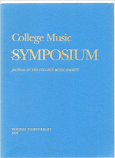
Issue Cover
< Previous Issue
In this Issue
Articles: Scholarship and Research (5)
Articles: Music Business-Industry (1)
Forums (6)
Book Reviews (3)
Audio Reviews (5)
Performances, Lectures, Lecture-Recitals, Training (2)

Articles: Scholarship and Research

  • Paying Attention to Music and Baseball: Listening to the Savannah Bananas
    Danielle Fosler-Lussier

    Advocates for baseball and classical music have long insisted that enjoyment of these art forms requires expertise and focused attention from audiences. The claim has been made both ways: that cultivating music or baseball increases people’s capacity to pay attention, and (conversely) that the activity offers “intellectual and moral rewards” because it draws upon that capacity. Some have argued that the listener who pays close attention to technical details of baseball or music (“structural listening”) is more devoted, better trained, or less lazy than one who does not. Baseball and classical music organizations have continued to emphasize effort and expertise even as they struggle to attract audiences. By contrast, the Savannah Bananas have introduced a variant of baseball called “Banana Ball” that offers a new performance practice for the sport. One can still watch the game with attention to its technical details, but audience members can apply multiple modes of attention and enjoy the experience whether or not they understand the rules, strategies, or traditions of the game. Banana Ball undermines the idea that only expert spectatorship that attends closely to the rules and nuances of the game is valuable. Banana Ball’s innovations are relevant for the study, teaching, and marketing of classical music. We might choose to acknowledge multiple ways of listening, allowing that listening practices depend on the listener’s situation, experience, and preferences (Kassabian). Separating classical music’s value proposition from biased suppositions about attention or audience will be important to that music’s flourishing in the future.

  • Your Turn to Lead: Cultivating Student Leadership in Music Theory and Aural Skills
    Angela Ripley

    Universities and colleges aspire to equip students for leadership in their professions, and music students need leadership skills to navigate increasingly entrepreneurial careers. I argue that music theory and aural skills courses can provide scaffolded leadership opportunities for undergraduate and graduate students of all achievement levels. In this article, I consider two questions: Which leadership competencies do music students need? And how can instructors help students develop these competencies in the context of music theory and aural skills? I examine learning outcomes from the NASM Handbook and adopt Seemiller’s (2021) student leadership competencies, which provide faculty in disparate fields with a shared vocabulary for planning and assessment. I outline several categories of activities to build students’ leadership skills, share examples of these activities, provide tips for instructors, and discuss responses from students who participated in leadership activities. Activity categories include explaining answers to homework exercises, teaching from provided resources, leading class activities, composing and performing new musical examples, participating in panel discussions, giving class presentations with related audience-engagement activities, and planning conference-style events and presenting scholarly work to audiences beyond the class. These activities serve the dual purpose of engaging students in disciplinary thinking and equipping them with transferable skills. Participating in leadership opportunities tailored to their levels of experience can increase students’ confidence in their ability to teach, lead ensembles, and communicate with classmates and future colleagues. Propelled by constructive peer pressure, students take responsibility for their learning as they hone their leadership skills in a supportive environment.

  • Employment Matters in Higher Jazz Education
    Jacob Hertzog , Justin R. Hunter

    This study centers on jazz educators working in higher education within the United States to better understand the role of institutions as economic anchors for jazz, and the future of the profession. Jazz educators were surveyed (N = 393) with a research-created instrument that covered employment, satisfaction, and other activities. This paper presents unique profiles of jazz faculty and multiple forecasts for the jazz discipline in the context of challenging background conditions within higher education. Recommendations for practice are presented with emphasis on the importance of stable, tenure-track positions for jazz educators. While employment research is a ubiquitous feature in policy, economic, and business sectors, only a small number of studies have been produced related to creative economies. This study is significant as it is the only measurement of jazz faculty employment in the United States, and it presents a framework for conceptualizing employment in other artistic disciplines.

  • Reclaiming the Liberal Arts in a Disrupted World Order: A Case for the B.A. in Music
    Dylan Parrilla-Koester

    In the face of artificial intelligence, democratic instability, and recently outmoded market-driven reforms in higher education, this philosophical essay makes the case for a renewed vision of the Bachelor of Arts in music as a civically robust and honest college degree pathway. Within the curricular ecosystem of higher music education (HME), the B.A. stands to offer robust musicianship, cultural literacy and participation, and interdisciplinary, civic-minded inquiry grounded in the liberal arts tradition; in contrast, highly technical Bachelor of Music degrees and a growing emphasis on entrepreneurship and career-readiness often represent curricular capture by market logics, training students to become precarious workers rather than liberally educated citizens. Drawing on historical conceptions of music as one of the original liberal arts as well as recent journalism and scholarship, this essay brings to bear a framework of tertiary music curricula grounded in the virtues of a liberal education whose North Star is the development of democratic thought and action, civic-mindedness, and truth-seeking habits of mind.

  • More Than Just Piano: Patch Literacy as a Core Competency in Contemporary Ensemble Practice
    Eugene Seow

    In contemporary ensemble contexts, keyboardists are increasingly expected to function as sonic multi-instrumentalists, shifting rapidly among acoustic piano, organ, and synthesizer roles. Yet most formal piano training omits instruction in electronic keyboard technique and sound selection. This article introduces the concept of patch literacy: the ability to fluently choose, modify, and perform with keyboard patches appropriate to musical context. Drawing on scholarly research, practitioner discourse, and practice-based teaching observations, the article presents a role-based pedagogical framework for patch training organized into three patch families: pad, lead, and pianistic. Each category is explored in terms of its ensemble function, common student pitfalls, and idiomatic performance techniques. The author synthesizes practitioner strategies, such as voicing economy, register awareness, and patch-specific articulation, with structured educational methods, including contextual listening, low-cost gear simulations, and rig management skills. Workshop vignettes illustrate the impact of patch literacy on ensemble cohesion, rehearsal efficiency, and student musical identity. The article argues that integrating patch pedagogy into formal music education can address a longstanding curricular gap and equip keyboardists with the fluency required for diverse gigging, studio, and ensemble settings. By embedding patch choice into ensemble decision-making, educators can train students not only to play the right notes but to deliver the right sound; ultimately fostering more responsive, stylistically authentic ensemble playing.

Articles: Music Business-Industry

  • The Music Industry, Musical Industry, and Dirty (Blond) Work
    Gareth Dylan Smith

    In this article, the author presents vignettes from his perspective as the drummer in a Blondie covers band in the northeast region of the US, detailing the hard work germane to making music and preparing to make music in a group playing the dive bar circuit. Using an autoethnographic approach to center his experience as a hardworking musician, the researcher parses commonplace discussion in music industry studies of the music Industry writ large, from a way he proposes of understanding musicians’ labor, as musical industry. Using the rhetorical device of dirty work to conceptualize his own labor as indicative of the work undertaken by peers, the author contends that less glamorous, everyday musical industry is commonly elided in scholarship on the music Industry. The article contains two logic models that depict respective teleological perspectives on making music – one leading to commercial success and the other culminating in human connection. In closing, the author lights on the sociological notion of resonance and argues that scholarship in music industry studies might benefit from foregrounding discussion of deep intra- and inter-personal human connection.

Forums

  • An Overview of the 2026 Think-Tank Summit—Ideas into Action: Reimagining Music Schools for 2026 and Beyond
    Brian Kai Chin
  • Finding Friction: Collective Intelligence in the Age of Infinite Generation
    Margaret Schedel
  • Advocacy as Vocation: Articulating and Animating the WHY of Music Education
    Deborah Confredo
  • Belonging for Whom? Seeing Class in Classical Music Institutions
    Anthony Taylor
  • Creativity: Who? What? Why Not?
    Adrian Davis
  • Improve Outcomes with Paid Internships
    Gerald Klickstein

Book Reviews

  • Unlocking Meaning in Art Song: A Singer’s Guide to Practical Analysis Using Schubert’s Songs by Beverly Stein
    Nicholas Klein
  • The Savvy Musician 2.0: Amplifying Impact, Income, and Inspiration by David Cutler
    James Harrington
  • Cross-Cultural Collaboration in Popular Music: Practice-Based Research by Toby Martin, Seyed MohammedReza, and Dang Lan
    Kelsey Paquin

Audio Reviews

  • Catapult Opera and Talea Ensemble, conducted by Neal Goren. Nadia Boulanger: La ville morte
    Chester Biscardi
  • Resonance Collective, conducted by Fahad Siadat. Siadat & Wolpé: The Conference of the Birds
    Yike Zhang
  • Jan Lisiecki. Preludes
    Joseph Vaz
  • Quartetto Eridàno. Schulhoff: A Lone Voice
    David Bernat
  • Boston Symphony Orchestra, conducted by Andris Nelsons, with Yuja Wang, Cécile Lartigau. Messiaen: Turangalîla-Symphonie
    Marco A. Jimenez

Performances, Lectures, Lecture-Recitals, Training

  • One Hundred Years of Chinese Piano Music: Embracing Change, Encountering Challenge, and Establishing Character. Dr. Jennifer Chu. August 3, 2024. Klavierhaus in New York City
    Jennifer Chu
  • Review of One Hundred Years of Chinese Piano Music: Embracing Change, Encountering Challenge, and Establishing Character. Dr. Jennifer Chu. August 3, 2024. Klavierhaus in New York City
    Anthony Paul De Ritis
About
  • CMS Executive Office Staff
  • Internship
  • Contact Us
  • Privacy Policy / Discrimination & Harassment Policy
Chapter Leadership Resources
  • Chapter Conference Planning
  • Resources for Chapter Presidents
  • Resources for Chapter Treasurers
  • Timelines for Governance and Conference Planning
CMS Chapters
  • Central
  • Great Lakes
  • International
  • Mid-Atlantic
  • Northeast
  • Northwest
  • South Central
  • Southern
  • Southwest
  • CMS Chapter Boundaries
  • Chapter Roommate Finder
Resources
  • Permission To Reuse Material
  • Editor Guides
  • Peer Review Process
  • Terms Of Service
The CMS Fund
Publications
  • College Music Symposium
Books & Monographs
  • General Editor's Welcome
  • Partnership With Routledge
  • Cultural Expressions In Music (CEM)
  • Emerging Fields In Music (EFM)
  • Pedagogies & Innovations In Music
  • Webinars
  • CBS Records' Black Composers Series
CMS Library
  • Presidents' Messages
  • Webinars
  • Annual Reports
Partnerships
  • NAMM
  • ATMI
  • CMS-NAMM GenNext
Archives
  • Past Presidents
  • Summits
  • Conferences
  • History Of CMS

The College Music Society is dedicated to the advancement of music teaching, learning, scholarship, performance, and creative activity. Rooted in higher education, CMS serves as an inclusive forum for dialogue and collaboration among music professionals across all disciplines and career paths. We support faculty, students, independent scholars, and industry partners by fostering innovation, promoting diversity, and encouraging the exchange of ideas to shape the future of music in society. Through advocacy, professional development, and community engagement, CMS empowers its members to lead and inspire in academic, artistic, and entrepreneurial contexts.

312 East Pine Street | Missoula MT 59802 | USA
Ph: 406.721.9616 | Email: [email protected] | Web:www.music.org
symbol 16x15 Copyright © The College Music Society. All Rights Reserved.

Instagram   Facebook   YouTube