
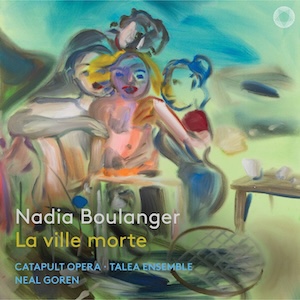
Catapult Opera and Talea Ensemble, conducted by Neal Goren. Nadia Boulanger: La ville morte. 2025. Pentatone 5187492. CD and MP3 download, 2 discs, 22 tracks (01:39). pentatonemusic.com. CD €33.75, download €23.99
If you knew little else about Nadia Boulanger, you would know that she was a brilliant musical taskmaster. Her influence was legendary, especially among the many American composers who studied with her at the American Conservatory, at Fontainebleau. She also knew when to let a young composer emerge on their own terms. In “A Teacher Remembers,” she wrote: “A very long time ago, Copland was my student. To let him develop was my great concern. One could tell his talent immediately. The great gift is a demonstration of God. The more the student is gifted, the more you must be careful not to invade their self. But I hope that I never did disturb him, because then it is no longer to be a teacher, it is to be a tyrant.”
Considered intensely disciplined yet emotionally volatile, she was rumored to have had several affairs, including with her teacher at the Paris Conservatoire, Gabriel Fauré, though no solid evidence confirms this. A private if not lonely figure, she abandoned her own compositional career (despite winning the Prix de Rome at twenty) after the death of her younger sister, Lili Boulanger. She thereafter devoted herself to promoting Lili’s music, redirecting her creative energies toward conducting, teaching, and playing the organ; as a soloist, she premiered Copland’s Symphony for Organ and Orchestra.
This background made it all the more striking when, in March, 2024, at the Century Club in New York, I heard a preview of La ville morte, an opera Boulanger wrote in 1914 with Raoul Pugno, based on La città morta, a play and subsequent libretto by Gabriele d’Annunzio. (La città morta had its premiere in 1898, starring Sarah Bernhardt, and later Eleanor Duse.) It’s Boulanger’s only opera, and what a wild, strange, sensuous work it is, a bizarre story in four acts involving four characters. Hébe is lusted after by a married couple, Alexandre and Anne, as well as by her own brother, Léonard, who eventually kills her. To keep her pure? (She’s still a virgin.) Or to end his lust for her? In the final scene, Anne, who is blind, regains her sight when she touches Hébe’s dead body.
The work’s Paris production in 1917 was canceled because of the war. A piano/vocal score remains, but the orchestrations were lost in a fire. The opera was finally performed in January, 2024, in Greece, and then again in New York in April of the same year, by Catapult Opera (a co-production with the Greek National Opera), conducted by Neal Goren, directed by Robin Guarino, with orchestrations by Joseph Stillwell and Stephan Cwik, supervised by David Conte. A live recording was released on Pentatone in November, 2025.
The singers and the drama are well served by a small orchestra, in keeping with Boulanger’s ideal of instrumental clarity. The orchestration creates the right balance between purely instrumental music and distinct, at times soaring vocal lines, all of which Goren realizes masterfully with the musicians. Occasionally, this transparent orchestration leans toward musical theatre, as in the almost heroic, rhythmic music in Scene 5 of Act I, while still allowing for a lush blend of musical styles (with nods to Debussy and Wagner) and emotions ranging from tender to the most anguished. All of the singers perform with exquisite beauty and authority in this convincing first performance and recording, expertly engineered by Adam Wadeshouse.
The company includes Melissa Harvey, soprano (Hébe), Laurie Rubin, mezzo-soprano (Anne), Joshua Dennis, tenor (Léonard), and Jorell Williams, baritone (Alexandre). The helpful booklet, with liner notes by Caroline Potter, includes the entire libretto and is bundled with the CD.
 Copyright © The College Music Society. All Rights Reserved.