
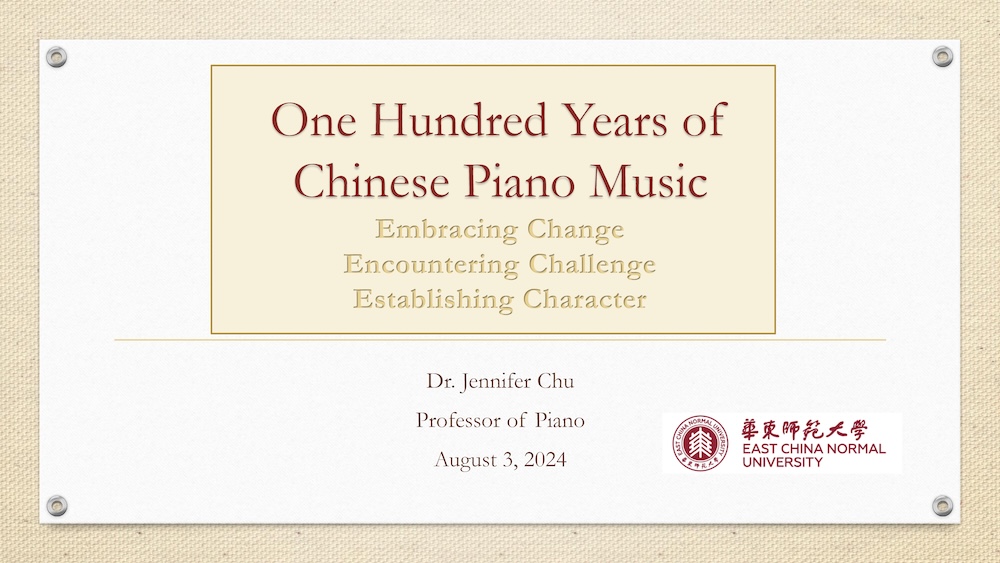
One Hundred Years of Chinese Piano Music: Embracing Change, Encountering Challenge, and Establishing Character. Dr. Jennifer Chu. August 3, 2024. Klavierhaus in New York City
Download the video | Read the review
Transcript
Good afternoon! I am delighted to be here today, and I’d like to thank Klavierhaus and Mumeneer Studio for providing this event space and the AV services today.
As a pianist born and raised in New York and trained in the Western Classical music tradition, I never had occasion to delve into the field of piano music from my ancestral homeland, China. Three years ago, in 2021, I moved to Shanghai, where I’m currently professor of piano at East China Normal University, and it was here that I really started to explore the history of piano music written by Chinese composers, which I’d like to share with you today.
Given the prevalence of Chinese performers and students on today’s Western Classical piano music scene, it is easy to take their presence for granted and fail to recognize how new the concept of piano music in China actually is. The explosive popularity of Western Classical piano music in China is a phenomenon of the 20th century, and despite frequent external social turbulence that threatened to stunt musical growth throughout this roughly 100-year period, there was quite a rapid maturation of the piano music genre as successive generations of composers learned and adopted the idiom of Western classical music as an alternative platform to presenting traditional elements of their own musical culture, the result of which is an attractive synthesis that is both universal and unique.
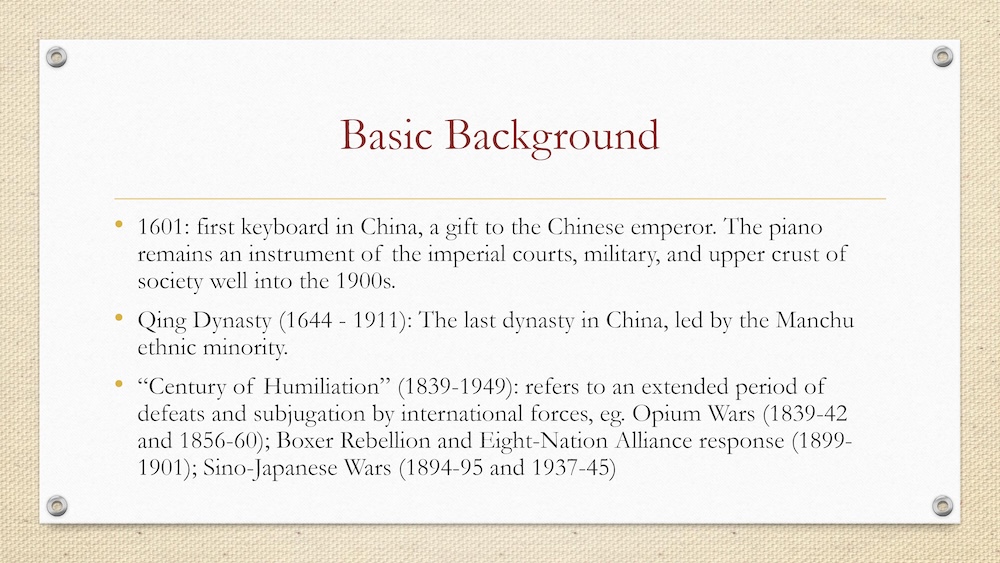
In early twentieth century China, the term “piano music” necessarily implied Western, or Western-influenced, music, because the piano is, of course, not a native instrument to China. Though Beijing saw its first keyboard in 1601, a gift to the Ming dynasty emperor from the Italian Jesuit missionary Matteo Ricci, keyboard music or instrumentalists were virtually unheard of in China until the early 1900s. Even then, piano music was a thing for the upper crust of society, and Western music at large was associated with the imperial courts and military bands. Certainly laymen did not have access to this type of music. The music of the populace was vocal, and instrumental music tended to be collaborative in nature rather than solo.
During the nineteenth century, under the ethnic minority Manchu-led Qing dynasty, China suffered repeated defeats and subsequent weakening of the nation through events like the Opium Wars and the signing of unequal treaties. By the turn of the twentieth century, China, tired and humiliated by decades of war and defeat, was ready for a change. Many started to view certain foreign elements as being superior to outdated traditions and able to bring about revival to the nation. Slowly, Western curriculums began to be incorporated into Chinese schools, music being among those subjects. A trickle of Chinese students began to leave the country during the first decade of the 1900s to study music abroad.
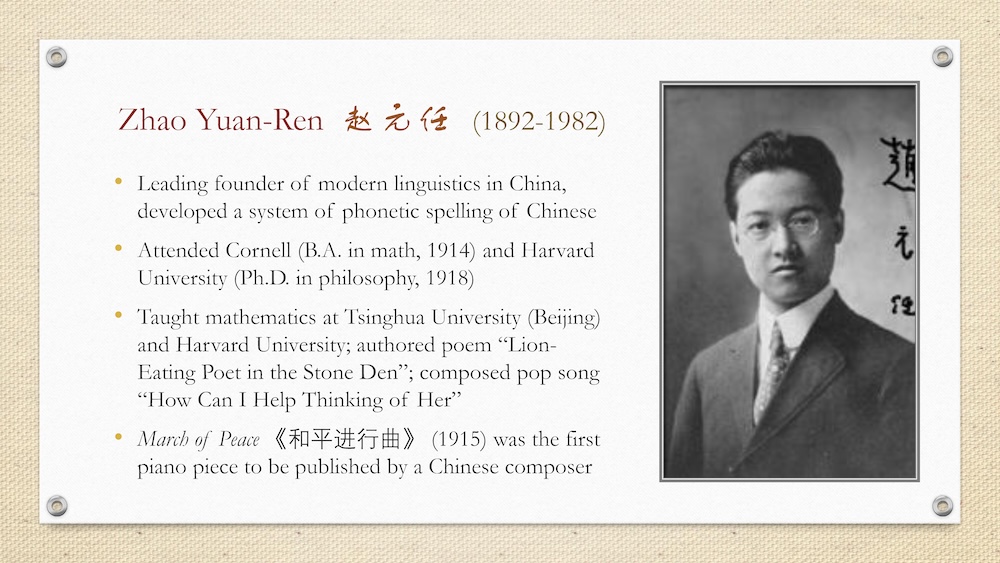
Zhao Yuan Ren was one of the early study-abroad students. He first studied physics and mathematics at Cornell University, then earned a Ph.D. in philosophy from Harvard University. A true Renaissance man, Zhao was incredibly versatile and gifted in many diverse fields. He is perhaps primarily remembered today for his contributions to modern Chinese linguistic studies, helping to create a system of Romanization spelling of Chinese that was officially adopted by the Nationalist government in 1928. As a musician, he composed the song “How Can I Help Thinking of Her” (教我如何不想她), which became a pop hit in China in the 1930s. For the purposes of our discussion, he holds the distinction of being the first Chinese composer to publicly publish a piece of piano music.
During his studies at Cornell and Harvard, Zhao took music elective courses. His own musical background, prior to this, seems to be limited to his father having taught him to play the Chinese reed flute by ear. In 1915, his composition, March of Peace, was published in Science, a journal he co-founded during his studies at Cornell.
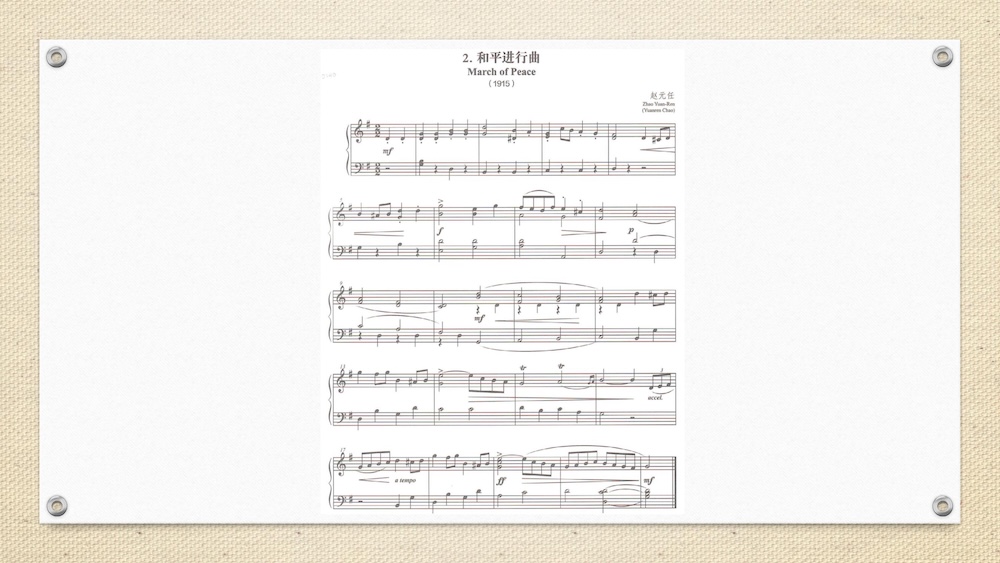
The music itself is uninspiring and simple, giving off an air of childishness that smells like a student exercise in Western tonal harmony. Set in G Major, the progressions are straightforward, the melody and accompaniment rudimentary. But what makes it significant is the very fact of its use of basic Western music harmonic language, a language that for Zhao and the Chinese ear was quite foreign. Furthermore, the notation itself – staves and noteheads! – was completely new territory as well, for Chinese music notation was very different. Thus, Zhao’s seemingly inconsequential miniature propelled China into the new frontier of Western-style piano-music-making.
Unassuming and brief, March of Peace embodies a rather grandiose sentiment, both universal and personal. On a global level in 1915, the world was embroiled in World War I, while in China, the highly unpopular reign of dictator-turned-self-appointed-emperor Yuan Shikai would soon come to an end to be replaced by a period of decentralized warlord government. In his own lifetime, Zhao had lived through such unnerving events as the 1st Sino-Japanese War, the Boxer Rebellion, and the Revolution of 1911 that overthrew more than 2.5 centuries of Manchu rule. It seems that Zhao uses his fledgling Western music language skills to voice a noble appeal for world peace on behalf of his homeland and all the world’s citizens. Let’s take a listen.
[Music: March of Peace]
That’s it. Almost laughable, isn’t it?
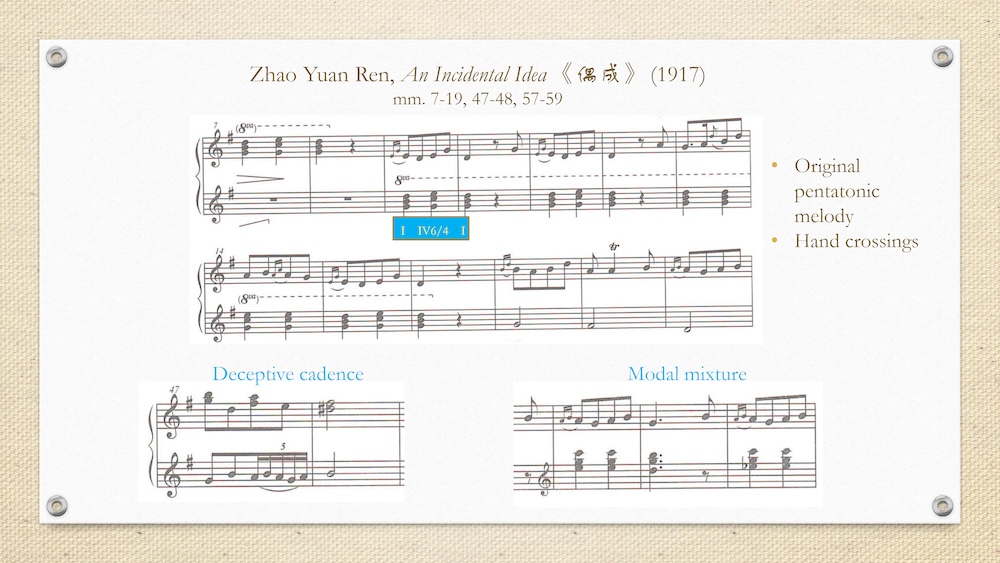
In 1917, Zhao’s second piano piece to be published appeared again in the journal Science. In An Incidental Idea, we can detect an advancement in Zhao’s music style. There is overall a greater sense of refinement, a somewhat more elevated harmonic language, and a bit more technique required on the part of the pianist. The musical shape, ABA ternary form where the outer A sections are similar and the middle B section is contrasting, is a construct familiar in Western music. A basic I-IV-I chord progression infuses all three sections of the piece, and is presented in both the opening and closing as a bareboned and elementary-sounding chordal motif. This:
[Music]
Details such as a deceptive cadence and modal mixture help add a splash of color and dash of interest to the piece. So for instance, rather than hearing an expected tonic-dominant-back to tonic chord progression, such as this:
[Music]
We will hear this deceptive cadence instead:
[Music]
Modal mixture borrows chords from the parallel minor mode, so you get a mix of major and minor chords. For instance:
[Music]
Zhao also gives the music a more individualistic sound by composing an original pentatonic melody -- there can now be no doubt of the work’s Chinese identity – graced with ornamental notes that mimic the inflections of a traditional instrument, perhaps the reed flute. This opening melody is played with the hands crossed, a stunt that was attractive for its visual novelty and requires a certain level of coordination to pull off well.
While the piece is still undoubtedly student-sounding, it does bear the hallmarks of an upperclassman who has absorbed many teachings that he is now eager to try out.
[Music: An Incidental Idea]
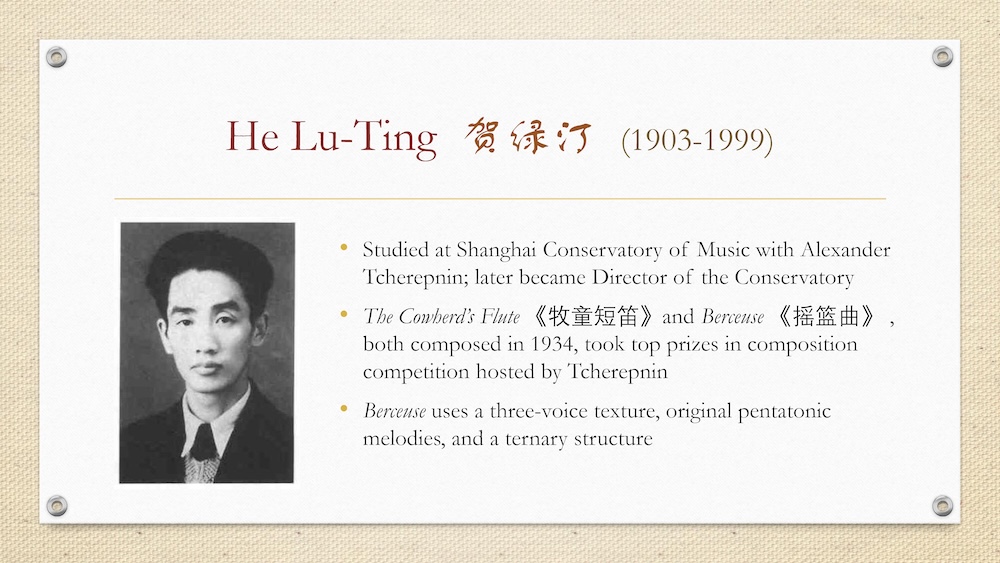
In 1934, He Luting was a student of Russian pianist and composer Alexander Tcherepnin at the Shanghai Conservatory. Tcherepnin, who had gone to Shanghai to perform and remained to teach, was quite impressed with the musical aptitude he witnessed in China, particularly in light of the fact that Western music in China was such a recent introduction. He expressed concern, however, that in their eagerness to absorb the Western style, Chinese students were losing their own musical voice. To encourage the development of a unique musical style, Tcherepnin hosted a competition for “Piano Compositions in the Chinese Style.” He Luting took the top two prizes with his Cowherd’s Flute, arguably his most well-known piano piece, and Berceuse.
We will take a look at the Berceuse. In terms of compositional technique, things have certainly progressed from the early works of Zhao, though the piece is still quite basic. Having been trained as a pianist, He Luting writes more pianistically and the piece enjoys a more organic development. The Berceuse uses mostly a three-voice texture, requiring the performer to finely control voicing within one hand.
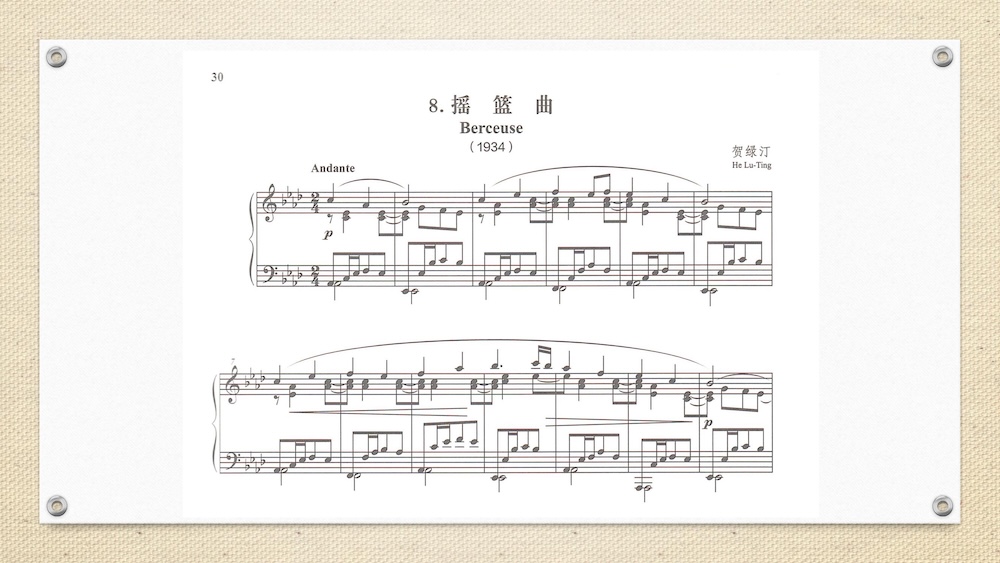
As you can see, the melody, played mostly by the right-hand pinky and, sometimes, fourth finger, must project and maintain a legato line over the inner voice accompaniment, played by the right hand’s other three fingers, which needs to sound not “clunky” or protruding.
Other berceuses for the piano literature include those by Chopin, Liszt, and Balakirev, all of which are in the key of Db major. In his Berceuse, He retains the tendency to use a flat key (in this case Ab, or, more accurately, the Ab-pentatonic system), which is these five notes:
[Music]
In ternary form, outer A sections consist entirely of the Ab-pentatonic system, featuring a soothing lullaby melody over a rolling left hand accompaniment figure.
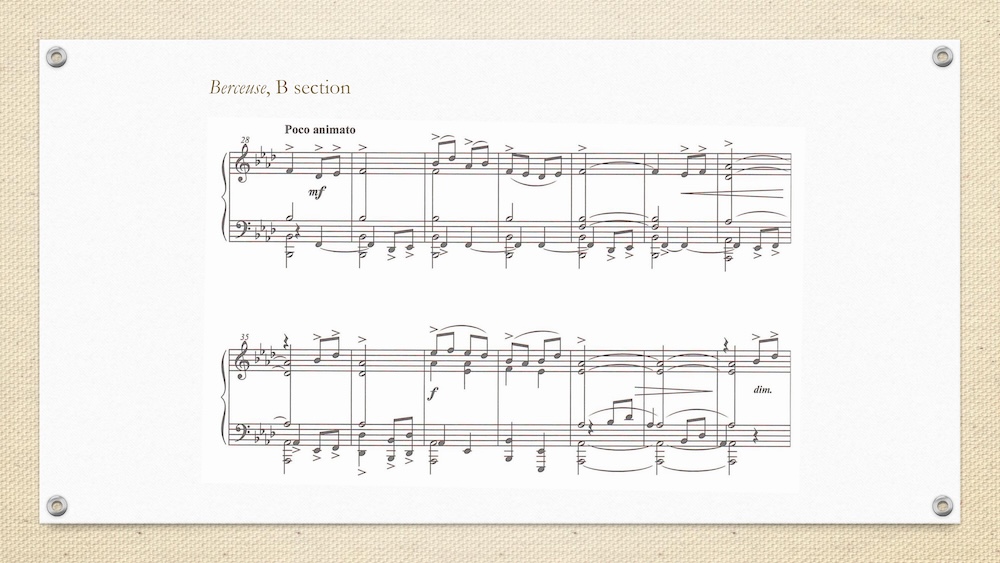
A somewhat more punctuated and agitated B section interrupts the calm of the lullaby and shifts the tonal palette to a minor-sounding mode. In actuality, we have shifted to the Db-pentatonic system
[Music]
but centered around the note B-flat.
[Music]
While the structural framework of the piece is familiar, the flavor is culturally distinct.
[Music: Berceuse]
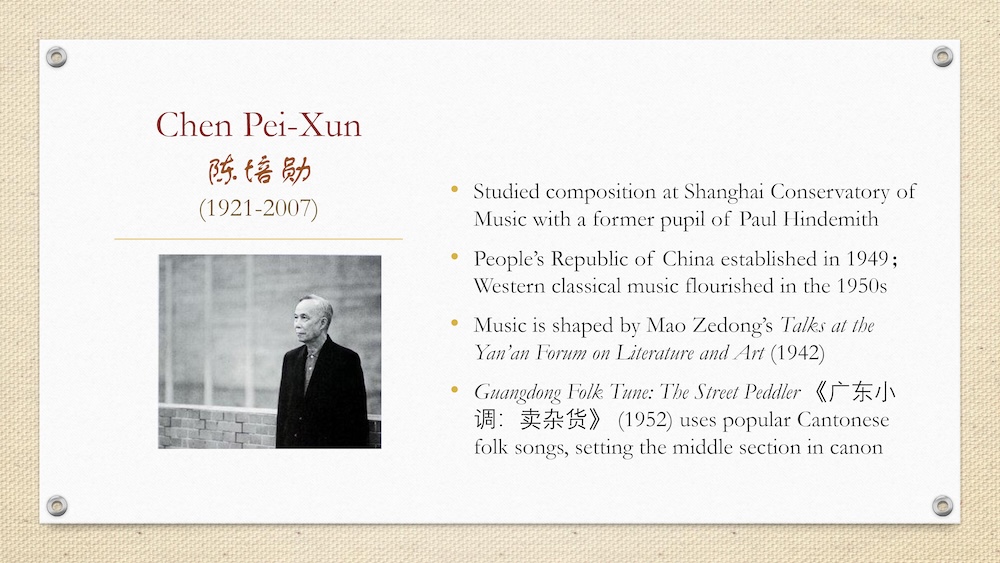
Born in Hong Kong, Chen Pei Xun completed advanced studies in music composition at Shanghai Conservatory of Music (with one year abroad in London) where his teachers included a former pupil of German composer Paul Hindemith. Chen’s years of study and apprenticeship took place during the turbulent years of the Second Sino-Japanese War and the ensuing Chinese Civil War.
In 1949, the People’s Republic of China was officially established under the leadership of Mao Zedong. A new era of comparative political stability ensued in the nascent years of the nation, allowing for artistic development to occur in a way that hadn’t been possible during the preceding years of external and internal conflict. However, to be safe, creative works had to abide by the points made by Mao in his famous 1942 Talks at the Yan’an Forum on Literature and Art: principally, that music was for the benefit of the masses and thus should reflect the working class; and that art should ultimately serve politics, standing with the official Party line.
One of Chen’s signature piano pieces is Guangdong Folk Tune: The Street Peddler, written in 1952, which uses a couple of Cantonese folk melodies popularly sung by street vendors and the general populace. Thus the condition of music being about and for the masses was satisfied. One wonders how much, if any, of Hindemith’s views on Gebrauchmusik – that is, utilitarian music written for a specific social or political purpose – reached and influenced the student Chen’s attitudes.
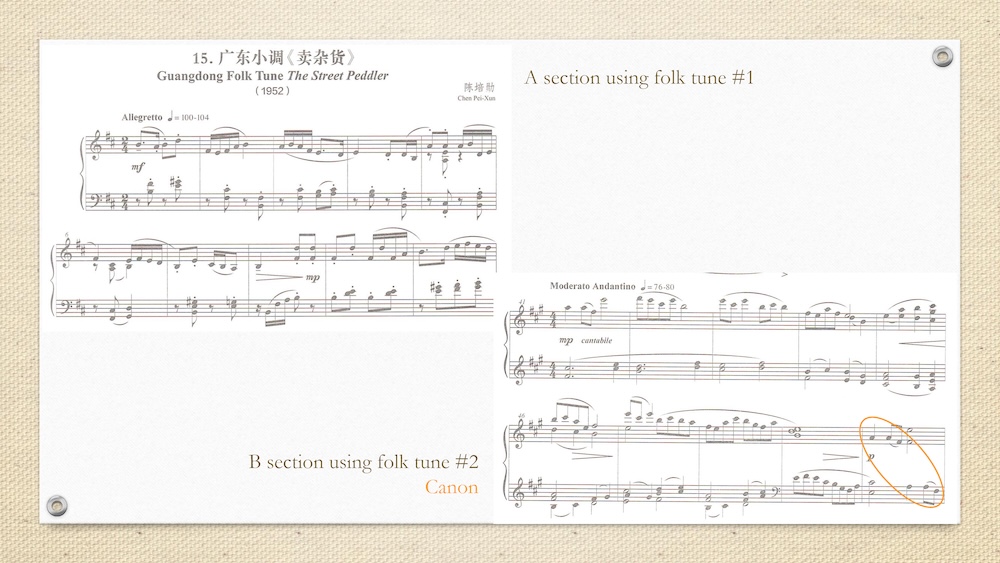
Chen elevates the common man’s music into an attractive little concert piece using catchy rhythmic and harmonic accompaniments, and inserting energetic, fiery passagework for added flair. In ternary form, the spirited outer sections transport the listener to the bustling scene of a market vendor pedaling his wares. We can see from the example, folk tune number 1 is in the melody line, accompanied by a left hand contributing staccato, weak-beat punctuations, adding vitality to the already lively melody.
A poignantly lyrical middle section offers reprieve from the energy of the street scene. More intimate in nature, this tune was known as a “dressing room tune.” Chen weaves in a rather extended use of canon, a compositional technique also favored by Hindemith. The canon example begins in the last measure of the music example on the screen, circled. The right hand begins the melody and the left hand echoes it two beats later, continuing on in this fashion for several phrases.
On a technical level, this piece surpasses the demands of the previous pieces we’ve heard so far. There is much more dexterity involved, quick shifts of character, and offbeat rhythmic emphases that require precision and control for satisfying execution.
[Music: Guangdong Folk Tune—The Street Peddler]
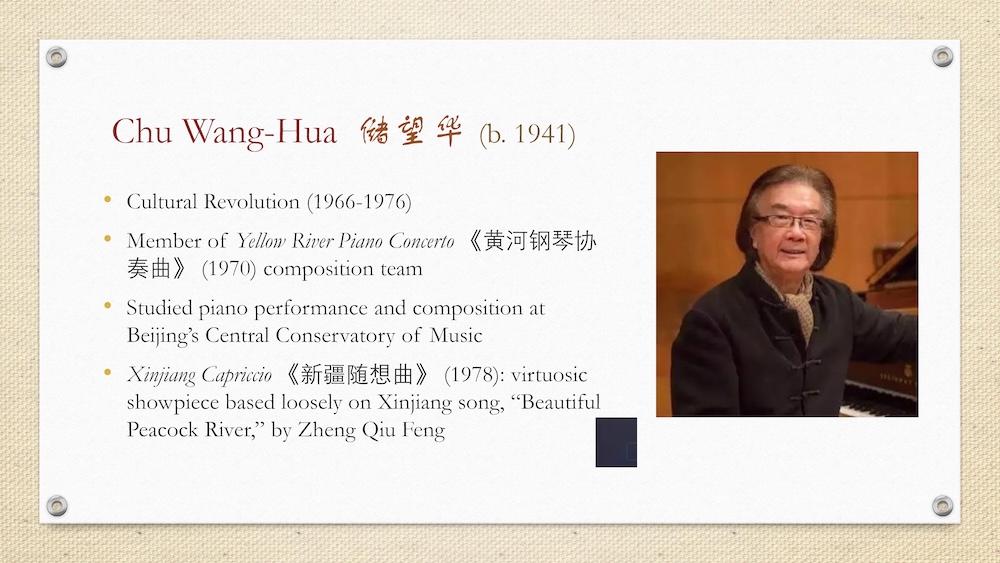
From 1966 to 1976, the Cultural Revolution engulfed China, stripping it of the means and opportunity for any meaningful music-making. During this artistically-starved decade, only a handful of Party-approved compositions were allowed for performance. Western music was banned altogether, the piano in particular under attack for its bourgeois and Western association, and instruments were literally destroyed. Despite this, one of the works that was written and sanctioned during the Cultural Revolution was the now well-known Yellow River Piano Concerto. It was created by a team of musicians, one of the primary contributors being composer Chu Wang Hua.
Trained as a pianist in Beijing’s Central Conservatory of Music in the 1950s and early 60s, Chu Wang Hua was denied admission to the composition department for advanced studies because of a politically inflammatory article his father had penned. Chu thus pursued his passion for composition on his own while majoring in piano. Xinjiang Capriccio, written in 1978, was composed shortly after the end of the Cultural Revolution, continues in the vein of the Yellow River Concerto: virtuosic, full of bravura, and packing a definite wow-factor. The difference is, given the time at which it was written, one has a sense that the composer is celebrating the return of musical freedom with abandonment, casting off the shackles of artistic repression and political correctness, writing in a flashy manner for virtuosity’s sake, and choosing as its subject a place on the “fringe,” associated with rugged, wild beauty.
The Capriccio draws its source material from a song composed in 1977 titled “Beautiful Peacock River” after the eponymous river in Xinjiang. Let’s take a listen to the opening of the song
[Music: Excerpt of “Beautiful Peacock River” audio]
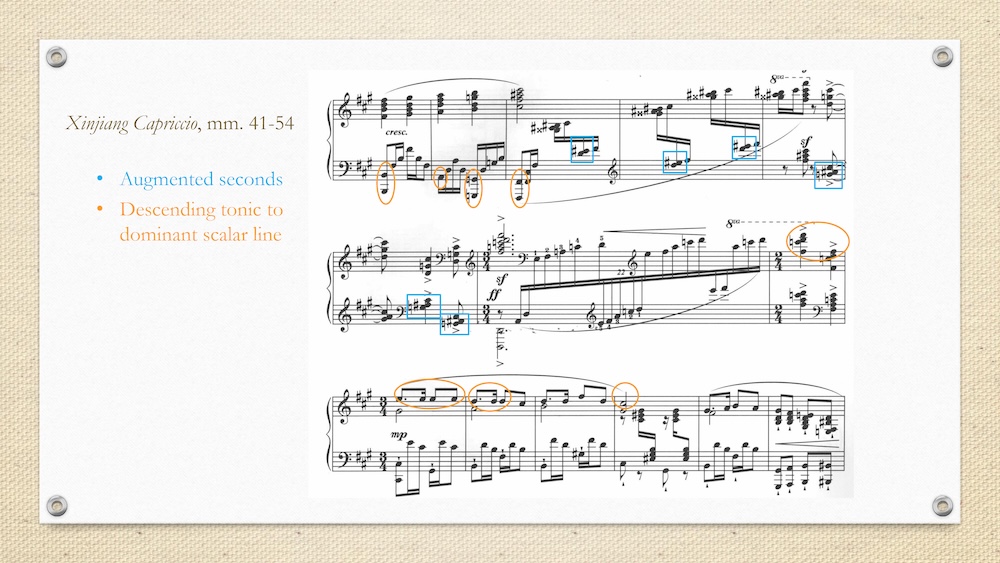
In Xinjiang Capriccio, Chu turns the gentle and languid strains of the song into a tour de force of pianistic virtuosity and display, grand and majestic as the windswept plains, deserts, and mountains of the Xinjiang landscape. He capitalizes on the distinct features of the Xinjiang scale, also known as the Phrygian Dominant scale, to emphasize the “exotic-ness” of this music. The Phrygian scale sounds like this:
[Music]
We will hear frequent usages of augmented second intervals, both melodically and harmonically, and descending tonic to dominant scalar lines. These sounds:
[Music]
In Chu’s capturing of the “otherness” of the Xinjiang ethnic groups, I am reminded of Franz Liszt’s musical portrayal of Hungarian folk/gypsy music. Indeed, in the Capriccio’s showmanship and gestures, there are a number of instances in which one might be reminded of Liszt’s bravura, virtuosic piano writing, and I offer a few stylistic similarities for comparison:
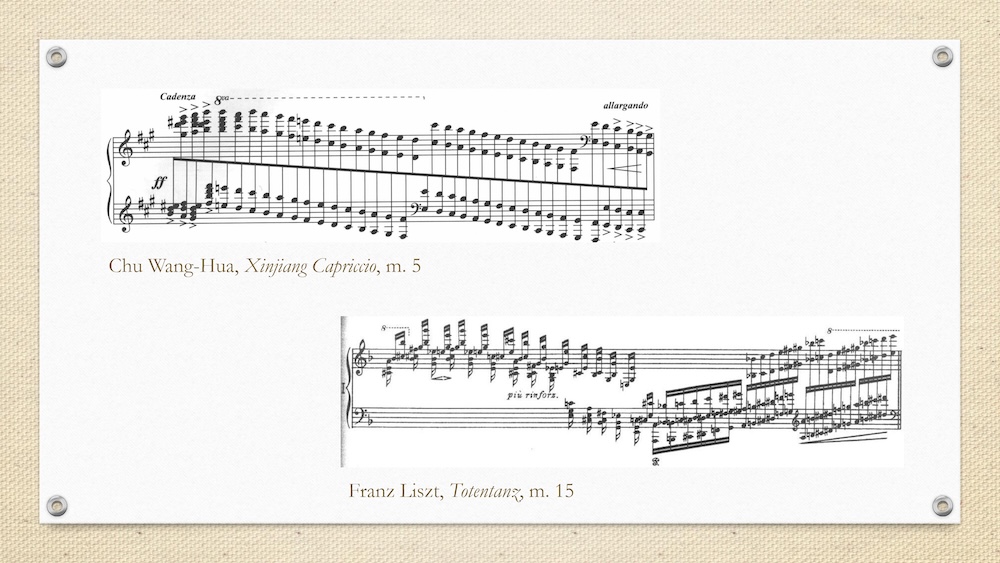
Here, from the opening measures of the Capriccio and Liszt’s Totentanz, we can see a similar texture of alternating octaves between the two hands, creating a flashy, virtuosic effect.
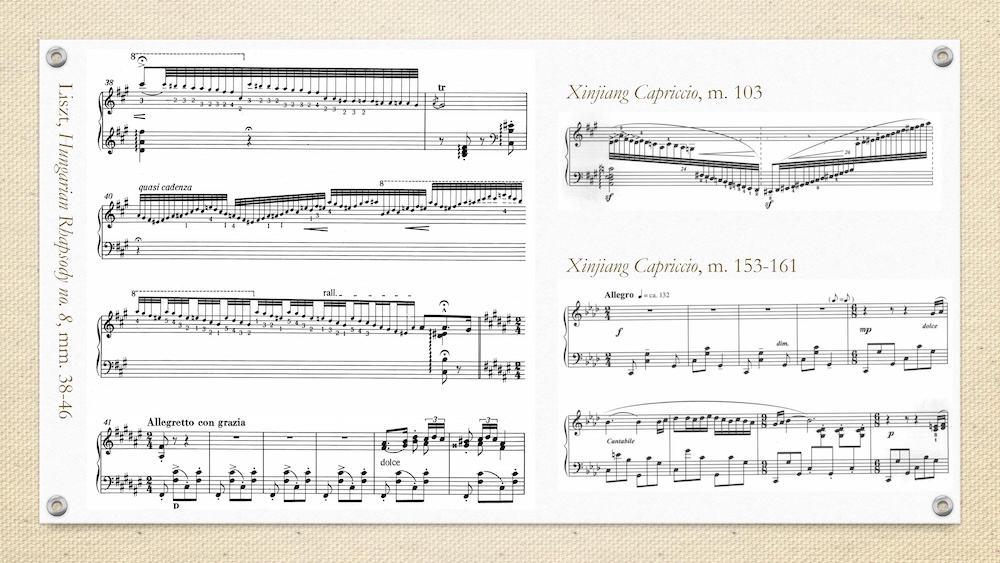
Cadenza-like passages are frequently encountered in Liszt’s rhapsodies. On the left-hand side is an example from Liszt’s Hungarian Rhapsody no. 8. In Chu’s Capriccio, these types of cadenza-like passages add to a rhapsodic quality.
We can also see that when transitioning to a contrasting new section, such as Liszt does in the same Hungarian rhapsody (last system, m. 41), Chu does something similar to Liszt: they both use the left hand to establish a rhythmic pulse before layering on the melody.
Despite its spectacle and conjured connections with other Western showpieces, the Capriccio never loses sight of its Xinjiang soul. From rumbling, energy-packed phrases to exhilarating musical heights, this is a piece that celebrates and revels in the spirit of Xinjiang.
[Music: Xinjiang Capriccio]
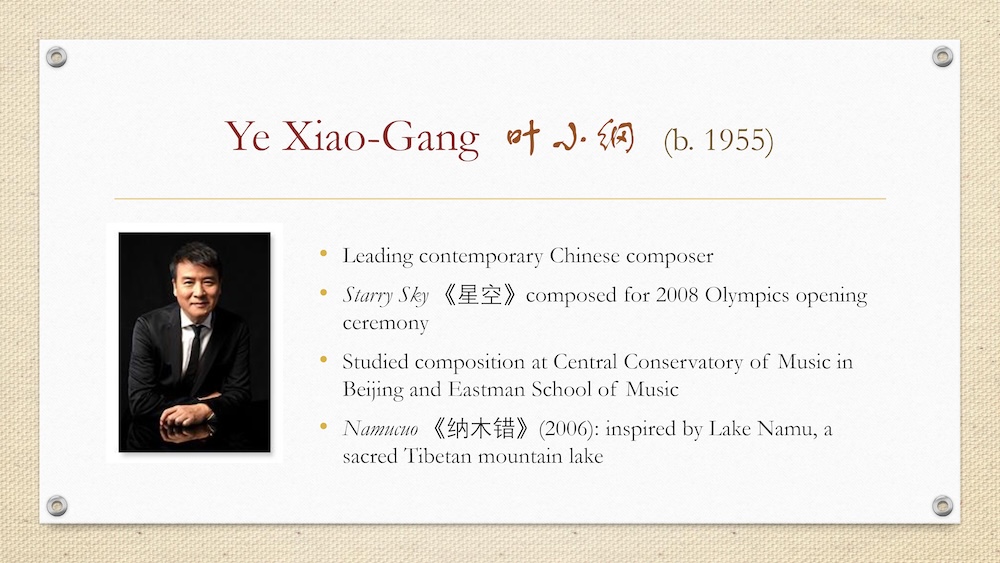
Composer Ye Xiaogang is perhaps a more readily recognized composer on the international front, owing in part to his work, Starry Sky, being performed at the opening ceremony of the 2008 Beijing Olympics. As an adolescent during the Cultural Revolution, Ye was assigned to farm labor and, later, factory work for six years. In 1978, Ye was among the first classes of composers admitted to Beijing’s Central Conservatory of Music once it reopened after the Cultural Revolution. Following his studies there, he pursued graduate studies at the Eastman School of Music.
Namucuo, composed in 2006, was inspired by the composer’s visit to Lake Namu, a sacred mountain lake in Tibet holding special religious and spiritual significance for many Tibetans. Moved by the natural and spiritual beauty of the location, Ye wrote this piece, which would become the first in a series of pieces for various instrumentations, known as his set of “Nine Sacred Lakes of Tibet.”
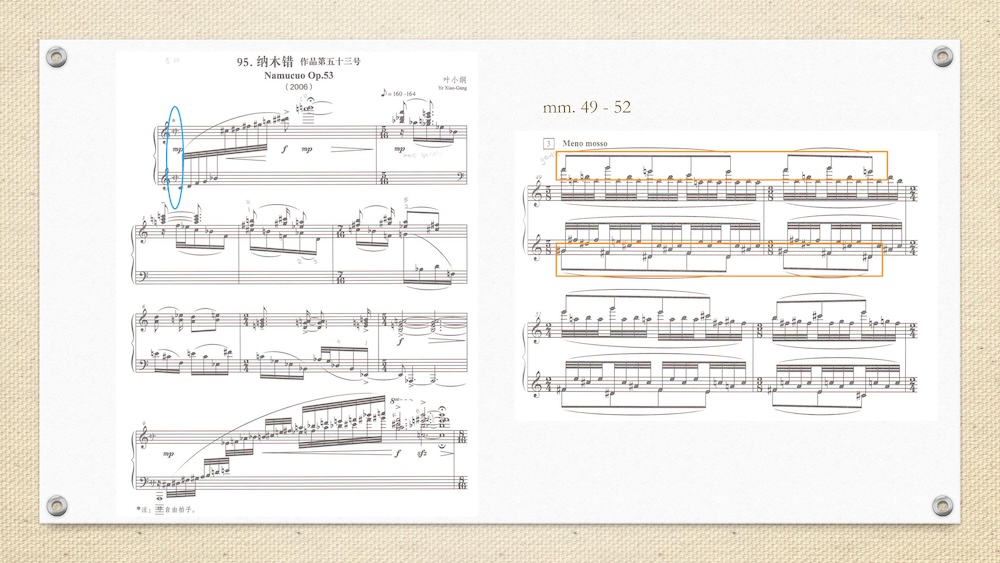
At first listen, this is the most “dissonant”-sounding of the pieces we’ve heard so far. Atonality had generally been frowned upon for its decadence, elitism, and inaccessibility to the masses. With the gradual opening up of China in the Reform Era, greater liberties were taken, and composers were keen to employ some of the more modern compositional techniques of Western composers. The harmonic language in this piece is quite removed from the more traditional, conservative Western consonant harmonies used by Ye’s Chinese predecessors. In Namucuo, the sense of dissonance is created by avoiding triadic harmonies as well as utilizing bitonality. Consonant-sounding chords are built from intervals of the third, like this:
[Music]
So in this piece, there is a lot more use of intervals like seconds and fourths to build chords.
[Music]
Bitonality refers to the occurrence of different modes or scales sounding simultaneously, which happens frequently in this piece. An example can be found at m. 49. Here, the right hand is primarily centered around a white-note pentatonic scale while the left hand is primarily playing a black-note pentatonic scale.
[Music]
There is also a feel of unevenness – a sense that one can’t quite pinpoint the beat – due to frequent meter and rhythmic changes. In the very first measure, where the time signature usually lives, we see this symbol, which indicates “to be metrically free.” When a time signature does enter, it changes very frequently and does not use common, standard meters.
Ye uses these modern compositional techniques, manipulating melodic and rhythmic features to approximate a Tibetan music style, emulating the natural splendor of the East Asian highlands, and animating its spiritual plane. Listen closely and you can almost hear the flapping of prayer flags in the high altitude wind.
[Music: Namucuo]
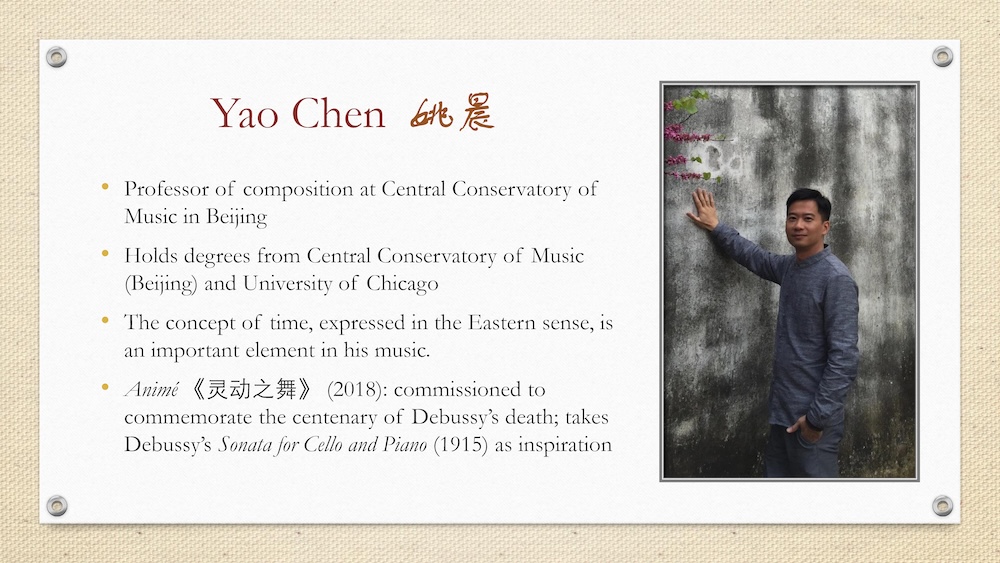
For the final piece in today’s program, we hear from contemporary composer Yao Chen, who is the current Director of the Composition Department at Central Conservatory of Music in Beijing. Having earned his own degrees in composition from the same institution and also from the University of Chicago, Yao describes his music as exhibiting a well-integrated mix of Western and Eastern influences. Though for him the differences between so-called Western and Eastern music are negligible, he does point to one notable distinction: the use of musical time. While Western music emphasizes the organization of time such that musical materials are shaped by it in horizontal space, Eastern music has a more diffusive approach to time, often allowing a single pitch to linger without a need to move anywhere, thus allowing one to fully experience and savor its colors and nuances in vertical space.
Animé was commissioned in 2018 as part of a program to commemorate the centenary of French composer Claude Debussy’s death. Whereas we have seen how Chinese composers packaged Eastern music characteristics in Western garb, here we have the reverse: starting with a Western model and assimilating it into Yao’s compositional voice. Yao takes inspiration from Debussy’s Sonata for Cello and Piano, one of the final pieces Debussy composed, written in 1915 during the throes of World War I while the composer was himself battling terminal cancer. Debussy’s work was an homage to the French Baroque tradition he favored, while his harmonic language was a continued foray into his brand of modernism. Along the way, a programmatic element became attached to the work, although Debussy repudiated this connection: the association with Pierrot, the lovesick and sad clown character from the Italian commedia dell’arte.
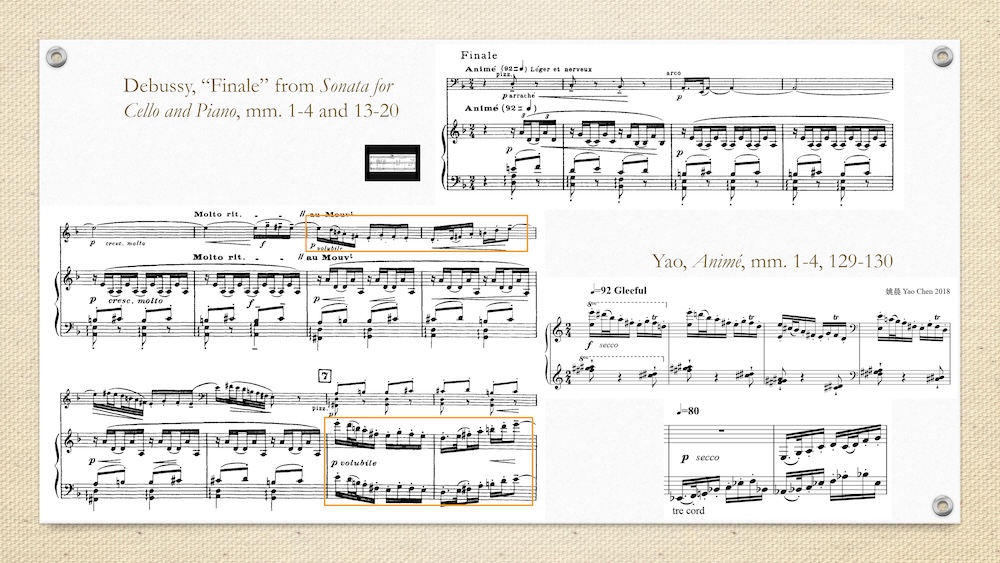
The title of the work, Animé, draws from the tempo marking in the finale movement of Debussy’s sonata. A prominent rhythmic motive from this movement, played by the cello and which, incidentally, features a pentatonic scale, infuses the outer sections of Yao’s Animé. We’ll listen to the opening of the last movement of the cello sonata, and in particular, we’re listening for the rhythmic motive first played by the cello in measure 15, (blocked in yellow), then picked up by the piano two measures later.
[Music: excerpt of Debussy cello sonata “finale”]
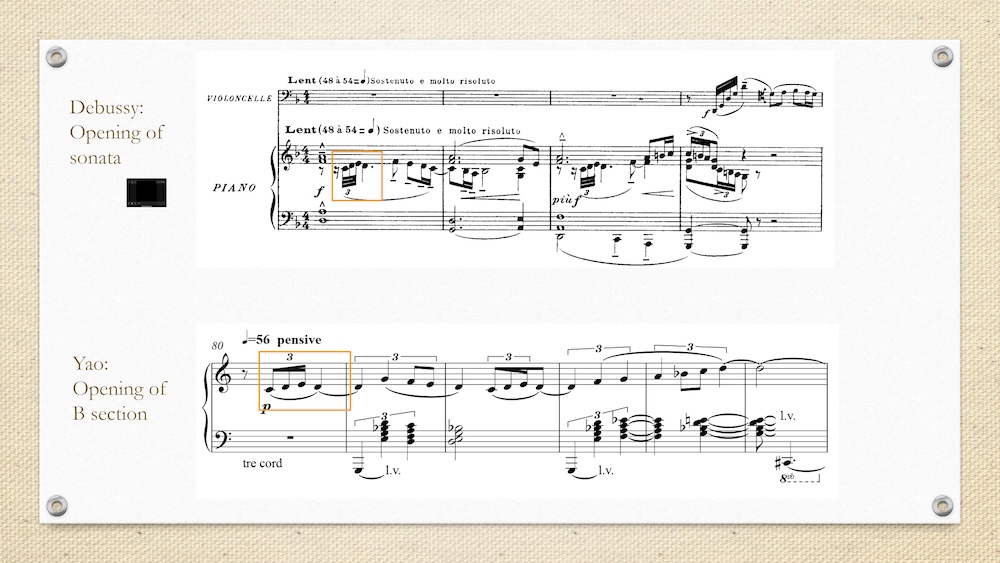
The opening rhythmic gesture from the first movement of the cello sonata is transformed by Yao into a slow middle section in Animé. Now we’ll listen to the opening of the cello sonata. Take note of the triplet figure played by the piano.
[Music: excerpt of Debussy cello sonata opening]
Yao builds upon the moods and themes of Debussy’s sonata to develop his Animé. The fraught energy of each of the outer sections in Animé builds in momentum toward a frenetic climax of mechanical repetition, an almost manic and crazed expression of trying to escape or break free, while also hinting at an association with another Pierrot, the moonstruck Pierrot of Arnold Schoenberg fame. The middle section of Animé takes on a tone of wistful lament – a eulogy for that which is no longer, and, at the same time, a peaceful Taoist acceptance of that reality.
[Music: Animé]
Using one of Debussy’s final work as a springboard for creating new music is itself a metaphor for how successive generations of composers build upon what came before and branch ever further out, but ultimately, all is connected. Through various associations, Animé explores themes of life and death, old and new, East and West, paying homage to Debussy’s life and heritage as well as to Yao’s own cultural heritage and spheres of influence. It is a true amalgamation of compositional voices, a vibrant example of current Chinese piano music, and a testament to the boundary-erasing quality of music: it makes an apt closing to today’s survey.

Thank you so much for your time and for this opportunity to share with you this afternoon. In our remaining time together, if there are any questions or comments, I’m happy to take them now. Thank you again.
 Copyright © The College Music Society. All Rights Reserved.