
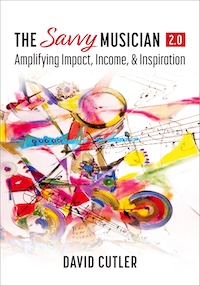
The Savvy Musician 2.0: Amplifying Impact, Income, and Inspiration. David Cutler. New York: Oxford University Press, 2025. 320 pp. ISBN: 9780197795958, $132.00 (hardcover); ISBN: 9780197796368, $29.99 (paperback); ISBN: 9780197795972, $20.99 (ebook).
When David Cutler’s The Savvy Musician: Building a Career, Earning a Living, and Making a Difference came out in 2009, the classical music world was reeling from the second major economic downturn of that decade, a crash that fundamentally changed the economics of the arts in the United States, decimating private donations and further imperiling the meager federal support the arts enjoyed. In the opera world, for one, this downward pressure scuttled the ranks of the mid-career artists who had clawed their ways to a modest living only to find their fees cut in half or worse, or reassigned to younger, more exploitable talent. The world in which the contemporaneous professorate learned the ropes was no more; young creatives needed not information but a mindset that helped them clarify their purpose, create demand, and build thriving artistic practices that paid enough for them to survive. Cutler’s The Savvy Musician helped them do just that with wisdom and compassion. In the intervening years, a handful of exceptional books (including those by Jeffery Nytch, Mark Rabideau, and a new edition from Angela Myles Beeching) have arrived to help young musicians find profitable and fulfilling outlets for their talents and to reinforce the importance of the arts to our communities. Times of economic struggle have historically been fertile ground for the creative arts in the United States, and in 2026, the arts find themselves in another difficult economy, which may or may not have seen its worst days. Predictably, our communities need and are filled with art and artists documenting, critiquing, and healing the world around them. It is to this crop of up-and-coming musicians that David Cutler speaks in The Savvy Musician 2.0: Amplifying Impact, Income, and Inspiration, an impressive and thoughtful revision of his 2009 book.
The book is divided into three parts, with Part I (Chapters 1-12), “Entrepreneurial Journey,” focusing on the nuts and bolts of building a creative business centered on music. One of the most difficult aspects of teaching an entrepreneurship mindset to students at the university level is communicating the universe of possible forms a creative career can take—a universe that stubbornly refuses to hold the same parameters from one decade to the next, confounding teachers and students alike. To this end, Cutler provides insightful and helpful scaffolding to assist aspiring music professionals in organizing their competencies and goals. (In one example of this scaffolding, the author breaks career models into three types: the familiar “portfolio” career, the “basket” career, and the tongue-in-cheek “hat” career, referring to the various degrees to which musicians’ income is derived from their performing work.) This part of the book also contains dozens of tools, both original and externally sourced. It is itself an outstanding resource for music entrepreneurship classes and could easily provide half a semester’s worth of assignments that leave students substantially better equipped than their peers in beginning to conceptualize their pathways to modern careers in music. The first part of the book is over half the volume’s total length, and for good reason. In addition to creating a scaffolding onto which the book’s wealth of information may be attached, alongside a generous collection of resources and templates, Cutler succinctly covers top-level concepts in branding, marketing, promotion, fundraising and earning, project management, artistry, and multimedia production.
Part II (Chapters 13-15), “Art That Matters,” is part manifesto, part instruction manual. Chapter 13 leans heavily on the author’s views on practical aspects of artistry interspersed with brief case studies related to each topic. Some of these are novel (approaches to building a setlist, choosing a venue, interdisciplinarity) while in other cases, the author returns to evergreen conversations to re-engage the artist’s imagination. If the reader is tempted to thumb past these familiar topics, I would encourage them to consider that revisiting our artistic priorities, however entrenched, can be a powerful way to reorient, clarify, and reenergize our approach to our art. Chapters 14 and 15 are in-depth explorations of the modern processes of recording audio and video and contain useful discussions of the “whys” of producing these media alongside typically solid information on the “hows.”
Part III (Chapters 16-20), “Nice Work If You Can Get It,” gives the broadest view of any portion of the book. Chapter 16 focuses on professional documents and job searches in various fields and is followed by specific chapters on larger disciplines into which musicians’ careers typically fall: teaching, performance, composition, and the music industry, including arts administration. The information in these chapters is basic to intermediate, but the case studies contained therein are excellent and relevant.
Despite the breadth of information covered, Cutler does not pretend to be a “one-stop shop” for the topics contained herein. Rather, he provides a thorough bibliography in the back of the book featuring over one hundred sources sorted into “Top 5” lists on the broader concepts covered, an excellent resource.
Teaching arts entrepreneurship is principally about teaching mindset rather than information; information expires, while a mindset that prioritizes adaptability can always find its way through a new landscape by its wits. The author really seems to understand this, as even many of his resources in the information-dense Part I are aimed at helping the musician understand the world around them, re-frame what they observe, and adapt their approaches to artistry and business management accordingly. Cutler has compiled a timely resource with heart and wisdom in equal parts, empowering entrepreneurial musicians as he teaches them the ropes. This updated volume is an excellent option for a college-level course on arts entrepreneurship, but it contains enough material across a multitude of subjects that it is also suitable for discussion within the context of a college or conservatory studio class or for an independent musician looking to understand more about the market surrounding their passion project.
 Copyright © The College Music Society. All Rights Reserved.