
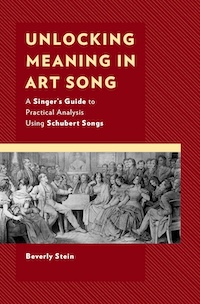
 Unlocking Meaning in Art Song: A Singer’s Guide to Practical Analysis Using Schubert’s Songs. Beverly Stein. London: Rowman & Littlefield, 2024. 340 pp. ISBN: 9781538187869, $110.00 (hardcover); ISBN: 97815387876, $39.95 (paperback); 9798881868253, $39.95 (ebook).
Beverly Stein’s Unlocking Meaning in Art Song walks readers step by step through the foundations of text and music analysis before inviting them into detailed case studies of twenty of Franz Schubert’s Lieder, works ranging from the deceptively simple “An die Musik” to the dramatic tour de force of “Erlkönig.” While many composers of Lieder deserve attention, Schubert remains the foundational voice in the genre, and his 600-plus songs provide almost limitless variety for illustration. Stein wisely selects songs that span both technical difficulty and expressive character, ensuring that the reader can practice her methods on pieces familiar to students, as well as more advanced repertoire. At 340 pages, the book is both substantial and approachable, weaving together theory, history, and performance practice into a resource that feels simultaneously scholarly and personal. Here, Stein offers singers, collaborative pianists, and voice teachers an extraordinary guide to deepening interpretive artistry through analysis.
Unlocking Meaning in Art Song is thoughtfully structured as a practical reference. Each chapter includes summaries, guiding questions, and analysis templates that can be applied directly to new repertoire. A detailed glossary ensures that readers unfamiliar with certain analytical terms never feel lost. These organizational features make the book ideal not only for individual performers but also for classroom use.
Yet what elevates the book beyond the status of “how-to” manual is that Stein writes with a genuine passion for art song. Engaging deeply with both text and music is something she presents not as an academic chore, but as a pathway to discovery. Her interpretations reinvigorate repertoire that might otherwise feel over-familiar, reminding us that even the most canonical works hold secrets waiting to be uncovered.
What immediately struck me about the book’s opening chapters was their balance of clarity and depth. Too often, analyses of art song are either overly academic treatments that intimidate performers, or they are simplistic commentaries offering little beyond surface-level “feelings” about the poetry. Stein finds a middle ground. Her writing is straightforward without being reductive, and she constantly demonstrates how poetic features such as meter, rhyme scheme, and vowel color can influence melodic design, rhythm, or harmonic pacing. Stein explains, for example, how a composer might elongate or compress a poetic phrase to reflect the emotional intensity of the text in the music, illustrating her discussion with musical examples.
Stein’s analytical methods and observations help to foster in the reader an artistic consciousness that extends beyond the notes on the page into the deeper world of storytelling. Her techniques of cadence mapping, motivic tracking, and rhyme-scheme analysis open doors for discovery. Her cadence maps, for instance, help teachers and students see at a glance where the music makes an arrival, stalls, or surprises the listener; this can aid the player in making interpretive decisions that can transform performance. Her treatment of “Die Forelle,” for instance, demonstrates how a seemingly lighthearted, strophic song contains subtle shifts of texture and harmony that align with the narrative’s moral undertone. In discussing “Erlkönig,” Stein dissects every tonal shift, every motivic recurrence, and every subtle inflection in the vocal line. She shows how Schubert creates a sense of mounting terror not only through the obvious galloping rhythm, but also through unexpected modulations and registral contrasts distinguishing between characters’ voices.
The clarity of Stein’s writing makes the material approachable for beginners, while the richness of her insights ensures that advanced artists and educators will not feel patronized. I particularly value the way Stein models inquiry rather than prescribing conclusions. She poses questions such as “Why might Schubert choose this harmonic shift here?” or “How does this rhyme pattern affect the pacing of the vocal line?” and leaves space for the reader to explore possible answers. This pedagogical style empowers singers to take ownership of their interpretive choices instead of relying solely on directives. For younger students, this approach builds confidence. They begin to see that analysis is not a secret code known only to theorists, but a tool they can learn and use. For more advanced singers, the book provides a framework for rethinking repertoire they may have performed dozens of times. Many performers, especially singers, feel daunted by the prospect of analysis, assuming it requires advanced theoretical training. Stein dismantles that barrier by showing that complex analysis can be learned step by step, even by those with limited background in formal music theory. She makes the process accessible without diluting its power.
In short, Beverly Stein’s Unlocking Meaning in Art Song is a standout contribution to the fields of voice and performance practice. It is scholarly yet approachable, rigorous yet inspiring. More than just a book about analysis, it is a guide to artistic growth. For singers, pianists, and teachers alike, it offers exactly what its title promises: it unlocks layers of meaning that transform singing from mere execution into true storytelling. It will sharpen the reader’s analytical tools, expand the reader’s expressive imagination, and, perhaps most importantly, remind the reader why they fell in love with this repertoire in the first place.
 Copyright © The College Music Society. All Rights Reserved.