
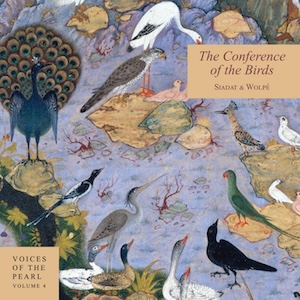
Resonance Collective, conducted by Fahad Siadat. Siadat & Wolpé: The Conference of the Birds. 2024. Voices of the Pearl 4. CD and MP3 download, 20 tracks (01:03). voicesofthepearl.org. $10
In March, 2024, Voices of the Pearl released a terrific recording of Fahad Siadat’s 63-minute oratorio The Conference of the Birds, sung by the Resonance Collective. The work takes its title from The Conference of the Birds, a celebrated Sufi mystical poem by the twelfth-century Persian poet Farīd ud-Dīn Attar. Librettist Sholeh Wolpé, an Iranian-American writer, translated Attar’s poem into English in 2017 and later adapted it into the libretto for this oratorio.
The poem tells a fascinating story: birds from all over the world fly through seven spiritual valleys in search of their sovereign, the mythical Simorgh. Into this narrative, Attar inserted dozens of short stories and parables, conveying spiritual truths about the inner journey, divine unity, and self-realization.
In 2022, the oratorio, with a choreographed dance component, had its premiere at BroadStage, in Santa Monica. Fahad Siadat, the composer and artistic director of the Resonance Collective, both sang and conducted the performance, leading the soloists, choral ensemble, and dancers (choreographed by André Megerdichian). While the album version cannot convey the visual aspects of the premiere performance, this studio recording captures the clarity of the voices, the intricate harmonies, and the performers’ techniques, making the music itself a vivid and immersive experience.
The album has 19 tracks played attacca. Like the original poem, the oratorio weaves parables into the journey. As a nearly a cappella work, the singers, especially the ensemble, must carry the entire piece (apart from brief moments of harmonium playing). From the very beginning, the performance confidently demonstrates the singers’ virtuosity and Siadat’s skillful orchestration of the voices.
The ensemble sings as an accompaniment to the soloists for much of the work, singing a wide range of instrumental textures. The first track, “The Birds of the World,” immediately showcases the singers’ variety of sounds and extraordinary vocal control, sustaining harmonies across a wide dynamic range and navigating complex ostinatos. The recording sensitively places the ensemble behind the soloist when they serve an accompanying role, and allows them to emerge clearly when they take on more prominent passages.
Soprano Anne Harley’s voice is ideally suited to the role of the Hoopoe, the wise guide leading the birds on their journey toward the Simorgh. Harley brings a strong, rich, and thick sound, while also using her great dynamic control to reveal moments of true gentleness. In the main role of the oratorio, Harley confidently leads us through the birds’ journey.
The other soloists also bring highly distinctive vocal characters, each clearly defined and individual. “The Moth,” one of the highlights of the oratorio, features an alluring, wordless melody. Soprano Amanda Achen brings a beautiful, exquisite vibrato, embodying the moth’s attraction to and fascination with the flame. Achen produces a note-ending vibrato like I have never heard before, creating a truly eerie effect. Later in the movement, mezzo-soprano Molly Pease takes up the same melody, first with grace and steadiness, then gradually transforming it into something painful and raw, ending in a scream, as the moth flies into the flame and perishes.
In a work this large in scope, Siadat intersperses passages that keep the piece feeling cohesive. The music starts with a turba, a chaotic crowd texture. The ensemble imitates a flock of birds gathering, each producing non-pitched whispers, then gradually and smoothly transforming into fast, pitched murmurs. The turba returns in track 13, after the birds have gone through the seven valleys. At the end of the work, we hear the turba for the last time, fading away. Every time the turba is accompanying the character of the “narrator,” sung by the composer. The end of every parable is marked by a coda of harmonium drone and choral homophony, repeated with slight variations. The texture is ritual-like, sung in Farsi.
In the end, only thirty birds survive the journey. When they reach their destination, the gate opens and they discover that there is no king waiting for them; instead, they see their own reflections, realizing that the seeker and the sought are one. Siadat and the Resonance Collective offer an oratorio that listens inward — one that lingers long after the final fade-out, like a mirror held up to the self.
 Copyright © The College Music Society. All Rights Reserved.