
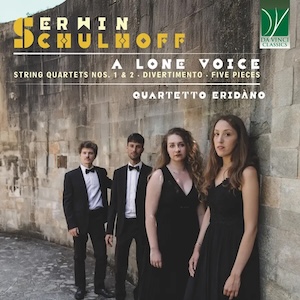
Quartetto Eridàno. Schulhoff: A Lone Voice. 2025. Da Vinci Classics C01110. MP3 download, 19 tracks (01:13). davinci-edition.com. $10
The December 2025 release Schulhoff: A Lone Voice by the Quartetto Eridàno brings together four works spanning the breadth of Erwin Schulhoff’s writing for string quartet. Schulhoff’s music is often framed as a patchwork of disparate influences, yet when heard across the narrative of this album’s program, a distinctly personal voice emerges.
The Eridànos bring buoyancy and disarming simplicity to Schulhoff’s first string quartet endeavor, the Divertimento, WV 32, from 1914. The gestures of this quartet are rooted in the traditions of the previous centuries, and obfuscate early identifiers of Schulhoff’s mature voice. The opening movement begins with a cello ostinato in fifths and cascading violin pizzicati — an evocation of a folk band, a reference that reappears throughout Schulhoff’s later music. The following cavatina offers a rare moment of songfulness, which Quartetto Eridàno expresses in a most sincere and natural way. Although the playing is deeply felt, the music flows easily and makes the sentiment feel poignantly fleeting before two lighter movements lead to a quirky and circuitous rondo finale. Several extended detours into the realm of sentimentality return to a witty main subject seemingly plucked straight from Vienna circa 1775.
In 1906, at the age of twelve, Schulhoff left his native Prague to study music in Vienna. After the horrors of World War I, and years spent drifting between the Dadaists, Second Viennese School, and jazz clubs of Berlin, he returned to Prague in 1923, entering a period of extraordinary productivity. One of the first works from this period, Five Pieces for String Quartet, WV 43 (1923), is an eclectic and international suite of dances. Two dance pairings follow the opening movement’s Viennese waltz, played with a spirited balance of brashness and elegance. The first, Alla Czecha, is a serenade cast in the characteristic meter of 5/8, reflecting Schulhoff’s renewed connection with his Czech roots. The second is a sultry tango alongside a tarantella. This performance might have used greater intensity of sound, and abandon in the tempo, to capture the frenzy of this final movement. Interestingly, the Eridanos include the discarded Alla Napoletana movement, an atmospheric vignette that could have functioned well as a scenic interlude between dances.
Over the next two years, Schulhoff wrote two other multi-movement string quartets in Prague. The String Quartet No. 1, WV 72 (1924), opens with a dazzling display of his instrumental language from this period — strumming, left-hand pizzicato, and a driving rhythmic energy propelled by brilliant fiddle-like passagework. Frequent unison writing and open intervals prioritize rhythmic energy over pitch and melodic development. As in the String Quartet No. 2, WV 77 (1925), the second and fourth movements are enigmatic. The second movement, marked Allegro con moto e con malinconia grotesca, alternates between murky ensemble textures and a declamatory viola recitative, before finally evaporating unresolved. After a rustic, earthy third movement, the piece concludes with a slow movement lasting nearly half of the work’s compact fifteen minutes. There is a quiet mysticism about this movement; searching melodic lines unfold above an unchanging harmonic texture, occasionally swelling into declamatory and rhapsodic recitative.
Schulhoff’s String Quartet No. 2, WV 77 (1925), follows a similar framework of two short energetic and two expansive slower movements, but compared to the first quartet, each movement contains more layers. In the first movement, rhythmic motives are interwoven into a chaotic texture, and driving rhythmic forces are tempered by more languid melodic gestures. One of the more complete movements Schulhoff wrote, the Theme and Variations, begins with a lonely vocalization built around a lamenting half step and ascending triad. The brisk third movement, as in the String Quartet No. 1, leads to a sprawling finale, this time closing energetically and with finality.
This recording presents a wonderful, near-complete survey of Erwin Schulhoff’s string quartet writing. It would have been illuminating to include his somewhat reactionary String Quartet in G major, Op. 25 (1918), both for the sake of completeness and to directly juxtapose Schulhoff’s immediate pre- and post-World War I compositions. Quartetto Eridàno approaches these works with an earnestness that highlights their inventiveness and spectacular range of style and character. The album’s program can easily be enjoyed start to finish, like a recital, and represents an admirable contribution to the awareness of a still under-appreciated composer.
 Copyright © The College Music Society. All Rights Reserved.