
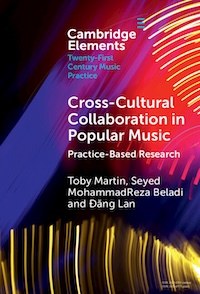
Cross-Cultural Collaboration in Popular Music: Practice-Based Research. Toby Martin, Seyed MohammadReza, and Đăng Lan. New York: Cambridge University Press, 2025. 86 pp. ISBN: 9781009454117, $70 (hardcover); ISBN: 9781009358248, $23.00 (paperback); ISBN: 9781009358231, $23.00 (ebook).
Cross-Cultural Collaboration in Popular Music: Practice-Based Research was written cooperatively by musicians representing diverse cultural perspectives and traditions: Toby Martin (based in Australia), Seyed MohammadReza Beladi (born in Iran and based in England), and Đăng Lan (born in Vietnam and based in Australia). The authors detail their own experiences collaborating with each other and with other musicians from culturally diverse backgrounds. The book serves as a valuable resource for those looking to collaborate respectfully and mindfully with artists across cultures or those looking to perform or better understand art that is inspired by multiple cultural traditions.
Although the book consists of nine chapters, it is essentially composed of three parts: (1) an overview of the methodologies and existing research related to cross-cultural and practice-based research, (2) an introduction to the collaborators, and (3) an overview of the three practice-based research projects conducted by the authors. The first few chapters provide an introduction to the philosophical orientation of the collaborations, namely that the act of collaborating itself is a form of research, not just the resulting materials. In Chapter 4: Cross-Cultural Music Making and Co-Produced Research: Literature and Context, the authors point out the importance of understanding the issues inherent to cross-cultural collaboration, including inequality, exoticism, artistic citizenship, ownership, and democratic decision-making. This chapter reviews socio-economic and political frameworks the authors considered as they collaborated artistically, highlighting how they aimed for shared artistic ownership. The authors, however, are upfront about the ways in which true equity simply could not always be achieved in the collaborations.
In Chapter 5, “Collaborators’ Backgrounds,” each musician provides their own account of their background and experiences, offering personal and insightful stories. The first-person writing provides a refreshing variety of narrative perspectives. Beladi’s research and performances focus on the music of Bushehr, a port city in the south of his native Iran. He explains that the traditions of Bushehr are inherently cross-cultural due to (among other reasons) the region’s unique proximity to both Africa and India (28). Beladi explains how his instruments—the dammam (drums), neyanban (bagpipes), and ney (flute)—are important in both classical and folk traditions of Syria. Đăng Lan—whose studies in voice and modern Western music and career as an actor and dancer have taken her across the globe—was born in Vietnam and relocated to Australia as a refugee in 1975, interestingly the same year that Toby Martin was born (also in Australia); they explored this serendipitous fact in their collaborative work Cat and Pig, which reflects their vastly different experiences of the same place. Lan plays đàn bầu (one-stringed instrument), đàn tranh (16-string zither), and sinh tien (wood and coin clappers). Martin, an indie-rock singer, songwriter, guitarist, and professor who has recorded nine albums and toured with the band Youth Group, draws as a musician on influences ranging from Joni Mitchell to post-punk, and his academic research has focused on country music in Australia. It is clear from this chapter that each musician brings diverse viewpoints on music, culture, and life, as well as knowledge of the instruments unique to their traditional performance practices. The authors make a particular point to discuss how these perspectives and styles come together in their collaborations to create a result representing as much as possible a product of which the three artists can take equal ownership.
The three chapters that follow outline the three collaborative projects in which these artists engaged. Each chapter begins with a list of musicians and their instruments, producers, recording engineers, composers, resulting materials, and information about financing and proceeds to detail all aspects of the creation of the project. These thorough discussions offer clarity into how the musicians engaged with each other to create a unified musical product that nevertheless honors the integrity of the performers’ cultural differences.
Chapter 6 describes the project entitled Songs from Northam Avenue (2017), a collaboration between Martin and Lan that resulted in one album and various live performances. Martin serves as composer, guitarist, and vocalist, while Lan performs on đàn bầu, đàn tranh, teacup, and coin percussion. The album featured a large ensemble of instrumentalists from both Western and Vietnamese traditions. The project was the result of Martin’s commission by Urban Theatre Projects, located in Bankstown, Australia. The songs on the album were inspired by the culture of Bankstown, which has, as Martin describes, “a culturally diverse population” (33). Martin set up in Bankstown residents’ yards to observe the life of the neighborhood; the first location was on Northam Avenue, the album’s namesake. He colorfully describes the experiences and conversations that he shared with the residents and how he was better able to understand their backgrounds and stories. He aimed to reflect the great diversity of the people, many of whom were Vietnamese and Arabic, and their cultures in the resulting music (33). Martin and Lan offer transcripts of conversations between the two that highlight new mutual cultural and musical understanding (38). The personal approach of the writing highlights the authors’ insistence that cultural and social considerations are a paramount aspect of cross-cultural collaboration.
Chapter 7 discusses another collaboration between Martin and Lan, which resulted in the album Song Khúc Lượn Bay/Two Sounds Gliding (2024) as well as performances for both Western and Vietnamese audiences. Both Martin and Lan serve as composers, while Martin performs guitar and vocals and Lan performs đàn bầu, đàn tranh, and vocals. This project featured a smaller instrumental ensemble, again, from both Western and Vietnamese traditions. Interestingly, the approach to this project was inspired by the limitations of Songs of Northam Avenue. Namely, the songs on the album Song Khúc Lượn Bay/Two Sounds Gliding were written collaboratively between Martin and Lan, who deliberately sought Vietnamese audiences. The lyrics were taken from recorded conversations between the two, which often focused on home and family. This allowed for equal ownership of the lyrics and subject matter and also points to the importance of mutual understanding of the individual and larger cultural traditions. Lan translated some of the lyrics into Vietnamese, and these were occasionally sung by Martin. An interesting discussion emerged regarding Martin’s discomfort with singing in a foreign language, both physically and socially, as well as the joy that it brought to Lan (54). Other conversation transcripts revealed discussions about different perspectives on labeling cross-cultural music and the differing ideas about project leadership (50).
Chapter 8 follows the creation of the album I Felt the Valley Lifting (2021), a collaboration between Martin and Beladi that resulted in three performances in England. Martin served as composer, guitarist, and vocalist while Beladi performed on Ney, neyanban, and dammam. Martin wrote the songs while living in Slaithwaite, a small English village packed with musical diversity, including reggae, bhangra, Kurdish music, and Persian music. The songs on I Felt the Valley Lifting fit within the age-old ballad tradition of the British Isles, but with modern-day subject matter. Martin invited local musicians to arrange instrumental parts for the songs, resulting in a truly diverse and collaborative sound. The juxtapositions of old forms with modern subjects, and of traditional British forms with “exotic” sounds, make for a fresh perspective steeped in history.
This book is a thoughtful meditation on what should be considered when collaborating across different cultures. The ideas presented, especially the discussion of research in Chapter 4, can easily be recontextualized for audiences outside of music. The social, political, cultural, and personal observations contained in this book are important for musicians and scholars who wish to engage in a respectful and equitable exchange of ideas, culture, and music. The authors discuss these considerations in detail, reviewing existing research and giving an account in terms of practical application in their three different musical projects, through which the reader gleans nuanced insights into how the authors’ philosophies on intercultural collaboration can be enacted and experienced in the real world.
 Copyright © The College Music Society. All Rights Reserved.