
Introduction
According to the U.S. Department of Education’s College Scorecard, the majority of recent applied music graduates earn less income than high school graduates who never attended college (U.S. Department of Education n.d.). A practical way to reverse that dismal statistic and equip graduates with more income-earning skills is to implement paid student internships. Undergraduates who participate in paid internships receive more job offers (Figure 1), attain higher starting salaries, and secure jobs sooner than those who had no internships or took part in unpaid internships (Collins 2020). In my work as a higher education professional, I found that paid internships also yielded valuable professional references, enhanced student self-confidence, and fostered important competencies not addressed in curricula.
In fact, compared to other interventions meant to aid the college-to-work transition, paid internships provide unmatched effectiveness and ease of implementation (Deming et al. 2023). In the following paragraphs, I summarize strategies for music schools to set up paid internships, and then I conclude with a call to action.
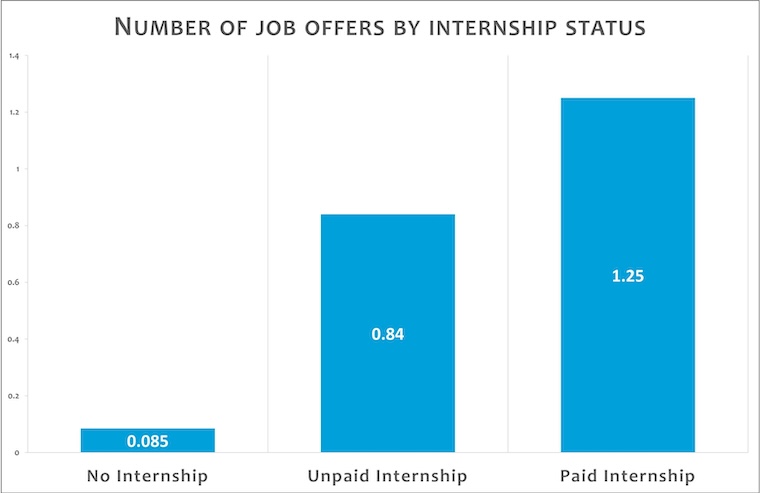
Figure 1. From Collins 2020. “Number of Job Offers by Internship Status.” Data collected Feb. 13, 2019 through May 1, 2019 from 3,952 graduating seniors across the U.S. (majors not reported).
Paid Internships Suited to Music Students
Internships can be defined as “short-term work experiences that help students gain entry-level exposure and applied experience in a particular industry, field, or organization” (Deming et al. 2023, p. 18). Unlike curricular internships, the sorts of paid internships I describe here seldom earn credit. They can be either co-curricular or extra-curricular, but they usually bear some relation to a student’s course of study. Optimal internships additionally take place in industries with favorable employment outlooks, such as, music teaching, church music, fundraising, and management (U.S. Bureau of Labor Statistics 2025).
As an illustration, paid interns might work 5-6 hours per week during the academic year as music teaching assistants at arts high schools, with El Sistema programs, or for their own institution’s studio faculty. Students interested in managerial functions might intern in the administrative offices of orchestras, theaters, or museums, assisting with the likes of fundraising, marketing or event planning. Church music directors could employ interns to help rehearse and lead choirs, play keyboards, and facilitate operations.
Funding & Configuring Paid Internships
1. On-Campus Work-Study
The federal work-study program serves as a straightforward source to fund on-campus internships.[1] Some financial aid offices might classify work-study positions as “jobs” and not permit them to be labeled “internships,” but schools and employers can nonetheless define student worker roles to maximize benefits to both employers and student workers, resulting in positions that resemble employment-internship hybrids. Let’s consider positions for studio teaching assistants. Teaching assistant duties require far more preparation and skill than clerical work-study roles, so the hourly pay rate should be much higher, perhaps double. Both undergraduate and graduate students with work-study grants and faculty recommendations could qualify. Such assistants provide add-on, non-credit instruction on campus and cannot be teachers of record nor serve as substitutes. They might teach weekly 30-minute one-on-one tutorials to the freshman students of their major teachers. They could run weekly workshops that elevate the performance, technique, or sight-reading skills of freshmen and sophomores. They can assist fledgling chamber groups during rehearsals. Periodic faculty observation and feedback enable assistants to heighten their teaching competencies.
2. Off-Campus Work-Study
Work-study funds can also support off-campus roles (Office of Federal Student Aid n.d.). If students work for off-campus public or non-profit agencies, and their activities can be classified as community service, then federal work-study funds can readily be used to reimburse their employers (employers pay student workers directly and then submit reimbursement forms to a school’s payroll office; a standard reimbursement would total 75% of the wage). Note that student workers must not displace existing employees nor undertake maintenance, construction, political, or religious activities (National Association of Student Financial Aid Administrators n.d.). For example, if students serve as music teaching assistants at public arts high schools or non-profit El Sistema programs, then their work can ordinarily be classified as fundable community service. Actually, the Department of Education requires institutions to spend 7% of their work-study allocations on community service jobs (Office of Federal Student Aid 2023). That mandate incentivizes financial aid offices to champion such off-campus work-study positions.
3. Privately Funded Roles that Mirror Work-Study
For students without work-study grants, privately donated monies in school foundation accounts can fund on- and off-campus internships that mirror work-study positions. A school’s payroll office would execute employer reimbursements in a manner identical to that used for work-study, but the monies would come from a separate account number. Such private funds can further be tapped to finance church music internships because federal work-study monies cannot support employment involving worship (National Association of Student Financial Aid Administrators n.d.). Another option would be for employers to sponsor all the costs of paid internships.
Initiating & Administering Off-Campus Paid Internships
To initiate off-campus work-study internships, I advise music schools to start small, with one conveniently-located employer and two or three positions. The timeframes when an employer would need student workers should match student availability, and the employer must have a supportive payroll staff.
Once a suitable employer is identified, a school’s financial aid office must approve the employer and the work-study roles. Financial aid officers possess the expertise and documents to carry out approvals and comply with federal regulations. Still, a music faculty member or career officer should collaborate with the financial aid office and employer to refine the roles, schedules, compensation, and job descriptions as well as specify how interns will be managed and evaluated. All of those steps should be completed before a semester begins.
With structural elements in place, job announcements can be posted, qualified students can apply, and then interviews and hiring can commence. After a trial internship program proves effective, schools can engage more employers and students, perhaps for both work-study and privately funded internships, and then a school’s career, financial aid, and payroll offices can manage most operations. Nonetheless, music faculty oversight goes a long way toward ensuring continued program success.
Concluding Thoughts
Music students who participate in the above sorts of paid internships become qualified for remunerative and fulfilling positions in the fields of studio teaching, church music, arts administration, and more. Plus, as gainfully employed graduates, they can concurrently pursue their performance or composition careers, building on the artistic abilities they acquired in school. Those who apply for graduate study instead of entering the job market reap qualifications to win scholarships and assistantships.
Beyond the benefits to music students, the aggregate boost to graduate earnings that paid internships produce can help justify ongoing federal loans to music students. Given the soaring cost of college (Kerr and Wood 2025), surge in student debt levels (Federal Reserve Bank of St. Louis 2025), and alarming number of borrowers struggling to repay their loans (TransUnion 2025), taxpayer-funded student loan systems are overdue for reforms that will reduce debt levels and minimize defaults. At present, loan amounts mainly align with a student’s cost of attendance and financial need. Going forward, it seems certain that amounts will increasingly be tied to data showing graduates’ capacities to repay, which new accountability frameworks are designed to encompass (U.S. Department of Education 2026).
If music graduate earnings do not improve, and future federal loan amounts to music students are slashed, then enrollments will plummet, and music schools will wither. So, for both pragmatic and ethical reasons, I hope that music schools will make it a priority to launch paid internship programs as well as curricular innovations that will raise the economic value of music degrees (Klickstein 2023). By doing so, we outfit our graduates for both artistic and financial success.
[1] Some financial aid offices might classify work-study positions as “jobs” and not permit them to be labeled “internships,” but schools and employers can nonetheless define student worker roles to maximize benefits to both employers and student workers, resulting in positions that resemble employment-internship hybrids.
References
- “Open the Door: Disparities in Paid Internships.” NACE Journal, November 2020. Accessed April 9, 2026. https://my.cgu.edu/career-development/wp-content/uploads/sites/8/2020/12/Internships-NACE-Journal-Nov-20201.pdf
- Delivering on the Degree: The College-to-Jobs Playbook. Harvard Kennedy School, Wiener Center for Social Policy. Accessed April 9, 2026. https://files.eric.ed.gov/fulltext/ED636056.pdf
- Louis. 2025. “Student Loans Owned and Securitized.” Updated February 7, 2025. Accessed April 9, 2026. https://fred.stlouisfed.org/series/SLOAS#
- “20 Years of Tuition Growth at National Universities.” U.S. News & World Report, September 24, 2025. Accessed April 9, 2026. https://www.usnews.com/education/best-colleges/paying-for-college/articles/see-20-years-of-tuition-growth-at-national-universities
- “Enrollment Growth Amid a Shrinking Student Population.” College Music Symposium62 (1): 58-63. 10.18177/sym.2023.63.fr.11586
- “Federal Work-Study Program,” Section 675.20. Accessed April 9, 2026. https://www.nasfaa.org/part_675_federal_work-study_program
- Department of Education. 2023. “Community Service Requirements in the FWS Program.” January 10, 2023. Accessed April 9, 2026. https://fsapartners.ed.gov/knowledge-center/library/dear-colleague-letters/2023-01-10/community-service-requirements-fws-program
- Dept. of Education. n.d. “Federal Work-Study jobs help students earn money to pay for college or career school.” Accessed April 9, 2026. https://studentaid.gov/understand-aid/types/work-study
- “Following the Resumption of Federal Collection Activities in May, Nearly One in Three Federal Student Loan Borrowers Find Themselves at Risk for Default.” June 24, 2025. Accessed April 9, 2026. https://newsroom.transunion.com/june-2025-student-loan-update/#
- Bureau of Labor Statistics. 2025. “Occupational Outlook Handbook,” Updated August 28, 2025. Accessed April 9, 2026. https://www.bls.gov/ooh/
- Department of Education. n.d. “College Scorecard.” Accessed April 9, 2026. https://collegescorecard.ed.gov/
- Department of Education. 2026. “U.S. Department of Education Reaches Consensus on Historic New Accountability Framework and Concludes Higher Education Reform Rulemaking Sessions.” January 9, 2026. Accessed April 9, 2026. https://www.ed.gov/about/news/press-release/us-department-of-education-reaches-consensus-historic-new-accountability-framework-and-concludes-higher-education-reform-rulemaking-sessions
 Copyright © The College Music Society. All Rights Reserved.