
Abstract
A Dirty Blond Show
I’m home on a Saturday afternoon in Hampton, Connecticut and my band has a Blondie covers gig tonight in New York City. I give myself a strong coffee and four hours and for what Google Maps predicts is a three-hour drive (traffic anywhere near the George Washington bridge is a perpetual catastrophe and Google never remembers). I should arrive on the Lower East Side two hours before we play, giving me ample time to find a parking spot and walk (I’m guessing) half a mile to the venue, catch my breath, hydrate, stretch a little, and calmly set up on stage. The gig will be good; they always are because Dirty Blond is tight, well-rehearsed and focused.
The traffic is even worse than I expect but I suck up the tolls ($7.46) on the purportedly fastest route and remember to fill up from near empty in Jersey where gas is cheapest – $38. I drive past the venue anxious, tired, stiff and desperate for the restroom. I’ve received three texts from the band telling me they have arrived but “not to rush.” I circle for 20 minutes and find a free parking space the anticipated half-mile from the venue. I double check street signs and give myself a 70/30 chance the car is where I left it, sans ticket, after the gig. I load up – backpack, front-pack, and three heavy cases that bruise my legs as we bump along the sidewalk. It’s freezing out but I am quickly sweaty. My forearms burn waiting at each crosswalk, but putting the stuff down and picking it up again takes time. I hate running late so I’m frustrated and anxious but can’t move any faster. At the venue door a security guy tells me it’s $12 cash and I swallow my sarcasm to identify myself and my bags as being in a band.
I drag the bags against the grimy walls down the narrow stairs to the basement venue. I heave myself and my gear through a teeming, half-drunk crowd and lumber on to the stage where everyone else is plugged in ready to go. The sound guy asks if I’m nearly set and I can’t even. I have cramp in both arms and still need to pee. I drop my stuff, wade through the crowd again, convince the men’s room security guard that my need is greater than others’ so get to skip the line, relieve myself and battle back toward the stage. I’m parched but the line at the bar is four deep so there’s no way I can get water. I set up carefully and with focus (they can’t start without me). Ten minutes later I’m ready to rock, replete with unsteady house rack tom, flimsy snare stand and two of three floor tom legs held up with year-old duct tape.
Overheating, body calm and mind racing, I look up for the first time. My three bandmates are all grinning eagerly at me, excited to play and energized by the size of the crowd; we thought it would be empty here tonight, but people showed up. The sound guy gives me a thumbs-up with raised eyebrows. I nod, smile broadly, feel my shoulders relax and count boisterously into “Union City Blue,”[1] Harry, Debbie, and Nigel Harrison. 1979. “Union City Blue.” Eat to the Beat. Chrysalis. beating the crap out of the toms in the intro and shocking my body into gig mode, letting the band know I’ll drive hard from behind for the next 45 minutes. They all respond with fireworks, taking the energy in the room to 11. After “Union” I get the ok from the guitarist and count off “Hangin’ on the Telephone.”[2] Lee, Jack. 1978. “Hanging on the Telephone.” Parallel Lines. Chrysalis. The audience goes nuts and in the guitar solo I launch us into the stratosphere, enmeshed in joyful, intense reciprocal rocking out. We remain in near-earth orbit the whole set.
When we finish, I am saturated in sweat and dizzy. I’m dehydrated. The familiar post-rock-show exhaustion is fleeting (if I can only find water). My sweat-drenched hands slip over everything as I hurriedly deconstruct the drums and re-pack my cases so the next drummer (literally breathing down my neck as he assesses outlet access and the shoddy house cymbal stands) can set up for his band’s imminent set. My muscles too hot and tired to hurt, I lumber from the floor-level stage through the now-more-drunk audience towards the bar but the throng is deeper still and I need air more than water. I find a fire exit and climb to the street. Feeling the biting December wind through soaked shirt and blazer, I realize my dry change of clothes is in the car. I’m famished! (Maybe I left a snack in the car?) I take some wrong turns on the walk and can’t hold my phone for GPS due to the bags. I stumble on the car – no ticket! I heave the stuff into the trunk, hasten to the front seat (alas, no snack), and turn on the heating in lieu of changing now. I’ll stop at a gas station for water. Or I’ll go straight back to the house. Panting, I text the band to tell them I left and had an incredible show. Truly, it felt bloody brilliant and I can’t wait till the next one. GPS says two hours to bed. The guitarist texts me back to say we each made $20.
This behavior describes a reality familiar to many thousands of musicians (Azzerad 2001). We work hard at what we do, we do it well and we often lose money doing it (Ferrarese 2015; Touchette & Smith in press). Based on a lifetime of experiences like the one described in the opening, I suggest an alternative teleology of musical industry that overlaps with and runs parallel to commonplace characterizations of value of musical Industry residing in commodity or commodification (Bennett and Guerra 2023).
In this position paper I adopt an autoethnographic stance (Chang 2008; Denzin 2014), well suited to highlighting aspects of the inherently subjective nature of music-making experience (Bartleet and Ellis, 2015; Lee 2024; Zagorski-Thomas 2022). I use my own (auto) experiences of “cultural labor” (Whiting 2024, 508) in Blondie covers band, Dirty Blond (ethno), as the primary locus of data informing, and generated through, my writing (graphy). Henceforth herein I refer to the music Industry (capitalized) to mean the phenomena to which that term is commonly applied (notwithstanding complexity and problematics inherent in the term and its applications (Arditi and Nolan 2024; Parkinson and Smith 2015)), and I refer to musical industry (all lower case) to denote musicians’, and in particular my own, labor.
The Music Industry and musical industry
Academic discourse tends to construe the music Industry primarily in two ways: 1) as an example of a complex, multifaceted organism within the broader economy, subject to trends in technology and taste (Zinnbauer 2025), and 2) as a tempestuous territory ripe with challenging and exciting opportunities for musical entrepreneurs (Coles and Miller 2025). Bennett (2024) outlined a case for conceptualizing a single Music Industry, while Cloonan and Hulstedt (2012) preferred to think of plural music industries. While these paradigms afford valuable and informative stances on music Industry, they mirror an unfortunate trait to which scholarship in popular music studies often succumbs, that is elision of or unstated assumptions about the musicians whose industry comprises so much of the Industry. A case in point, the text, Understanding Popular Music (Kotarba and Vannini 2008; Kotarba 2013, 2018), perplexingly appears to contain no perspective from any musicians. In this article I parse the edifice, structures and policies of the music Industry from the musical industry, i.e., musicians’ labor, that discussions of the Industry can downplay and, to an extent, take for granted (Jones and Heyman 2024).
The vast majority of music is created by non-famous musicians. Regardless, streaming and social media algorithms, legacy record company policies, individuals’ decision fatigue and nostalgia conspire to create the illusion that what most of us repeatedly hear is either all or the best there is. Feeding these mechanisms are co-conspiratorial myths of the democratized and debunked music streaming ideologues’ darling utopia of the “long tail” (Anderson 2006, 2008), and the pipe dream that if one’s music is only good enough, niche enough or sufficiently well promoted, then it will inevitably find an appreciative, admiring and paying audience (Cartwright and Smith 2013; Cartwright et al. 2015). These conjurements work hand-in-glove to feed the poisonous protestant work ethic that labor is its own reward, and that if it doesn’t feel like it is, never mind because your real reward awaits you in heaven or in retirement.
Such invidious visions of the Music Industry lionize entrepreneurism while stripping all process and product of any meaningfulness for those creating art or pursuing their craft for reasons that have very little to do with culturally conservative contortions of Christian doctrine. Musicians know that art, fundamentally and perennially, both precedes and transcends the contrivances of capitalism or any other economic system. Making art is a human compulsion, and musicians do it fundamentally, foremost and far more ubiquitously than mainstream cultural ideology would have us believe, in order to forge, maintain and deepen trusting, meaningful connections with other people and ourselves (Boyce-Tillman 2020; Dissanayake 2000; Hendricks et al. 2023; Smith and Lee 2025).
An expanding body of literature serves as a counterpoint to the reified practice of writing about Music Industry without hearing much at all from musicians about their own industry. Examples include work on music making and leisure (Mantie and Smith 2017), collegiate a capella (Mantie and Talbot 2020), amateur popular musicians (Cremata et al. 2018) and practice research (Zagorski-Thomas 2022). Nevertheless, this scholarship remains somewhat on the fringes of a mainstream largely embedded in ideologically neoliberal, market-based assumptions about the functions and meanings of musical industry (Moir, 2026).
Dirty work
The reference to “Dirty (Blond) work” in the title of this article functions in two ways. First it is a play on “Dirty Blond,” the name of the Blondie covers band in which I play drums, and my work in the band. Being in Dirty Blond is not anyone’s job, and this band is not a source of net income. However, it involves labor. After personal practice, collective rehearsal, rescheduling childcare, arranging meals and (paid, day job) work around gigs, driving several hours, parking, loading in, often re-parking after load-in, sound-checking, playing the energetic rock show full throttle, fiercely rehydrating, unparking, loading out, driving home, sleeping precious few hours, and getting back to parenting, pets and paid work the following day, playing in Dirty Blond feels like work.
Further helpful for conceptualizing Dirty Blond’s labor as musical industry, is Stebbins’ (2014) notion of “devotee work” (4), wherein Stebbins positions such strenuous non-employment activity as “serious leisure” (4). The notion and ideal of leisure are, however, fraught with complexity and nuance, as sociological notions of music as leisure (Mantie 2022) rub up against the viscerally experienced, non-leisurely feeling of doing the work of Dirty Blond covers band. Colloquial understandings of leisure as more easy-going and light-hearted, make leisure a slightly awkward fit (Smith 2017), highlighting the challenge that scholars and others face in understanding and articulating the human value and teleology of much music making (Silverman 2023). Despite and because of the hard work involved, I often experience Dirty (Blond) work as fun; the band and I play music after all, and it feels like play, which is a vital if oft-under-emphasized reason that musicians do what we do (Smith and Lee 2025).
The second function of referring to “Dirty (Blond) work” in the title is that it acknowledges the unsavoriness of labor in a dive bar punk cover band. I acknowledge a commonplace usage of “dirty work” to characterize jobs that contemporary society deems essential but finds unbearable or unconscionable; these are traumatizing, morally questionable occupations like piloting bomber drones, working in slaughterhouses and guarding violent prisoners (Press 2021). Dirty work also includes that of essential workers who labor in distribution warehouses, food delivery and other marginally more savory but barely more visible forms of employment (Guendelsberger 2020). I am not attempting herein to equate playing in my spare time in a rock band with other dirty work, nor am I suggesting that my position as a white, salaried, middle class professional employed by a private research university is in any way comparable to the work or lot in life of the socially and culturally marginalized people who undertake the aforementioned labor that forms much of the foundation on which and because of which modern enterprise and societies can thrive.
Nonetheless, it requires barely a stretch of the “dirty work” rhetorical device to construe Dirty Blond’s efforting as analogous to society’s invisibilized dirty work, given how the labor of such cover bands is largely unacknowledged in press or scholarship – certainly when considered proportionally to the sheer volume of bands and artists donating their musical industry at this stratum of the Music Industry. It has also not been uncommon for other adults in my life (always, notably, those who are not also musicians) to question the morality of my life choices in devoting so much of my own industry to making so much music for so little financial gain. Initial intrigue often turns quickly to disdain that I take so seriously the self-imposed obligation to do what I do. The scorn, sometimes unspoken, is always tangible, manifesting for instance in the eagerness with which my daughter’s friends’ parents, along with other caregivers, offer to take my daughter in for the evening to shield her from whatever sordid and contemptuous dirty work I am prostrating myself to partake in. Unlike Press’s (2021) conception of dirty work where society’s constituents recognize the value of hidden labor but abhor it nonetheless – and thus recalling Becker’s (1963) work on the social construction of workaday jazz musicians’ deviance – my middle-aged peers seem genuinely baffled that a fellow fully-grown human would willingly spend money and time (so very much time!) doing the musical industry of Dirty Blond work.
My Dirty Blond work is often sensorily unsavory on account of the sticky, greasy and aromatic floors, walls and streets where I labor. Venues can be filthy; perhaps grungy makes the perennial lack of cleanliness sound more palatable (at least to a child of the ‘90s like this author). Musicians and scholars in the UK refer with disparaging affection to the dive bar echelon of the Music Industry as the “toilet circuit” (Parkinson et al. 2015, 8). Musicians who have exerted their industry in these venues share a sort of commoners’ solidarity. The figurative and felt dirtiness of Dirty Blond’s work is captured by deprecatory idiom, below stairs, where the band often works. As a rock band peddling punk at ear shattering volumes in small spaces, we are often relegated to beneath the streets of New York City in underground spaces that never seem to be served by an elevator, beneath more respectable drinking establishments where the night life’s soundtrack is manufactured beats and identikit pop music served on ice with a surfeit of sub-bass. As a consequence, we usually enter a venue through (to deploy another British pejorative) the tradesmen’s entrance.
Punk
Drumming in Dirty Blond is manifestly punk – a term that for centuries, from Shakespeare (1575/2023) to Sondheim (Laurents et al. 1958), has with its double plosives expectorated a vitriolic disgust for society’s dirty workers, only to be co-opted by a generation of artists – including Blondie – who wanted and still yearn to express and explore ourselves in unholy, corporeal communion (Smith 2017). This dirty work is collaboratively corporeal. Baseness and the body have long been equated in the heteropatriarchal, superstructural Enlightenment habitus (Merleau-Ponty 1945) that permeates respectable, middle-class, mainstream Euro-American culture (Boyce-Tilman 2020). It is unsurprising that marginalized musical cultures are labeled with language of the bordello, giving us punk and, before it, jazz (Brennan 2020). While jazz has occasionally courted and largely adopted a culture of sophistication, punk musicians old and new routinely retain the down-and-dirty aesthetic of the genre’s ontogeny. Dirty Blond – like Blondie, whose songs we cover – navigate an aesthetic tension familiar to seasoned punks, between showcasing our preparedness and being excellent and grooving enough to satisfy ourselves and the audience (executing Blondie songs well sets a fairly high musical bar), and sustaining a partly paradoxical position between the pleasure and pain of participation (Khan-Egan 1998).
Comparing musical industry and music Industry paradigms
In support of my position herein, construing musical industry as a part of and yet apart from the music Industry[3] I have borrowed the idea of being a part of apart from, from Bill Bruford’s (1998) album with his band, Earthworks, A Part, And Yet Apart (Discipline Global Mobile)., I propose as a rhetorical device two logic models that outline these respective and overlapping teleological views of musical industry and the Music Industry. These are standard Industry model (SIM) (Figure 1) and the alternative industry model (AIM) (Figure 2).
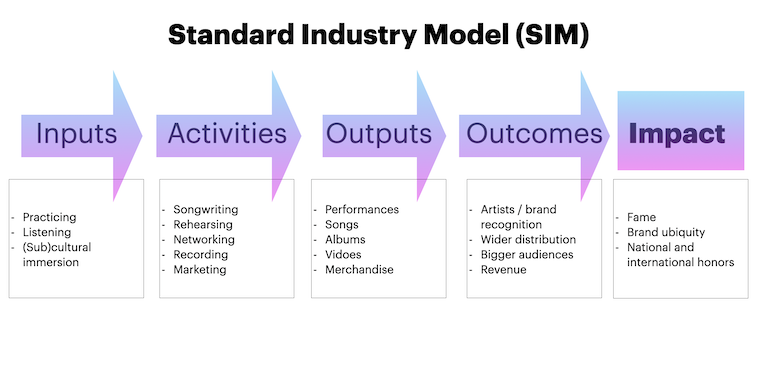
Figure 1. Standard Industry model
The SIM centers generating original music, as is expected and tacitly understood as a point of authenticity in a popular music paradigm (Parkinson and Smith 2015) and throughout commonplace conceptions of the Music Industry. The AIM, meanwhile, highlights how normative notions of the Music Industry risk excluding accounts of workaday, human musical industry (Duby 2025; Mantie 2023). I have worked tirelessly for decades at honing my craft in idealistic pursuit of the outcomes and impacts of the SIM. I still play drums in originals bands, hoping (or perhaps now just nostalgic for the evaporated dream of) realization of the fruitful SIM trajectory in my own experience. But along the way I have, for the most part unconsciously, but nonetheless effortfully, fostered the ethos and teleology of the AIM, centering meaningful relationships with humans including myself (Smith 2022). This musical-industrial teleology is quite familiar to musicians who are not household names (Smith and Lee 2025) as well as to some who are.
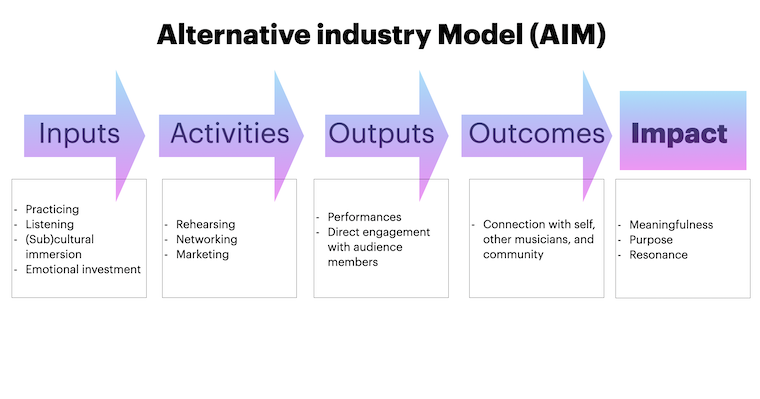
Figure 2. Alternative industry model
There are well-known examples of bands that appear to exemplify extremes of both SIM and AIM paradigms inasmuch as they have achieved commercial-industrial success while developing and even intentionally sustaining camaraderie. An example jazz is Brian Blade’s Fellowship band (Philip 2013). Another is hybrid/fusion ensemble Snarky Puppy whose brand of “music for the brain and booty” (Saunders 2025) customarily (for a commercially successful, multiple GRAMMY-winning collective, whose membership and collaborations are perpetually in some degree of flux) deflects from the friendship and brotherhood that, to someone who has followed the band’s trajectory over 16 years to date, seem foundational to the ethos and bedrock of the band. As a counterexample, Bill Bruford, who experienced decades of international visibility and commercial success as a drummer in rock bands and jazz combos, bemoaned the musically and artistically limiting propensity for some bands to form around friendship and to commit to that fostered familiality as a guiding principle (Bruford 2009). However, suggesting these two logic models here serves, I hope, to underline the familiar, reified doxa of a Music Industry trajectory and raison d’être on the one hand, and my own account of a broadly commonplace lived reality of musical industry on the other.
The Aim is Resonance
In the impact box in the AIM, is resonance (Rosa 2016), a sociological concept that accounts for and centers humans’ foundational pre-linguistic, pre-rational and pre-sensory model of being in the world. A capacity and profound need for resonance are what make humans human; for Rosa (2016), “humans are… first and foremost creatures capable of resonance” (36). Rosa (2016) construes humans’ means of connecting meaningfully with the world as our “axes of resonance” with ourselves, with one another and with other phenomena (105). Rosa’s theory of resonance arose as a deeply thoughtful and powerful sociological response to contemporary, hyper-individualized, uber-commercialized, neoliberal late capitalist societies that have refined and reified epistemologies and teleologies resulting in “mute relationships to the world” (Rosa 2016, 96), epitomized by the SIM, where human relations are devalued and ignored or at best subjugated by vacuous monetary ends that can feel inauthentic and desolately empty. Rosa (2016) describes this as a condition in which “all axes of resonance have fallen mute… a radical form of physical and psychological alienation” (105).
I find resonance to be a convincing explanation and accurate characterization of Dirty Blond’s musical industry and the AIM – through what resonance spotlights and because it underlines so much of what is elided, downplayed and obliterated by the human disinterestedness of the SIM. Punk is perhaps especially readily conducive to resonance and the AIM, because punk foregrounds a furtive, feral physicality, even when layered with some of the pop-ish finesse of Blondie’s music.
Under the hood, “Dreaming”[4] Stein, Chris, and Debbie Harry. 1979. “Dreaming.” Eat to the Beat. Chrysalis. is a three-minute punk rock drum solo comprising a thunderous 8th-note floor tom pattern and fill after rattling fill. The bridge contains less punctuation so enables the band all to dig in harder to the relentless pounding groove. I lean back to help me plow more into the floor tom head with my right hand and can feel Johnny (bass) and Levi (guitar) sinking in too. For every backbeat, I raise the left stick above my head to achieve maximum downward velocity and give the audience a visual to match the band’s increased intensity. Ingrid’s vocals soar, and the audience joins her in flight.
Rosa (2016) contends – and from my experience in Dirty Blond I vehemently concur – that music is especially (and perhaps even uniquely) suited to countering aspects of technologically advanced societies’ contemporary condition, asserting, for instance, that “the relational quality lacking in our screen-mediated relationship to the world can in certain contexts be established… through music” (93, emphasis in original). He continues, noting that “through music, our relationship to the world as a whole becomes more tangible” (94) and that “music affirms and potentially corrects, moderates, and modifies our relation to the world” (95). I should note that Rosa’s characterization of music seems to be about humans consuming music (almost as if music were somehow just there) and he barely speculates about how making and co-creating music in real time may be especially conducive to an expression of resonance. Nonetheless, Rosa’s resonance theory opens a doorway through which I think his limitations as a musician prohibit him from walking. Rosa understands enough of music’s capabilities to allow musicians to affirm that what he says about music and resonance absolutely rings true, and all the more powerfully so when applied in service of attempting to explain much of what happens when musicians more than merely play together, but really groove (Roholt 2014; Smith 2022).
In “Rapture,”[5] Harry, Debbie, and Chris Stein. 1981. “Rapture”. Autoamerican. Chrysalis. the instrumentalists lay down a mid-tempo, slinky red velvet disco groove for Ingrid to swagger all over with falsetto singing and nonchalant rap. We keep the audience in a trance for five and a half minutes before Levi pivots and rips into an epic wailing guitar solo. I add rocking quarter-note open hi-hats to stoke the fire under his shreddery for as long as it takes, adding bigger and fuller fills to catapult him farther from earth as the audience, shaken from their meditation, stare rapt while the band rollicks, mesmerized in the depth of our mutual listening.
Resonance thus encapsulates phenomena similar to those described by more familiar frameworks like flow (Csikszentmihalyi 1991) and autotelic experience (Baumann 2012). Resonance goes farther than these theories, though, in that it portrays also a teleology of how we as humans can, and desire, ideally to relate to the world, despite having opportunities for and access to resonance denied at every turn in contemporary society.
The SIM (Figure 1) and the AIM (Figure 2) diverge after some commonalities, indicative of how resonance could be (but is not) a teleological end of both musical industry and the Music Industry. As Rosa (2016) notes, recalling what Bourdieu (1984) called habitus, “how we relate to the world is thus the result of cultural worldviews and social practices as much as of individual physical or psychological dispositions” (109). I enjoy in drumming in Dirty Blond because I find therein resonance with myself, bandmates and audiences, because of our respective and collective rootedness in and dedication to our musical culture and practice.
Our biggest crowd-pleaser is “One Way or Another.”[6] Harry, Debbie, and Nigel Harrison. 1978. “One Way or Another.” Parallel Lines. Chrysalis. The band grins when the audience starts whooping during the familiar intro: I count off the guitarist who riffs for four bars before the drums build a 16-beat eighth-note crescendo on floor tom and snare and I feel an additional surge of energy to thump home the beat that propels the anthem all the way at full speed. We sizzle with collective effervescence.
The primary raison d’être of Dirty Blond and countless other musical groups is resonance. Resonance is not an incidental by-product of my experience and activities in the teleology captured by the SIM (Figure 1). Resonance is the point, the teleological end toward which I direct my musical industry, as depicted in the AIM (Figure 2). Resonance is the reason for and reward for Dirty Blond’s dirty work.
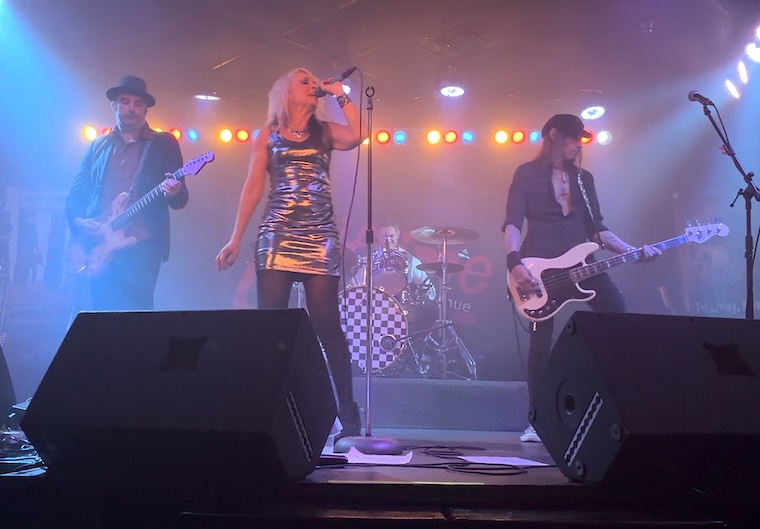
Figure 3. Dirty Blond performing at the Halftime Sport and Music Bar in Newark, Delaware, November 22, 2025. (The audience comprised the four members of the band performing after us.)
Further Research
This short article scratches the surface of a relatively under-explored arena of musical industry in the broader Music Industry. With exceptions (e.g., bell 2015; Shadrack 2020; Stith Bennett 1980; Vila Diéguez 2026), one often has to look to journalism and the trade press, rather than to the academic disciplines, to study musical dirty work of the sort spotlighted herein. As a de facto pilot study with a convenience sample of one participant, this study begs a deeper exploration of experiences and raisons d’être of musicians and other musickers (Small 1998) dedicated to their art and craft, and greater incorporation of those into broader Music Industry discourse. To borrow Finnegan’s (1989) assertion about music making in England, I contend that the Music Industry “cannot be fully understood without some appreciation of the contribution of the local musical activities at the grass roots” (331, emphasis in original). It might be instructive, therefore, to continue the present research with a case study of the whole Dirty Blond band, for instance approached duoethnographically (Denzin 2014; Kladder and Cummings 2023), followed or accompanied by a wider case study of the New York / New Jersey scenes of which Dirty Blond is a part. Dirty Blond, or my experience in the band as their drummer, are not the salient foci of this article or of future, related research; understanding more about how and why people make music and how and why they do so with such dedication, determination and hard work, can help provide music students – and professors – at all levels of the academy with greater understanding of musical industry and the Music Industry.
[1] Harry, Debbie, and Nigel Harrison. 1979. “Union City Blue.” Eat to the Beat. Chrysalis.
[2] Lee, Jack. 1978. “Hanging on the Telephone.” Parallel Lines. Chrysalis.
[3] I have borrowed the idea of being a part of apart from, from Bill Bruford’s (1998) album with his band, Earthworks, A Part, And Yet Apart (Discipline Global Mobile).
[4] Stein, Chris, and Debbie Harry. 1979. “Dreaming.” Eat to the Beat. Chrysalis.
[5] Harry, Debbie, and Chris Stein. 1981. “Rapture”. Autoamerican. Chrysalis.
[6] Harry, Debbie, and Nigel Harrison. 1978. “One Way or Another.” Parallel Lines. Chrysalis.
References
- The Long Tail: How the Future of Business is Selling Less of More. New York: Grand Central Books
- New York: Grand Central Books.
- “Introduction: Why We Need Critical Music Industry Studies.” In David Arditi and Ryan Nolan (Eds.), The Palgrave Handbook of Critical Music Industry Studies, 1–18. Basingstoke: Palgrave Macmillan
- Our Band Could Be Your Life: Scenes from the American Indie Underground 1981-1991. Boston, MA: Back Bay Books.
- “Making Autoethnography Sing/Making Music Personal”. In Music Autoethnographies: Making Autoethnography Sing/ Making Music Personal, edited by Bridie-Leigh Bartleet and Carolyn Ellis, 1–20. Brisbane: The Gap: Australian Academic Press.
- “Autotelic Personality.” In Advances in Flow Research, edited by Stefan Engeser, 165–186. New York: Springer.
- Outsiders: Studies in the Sociology of Deviance. Glencoe, IL: Free Press of Glencoe.
- "DAW Democracy? The Dearth of Diversity in ‘Playing the Studio’." Journal of Music, Technology and Education 8 (2), 129–146.
- “DIY, Alternative Cultures and Society.” DIY, Alternative Cultures and Society 1 (1): 3–6.
- “The Music Industry Does Exist.” In The Palgrave Handbook of Critical Music Industry Studies, edited by David Arditi and Ryan Nolan, 557–579. Basingstoke: Palgrave Macmillan.
- “An Ecology of Eudaimonia and Its Implications for Music Education.” In Eudaimonia: Perspectives for Music Learning, edited by Gareth D. Smith and Marissa Silverman, 71–89. New York City: Routledge.
- Kick it: A Social History of the Drum Kit. New York: Oxford University Press.
- Bill Bruford: The Autobiography. London: Jawbone Press.
- “Innovation and Value in Networks for Emerging Musicians.” In Strategies and Communications for Innovations: An Integrative Management View for Companies and Networks, second edition, edited by Nicole Pfeffermann, Tim Marshall, and Letizia Mortara, 437–445. London: Springer.
- “Valuing Networks for Emerging Musicians.” In Les TendancesTechnico-économiques de la Valeur, edited by Valerie Lejuene, 129–260. Paris: ‘l’Harmattan.
- Autoethnography as Method. Walnut Creek, CA: Left Coast Press.
- Taking Notes: A Mapping of HE Popular Music and an Investigation into the Teaching of Theory and Analysis. A report for the Higher Education Academy. https://www.heacademy.ac.uk/
- “More Necessary Than Ever: Portfolio Careers in Music as a Way of Adapting to the Current Economic Paradigm.” College Music Symposium 65 (2). https://symposium.music.org/current-issue/item/11695-more-necessary-than-ever.html
- The Music Learning Profiles Project: Let’s take this outside. New York: Routledge.
- Flow: The Psychology of Optimal Experience. New York: Harper Perennial.
- Interpretive Autoethnography., second edition. Thousand Oaks, CA: Sage.
- Art and intimacy: How the arts began. Seattle, WA: University of Washington Press.
- What Musicking Affords: Musical Performance and the Post-Cognitivist Turn. Cambridge: Cambridge University Press.
- Banana Punk Rawk Trails: A Euro-Fool's Metal Punk Journeys in Malaysia, Borneo and Indonesia. Pealing Jaya: Strategic Information and Research Development Center.
- The Hidden Musicians: Music-Making in an English Town. Middletown, CT: Wesleyan University Press.
- On the Clock: What Low-Wage Work Did to Me and How it Drives America Insane. New York: Back Bay Books.
- “Facilitating Trust and Connection Through Musical Presencing.” In The Oxford Handbook of Care in Music Education, edited by Karin Hendricks, 219–230. New York: Oxford University Press.
- Sound Advice: The Ultimate Guide to a Healthy and Successful Career in Music., the International Edition. London: Shoreditch Press.
- "Developing Fieldwork Experiences in Popular Music: Reflections and Opportunities." Journal of Popular Music Education 7, no. 1: 105–121. https://doi.org/10.1386/jpme_00106_1
- Understanding Society Through Popular Music, first edition. New York: Routledge.
- Understanding Society Through Popular Music, second edition. New York Routledge.
- Understanding Society Through Popular Music, third edition. New York: Routledge.
- West Side Story: A Musical. Libretto. London: Chappell and Co.
- “Heuristic Inquiry as a Method for Culturally Competent Caring in Music Education.” Visions of Research in Music Education
- “What Should One Expect from a Sociology of Music Education?” Action, Criticism, and Theory for Music Education22, no. 1: 112–138. https://doi.org/10.22176/act22.1.112
- The Oxford Handbook of Music Making and Leisure., edited by Roger Mantie and Gareth D. Smith. New York: Oxford University Press.
- Education, Music, and the Lives of Undergraduates: Collegiate A Capella and the Pursuit of Happiness. New York: Bloomsbury.
- Phenomenology of Perception. Translated by James M. Edie. New York: Routledge.
- “Improvisation and Higher Popular Music Education: Onto-epistemic Heterogeneity, Liberation, and Counter-hegemonic Praxis.” In Improvisation as Liberatory Praxis in Popular Music Education, edited by Gareth D. Smith and Zack Moir, 12–34. New York: Oxford University Press.
- Understanding Small Music Venues: A Report by the Music Venues Trust. London: Music Venues Trust
- Being Here: Conversations on Creating Music. New York: Radhio. Press, Eyal. 2021. Dirty Work: Essential Jobs and the Didden Toll of Inequality in America. New York: Farrar, Straus and Giroux.
- Groove: A Phenomenology of Rhythmic Nuance. New York: Bloomsbury.
- Resonance: A Sociology of our Relationship to the World. New York: Polity.
- “‘Music for the Brain and Booty’: Snarky Puppy and the Art of Becoming Human.” Paper presented at Royal College Student Association Academic Symposium. Vancouver, Canada, March 28.
- Black Metal, Trauma, Subjectivity and Sound: Screaming the Abyss. Leeds: Emerald Publishing.
- Measure for Measure. Massachusetts Institute of Technology. https://shakespeare.mit.edu/measure/full.html
- “Reclaiming ‘Happiness’: Music Education, Meaningfulness, and Collective Flourishing.” International Journal of Education and the Arts24, Special Issue 2.1.
- Musicking: The Meanings of Performing and Listening. Middletown, CT: Wesleyan University Press.
- “(Un)popular Music Making and Eudaimonia.” In The Oxford Handbook of Music Making and Leisure, edited by Roger Mantie and Gareth D. Smith, 151–170. New York: Oxford University Press.
- A Philosophy of Playing Drum Kit: Magical Nexus. Cambridge: Cambridge University Press.
- “Meaningfulness in DIY/DIWO Music Making and Learning: A Duoethnographic Exploration of a Rock Band and a High School Choir.” DIY, Alternative Cultures and Society 3, no. 1, 50–62.
- On Becoming a Rock Musician. Amherst, MAL: The University of Massachusetts Press.
- In press. “Countering Creativity in Music Teaching Through DIY Punk Reggae Music Videos.” DIY, Alternative Cultures & Society.
- “Reflecting on Carnivalesque Improvisation as Anti-Racist Public Pedagogy: The Case of the Rumba Madre. In Improvisation as Liberatory Praxis in Popular Music Education, edited by Gareth D. Smith and Zack Moir, 255–156. New York, NY: Oxford University Press.
- “‘A Rising Tide Lifts All Boats’: On a Musician’s Minimum Rate, Cultural Labour, and the Live Music Sector.” In The Palgrave handbook of critical music industry studies, edited by David Arditi and Ryan Nolan, 505–523. Basingstoke: Palgrave Macmillan.
- Practical Musicology. London: Bloomsbury.
- “Voices of Change: How Generation Z is Reshaping the Music Industry.” Music College Symposium65 (2). https://symposium.music.org/current-issue/item/11696-voices-of-change.html.
 Copyright © The College Music Society. All Rights Reserved.