
Abstract
In 1956, Ford Frick, the Commissioner of Major League Baseball, tried to woo music fans to pay more attention to baseball. Writing in Music Journal, Frick hoped that his “comparison of music and baseball should be of interest to devotees of both of these arts.”[1] Ford Frick, “Baseball Has Its Musical Angles,” Music Journal 14, no. 7 (September 1956): 11. (As I am a devotee of both, my interest was piqued.) Frick described “a young woman writer” visiting a major league ballpark for the first time: “her tastes were highbrow and her attitude toward baseball openly snobbish.”[2] Frick, “Baseball Has Its Musical Angles,” 11. As Frick described it, her enthusiasm grew as she began to attend to the details of play. “She compared the action to ballet, saying the ball players created tableaux just as full of grace as the ballet’s, even though they were more fluid and less stylized. And speaking of the theatre, she added, there was doubtless more suspense, more drama, certainly as much display of genuine emotion in a baseball stadium as she had seen in many a theatrical production… perhaps more.”[3] Frick, “Baseball Has Its Musical Angles,” 11. Frick claimed that the unnamed woman “reached the core of baseball’s appeal”: “To her astonishment, she had learned that grace and rhythm are essential to what she had regarded as a slightly rowdy sport.”[4] Frick, “Baseball Has Its Musical Angles,” 11. Frick was not alone in hoping that people would see baseball as a performance analogous to the arts: such comparisons come up again and again in descriptions of the game. George Grella called baseball “as instructive, as beautiful, and as profound as the most significant aspects of American culture” and compared the theory and practice of the sport to “our painting, music, dance, and literature.”[5] George Grella, “Baseball and the American Dream,” The Massachusetts Review 16, no. 3 (Summer 1975): 550.
If baseball lovers have sometimes longed for their sport to be taken as seriously as music, music, too, has aspired to the condition of baseball—at least in one regard. The longtime director of the Eastman School of Music, Robert Freeman, wished people would pay the same kind of focused analytical attention to music as they do to baseball. Finding the public “notably deficient” in attending to the unfolding of sound over time, Freeman scoffed at “those at any orchestral concert in Carnegie Hall whose attention is directed primarily to the antics of the conductor, to the physical activity of the double bass players, to the evening gown of the lady just across the aisle.”[6] Robert Freeman, “Music and Baseball,” Design for Arts in Education 87, no. 5 (May/June 1986): 48, 49. Freeman asked readers to imagine “the kind of musical society we would have achieved if even a hundred people in a concert hall could anticipate the musical implications of the first eight bars of the Beethoven Fifth with anything approaching the richness of understanding that thousands of people bring to baseball games.”[7] Freeman, “Music and Baseball,” 48. Though Freeman insisted that he did not “wish to impose” his own “manner of perception” on others, he made a clear distinction between superficial and deep ways of paying attention.[8] Freeman, “Music and Baseball,” 49.
In Freeman’s view, the audience’s inattentiveness was not only a failure of individuals, but in part also a failure of music educators to foster “an aural memory” in training general audiences: “music has practically never been taught in such a fashion that those learning it end by apprehending much if anything of a composer’s strategy and tactics.”[9] Freeman, “Music and Baseball,” 49, 47. Making reference to “music appreciation” teachers of the past from François Fétis to Daniel Gregory Mason, Freeman reported that efforts to win over a broader public for classical music had failed to change the public’s listening skills. Freeman’s essay is suffused with social and economic urgency. He believed that educators’ failure to train students in the necessary attention skills was the reason that the audience for classical music was too small to sustain the enterprise. He recommended trying again to educate the public by making music a more central part of the school curriculum; equipping music teachers better; and preparing “to abandon the idea that any reflection about music is hard work which somehow spoils its beauty.”[10] Freeman, “Music and Baseball,” 49. Freeman wanted to maintain high standards for appropriate listening and teach students and audience members to comprehend musical forms in detail. He also hoped to persuade them that close listening is fun, not work.
Freeman and Frick were describing how they wanted people to behave, not how they thought most people actually behave. Both baseball and classical music devotees have frequently argued—all the way across the twentieth and twenty-first centuries—that sustained attention is necessary for appreciation of these performances, and that this form of attention must be cultivated through education and effort. We might think of baseball and classical music as different spheres of activity: a sport and an art form. But in my own experience, music and baseball reward similar kinds of focused attention—and other commentators have also considered them together when describing the skills and knowledge on which these performances depend.[11] Attendance at concerts and spectatorship at sporting events were both categorized as “Recreational Services” in a 1937 study of their economic impacts. Julius Weinberger, “Economic Aspects of Recreation,” Harvard Business Review 15, no. 4 (Summer 1937): 453-454. Interviewed for an alumni magazine, philosophy professor Alva Noë explained that baseball “is boring the way physics is boring or classical music is boring. If you don’t know what’s going on, it’s indeed mind-numbingly, excruciatingly boring.” But, he continued, “Once you have been brought into it, once you have been given the eyes to see, it’s actually a game of immense tactical complexity.”[12] Coby McDonald, “Get Your Head in the Game: A Thinking Fan’s Guide to Baseball,” California, University of California Alumni Association, 20 June 2019, accessed 7 December 2024, https://alumni.berkeley.edu/california-magazine/summer-2019/get-your-head-in-the-game-a-thinking-fans-guide-to-baseball/. A book reviewer for Music Clubs Magazine, Gertrude Friedberg, recommended the purchase of a newly published music appreciation textbook on a similar basis: “A baseball game to one who knows nothing about it must be a meaningless sequence of runnings and throwings and hittings. Knowledge of the rules and the aspirations brings great enjoyment. Music, too, yields pleasure to those willing to examine its materials and forms.”[13] Gertrude Friedberg, review of Joseph Machlis, The Enjoyment of Music, Music Clubs Magazine 34, no. 5 (June 1955): 44. Machlis’s book is still in use, now in its fourteenth edition. See Kristine Forney, Andrew Dell’Antonio, and Joseph Machlis, The Enjoyment of Music (W.W. Norton and Co., 2022). These commentators believed in “explicit normative rules for an adequate approach” to these experiences, and they thought these rules could be instilled in listeners through education if everyone tried hard enough.[14] Ola Stockfelt, “Adequate Modes of Listening,” trans. Anahid Kassabian and Leo G. Svendsen, in Keeping Score: Music, Disciplinarity, Culture, ed. David Schwarz, Anahid Kassabian, and Lawrence Siegel (University Press of Virginia, 1997), 130.
Friedberg’s and Noë’s comments imply that baseball and classical music were not just entertainment, but rather elevating forms of social activity for which citizens should be trained. Both classical music and baseball gained a foothold in US public schools between the 1920s and the 1940s—so perhaps it is no surprise that commentators have described their virtues in similar terms.[15] The growth of sports and music education accompanied the dramatic expansion of US public schools. In 1910 only 9% of US youths held high school diplomas; by 1940 more than 50% did. See Claudia Goldin and Lawrence F. Katz, “Why the United States Led in Education: Lessons from Secondary School Expansion, 1910 to 1940,” Working Paper no. 6144 (National Bureau of Economic Research, August 1997), 1, https://www.nber.org/papers/w6144. On the growth of school music in the 1920s, see Osbourne McConathy, “Music Education,” chapter IX of Biennial Survey of Education in the United States, 1928-1930, United States Department of the Interior Bulletin no. 20 (U.S. Government Printing Office, 1931), 1-30. Cf. Joel H. Spring, “Mass Culture and School Sports,” History of Education Quarterly 14, no. 4 (Winter 1974): 483-499. As Friedberg’s example suggests, the argument about these activities’ educational value has long been useful for persuading school boards to institute programs supporting sports and the arts, getting parents to sign their children up for lessons, and for selling instructional materials. The claim has been made both ways: that cultivating music (or baseball) increases the capacity to pay attention, and (conversely) that the activity offers “intellectual and moral rewards” because it draws upon that capacity, making specific demands on participants.[16] Marta García Quiñones, “On the Modern Listener,” in Sound as Popular Culture: A Research Companion, ed. Jens Gerrit Papenburg and Holger Schulze (MIT Press, 2016), 184. In 1973 Alan Smith described “almost unanimous advocacy by musicians, music educators, and aestheticians that listening should be active and should concentrate on formal matters.” Alan Smith, “Feasibility of Tracking Musical Form as a Cognitive Listening Objective,” Journal of Research in Music Education 21, no. 3 (1973): 211. There is also a long and significant tradition of arguments that reject these premises: some advocates for “music appreciation” have argued that classical music is “for everybody” and that special study is not required for enjoyment.[17] See, for instance, Sigmund Spaeth, “Music for Everybody,” Music Clubs Magazine 14, no. 2 (November-December 1934): 10. And some musicologists have criticized the idea of “structural listening” (listening for comprehension of form) and sought alternatives.[18] See especially Rose Rosengard Subotnik, Developing Variations: Style and Ideology in Western Music (University of Minnesota Press, 1991), 277-283; Subotnik, Deconstructive Variations: Music and Reason in Western Society (University of Minnesota Press, 1996): 151-176; Andrew Dell’Antonio, ed., Beyond Structural Listening?: Postmodern Modes of Hearing (University of California Press, 2004).
In this article, I will examine some claims that advocates of both baseball and classical music have made on human attention; the role of attention in recent challenges to tradition; and the implications of those claims and challenges for our teaching of music. I am prompted to undertake this study for several reasons. The literature on (in the words of Lawrence Kramer) Why Classical Music Still Matters is voluminous; for more than a century, and continuing in the present day, musicians and writers have described this music’s value in the terms outlined above.[19] Lawrence Kramer, Why Classical Music Still Matters (University of California Press, 2007). Some classical music organizations are looking for ways to renew their repertoires and invite new audiences, but these organizations also face fiscal and labor crises. Some commentators predict a “doomsday scenario in which classical music appears hopelessly outdated and irrelevant.”[20] Susanna Eastburn, “Is Classical Music a Living or Heritage Art Form?” in The Classical Music Industry, ed. Chris Dromey and Julia Haferkorn (Routledge, 2018), 145.
Recent innovations in baseball have raised similar questions of value—of what makes the game worthwhile, whether it still addresses the needs of viewers and fans, and (in the words of Susan Jacoby), Why Baseball Matters.[21] Susan Jacoby, Why Baseball Matters (Yale University Press, 2018). My analysis of the “Why…Matters” literature in this essay owes a great deal to Richard Taruskin, “The Musical Mystique: Classical Music Defended Against its Devotees,” The New Republic 237, no. 8 (22 October 2007): 34-45. Over the course of the last century, from the time baseball and classical music were institutionalized as educational recreation to the present, concerned commentators about these forms have often attributed these industries’ problems to the attentional challenges posed by media technologies (first radio, then television, then the internet and social media). Over that century there have also been numerous efforts to increase participation in these enterprises through education and other social interventions. Those interventions have typically nibbled around the edges without fundamentally changing the nature of the enterprise: the value propositions of these industries have remained remarkably stable over the past century.
The Savannah Bananas pose an exceptional case. From humble beginnings as a collegiate summer baseball team, between 2021 and the present the franchise has developed a new performance practice for the sport of baseball, called “Banana Ball.” This performance practice is designed to address the problem of managing spectators’ attention. Though the Bananas typically use dance forms cultivated on the social media platform TikTok, and popular (not classical) music, their strategy has implications for the evolving romance between baseball and classical music—especially for how we expect people to pay attention to a performance.
This article begins by outlining long-standing and recent controversies about attention within Major League Baseball and considering the parallel claims that proponents of classical music and baseball have made about attention and value. I then describe the innovations of Banana Ball and analyze the implications of those innovations for the management of attention and experience in a recreational enterprise that demands significant expertise of its participants. Last, I consider the relevance of these innovations for the study, teaching, and marketing of classical music. The comparison between baseball and music offers a way to defamiliarize, observe, and assess the claims that have come to seem like a natural part of how we teach classical music. Watching the Bananas overturn the norms of “baseball appreciation” leads me to wonder: what do we believe about the role of attention in “music appreciation” today? Do those beliefs stand up to scrutiny? And how do those beliefs affect teaching and learning?
“Baseball is Boring”: Tradition and Innovation
Even dedicated fans of baseball acknowledge that the sport is slow to watch. Few players succeed in hitting the ball or reaching base. During many portions of the game, there is little visible action: the pitcher may wait to deliver a pitch; the batter may step outside the batter’s box; and coaches or other players may visit the pitcher’s mound to discuss strategy. By many accounts, baseball is declining in popularity—and since the 1950s commentators have often attributed that lack of popularity to the game’s length, which frequently extends past the three-hour mark.[22] Recent commentators claim that typical playing time was closer to two and a half hours in the 1990s, compared with over three hours today: see, for instance, Jeremy Siegel, “How the MLB is Trying to Solve Slow, Boring Baseball Games,” interview by Jen McCaffrey, WGBH website, published 6 March 2023, updated 7 August 2023, accessed 8 December 2024, https://www.wgbh.org/news/local/2023-03-06/how-the-mlb-is-trying-to-solve-slow-boring-baseball-games. But in 1955, Fred Hall remarked: “My gripe is about the length of the games. A game used to be played in under two hours. Now it often will take three hours.” Hall’s and similar remarks suggest that recollections of shorter games may be inaccurate. See Jimmy Jemail, “The Question: What Should Be Done to Stop the Falling Off of Attendance at Baseball Games? (Asked at the Governors’ Conference in Chicago),” Sports Illustrated 3, no. 11 (12 September 1955): 6.
It’s not just the pace: it’s also the content. Professional baseball features a restricted set of common gestures and visual patterns that combine to make up the game.[23] “[Viewers] have seen most of these plays before, but never with quite the same players or in quite the same patterns.” Stephen Seligman, “The Sensibility of Baseball: Structure, Imagination, and the Resolution of Paradox,” Contemporary Psychoanalysis 46, no. 4 (2010): 567. A ground ball hit to the shortstop is usually fielded in one smooth motion and thrown to first base for a quick out. A fly ball that will predictably be caught by an outfielder requires no bodily movement from anyone else on the field. A home run is an exciting event in the game, but it is visually routine: after the ball flies over the far fence, the batter jogs casually around the bases as the defending team looks on. One might see each of these patterns several times within a single game, and hundreds of times over a season. The game consists of a good deal of waiting and ritual action, punctuated by moments where something happens. Many people who love baseball don’t mind these aspects of the game because they have learned a set of strategies for paying attention to minute differences in gameplay.
The narrative storylines that fans and broadcast announcers build around the sport also assist in giving the game meaning. Within a single game, the narrative arc (coming from behind to triumph or collapsing to lose in the final inning) is one of the primary things that keeps viewers interested. We might see this kind of thinking as analogous to a listener attending to the progression of a sonata-form movement through time. Sportscasters and fans also interpret the story of that particular game within larger narrative contexts such as knowledge about the season’s progress, or even multi-year trajectories of a team’s success or failure. This kind of interpretation plays a role similar to the stories we tell in program notes about the place of a piece in a composer’s biography or how a particular work fits into a broader history of stylistic development.[24] Peter Schickele (alias P.D.Q. Bach) vividly drew this analogy in a recorded version of the first movement of Beethoven’s Symphony no. 5 with sportscaster-style commentary that guides the listener through the performance. This track, entitled “New Horizons in Music Appreciation,” appeared on the LP Report from Hoople: P.D.Q. Bach On the Air (Vanguard Records 79268, 1967). The track can be accessed on YouTube under the title “P.D.Q. Bach (Peter Schickele) - "New horizons in music appreciation" (Beethoven),” https://www.youtube.com/watch?v=f0vHpeUO5mw&list=PL07AEEE2BF9A919B2. Those who attend baseball games in person may construct narratives on their own through close observation and by reading statistical details from a scoreboard filled with data. Much as a concertgoer might look at program notes or talk with a friend, baseball fans may refer to their seatmates or the internet for further information. These forms of engagement provide a kind of social interest that may be just as important to viewers as the game itself.[25] Observers are “interested in the unfolding of the game itself and of each game as a contribution to a pennant race.” Freeman, “Music and Baseball,” 48. Commentators and fans praise these kinds of attention as a valuable part of the practice of the game.
Nevertheless, as attendance at Major League Baseball (MLB) games has declined and participation in youth baseball has decreased, concerns that baseball is “boring” have led to efforts to improve spectators’ experience.[26] Concerns about declining attendance have also circulated for more than a century. Dudley A. Sargent, “Ideals in Physical Education,” American Physical Education Review, 6, no. 2 (1901): 111-112; Weaver Pangburn, "Municipal Sports in the United States," National Municipal Review 14, no. 11 (November 1925): 651. In-person MLB attendance declined from 79.5 million in 2007 to 71 million in 2024. See “Major League Baseball’s Attendance Problem and How to Fix It,” Disrupt, https://disruptmagazine.com/major-league-baseballs-attendance-problem-and-how-to-fix-it/; and Associated Press, “Major League Baseball Attendance 1980-2024,” 1 October 2024, accessed 1 January 2025, https://apnews.com/sports/baseball-638e10b85a15366a7c6ffa5e7f21d6b3. In recent years, MLB and its affiliated minor league teams have experimented with a suite of small changes to the game’s rules. Most noteworthy was the introduction in 2023 of a pitch clock that limited the time the pitcher could take between throws, speeding up the game. The league also made the bases larger and set limits on where the defending infielders could stand. These changes made it more likely that batters might reach a base and eventually score—hoping to increase the amount of action fans would see. Further changes were undertaken in 2024.[27] Kyle Glaser, “MLB Rule Changes Include Modified Pitch Clock For 2024 Season,” Baseball America, 21 December 2023, accessed 1 January 2025, https://www.baseballamerica.com/stories/mlb-rule-changes-include-modified-pitch-clock-for-2024-season/. MLB has also introduced media innovations, including its Big Inning service, which allows the viewer to watch four games simultaneously. These changes were noticeable, but they did not fundamentally alter the way the game is played.
Attention played a central role in the controversy over these rule changes. In her book Why Baseball Matters, Susan Jacoby declares that “this dispute is really about the understanding, education, and attention span of younger fans and not about the actual length or pace of games.”[28] Jacoby, Why Baseball Matters, 97. The executive director of the players’ union, Tony Clark, spoke out against the pitch clock and other changes to baseball’s rules. “Instead of seeing pauses between pitches as a dead zone,” Jacoby writes, “Clark told reporters that baseball should use that time to educate fans about the nuances of the game.”[29] Jacoby, Why Baseball Matters, 96; Bob Nightengale, “M.L.B. Union Chief Tony Clark: Rule Changes Unlikely, Yankees’ Levine ‘Unprofessional,’” USA Today, 10 February 2017, updated 19 February 2017, https://www.usatoday.com/story/sports/mlb/2017/02/19/mlb-union-chief-tony-clark-rule-changes-unlikely-yankees-levine-unprofessional/98134196/. MLB commissioner Rob Manfred countered: “I reject the notion that we can ‘educate fans’ to embrace the game as it’s currently played.”[30] Jacoby, Why Baseball Matters, 96; Tyler Kepner, “Commissioner Chides Union for Resisting Changes,” New York Times, 21 February 2017. According to Manfred, fans want “better pace”; “more action”; and “more of the athleticism of our great players.” Ronald Blum, “MLB Adopts Pitch Clock, Shift Limits, Bigger Bases for 2023,” Associated Press, 9 September 2022, accessed 1 January 2025, https://apnews.com/article/mlb-pitch-clock-shift-limits-bigger-bases-311fdb091b61f40b654c05e600a0d4ce. Jacoby concludes that the “diminution of concentration—a phenomenon affecting Americans of all ages”—is to blame for declining interest. Citing statistics from Nielsen and the Pew Research Center, Jacoby writes that it is hard to imagine a solution for the attention problem, given “the altered nature of childhood in a culture gorging on entertainment.”[31] Jacoby, Why Baseball Matters, 150. Though Jacoby admits that the advent of radio and television sparked similar complaints in their time, she insists that the social media era is different.[32] Jacoby, Why Baseball Matters, 125-27. And, like Manfred, she does not hold out hope that fans can be educated to appreciate the game, with or without these changes.[33] Jacoby, Why Baseball Matters, 128-29.
Attention and Value: Key Claims and their Implications
The insistence of Clark and others that the game itself is fine, but the fans need more education to fully appreciate it, is remarkable. Is the game so intrinsically valuable that it need not please its ticket-buyers? Should the audience have to work harder to like their leisure activity? Similar claims about attention and value have been made for classical music, and they have been repeated with remarkable consistency.[34] As Anahid Kassabian has written, “attention of a particular kind is what the defenders of a structural classical listening intend and assume, and sometimes even state outright.” Anahid Kassabian, Ubiquitous Listening: Affect, Attention, and Distributed Subjectivity (University of California Press, 2013), xviii. These claims rely on several different premises, and it is worth spelling them out. My survey of exemplary instances of these claims cannot be comprehensive. It is merely meant to show the persistence of these ideas and their parallel applications in the fields of music and baseball, and to examine the principles that underlie how people have thought about appreciating these performances.
Claim: The art form is intrinsically valuable. The American music critic John Sullivan Dwight distinguished classical music from popular music: classical music seemed “more solid, serious, earnest, of deeper import, dealing with greater subjects, stirring deeper feelings, taxing higher powers of appreciation, than the mere music of an hour’s amusement,” which included waltzes, polkas, “trifling or weakly sentimental songs,” and more.[35] “What is Classical Music? Part 2,” Dwight's Journal of Music, 4 December 1858, 286. Quoted in Paul Charosh, “‘Popular’ and ‘Classical’ in the Mid-Nineteenth Century,” American Music 10, no. 2 (Summer 1992): 120. This claim of intrinsic value is often deployed comparatively, either to elevate one genre or to diminish another. Frick’s and Grella’s descriptions of the graceful gestures of baseball, cited above, suggest that they hoped to exalt this sport by comparison to “high” art.
Dwight’s phrase “taxing higher powers of appreciation” reveals another claim: There are different ways of paying attention, and some ways are better than others. Commentators on both baseball and music have often asserted that paying attention to nuances, rules, or underlying processes (“structural listening” or “the unfolding of the game itself”) is a valuable or elevating activity in a way that other kinds of attention are not. This kind of attention requires detailed knowledge and preparation, as well as focused engagement in real time as the performance progresses. Frick’s and Freeman’s comparisons of music and baseball hinged on this claim. More recently, the novelist Michael Chabon speculated that enjoyment may also depend on trained attention: “the more you know about [baseball], the more you learn about it, the more rewarding it is. . . . It’s like listening to a piece of classical music. If you’re only half paying attention, you probably only half enjoy it. If you’re fully paying attention, you greatly enjoy it, but if you actually know something about music and musicology, then you’ll really be able to enjoy it. I think that is the way it is with baseball.”[36] Michael Chabon, quoted in Pete Golis, “Pulitzer Prize-Winner’s Unlikely Next Step,” The Press Democrat (Santa Rosa), 22 September 2002. I found this source via Paul Dickson, The Hidden Language of Baseball: How Signs and Sign-Stealing Have Influenced the Course of Our National Pastime, 2nd ed. (University of Nebraska Press, 2019), 125. Whereas Chabon leaves open the possibility of half-attentive listening, the musicologist Julian Johnson writes that the valorized form of attention is a requirement of the art form: “in order to make musical sense,” classical music “requires concentrated attention from start to finish....I can pause Beethoven halfway through a symphony, answer the telephone, and return where I left off. In some ways this is like putting the book down and beginning again in the same place; but in other ways, it is like answering the phone in the middle of making love and trying to begin again from where you left off.”[37] Julian Johnson, Who Needs Classical Music? Cultural Choice and Musical Value (Oxford University Press, 2002), 35-36. The claim about what kind of attention is best is really about connoisseurship: it articulates a preference for how people should attend to and enjoy performances of these kinds.
Claim: This art form is better than others because it requires a higher degree of attention. In his book Why Classical Music Still Matters, Lawrence Kramer asserts that a virtue of classical music is that it cultivates this precise kind of attention:
All music trains the ear to hear it properly, but classical music trains the ear to hear with a peculiar acuity. It wants to be explored, not just heard. It “trains” the ear in the sense of pointing, seeking: it trains both the body’s ear and the mind’s to hearken, to attend closely, to listen deeply, as one wants to listen to something not to be missed, a secret disclosed, a voice that enchants or warns or soothes or understands, a faint echo of the music traditionally said to hold the world itself together in a kind of harmony. This kind of listening is done not with the ear but with the whole person. ... It is not a passive submission to the music but an active engagement with it.[38] Kramer, Why Classical Music Still Matters, 11.
An important corollary to this claim is that forms of entertainment that require less attentive labor from fans are less valuable. Ian Pace writes that classical music “does often require a degree of active agency or volition, entailing conscious effort, which exceeds that required for seemingly more immediate contemporary commercial music designed for mass consumption, often to be heard while undertaking other activities.”[39] Ian Pace, “Why Classical Music Matters,” paper presented at the Living Freedom Summer School (28-30 June 2023, London, UK), 4, PDF accessed at https://openaccess.city.ac.uk/id/eprint/31207/3/Why%20Classical%20Music%20Matters%20-%20talk%20for%20Living%20Freedom.pdf. Although Pace does not state directly that popular music is less valuable, he does imply that it is different, and that it is impoverished by comparison: “I would think it to be a much poorer world if contemporary commercial music was all there is.”[40] Pace, “Why Classical Music Matters,” 5.
A problem with this way of valuing classical music is that by virtue of social stereotyping, musical styles and other entertainment forms are closely associated with the people who like them. It is easy to traverse the narrow gap from the idea of the music’s superiority to the idea that its listeners are superior. Claim: The listener who pays attention is a better person (i.e. more capable, more devoted, better trained) than the one who does not. The conductor Pierre Boulez wondered aloud whether listeners who failed to appreciate contemporary classical music were lazy or unadventurous: “Is there really only lack of attention, indifference on the part of the listener toward contemporary music? Might not the complaints so often articulated be due to laziness, to inertia, to the pleasant sensation of remaining in known territory?”[41] Michel Foucault and Pierre Boulez, “Contemporary Music and the Public,” translated by John Rahn, Perspectives of New Music 24, no. 1 (Autumn -Winter 1985): 10. With tongue in cheek, George Grella implied that baseball’s knowledgeable and attentive fans were more cultivated people than those who preferred, say, football: “those observers who constantly complain about the static nature of [baseball] are sado-masochistic types who feed on a steady diet of violence and action and enjoy mindless repetition....More charitably, they may be suffering from a mere lack of proper instruction in the riches of the game.”[42] Grella, “Baseball and the American Dream,” 565. This is not to say that everyone who makes claims about classical music’s (or baseball’s) high value necessarily sets out to demean others. But it is to say that people often take musical styles or genres as metonymy: as a part-whole relationship where music stands in for a socially defined group.[43] Pierre Bourdieu described how taste is manifested in practical choices (such as what to wear or listen to), and how those choices become a way that people classify each other. Pierre Bourdieu, Distinction: A Social Critique of the Judgment of Taste, translated by Richard Nice (Harvard University Press, 2002 [1994]), esp. 466-470. See also Charosh, “‘Popular’ and ‘Classical’ in the Mid-Nineteenth Century,” 120-122.
As Grella’s comment about “proper instruction” implies, the preferred kind of attention may be acquired with significant educational effort. Claim: People can and should be taught to apply this necessary form of attention. The music educator Mary L. Regal described how “unremitting effort is made to teach the pupil to listen, which is not as simple a matter as may be supposed.” But, she said, such training is worthwhile because it improves one’s cognitive skills—and not just for music. Regal wrote: “There is perhaps no better training in concentration of mind than following a complex musical work in all its details from beginning to end.”[44] Mary L. Regal, "The Study of the Appreciation of Music in the High School of Springfield, Mass.,” Journal of Proceedings and Addresses of the National Education Association, 1910, 805. Julian Johnson makes a similar observation in Who Needs Classical Music?, 36-37. Because appreciation depends on trained attention, though, these cultural forms are often portrayed as vulnerable: as Freeman suggested, failure to cultivate the skill of attentive spectatorship could reduce the audience. Writing in 2007, Irving Rein and Ben Shields identified waning youth engagement as a threat to baseball’s future: “If young people are not educated about the game during childhood, baseball faces a real challenge in generating and sustaining its stars, whose athletic talents are not as obvious or exciting to the average, uninformed viewer.”[45] Irving J. Rein and Ben Shields, “Reconnecting the Baseball Star,” NINE: A Journal of Baseball History and Culture 16, no. 1 (Fall 2007): 73. Cf. Pace, “Why Classical Music Matters,” 8-9. Rein and Shields observe that fans not educated to appreciate baseball are unlikely to enjoy it: without a robust educational infrastructure, these forms of entertainment may not endure. The music educator Estelle R. Jorgensen has likewise described “musical illiteracy” as a key contributor to the looming “extinction” of classical music.[46] Estelle R. Jorgensen, “Western Classical Music And General Education,” Philosophy Of Music Education Review 11, no. 3 (Fall 2003): 130-131.
Taken together, this set of claims reflects a circular logic. Whether the art form under discussion is classical music or baseball, this art form is supposedly better than others in part because it requires a particular, trained form of attention; but the demanding nature of that form of attention also reflects on the skill or quality of the persons who are paying it. The underlying principle reflected in these claims is that classical music (or baseball) is excellent because it demands more of fans; but the fans are also thought to be achieving something by mustering the necessary attention.
These are strange claims to make about an activity people ostensibly do for fun. Even though baseball and music are leisure activities, this aspect of them has often been described in terms more like work. In asking us “to abandon the idea that any reflection about music is hard work which somehow spoils its beauty,” Freeman only reinforces the idea that attentive listening is effortful.[47] Freeman, “Music and Baseball,” 49. Jonathan Beller has described this kind of effort as attentional labor.[48] Jonathan Beller, The Cinematic Mode of Production: Attention Economy and the Society of the Spectacle (University of Chicago Press, 2006), 1-8. For Beller, cinema’s recruitment and control of human attention uses our capacity for pleasure as a way to capture “attentional biopower” for use by capital (4). Beller’s Foucauldian theory resonates with the research of Christina Baade, who has documented how music was used in wartime factories to keep workers engaged and increase their output. Christina L. Baade, Victory through Harmony: The BBC and Popular Music in World War II (Oxford University Press, 2012), especially 62-68. When people insist that there is a right way to perform that labor, they invoke the list of interlocking claims and value judgments specified above. Beller draws on the scholarship of Raul Ruiz, who notes that knowing the conventional rules of an art form helps spectators understand what’s going on as they watch and listen. But, in Ruiz’s view, this knowledge is not just understanding; it’s also a form of social control, a “totalitarian social space” that makes demands on people’s bodies and minds.[49] Raul Ruiz, Poetics of Cinema, translated by Brian Holmes (Editions Dis Voir, 2005), 58. Cited in Beller, The Cinematic Mode of Production, 2.
I won’t go that far. The perfectly focused attention called for in baseball and classical music is ideal, not necessarily real; and although we might imagine a classical concert hall as a sternly controlled space, many forms of freedom still operate there. Listeners will choose how they listen. No matter what their training, many participants in classical music and baseball sometimes use these activities as background rather than giving them undivided, focused attention. Further, the existence of quite a few books that explain why these cultural forms “still matter” also suggests that any such control is far from complete: people choose to participate or not. Many of us no longer subscribe to the fantasies that undergird the claims listed above: the idea that classical music is inherently better than other music, or that its listeners are better than other music’s listeners, smacks of elitisms and essentialisms, including white supremacy, that we should not embrace today.[50] See Loren Kajikawa, “The Possessive Investment in Classical Music,” in Seeing Race Again: Countering Colorblindness Across the Disciplines, ed. Kimberlé Williams Crenshaw, Luke Charles Harris, Daniel Martinez HoSang, and George Lipsitz (University of California Press, 2019), 155-174; and Taruskin, “The Musical Mystique,” 35, 39-40.
Fortunately for lovers of baseball and classical music, the tightly structured and attentive connoisseurship that advocates have called for is not the only mode of attention that is available. Throughout the histories of baseball and classical music, people have paid attention in a variety of ways. Accounts of people entering and leaving opera houses mid-scene, or holding whispered conversations during a performance, are commonplace before the late 19th century, though often deprecated thereafter.[51] William Weber, “Did People Listen in the 18th Century?” Early Music 25, no. 4 (November 1997): 678-691. Likewise, baseball spectators make regular trips out of the stands for refreshments or other activities. Anahid Kassabian has called practices of participating without focused attention “ubiquitous listening.” Kassabian describes how even if listeners are not actively attending to music, the music still acts on them, so that “the relationship between listening and attention is anything but clear.”[52] Kassabian, Ubiquitous Listening, xix. William Weber, too, concludes that many ways of listening were and are possible within the classical music tradition.[53] Weber, “Did People Listen,” 690. So it is all the more interesting that many commentators have insisted on careful, focused attention. Kassabian asks, “does it matter what level of attention is paid to the music”?[54] Kassabian, Ubiquitous Listening, 110.—and across more than a century, as we saw above, a variety of commentators have specified that YES, it matters, even as audience behavior suggests otherwise.
If many of us no longer accept the principles underpinning old arguments about classical music’s merits, we may wish to discontinue using these principles to promote and teach music. And at the same time, if we are still admirers of any aspect of the art form, we may not want to abandon it either. Those who care about this music should probably figure out its value proposition—what value this music offers for listeners today—on a basis that is less ethically troubling than the list of claims set out above. Classical music still holds a central place in music curricula in higher education. My personal view is that the balance of musics we teach needs to be adjusted—not only including a widely heterogeneous collection of composers within European-derived classical music traditions, but also including substantial study of many different genres of music.[55] Calls for such adjustments have been made for decades. See, for example, Dwight Allen, “It’s Easier to Move a Cemetery Than to Change a School,” Music Educators Journal 57, no. 1 (1970): 29-32; Samuel A. Floyd, Jr., et al., “The Center for Black Music Research Forum,” College Music Symposium 29 (October 1989): 151-157; Barbara Reeder Lundquist, Harold M. Best, Donald J. Funes, Richard Long, William Malm, Colin Murdoch, Georgia Ryder, and Frank Tirro, “Music in the Undergraduate Curriculum: A Reassessment,” College Music Society Report no. 7 (1989), https://www.music.org/cms-reports/music-in-the-undergraduate-curriculum-a-reassessment.html; Joseph Kinzer, “Students Speak: Diversity in the Pedagogical Practices of Music in Higher Education,” College Music Symposium 54 (July 2014); Alejandro L. Madrid, “Diversity, Tokenism, Non-Canonical Musics, and the Crisis of the Humanities in U.S. Academia,” Journal of Music History Pedagogy 7, no. 2 (2017); Michael A. Figueroa, “Decolonizing ‘Intro to World Music?’” Journal of Music History Pedagogy 10, no. 1 (2020): 39–57; and many more. However, I do not want to eliminate classical music of the European tradition from the curriculum. As Samuel N. Dorf has pointed out, giving up on classical music would likely mean ceding ground: relinquishing that music to those who are already using it for nefarious political ends.[56] Samuel N. Dorf, “A Fascist’s Guide to Music,” presentation at the annual meeting of the American Musicological Society, Chicago, 2024. I think it is worth considering anew what we are teaching students about music, and how we are teaching them to pay attention, and why.
Enter the Bananas: Hijacking the Attention Systems of Baseball and Listening
Kassabian has pointed out that that human bodies and brains engage with music in many ways, and that even listening with partial attention evokes a variety of affects. According to Kassabian, it is not only the listener’s application of attentive perception to music that is important: strategies for attending also interact with the overall situation and the style and norms of the stimuli to shape meaningful experiences.[57] “Modes of listening, listening situation, and musical style coproduce each other.” Kassabian, Ubiquitous Listening, 3. We can expect that changing performance practice or other elements of the listening situation can elicit varied ways of paying attention.
Over the past few years, the Savannah Bananas have made rapid changes to the performance practice of baseball. These changes are worth our notice because they challenge the century-old claims about paying attention that I listed above. The Bananas’ version of the sport highlights the fact that there is more than one acceptable way to pay attention: they have purposefully broken the connoisseurship demands that are routinely stated by baseball’s advocates (and those of classical music). Banana Ball relies on a modified version of the rules of baseball. The team’s owner, Jesse Cole, has explained that Banana Ball was meant to address key problems of baseball: that many people find the game “long, slow,” and “boring.”[58] Jesse Cole, interview with Jared Orton in The Savannah Bananas, “What's Wrong with Baseball | Savannah Bananas: Unpeeled,” YouTube, 22 January 2019, timepoint 3:37, https://youtu.be/xWYw4GQBGQ8?t=217. Through rules changes in the game, the addition of a vastly expanded gestural vocabulary, a constant stream of auditory and visual cues, and novel strategies for audience engagement, Banana Ball materially alters the kinds of engagement expected of baseball fans, and thus elicits a different kind of attention from spectators.
The rules of Banana Ball are built on those of baseball, but this version of the game is designed to require less attentional effort. Banana Ball’s rules and distinctive performance practice shorten the game and increase the amount and diversity of activity fans see on the field.[59] The game is played with a two-hour time limit. In Banana Ball, each inning is scored as its own game—whichever team scores the most runs in one inning collects one point—thereby keeping game scores close throughout. If a game is tied, there are no interminable extra innings, but a fast-paced “showdown.” Four balls pitched outside the strike zone don’t elicit a “walk,” but a “sprint”—in which every player on the defending team must touch the ball while the batter rounds the bases as quickly as possible. A foul ball caught by a fan counts as an out: attentive fans may be rewarded with the power to affect the course of the game. Once per game, a fan can challenge an umpire’s call; the slow-motion video is visible on YouTube during the review. For further detail, see The Savannah Bananas, “Banana Ball Rules | The Savannah Bananas,” YouTube, 21 February 2024, https://www.youtube.com/watch?v=GfGXWBOd-Dg&t=10s. (Compare Figures 1 and 2.) Pitchers are praised for ending an inning in the shortest possible time, so they deliver pitches in rapid succession—much faster than pitchers work under MLB’s pitch clock. Defending players receive praise for trick plays, in which they catch a ball behind their backs, do a back flip while catching, or perform other risky maneuvers. In addition to adding visual interest and variety, the trick plays make the game less predictable, increasing the likelihood of errors and resulting in more action and more runs scored. This version is more chaotic, but also more varied and more exciting.
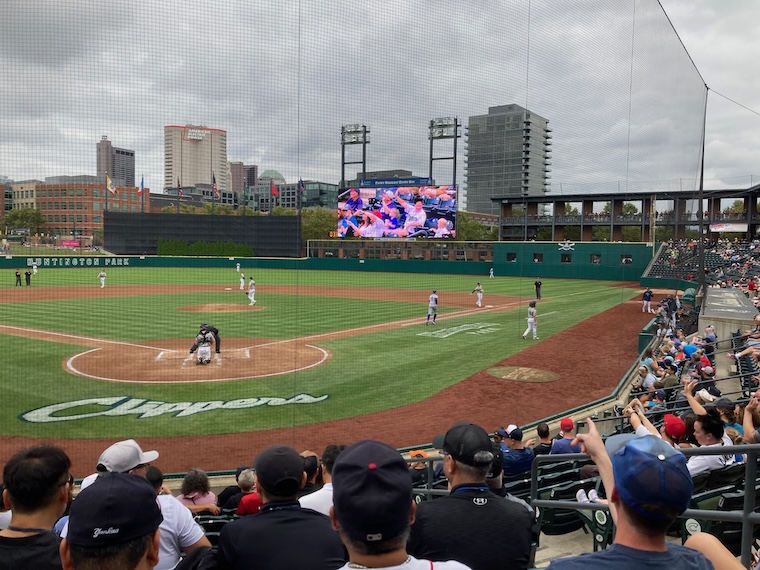
Figure 1. For most of an MLB game, the area of the field in front of the dugouts is orderly and largely empty: players who are not in the game remain in the dugouts. This photo shows the area near the home team’s dugout at a Columbus Clippers minor league baseball game. Photo by the author, 20 August 2025, Huntington Park, Columbus, Ohio.
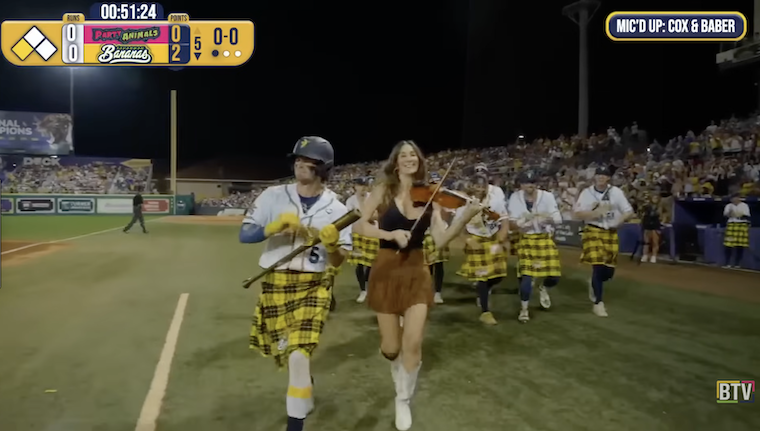
Figure 2. During a Banana Ball game, the area of the field in front of the dugouts is often full of activity. This screenshot shows a specialty walkup in which the next batter (front, left) approaches home plate, accompanied by a fiddler and a crowd of dancing teammates. Screenshot from “Kilts are Back! Savannah Bananas vs Party Animals LSU Finale,” streamed on YouTube by The Savannah Bananas, 16 March 2024, https://www.youtube.com/watch?v=dd1T29VIUbo
The soundscape of Banana Ball is radically different from that of baseball. In minor- or major-league baseball, players may have ten seconds of “walk-up music” that accompanies them as they walk from the on-deck circle to home plate, but that music typically goes silent as the player enters the batter’s box: the batter faces the pitcher in hushed concentration.[60] Bob Nightengale, “‘This is going to be fun’: MLB’s New Rules (Mostly) Ace First Spring Training Test,” USA Today, 24 February 2023, updated 25 February 2023, accessed 10 February 2026, https://www.usatoday.com/story/sports/mlb/columnist/bob-nightengale/2023/02/24/major-league-baseball-new-rules-success-mariners-padres/11341911002/ As in MLB, each Banana Ball player is associated with consistent walk-up music that helps define that player as a “character.” But in Banana Ball there is also a steady stream of other musical excerpts, changing every 15–30 seconds or so—indeed, a near-constant barrage of music plays throughout the game. These are not whole songs: they are the most recognizable passages of hit songs from past and present. Samples have included Jimmy Buffett’s “Margaritaville,” Shaboozey’s “Tipsy,” Manfred Mann’s “Doo Wah Diddy,” “We Just Got a Letter” from Blue’s Clues, Wild Cherry’s “Play that Funky Music, White Boy,” Brenda Lee’s performance of “Rockin’ Around the Christmas Tree,” and Chappell Roan’s “Pink Pony Club,” among many others. The playlist sometimes aligns with the activity on the field: when a Bananas player steals a base, fans hear “Baby Shark” and the players and fans do the accompanying arm movements. When the Bananas’ most frequent opponents, the Party Animals, steal a base, fans hear “Who Let the Dogs Out.”
Kassabian writes that heterogeneity itself is a way to capture and maintain attention, as is quotation. She explains that allusions and quotations are “not addressed to the inattentive consumer”: identifying and interpreting quoted matter requires attention, and recognizing references offers an intellectual payoff that encourages listeners to wait to catch the next one.[61] Kassabian, Ubiquitous Listening, 56-57. Kassabian’s observations are apt for Banana Ball: “Not only is there something for everyone, but the changes hold on to listeners, as they both watch and listen to the spectacle” (58). Even so, the attention invited by these practices does not require recall of a narrative or awareness of statistics. Rather, this experience generates meaning from moment to moment—every few seconds, audience attention is re-engaged by a new audio clip, new action on the field, or both.
In addition to the constantly changing auditory stimuli, the Bananas have integrated dance into the game. One or more times in each game, immediately before a pitch is delivered, the pitcher, second baseman, shortstop, center fielder, and catcher offer a choreographed dance—usually not more than 20–30 seconds in length—with the pitch delivered at an unpredictable point during that dance sequence (not “synced” to the music). Seen from a camera behind home plate, these dances generate video content that is ideally framed for TikTok, YouTube, or Instagram, and videos of these dances are widely shared on social media (Video 1). Dances that trend on TikTok are source material for the players’ dances, as well—so that fans often see dances that are familiar to them, or that they have done themselves, performed by the players. Early on, part of the charm of the in-game dances was the incongruity and surprise of baseball players breaking into a dance mid-game, in contrast to the staid, controlled movements characteristic of MLB. The planned dance events occur in a noisy stadium environment, but the music can be overdubbed later to make a clean-sounding video that still looks “live.”
Video 1. Mid-game, players dance to the theme song from the TV show “Law and Order.” Video short, “Come for the dance, stay for the BACKFLIP,” posted on YouTube by The Savannah Bananas, 8 August 2025, https://www.youtube.com/shorts/vn2GZODMukI
At first, the addition of dance moves and trick plays was occasional: in 2022 and early 2023, the game looked like baseball decorated with some extras. Dance was included mostly within choreographed numbers during or between innings, or as celebrations after a run was scored. But as the game has evolved over the past few years, and the players dance with increasing polish and practiced expertise, some Bananas and Party Animals players have begun to throw in dance moves at any opportunity. Individual players are free to respond to the constant stream of pop music clips, and often they react to events in the game with impromptu celebratory dance moves that last a second or two. Overt celebration of success is frowned upon in MLB, but in Banana Ball it is customary.[62] See, e.g., the comments from former Red Sox player Jonny Gomes in The Savannah Bananas, “Major League Stars Challenge Savannah Bananas | S2E6 Bananaland Documentary,” YouTube, 8 November 2023, timepoint 3:53, https://youtu.be/bDnP1nO9T5k?t=234. Not only does danced celebration add gestural variety, but it also makes key moments in the game visually perceptible and heightens their significance. When a pitcher dances after striking out a batter, even spectators who aren’t giving the game their full attention can see that something good has happened from that player’s perspective. This change in performance practice both re-engages attention and makes the gameplay more legible without full attention.
Banana Ball is also participatory in ways that baseball is not. Fans are invited to dance together with Banana Ball players during a break in the middle of the fourth inning. DJ Ötzi’s remix of Bruce Cannon’s “Hey Baby,” popularized as the theme song of the 2002 FIFA World Cup, is heard over the loudspeakers; the players line up and lead the dance from the field (Figure 3). The mixing of players’ and fans’ activity purposefully breaks the “fourth wall.” Team owner Jesse Cole writes, “Players have always seemed off-limits in professional baseball. Fans are used to looking at them like a movie.”[63] Jesse Cole with Don Yaeger, Banana Ball: The Unbelievably True Story of the Savannah Bananas (Dutton, 2023), 125. In a post on the social media platform “X” (formerly known as Twitter), a person with the handle “J*ckie” (@jackie_sabbagh) asked: “Is the music they play at baseball games diegetic? like can the players hear it in the world of the game”.[64] I saw this post when it was shared on a different social media platform, Bluesky, by Alexandra Merideth Erin (@alexandraerin.com), 10:25 am, 14 August 2024. The term “diegetic” is most frequently used in film studies, where it points to music heard within the characters’ world and audible to them, as opposed to the underscoring music that reveals affect or information only to the audience. Robynn J. Stilwell has noted that border-crossing between diegetic and non-diegetic frames gets attention and invites active interpretation: Stilwell, "The Fantastical Gap between Diegetic and Nondiegetic," in Beyond the Soundtrack: Representing Music in Cinema, ed. Daniel Goldmark, Lawrence Kramer, and Richard Leppert (University of California Press, 2007), 184. MLB players don’t show that they can hear the sounds of the fans or even their own walk-up music. If anything, MLB seems most like a theater, where audience sounds during the performance (sneeze, rustle, talking, cheering) may be heard by the actors, but are never acknowledged: a social boundary is enforced. By contrast, Banana Ball players indicate that they can hear the same music the audience hears, and their responsiveness makes them seem much closer to the audience. This joint participation that breaks the invisible wall recalls what Kassabian has written about listening to music: while listeners’ attention may be moving “from attentive to distracted and everything around and in between,” the act of listening holds open a “social channel” through which music may recapture attention.[65] Kassabian, Ubiquitous Listening, 72.
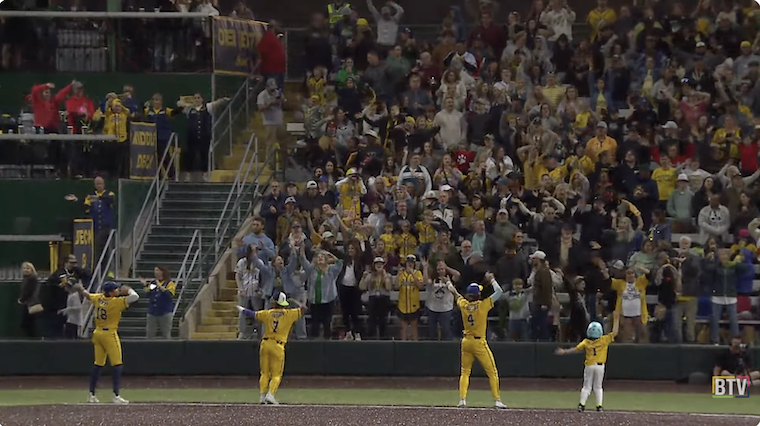
Figure 3. Savannah Bananas players lead fans in the “Hey Baby” dance. Screenshot from “FIRST 30 TRICK PLAY GAME IN BANANA BALL HISTORY - Savannah Bananas vs Party Animals,” streamed on YouTube by The Savannah Bananas, 21 March 2025, https://www.youtube.com/watch?v=1NcRbToMZG4
The social appeal of Banana Ball’s soundtrack is partly a matter of repertoire. The musical clips are varied enough — rock, country, hip hop, R&B, songs from children’s TV shows, ad jingles, memes, pop hits from to the 1940s to today—that everyone recognizes and relates to a good bit of the music. The familiarity of the references is relevant: one hears music one has some relationship with, or with which one has strong associations; one might be inclined to move oneself. Not everything will speak to everyone, but enough of it will speak to any given listener to keep them engaged. Indeed, at the Banana Ball game I attended in Cincinnati, an evidently intoxicated woman could not stop talking to her neighbor about each new audio clip: “do you know this one?” “I love this one.” The flow of beloved bits of songs was itself a powerful stimulus.
The Bananas have also adopted a transmedia strategy in which material is recirculated between live performance and social media, with constant references to fans’ prior musical knowledge as well as their familiarity with Banana Ball media. During several live events, pitcher Kyle Luigs and catcher Bill LeRoy re-enacted the pivotal dance scene from the film Dirty Dancing.[66] The Savannah Bananas, “’Dirty Dancing’ In Game Dance | The Savannah Bananas,” YouTube, 2 March 2024, https://www.youtube.com/watch?v=395u3VzEFl4&t=1s. These performances, in which the smaller catcher lifts the larger pitcher over his head as Patrick Swayze did with Jennifer Grey, became viral videos. During the 2024 season, the lift was frequently repeated in celebratory moments within and especially after games—reinforcing for fans something they had previously seen online—and it is now the capstone gesture of the Bananas’ standard victory dance. Another early viral video, in which the pitcher and infielders performed ABBA’s “Dancing Queen” on the mound (Video 2), has also been recirculated in performance. It has been re-enacted as a walk-up during a game; but the team also did the same dance together with fans en masse on a cruise ship. This performance, too, was filmed and recirculated (Video 3). The game of Banana Ball is ideally built to accommodate the recirculation of familiar material of this kind. That one can dance along with the players or recognize the sources of borrowed material again serves as a gratifying reward for paying attention, both during the games and while surfing the web.
Video 2. Video short, “Baseball team boogies to ‘Dancing Queen’ before pitch | Savannah Bananas,” posted on YouTube by The Savannah Bananas, 26 March 2023, https://www.youtube.com/shorts/VU6TdP7YLzg
Video 3. Video, “Recreating Mamma Mia! "Dancing Queen" on a Cruise Ship,” posted on YouTube by The Savannah Bananas, 4 November 2024, starting at timepoint 1:26, https://www.youtube.com/watch?v=M3Sie7z_lXg&t=86s
This version of the sport undermines the idea that one kind of attention is better than another, or that prior expertise is required for true enjoyment. The new form of performance that results from these innovations invites participation from those who don’t know or don’t care about the rules or narratives of baseball. That includes the youngest children, who may be captivated by a princess in a fairytale gown or a player on stilts. And it includes anyone else who might be entertained by participatory dancing and the prospect of seeing a player do a back flip while catching a ball. As one fan said on camera, “If you don’t even like baseball you can have a blast here.”[67] The Savannah Bananas, “Savannah Bananas Story,” YouTube, 25 February 2019, timepoint 0:05 https://www.youtube.com/watch?v=ulCsMyh7sO4.
The availability of inattentive spectatorship does not foreclose other kinds of appreciation. One can still watch the game with attention to its technical details, as the valorized baseball fans do. Banana Ball commentators narrate the game just as MLB announcers do, rattling off statistics and shaping storylines across the game and the season. Indeed, Banana Ball generates even more kinds of data for each player than MLB does. But in the circus-like atmosphere of the game, there is always something to look at, something to hear, usually multiple things at the same time.[68] For an example, see an Instagram post by RobertAnthony Cruz (coach.rac), 16 August 2024, https://www.instagram.com/reel/C-vIjHcAVSh. One can engage with the audio clips, gestures, and other stimuli as they come along, surfing atop the musical surface without following the technical details of the game. These experiences do not only engage individuals; they also create a shared experience. Kassabian explains that people can have and share “distributed subjectivity,” including meaningful affective experiences, in ways that “are not fully attentive at all.”[69] Kassabian, Ubiquitous Listening, xviii.
Banana Ball makes the claims of “specialty art forms” listed above optional, not required. The “deep structure” of the game—the detailed rules, the narrative storylines, the inning-by-inning progression of strategic decisions—is still available. But the use of that “deep structure” is just not mandatory or even preferred. As Banana Ball’s “Fans First” motto suggests, no one is denounced for paying attention in the wrong way.
Attending to the Comic Surface
Is such an inclusive perspective available for classical music listening? I think it is—even without alterations in classical music’s performance practice. The experience of Banana Ball, in which a dizzying array of contrasting referential and entertaining stimuli adorn the traditional structure of a baseball game, recalls a way of listening I first encountered as a graduate student. Wye J. Allanbrook—then visiting UC Berkeley to give a series of lectures—invited her listeners to hear how music of the Classic era teems with “motivic and stylistic multiplicity.”[70] Wye J. Allanbrook, “Theorizing the Comic Surface,” in Music in the Mirror: Reflections on the History of Music Theory and Literature for the 21st Century, ed. Andreas Giger and Thomas Mathiesen (University of Nebraska Press, 2002), 195. Allanbrook’s Bloch lectures are published in The Secular Commedia: Comic Mimesis in Late Eighteenth-Century Music, ed. Mary Ann Smart and Richard Taruskin (University of California Press, 2014). Allanbrook described the first movement of Mozart's Piano Sonata in F Major K. 332 as a sequence of small patches of styles and gestures (topics), each of which made reference to a different style or context, opening “the possibility of an entire universe of discourse, embracing all ranks and kinds of expressive gestures in their worldly variety.”[71] Allanbrook, “Theorizing the Comic Surface,” 195. Within the exposition of this brief sonata form movement, she described constantly shifting ideas: “In the opening measures of this movement, a wistful aria gives way to learned counterpoint (m. 5), followed by a minuet cadence (m. 9), itself rounded off by a nostalgic evocation of hunting horns (m. 12). A passage of Sturm und Drang, the self-consciously tragic style (m. 22), subverts the tonic and effects the drive to the dominant, which is confirmed by a symmetrical minuet period.”[72] Allanbrook, “Theorizing the Comic Surface,” 195. Within a short span of music, we hear fragments of many styles—“vividly distinct”—what Allanbrook called “a democracy of thematic material.”[73] Allanbrook, “Theorizing the Comic Surface,” 203. The appearance of heterogeneous and contrasting topics provides references to other music, known or unknown, that may be meaningful to those who know the references. But the contrasts themselves are engaging: they constantly recapture the listener’s attention through mercurial changes of character (Video 4).
Video 4. Luwen Chen plays Wolfgang Amadeus Mozart, Piano Sonata in F major, K. 332, movement I. The sequence of contrasting patches of style that Allanbrook describes starts at the beginning and runs to timepoint 1:08. Luwen Chen, YouTube, 7 December 2012, https://www.youtube.com/watch?v=y6iCUb-altc.
It seems to me that the Bananas have created a baseball analogue of a Mozart sonata: it is possible to enjoy the experience in a variety of ways, whether enjoying the play of contrasts on the surface or tracking the progression of the form in minute detail. Allanbrook encouraged us to listen to the “comic surface” as a primary feature of the music—to attend to the playful sequence of references as it goes by. She was not telling us to ignore the form—not at all—but she was telling us that “expression should be attended to as constantly and consciously as one attends to the tonal plan, formal nodes, or structural dissonances of any given work; attention to the surface is a crucial analytical principle.”[74] Allanbrook, “Theorizing the Comic Surface,” 214. Much of Allanbrook’s research concerned the relationship between surface features and form. See, for example, Wye J. Allanbrook, “Two Threads through the Labyrinth: Topic and Process in the First Movements of K.332 and K.333,” in Convention in Eighteenth- and Nineteenth-Century Music: Essays in Honor of Leonard G. Ratner, ed. Wye J. Allanbrook, Janet M. Levy, and William P. Mahrt (Pendragon Press, 1992), 125-171. See also Elisabeth Le Guin, “One Bar in Eight: Debussy and the Death of Description,” in Beyond Structural Listening? Postmodern Modes of Hearing, ed. Andrew Dell’Antonio (University of California Press, 2004), 233-251. When Allanbrook taught this way of listening, offering detailed analyses of several pieces, this repertoire and related repertoires came alive in ways that are still vitally important for me as a listener.
The strategy of listening for patches of meaning (topics) does not render classical music immediately accessible to every listener. After all, the minuet and the hunting horn are no longer regular points of reference in most people’s daily lives. But this way of listening is already familiar to many listeners from cinema—where the music often prompts us to understand a meaningful moment in the story by calling to mind styles of musical expression we know from other parts of our listening experience.[75] Lawrence Kramer acknowledges the importance of referential listening of this kind in Why Classical Music Still Matters, 13-16; and as Taruskin noted, Kramer’s analyses of cinematic uses of classical music demonstrate classical music’s continuing relevance without unnecessary claims of superiority. Taruskin, “The Musical Mystique,” 43-44. I have found that undergraduates can quickly learn to identify the comic incoherence of a Classic-era sonata movement—say, the first movement of Haydn’s marvelous E-flat sonata, no. 59, Hob. XVI:52, another of Allanbrook’s favorite examples (Video 5). And helping them attend to this music’s heterogeneously comic surface offers them a way to listen that is gratifying early on, and grows more gratifying as they develop the skill of recognizing and interpreting more and more of the styles that come up in their musically heterogeneous personal experiences. It is also a kind of listening that makes detailed study of music rewarding, but does not require perfect attention or the identification of every last topic.
Video 5. Heterogeneous musical topics presented in close succession. Alfred Brendel plays Joseph Haydn, Piano Sonata in E flat major, Hob. XVI:52, movement I. Video provided to YouTube by Universal Music Group. https://www.youtube.com/watch?v=Zpmwx8MVz_w
As with the Bananas’ performance of baseball, if we shift our attention to the comic surface, we do not rule out the option of listening for form, considering developmental processes over time, or any other kind of listening. “Concentrated attention from start to finish” (Julian Johnson’s words, cited above) is welcome and available, but not required. Validating referential listening (or any other kind of listening that people might bring to the table) has the virtue of recognizing that, as Kassabian says, meaning is not only contained within the work, but is also made by the listener, in connection with the listening situation and that listener’s experiences. Without the presupposition that some art forms make or mark “better” people by requiring special forms of attention, we may be able to practice listening to many kinds of meaningful music, on a more level playing field, leaving behind claims that classical music is superior to other kinds of music.
Instruction in musical form and structural listening are still part of almost all undergraduate music curricula. But how many of us are teaching our students—majors and non-majors alike—to listen referentially, and (dare I say) superficially? For students who may already have learned to keep quiet about their listening habits for fear of censure, opening a conversation about how they listen may bring about more growth than telling them how they should do it, or implying that they’ve been doing it wrong. As Rose Rosengard Subotnik noted, college teachers have a tremendous influence in establishing norms about what kinds of musical interpretation are valid.[76] Subotnik, Developing Variations, 282.
I will leave aside for now the question of whether classical music could be improved by audience engagement strategies analogous to the changes the Savannah Bananas have created in the performance practice of baseball. They are fun to imagine, and a potential backlash is also easy to envision. As classical music is already amenable to topical listening, such imaginings might be beside the point. I do think that separating classical music’s value proposition from biased and harmful claims about attention or audience will be important to its flourishing in the future. And considering carefully how we can remove those biased claims from our teaching practice seems a fine place to start. As Allanbrook wrote, we need not fear attending to the surface: “After all, surfaces are what catch the light.”[77] Allanbrook, “Theorizing the Comic Surface,” 195.
[1] Ford Frick, “Baseball Has Its Musical Angles,” Music Journal 14, no. 7 (September 1956): 11.
[2] Frick, “Baseball Has Its Musical Angles,” 11.
[3] Frick, “Baseball Has Its Musical Angles,” 11.
[4] Frick, “Baseball Has Its Musical Angles,” 11.
[5] George Grella, “Baseball and the American Dream,” The Massachusetts Review 16, no. 3 (Summer 1975): 550.
[6] Robert Freeman, “Music and Baseball,” Design for Arts in Education 87, no. 5 (May/June 1986): 48, 49.
[7] Freeman, “Music and Baseball,” 48.
[8] Freeman, “Music and Baseball,” 49.
[9] Freeman, “Music and Baseball,” 49, 47.
[10] Freeman, “Music and Baseball,” 49.
[11] Attendance at concerts and spectatorship at sporting events were both categorized as “Recreational Services” in a 1937 study of their economic impacts. Julius Weinberger, “Economic Aspects of Recreation,” Harvard Business Review 15, no. 4 (Summer 1937): 453-454.
[12] Coby McDonald, “Get Your Head in the Game: A Thinking Fan’s Guide to Baseball,” California, University of California Alumni Association, 20 June 2019, accessed 7 December 2024, https://alumni.berkeley.edu/california-magazine/summer-2019/get-your-head-in-the-game-a-thinking-fans-guide-to-baseball/.
[13] Gertrude Friedberg, review of Joseph Machlis, The Enjoyment of Music, Music Clubs Magazine 34, no. 5 (June 1955): 44. Machlis’s book is still in use, now in its fourteenth edition. See Kristine Forney, Andrew Dell’Antonio, and Joseph Machlis, The Enjoyment of Music (W.W. Norton and Co., 2022).
[14] Ola Stockfelt, “Adequate Modes of Listening,” trans. Anahid Kassabian and Leo G. Svendsen, in Keeping Score: Music, Disciplinarity, Culture, ed. David Schwarz, Anahid Kassabian, and Lawrence Siegel (University Press of Virginia, 1997), 130.
[15] The growth of sports and music education accompanied the dramatic expansion of US public schools. In 1910 only 9% of US youths held high school diplomas; by 1940 more than 50% did. See Claudia Goldin and Lawrence F. Katz, “Why the United States Led in Education: Lessons from Secondary School Expansion, 1910 to 1940,” Working Paper no. 6144 (National Bureau of Economic Research, August 1997), 1, https://www.nber.org/papers/w6144. On the growth of school music in the 1920s, see Osbourne McConathy, “Music Education,” chapter IX of Biennial Survey of Education in the United States, 1928-1930, United States Department of the Interior Bulletin no. 20 (U.S. Government Printing Office, 1931), 1-30. Cf. Joel H. Spring, “Mass Culture and School Sports,” History of Education Quarterly 14, no. 4 (Winter 1974): 483-499.
[16] Marta García Quiñones, “On the Modern Listener,” in Sound as Popular Culture: A Research Companion, ed. Jens Gerrit Papenburg and Holger Schulze (MIT Press, 2016), 184. In 1973 Alan Smith described “almost unanimous advocacy by musicians, music educators, and aestheticians that listening should be active and should concentrate on formal matters.” Alan Smith, “Feasibility of Tracking Musical Form as a Cognitive Listening Objective,” Journal of Research in Music Education 21, no. 3 (1973): 211.
[17] See, for instance, Sigmund Spaeth, “Music for Everybody,” Music Clubs Magazine 14, no. 2 (November-December 1934): 10.
[18] See especially Rose Rosengard Subotnik, Developing Variations: Style and Ideology in Western Music (University of Minnesota Press, 1991), 277-283; Subotnik, Deconstructive Variations: Music and Reason in Western Society (University of Minnesota Press, 1996): 151-176; Andrew Dell’Antonio, ed., Beyond Structural Listening?: Postmodern Modes of Hearing (University of California Press, 2004).
[19] Lawrence Kramer, Why Classical Music Still Matters (University of California Press, 2007).
[20] Susanna Eastburn, “Is Classical Music a Living or Heritage Art Form?” in The Classical Music Industry, ed. Chris Dromey and Julia Haferkorn (Routledge, 2018), 145.
[21] Susan Jacoby, Why Baseball Matters (Yale University Press, 2018). My analysis of the “Why…Matters” literature in this essay owes a great deal to Richard Taruskin, “The Musical Mystique: Classical Music Defended Against its Devotees,” The New Republic 237, no. 8 (22 October 2007): 34-45.
[22] Recent commentators claim that typical playing time was closer to two and a half hours in the 1990s, compared with over three hours today: see, for instance, Jeremy Siegel, “How the MLB is Trying to Solve Slow, Boring Baseball Games,” interview by Jen McCaffrey, WGBH website, published 6 March 2023, updated 7 August 2023, accessed 8 December 2024, https://www.wgbh.org/news/local/2023-03-06/how-the-mlb-is-trying-to-solve-slow-boring-baseball-games. But in 1955, Fred Hall remarked: “My gripe is about the length of the games. A game used to be played in under two hours. Now it often will take three hours.” Hall’s and similar remarks suggest that recollections of shorter games may be inaccurate. See Jimmy Jemail, “The Question: What Should Be Done to Stop the Falling Off of Attendance at Baseball Games? (Asked at the Governors’ Conference in Chicago),” Sports Illustrated 3, no. 11 (12 September 1955): 6.
[23] “[Viewers] have seen most of these plays before, but never with quite the same players or in quite the same patterns.” Stephen Seligman, “The Sensibility of Baseball: Structure, Imagination, and the Resolution of Paradox,” Contemporary Psychoanalysis 46, no. 4 (2010): 567.
[24] Peter Schickele (alias P.D.Q. Bach) vividly drew this analogy in a recorded version of the first movement of Beethoven’s Symphony no. 5 with sportscaster-style commentary that guides the listener through the performance. This track, entitled “New Horizons in Music Appreciation,” appeared on the LP Report from Hoople: P.D.Q. Bach On the Air (Vanguard Records 79268, 1967). The track can be accessed on YouTube under the title “P.D.Q. Bach (Peter Schickele) - "New horizons in music appreciation" (Beethoven),” https://www.youtube.com/watch?v=f0vHpeUO5mw.
[25] Observers are “interested in the unfolding of the game itself and of each game as a contribution to a pennant race.” Freeman, “Music and Baseball,” 48.
[26] Concerns about declining attendance have also circulated for more than a century. Dudley A. Sargent, “Ideals in Physical Education,” American Physical Education Review, 6, no. 2 (1901): 111-112; Weaver Pangburn, "Municipal Sports in the United States," National Municipal Review 14, no. 11 (November 1925): 651. In-person MLB attendance declined from 79.5 million in 2007 to 71 million in 2024. See “Major League Baseball’s Attendance Problem and How to Fix It,” Disrupt, https://disruptmagazine.com/major-league-baseballs-attendance-problem-and-how-to-fix-it/; and Associated Press, “Major League Baseball Attendance 1980-2024,” 1 October 2024, accessed 1 January 2025, https://apnews.com/sports/baseball-638e10b85a15366a7c6ffa5e7f21d6b3.
[27] Kyle Glaser, “MLB Rule Changes Include Modified Pitch Clock For 2024 Season,” Baseball America, 21 December 2023, accessed 1 January 2025, https://www.baseballamerica.com/stories/mlb-rule-changes-include-modified-pitch-clock-for-2024-season/. MLB has also introduced media innovations, including its Big Inning service, which allows the viewer to watch four games simultaneously.
[28] Jacoby, Why Baseball Matters, 97.
[29] Jacoby, Why Baseball Matters, 96; Bob Nightengale, “M.L.B. Union Chief Tony Clark: Rule Changes Unlikely, Yankees’ Levine ‘Unprofessional,’” USA Today, 10 February 2017, updated 19 February 2017, https://www.usatoday.com/story/sports/mlb/2017/02/19/mlb-union-chief-tony-clark-rule-changes-unlikely-yankees-levine-unprofessional/98134196/.
[30] Jacoby, Why Baseball Matters, 96; Tyler Kepner, “Commissioner Chides Union for Resisting Changes,” New York Times, 21 February 2017. According to Manfred, fans want “better pace”; “more action”; and “more of the athleticism of our great players.” Ronald Blum, “MLB Adopts Pitch Clock, Shift Limits, Bigger Bases for 2023,” Associated Press, 9 September 2022, accessed 1 January 2025, https://apnews.com/article/mlb-pitch-clock-shift-limits-bigger-bases-311fdb091b61f40b654c05e600a0d4ce.
[31] Jacoby, Why Baseball Matters, 150.
[32] Jacoby, Why Baseball Matters, 125-27.
[33] Jacoby, Why Baseball Matters, 128-29.
[34] As Anahid Kassabian has written, “attention of a particular kind is what the defenders of a structural classical listening intend and assume, and sometimes even state outright.” Anahid Kassabian, Ubiquitous Listening: Affect, Attention, and Distributed Subjectivity (University of California Press, 2013), xviii.
[35] “What is Classical Music? Part 2,” Dwight's Journal of Music, 4 December 1858, 286. Quoted in Paul Charosh, “‘Popular’ and ‘Classical’ in the Mid-Nineteenth Century,” American Music 10, no. 2 (Summer 1992): 120.
[36] Michael Chabon, quoted in Pete Golis, “Pulitzer Prize-Winner’s Unlikely Next Step,” The Press Democrat (Santa Rosa), 22 September 2002. I found this source via Paul Dickson, The Hidden Language of Baseball: How Signs and Sign-Stealing Have Influenced the Course of Our National Pastime, 2nd ed. (University of Nebraska Press, 2019), 125.
[37] Julian Johnson, Who Needs Classical Music? Cultural Choice and Musical Value (Oxford University Press, 2002), 35-36.
[38] Kramer, Why Classical Music Still Matters, 11.
[39] Ian Pace, “Why Classical Music Matters,” paper presented at the Living Freedom Summer School (28-30 June 2023, London, UK), 4, PDF accessed at https://openaccess.city.ac.uk/id/eprint/31207/3/Why%20Classical%20Music%20Matters%20-%20talk%20for%20Living%20Freedom.pdf.
[40] Pace, “Why Classical Music Matters,” 5.
[41] Michel Foucault and Pierre Boulez, “Contemporary Music and the Public,” translated by John Rahn, Perspectives of New Music 24, no. 1 (Autumn -Winter 1985): 10.
[42] Grella, “Baseball and the American Dream,” 565.
[43] Pierre Bourdieu described how taste is manifested in practical choices (such as what to wear or listen to), and how those choices become a way that people classify each other. Pierre Bourdieu, Distinction: A Social Critique of the Judgment of Taste, translated by Richard Nice (Harvard University Press, 2002 [1994]), esp. 466-470. See also Charosh, “‘Popular’ and ‘Classical’ in the Mid-Nineteenth Century,” 120-122.
[44] Mary L. Regal, "The Study of the Appreciation of Music in the High School of Springfield, Mass.,” Journal of Proceedings and Addresses of the National Education Association, 1910, 805. Julian Johnson makes a similar observation in Who Needs Classical Music?, 36-37.
[45] Irving J. Rein and Ben Shields, “Reconnecting the Baseball Star,” NINE: A Journal of Baseball History and Culture 16, no. 1 (Fall 2007): 73. Cf. Pace, “Why Classical Music Matters,” 8-9.
[46] Estelle R. Jorgensen, “Western Classical Music And General Education,” Philosophy Of Music Education Review 11, no. 3 (Fall 2003): 130-131.
[47] Freeman, “Music and Baseball,” 49.
[48] Jonathan Beller, The Cinematic Mode of Production: Attention Economy and the Society of the Spectacle (University of Chicago Press, 2006), 1-8. For Beller, cinema’s recruitment and control of human attention uses our capacity for pleasure as a way to capture “attentional biopower” for use by capital (4). Beller’s Foucauldian theory resonates with the research of Christina Baade, who has documented how music was used in wartime factories to keep workers engaged and increase their output. Christina L. Baade, Victory through Harmony: The BBC and Popular Music in World War II (Oxford University Press, 2012), especially 62-68.
[49] Raul Ruiz, Poetics of Cinema, translated by Brian Holmes (Editions Dis Voir, 2005), 58. Cited in Beller, The Cinematic Mode of Production, 2.
[50] See Loren Kajikawa, “The Possessive Investment in Classical Music,” in Seeing Race Again: Countering Colorblindness Across the Disciplines, ed. Kimberlé Williams Crenshaw, Luke Charles Harris, Daniel Martinez HoSang, and George Lipsitz (University of California Press, 2019), 155-174; and Taruskin, “The Musical Mystique,” 35, 39-40.
[51] William Weber, “Did People Listen in the 18th Century?” Early Music 25, no. 4 (November 1997): 678-691.
[52] Kassabian, Ubiquitous Listening, xix.
[53] Weber, “Did People Listen,” 690.
[54] Kassabian, Ubiquitous Listening, 110.
[55] Calls for such adjustments have been made for decades. See, for example, Dwight Allen, “It’s Easier to Move a Cemetery Than to Change a School,” Music Educators Journal 57, no. 1 (1970): 29-32; Samuel A. Floyd, Jr., et al., “The Center for Black Music Research Forum,” College Music Symposium 29 (October 1989): 151-157; Barbara Reeder Lundquist, Harold M. Best, Donald J. Funes, Richard Long, William Malm, Colin Murdoch, Georgia Ryder, and Frank Tirro, “Music in the Undergraduate Curriculum: A Reassessment,” College Music Society Report no. 7 (1989), https://www.music.org/cms-reports/music-in-the-undergraduate-curriculum-a-reassessment.html; Joseph Kinzer, “Students Speak: Diversity in the Pedagogical Practices of Music in Higher Education,” College Music Symposium 54 (July 2014); Alejandro L. Madrid, “Diversity, Tokenism, Non-Canonical Musics, and the Crisis of the Humanities in U.S. Academia,” Journal of Music History Pedagogy 7, no. 2 (2017); Michael A. Figueroa, “Decolonizing ‘Intro to World Music?’” Journal of Music History Pedagogy 10, no. 1 (2020): 39–57; and many more.
[56] Samuel N. Dorf, “A Fascist’s Guide to Music,” presentation at the annual meeting of the American Musicological Society, Chicago, 2024.
[57] “Modes of listening, listening situation, and musical style coproduce each other.” Kassabian, Ubiquitous Listening, 3.
[58] Jesse Cole, interview with Jared Orton in The Savannah Bananas, “What's Wrong with Baseball | Savannah Bananas: Unpeeled,” YouTube, 22 January 2019, timepoint 3:37, https://youtu.be/xWYw4GQBGQ8?t=217.
[59] The game is played with a two-hour time limit. In Banana Ball, each inning is scored as its own game—whichever team scores the most runs in one inning collects one point—thereby keeping game scores close throughout. If a game is tied, there are no interminable extra innings, but a fast-paced “showdown.” Four balls pitched outside the strike zone don’t elicit a “walk,” but a “sprint”—in which every player on the defending team must touch the ball while the batter rounds the bases as quickly as possible. A foul ball caught by a fan counts as an out: attentive fans may be rewarded with the power to affect the course of the game. Once per game, a fan can challenge an umpire’s call; the slow-motion video is visible on YouTube during the review. For further detail, see The Savannah Bananas, “Banana Ball Rules | The Savannah Bananas,” YouTube, 21 February 2024, https://www.youtube.com/watch?v=GfGXWBOd-Dg&t=10s.
[60] Bob Nightengale, “‘This is going to be fun’: MLB’s New Rules (Mostly) Ace First Spring Training Test,” USA Today, 24 February 2023, updated 25 February 2023, accessed 10 February 2026, https://www.usatoday.com/story/sports/mlb/columnist/bob-nightengale/2023/02/24/major-league-baseball-new-rules-success-mariners-padres/11341911002/
[61] Kassabian, Ubiquitous Listening, 56-57. Kassabian’s observations are apt for Banana Ball: “Not only is there something for everyone, but the changes hold on to listeners, as they both watch and listen to the spectacle” (58).
[62] See, e.g., the comments from former Red Sox player Jonny Gomes in The Savannah Bananas, “Major League Stars Challenge Savannah Bananas | S2E6 Bananaland Documentary,” YouTube, 8 November 2023, timepoint 3:53, https://youtu.be/bDnP1nO9T5k?t=234.
[63] Jesse Cole with Don Yaeger, Banana Ball: The Unbelievably True Story of the Savannah Bananas (Dutton, 2023), 125.
[64] I saw this post when it was shared on a different social media platform, Bluesky, by Alexandra Merideth Erin (@alexandraerin.com), 10:25 am, 14 August 2024. The term “diegetic” is most frequently used in film studies, where it points to music heard within the characters’ world and audible to them, as opposed to the underscoring music that reveals affect or information only to the audience. Robynn J. Stilwell has noted that border-crossing between diegetic and non-diegetic frames gets attention and invites active interpretation: Stilwell, "The Fantastical Gap between Diegetic and Nondiegetic," in Beyond the Soundtrack: Representing Music in Cinema, ed. Daniel Goldmark, Lawrence Kramer, and Richard Leppert (University of California Press, 2007), 184.
[65] Kassabian, Ubiquitous Listening, 72.
[66] The Savannah Bananas, “’Dirty Dancing’ In Game Dance | The Savannah Bananas,” YouTube, 2 March 2024, https://www.youtube.com/watch?v=395u3VzEFl4&t=1s.
[67] The Savannah Bananas, “Savannah Bananas Story,” YouTube, 25 February 2019, timepoint 0:05 https://www.youtube.com/watch?v=ulCsMyh7sO4.
[68] For an example, see an Instagram post by RobertAnthony Cruz (coach.rac), 16 August 2024, https://www.instagram.com/reel/C-vIjHcAVSh.
[69] Kassabian, Ubiquitous Listening, xviii.
[70] Wye J. Allanbrook, “Theorizing the Comic Surface,” in Music in the Mirror: Reflections on the History of Music Theory and Literature for the 21st Century, ed. Andreas Giger and Thomas Mathiesen (University of Nebraska Press, 2002), 195. Allanbrook’s Bloch lectures are published in The Secular Commedia: Comic Mimesis in Late Eighteenth-Century Music, ed. Mary Ann Smart and Richard Taruskin (University of California Press, 2014).
[71] Allanbrook, “Theorizing the Comic Surface,” 195.
[72] Allanbrook, “Theorizing the Comic Surface,” 195.
[73] Allanbrook, “Theorizing the Comic Surface,” 203.
[74] Allanbrook, “Theorizing the Comic Surface,” 214. Much of Allanbrook’s research concerned the relationship between surface features and form. See, for example, Wye J. Allanbrook, “Two Threads through the Labyrinth: Topic and Process in the First Movements of K.332 and K.333,” in Convention in Eighteenth- and Nineteenth-Century Music: Essays in Honor of Leonard G. Ratner, ed. Wye J. Allanbrook, Janet M. Levy, and William P. Mahrt (Pendragon Press, 1992), 125-171. See also Elisabeth Le Guin, “One Bar in Eight: Debussy and the Death of Description,” in Beyond Structural Listening? Postmodern Modes of Hearing, ed. Andrew Dell’Antonio (University of California Press, 2004), 233-251.
[75] Lawrence Kramer acknowledges the importance of referential listening of this kind in Why Classical Music Still Matters, 13-16; and as Taruskin noted, Kramer’s analyses of cinematic uses of classical music demonstrate classical music’s continuing relevance without unnecessary claims of superiority. Taruskin, “The Musical Mystique,” 43-44.
[76] Subotnik, Developing Variations, 282.
[77] Allanbrook, “Theorizing the Comic Surface,” 195.
Acknowledgements
The author thanks Leslie Sprout, Marian Wilson Kimber, Steve Swayne, James A. Grymes, and two anonymous peer reviewers for their helpful feedback.
References
- “Theorizing the Comic Surface.” In Andreas Giger and Thomas Mathiesen, eds., Music in the Mirror: Reflections on the History of Music Theory and Literature for the 21st Century, 195-216. University of Nebraska Press, 2002.
- “Two Threads through the Labyrinth: Topic and Process in the First Movements of K.332 and K.333.” In Wye J. Allanbrook, Janet M. Levy, and William P. Mahrt, eds., Convention in Eighteenth- and Nineteenth-Century Music: Essays in Honor of Leonard G. Ratner, 125-171. Pendragon Press, 1992.
- The Secular Commedia: Comic Mimesis in Late Eighteenth-Century Music. University of California Press, 2014.
- “It’s Easier to Move a Cemetery Than to Change a School.” Music Educators Journal 57, no. 1 (1970): 29-32.
- , “Major League Baseball Attendance 1980-2024,” 1 October 2024, accessed 1 January 2025, https://apnews.com/sports/baseball-638e10b85a15366a7c6ffa5e7f21d6b3
- Victory through Harmony: The BBC and Popular Music in World War II. Oxford University Press, 2012.
- The Cinematic Mode of Production: Attention Economy and the Society of the Spectacle. University of Chicago Press, 2006.
- “MLB Adopts Pitch Clock, Shift Limits, Bigger Bases for 2023.” Associated Press, 9 September 2022, accessed 1 January 2025. https://apnews.com/article/mlb-pitch-clock-shift-limits-bigger-bases-311fdb091b61f40b654c05e600a0d4ce
- Distinction: A Social Critique of the Judgment of Taste. Translated by Richard Nice. Harvard University Press, 2002.
- "‘Popular’ and ‘Classical’ in the Mid-Nineteenth Century.” American Music 10, no. 2 (Summer 1992): 117-135.
- “What's Wrong with Baseball | Savannah Bananas: Unpeeled.” Interview with Jared Orton. Video posted by The Savannah Bananas on YouTube, 22 January 2019. https://www.youtube.com/watch?v=xWYw4GQBGQ8
- Banana Ball: The Unbelievably True Story of the Savannah Bananas. Dutton, 2023.
- Beyond Structural Listening?: Postmodern Modes of Hearing. University of California Press, 2004.
- The Hidden Language of Baseball: How Signs and Sign-Stealing Have Influenced the Course of Our National Pastime. 2nd edn. University of Nebraska Press, 2019.
- “A Fascist’s Guide to Music.” Presentation at the Annual Meeting of the American Musicological Society, Chicago, November 2024.
- “What is Classical Music? Part 2.” Dwight's Journal of Music, 4 December 1858, 286-287.
- “Is Classical Music a Living or Heritage Art Form?” In Chris Dromey and Julia Haferkorn, eds., The Classical Music Industry, 141-147. Routledge, 2018.
- “Decolonizing ‘Intro to World Music?’” Journal of Music History Pedagogy 10, no. 1 (2020): 39–57.
- “The Center for Black Music Research Forum.” College Music Symposium 29 (October 1989): 151-157.
- “Contemporary Music and the Public.” Translated by John Rahn. Perspectives of New Music 24, no. 1 (Autumn-Winter 1985): 6-12.
- “Music and Baseball.” Design for Arts in Education 87, no. 5 (May/June 1986): 46-49.
- “Baseball Has Its Musical Angles.” Music Journal 14, no. 7 (September 1956): 11-12, 32.
- Review of Joseph Machlis, The Enjoyment of Music. Music Clubs Magazine 34, no. 5 (June 1955): 44.
- “On the Modern Listener.” In Jens Gerrit Papenburg and Holger Schulze, eds., Sound as Popular Culture: A Research Companion, 183-194. MIT Press, 2016.
- “The Metaphysics of Baseball.” Philosophy Today 20, no. 3 (Fall 1976): 209-226.
- “MLB Rule Changes Include Modified Pitch Clock For 2024 Season.” Baseball America, 21 December 2023, accessed 1 January 2025. https://www.baseballamerica.com/stories/mlb-rule-changes-include-modified-pitch-clock-for-2024-season/
- “Why the United States Led in Education: Lessons from Secondary School Expansion, 1910 to 1940.” Working Paper no. 6144 (National Bureau of Economic Research, August 1977). https://www.nber.org/papers/w6144.
- “Baseball and the American Dream.” The Massachusetts Review 16, no. 3 (Summer 1975): 550-567.
- Why Baseball Matters. Yale University Press, 2018.
- “The Question: What Should Be Done to Stop the Falling Off of Attendance at Baseball Games? (Asked at the Governors’ Conference in Chicago).” Sports Illustrated 3, no. 11 (12 September 1955): 6.
- Oxford University Press, 2002.
- “Western Classical Music And General Education.” Philosophy Of Music Education Review 11, no. 3 (Fall 2003): 130-140.
- “The Possessive Investment in Classical Music.” In Kimberlé Williams Crenshaw, Luke Charles Harris, Daniel Martinez HoSang, and George Lipsitz, eds., Seeing Race Again: Countering Colorblindness Across the Disciplines, 155-174. University of California Press, 2019.
- Ubiquitous Listening: Affect, Attention, and Distributed Subjectivity. University of California Press, 2013.
- “Commissioner Chides Union for Resisting Changes.” New York Times, 21 February 2017.
- “Students Speak: Diversity in the Pedagogical Practices of Music in Higher Education.” College Music Symposium 54 (July 2014).
- Why Classical Music Still Matters. University of California Press, 2007.
- “One Bar in Eight: Debussy and the Death of Description.” In Andrew Dell’Antonio, ed., Beyond Structural Listening? Postmodern Modes of Hearing, 233-251. University of California Press, 2004.
- “Music in the Undergraduate Curriculum: A Reassessment.” College Music Society Report no. 7, 1989. https://www.music.org/cms-reports/music-in-the-undergraduate-curriculum-a-reassessment.html
- “Diversity, Tokenism, Non-Canonical Musics, and the Crisis of the Humanities in U.S. Academia.” Journal of Music History Pedagogy 7, no. 2 (2017).
- “Major League Baseball’s Attendance Problem and How to Fix It.” Disrupt (online magazine), n.d. https://disruptmagazine.com/major-league-baseballs-attendance-problem-and-how-to-fix-it/
- “An M Added to the Three R’s.” Good Housekeeping 1, no. 4 (October, 1945): 4, 189.
- “Music Education.” Chapter IX of Biennial Survey of Education in the United States, 1928-1930. United States Department of the Interior Bulletin no. 20. U.S. Government Printing Office, 1931.
- “Get Your Head in the Game: A Thinking Fan’s Guide to Baseball.” California, University of California Alumni Association, 20 June 2019. https://alumni.berkeley.edu/california-magazine/summer-2019/get-your-head-in-the-game-a-thinking-fans-guide-to-baseball/
- “M.L.B. Union Chief Tony Clark: Rule Changes Unlikely, Yankees’ Levine ‘Unprofessional.’” USA Today, published 10 February 2017, updated 19 February 2017. https://www.usatoday.com/story/sports/mlb/2017/02/19/mlb-union-chief-tony-clark-rule-changes-unlikely-yankees-levine-unprofessional/98134196/
- “‘This is going to be fun’: MLB’s New Rules (Mostly) Ace First Spring Training Test.” USA Today, published 24 February 2023, updated 25 February 2023. https://www.usatoday.com/story/sports/mlb/columnist/bob-nightengale/2023/02/24/major-league-baseball-new-rules-success-mariners-padres/11341911002/
- “Why Classical Music Matters.” Paper presented at the Living Freedom Summer School, 28-30 June 2023, London, UK. https://openaccess.city.ac.uk/id/eprint/31207/3/Why%20Classical%20Music%20Matters%20-%20talk%20for%20Living%20Freedom.pdf
- "Municipal Sports in the United States." National Municipal Review 14, no. 11 (November 1925): 651-658.
- "The Study of the Appreciation of Music in the High School of Springfield, Mass.” Journal of Proceedings and Addresses of the National Education Association (1910): 803-808.
- “Reconnecting the Baseball Star.” NINE: A Journal of Baseball History and Culture 16, no. 1 (Fall 2007): 62-77.
- Poetics of Cinema. Translated by Brian Holmes. Editions Dis Voir, 2005.
- “Ideals in Physical Education.” American Physical Education Review 6, no. 2 (1901): 110-135.
- “Banana Ball Rules | The Savannah Bananas.” Video posted on YouTube, 21 February 2024. https://www.youtube.com/watch?v=GfGXWBOd-Dg&t=10s
- “Baseball team boogies to ‘Dancing Queen’ before pitch | Savannah Bananas.” Video short posted to YouTube, 26 March 2023. https://youtube.com/shorts/VU6TdP7YLzg?si=edZMlBfXxtycwejo
- “‘Dirty Dancing’ In Game Dance | The Savannah Bananas.” Video posted on YouTube, 2 March 2024. https://www.youtube.com/watch?v=395u3VzEFl4&t=1s
- “Major League Stars Challenge Savannah Bananas | S2E6 Bananaland Documentary.” Video posted on YouTube, 8 November 2023. https://www.youtube.com/watch?v=bDnP1nO9T5k
- “Recreating Mamma Mia! "Dancing Queen" on a Cruise Ship.” Video posted on YouTube, 4 November 2024. https://www.youtube.com/watch?v=M3Sie7z_lXg&t=108s
- “Savannah Bananas Story.” Video posted on YouTube, 25 February 2019. https://www.youtube.com/watch?v=ulCsMyh7sO4
- Bach). “New Horizons in Music Appreciation.” Report from Hoople: P.D.Q. Bach On the Air. Vanguard Records 79268. 1967.
- “The Sensibility of Baseball: Structure, Imagination, and the Resolution of Paradox.” Contemporary Psychoanalysis 46, no. 4 (2010): 562-577.
- “How the MLB is Trying to Solve Slow, Boring Baseball Games” [interview with Jen McCaffrey], WGBH website, published 6 March 2023, updated 7 August 2023, accessed 8 December 2024. https://www.wgbh.org/news/local/2023-03-06/how-the-mlb-is-trying-to-solve-slow-boring-baseball-games.
- “Feasibility of Tracking Musical Form as a Cognitive Listening Objective.” Journal of Research in Music Education 21, no. 3 (1973): 200-213.
- “Music for Everybody.” Music Clubs Magazine 14, no. 2 (November-December 1934): 9-10.
- “Mass Culture and School Sports.” History of Education Quarterly 14, no. 4 (Winter 1974): 483-499.
- "The Fantastical Gap between Diegetic and Nondiegetic." In Daniel Goldmark, Lawrence Kramer, and Richard Leppert, eds., Beyond the Soundtrack: Representing Music in Cinema, 184-202. University of California Press, 2007.
- “Adequate Modes of Listening.” Translated by Anahid Kassabian and Leo G. Svendsen. In David Schwarz, Anahid Kassabian, and Lawrence Siegel, eds., Keeping Score: Music, Disciplinarity, Culture, 129-146. University Press of Virginia, 1997.
- Deconstructive Variations: Music and Reason in Western Society. University of Minnesota Press, 1996.
- Developing Variations: Style and Ideology in Western Music. University of Minnesota Press, 1991.
- “The Musical Mystique: Classical Music Defended Against its Devotees.” The New Republic 237, no. 8 (22 October 2007): 34-45.
- “Did People Listen in the 18th Century?” Early Music 25, no. 4 (November 1997): 678-691.
- “Economic Aspects of Recreation.” Harvard Business Review 15, no. 4 (Summer 1937): 448-463.


 Copyright © The College Music Society. All Rights Reserved.