
Abstract
Following the end of World War I, Marcelle Soulage (1894-1970) engaged in an intense effort to launch her career as a composer in Paris through performing her music as a pianist at different salons, musical societies, and on the burgeoning medium of the radio. Between 1919 and 1921 Soulage completed five instrumental sonatas: four duo sonatas with piano for violin, viola, cello, and flute, and one for solo viola. Using these five sonatas as a case study, this article will explore, through contemporaneous accounts, the genesis and reception of these works that secured Soulage’s reputation in the early 1920’s; examine the influence on her writing of two seemingly antipodal iterations of Neoclassicism that were developing in France; and look at the impact of composer and music historian Maurice Emmanuel’s teaching of polymodality at the Conservatoire de Paris on her musical language.
In a review of a March 14, 1925 concert of the Société Nationale de Musique, critic Robert Dézarnaux writes of the premiere of Marcelle Soulage’s Piano Quartet,
The Quartet [is] an applied, serious work: it is even, in the first movement, a work with elan and poetry. But we notice the effort too much. Mlle Soulage is a very talented and admirably hardworking musicienne. What is she missing then? To no longer look at the world through the windows of the Conservatoire classrooms; or for a more precise image, through the complicated framework of musical “forms.” The best teachers are nature and life. And the architecture of sound is not the domain of a musicienne. Her garden is sensitivity. Mlle Soulage wanted to prove that she is capable of constructing a quartet, that is, vanquishing terrible difficulties. It is done. Now she needs to break windows and walls.[1] Robert Dézarnaux “La musique” La Liberté, 17 March 1925, 2. All translations are by the author, unless otherwise indicated.
Dézarnaux’s comments are rife with common misogynistic tropes that women composers faced in the male-dominated press of early twentieth century France, specifically that only male musicians are capable of composing large-scale, contrapuntally complex works (“sonic architecture”). [2] Soulage never referred to herself as a compositrice, nor a femme compositeur, but as a compositeur de musique. As the term compositrice is more often used in the francophone literature on the subject, I use compositrice. The usage of the feminine form is not settled and there are women composers today who employ compositeur. While not the focus of this article, there is a wealth of literature that explores issues of French compositrices and women composers in general, especially their treatment in the press. See, for example, Laura Hamer, Female Composers, Conductors, Performers: Musiciennes of Interwar France, 1919-1939 (New York: Routledge, 2018); Jacinthe Harbec, “Les femmes et la composition dans le Paris des années trente,” in Musiques et musiciens à Paris dans les années trente, ed. Danièle Pistone, (Paris : Editions Champion, 2000), 45–59; Laure Marcel-Berlioz, ed., Compositrices: L’égalité en acte (Paris: Musica falsa, 2019); Marcia J. Citron, “Gender, Professionalism and the Musical Canon,” Journal of Musicology 8 No. 1 (Winter 1990): 102–17; Hyacinthe Ravet, Musiciennes: Enquête sur les femmes et la musique. (Paris: Editions Autrement, 2011); and Florence Launay, Les compositrices en France au XIXe siècle (Paris: Fayard, 2006) . The review also hints at an aesthetic rivalry between two trends in the 1920s that converged in the style of Neoclassicism that came to dominate the Parisian musical scene: one ascribed to Claude Debussy and epitomized by his late sonatas, and the other to the avant-garde via Igor Stravinsky and Les Six. Dézarnaux, in his critique, echoes a debussyist ideal that Emile Vuillermoz defines in his biography Claude Debussy, which was that Debussy taught the young musicians of the postwar generation “to liberate themselves from formulae and to escape towards nature and life.” [3] Emile Vuillermoz, Claude Debussy (Paris: Flammarion, 1957), 21.
For interwar compositrice Marcelle Soulage (1894–1970), the early 1920s was a creatively productive time. She was engaged in career building, developing her compositional craft, and performing her works in concert and on the nascent medium of the radio. Fresh off a brilliant academic career at the Conservatoire de Paris, Soulage received First Prix in Piano Accompaniment (1913), Counterpoint (1915), and Music History (1916); a Second Prix in Harmony (1912); and the Prix Lépaulle (1918) in composition. Her composition teachers included Paul Vidal, Blas-María Colomer, and Nadia Boulanger, with whom she studied concurrently during her time at the Conservatoire from 1908 to 1917. [4] Anne Bongrain, Le Conservatoire national de musique et de déclamation, 1900–1930: Documents historiques et administratifs (Paris: Vrin, 2012), 693. Elements of Boulanger’s pedagogy and its influence on Soulage will be explored below. Between 1919 and 1921, Soulage completed five instrumental sonatas; several mélodies; works for solo piano; a trio for violin, cello and piano; and began work on the above-mentioned Piano Quartet. [5] For a myriad of reasons, these sonatas, as well as any study of Soulage and the place she occupied in the musical milieu of early twentieth century France, have been neglected for nearly 100 years, roughly fifty years after her death. My own “discovery” of Soulage is due to my search for francophone repertoire for viola of the early twentieth century. While her viola sonatas have fared much better in the twenty-first century, this is not the case with her other sonatas, although her Cello sonata was recorded in 2011.
This article will examine, as a case study, some flora from Soulage’s compositional “garden”—the five extant instrumental sonatas (one for solo viola and sonatas for flute, violin, viola, and cello, each with piano). It will provide details on the individual sonatas; discuss her compositional voice and how she drew inspiration from the teaching of Maurice Emmanuel, music history professor at the Conservatoire; and, finally, connect these works to broader trends in the Parisian musical scene of the early 1920s, trends, that despite her misgivings and remonstrances, Soulage would not be inured to. As René Dumesnil remarked, “It is very difficult to escape one’s era. Whatever one does, one is always subject to, whether one likes it or not, the influence of one’s time. And it is here where these brusque revolutions appear: we can even find traces of them in the most austere and even in those who seemed to oppose the movement they condemned.” [6] René Dumesnil, La musique en France entre les deux guerres, 1919–1939 (Paris: Éditions du Milieu du Monde, 1946), 24. The sonatas are important in understanding Soulage’s music and demonstrate how her compositional voice—despite whatever Dézarnaux deemed the domain of a musicienne—synthesized two seemingly opposing strains of French classical music of the early twentieth century, while integrating techniques of the avant-garde and belying the notion that the work of a musicienne is suited only to sensitivity rather than large-scale instrumental works.
Genesis and Reception of the Five Instrumental Sonatas.
Soulage began work as an accompanist at the Conservatoire de Paris following the end of her formal studies in 1918. This afforded her the opportunity to develop a rapport with many of the young, talented musicians who would become her chief collaborators and interpreters in the 1920s and 30s. With a keen eye to furthering her career, Soulage dedicated many of her works to prominent soloists and pedagogues of the time, professors whose students she would accompany. The Violin and Cello Sonatas are dedicated, respectively, to Suzanne Sapin-Suter, violinist, and Fernand Pollain, cellist and chamber music partner of Eugène Ysaÿe. The Flute Sonata is dedicated to Philippe Gaubert, flutist, pedagogue, composer, and conductor of the Société des Concerts du Conservatoire and the Opéra de Paris. [7] It is not known whether this dedication led to any performances by Gaubert of Soulage’s orchestral music from the early 1920s. Based on programs from the Société des Concerts du Conservatoire, Soulage’s music was never performed while Gaubert (or future directors) led the ensemble. She would be performed by other Parisian ensembles, including the Concerts Touche, Colonne, and Lamoureux. The Sonata for Viola and Piano is dedicated to the preeminent viola pedagogue in France of the early twentieth century, Maurice Vieux. The Sonata for Solo Viola is not dedicated to a person, per se, but to the instrument of the sole proponent of the viola-alta in France, Paul-Louis Neuberth. [8] Sapin and Neuberth performed Soulage’s Prix Lépaulle winning work, the Suite in C Minor for Violin, Viola, and Piano, at the Œuvre Inédite in 1920.
Around 1922, Evette et Schaeffer acquired the rights to publish four of the five instrumental sonatas: the Violin Sonata, the Flute Sonata, and both Viola Sonatas. [9] A. Sylvain, “La Musique—Compositeurs d’Aujourd’hui. Mlle Marcelle Soulage,” Revue moderne (Paris), July 15, 1922, 30. Éditions Henry Lemoine would purchase and eventually publish the Cello Sonata. Interestingly, the Flute Sonata was published first (possibly because Evette et Schaeffer was primarily a publisher of music for winds at the time) (see Appendix A).
Sonata for Viola and Piano, op. 25
Soulage composed her Sonata for Violin and Piano in 1919, a year that provides an interesting example of synchronicity in the history of the viola and its repertoire. It was in that year that Paul Hindemith composed his Sonata for Viola and Piano, op. 11, no. 4 and his Sonata for Solo Viola, op. 11, no. 5, and decided to pursue the viola professionally. It was also in 1919 that Elizabeth Sprague Coolidge required a sonata or suite for viola and piano as the medium for the Berkshire Festival’s composition competition. Of the more than 70 entrants, two pieces were deadlocked for the prize: Rebecca Clarke’s Sonata and Ernest Bloch’s Suite. [10] Eventually Coolidge broke the tie and decided to award first prize to Bloch’s Suite. It is not known whom the other 70 pieces were by, though there is much speculation. See David Bynog, “The 1919 Berkshire Festival Competition: A Momentous Weekend in the Viola’s History,” https://www.violinist.com/blog/dbynog/20198/27888/ accessed March 25, 2024. While one may wonder whether Soulage composed her sonata for the Berkshire Festival, the timing does not fit, as she finished the first movement in June 1919 and completed the work in November. The Berkshire Festival was held in August 1919, with entries due in July. Soulage had a more pressing project on her plate: the first Prix de Rome competition since World War I consumed Europe in 1914. Soulage did not pass the first round. [11] Soulage would go on to compete in 1920 and 1921; she would not pass the first round on those attempts either. Unlike Lili Boulanger in 1913, Marguerite Canal would win the Grand Prix de Rome in 1920 without having to share it with a male competitor
Out of the four sonatas for solo instrument and piano, the Viola Sonata is the only one to face a tinge of editorial bias in its naming convention, as the solo instrument follows the piano in the title: “Sonate pour piano et alto, op. 25.” [12] For the purposes of this article, I will refer to the work as the Sonata for Viola and Piano or the Viola Sonata, as Soulage does with her other sonatas for piano and solo instrument. There are many examples of the work being referred to as the “Sonate pour alto et piano” in the press. The two sonatas featuring viola also lack a key designation. It is not known when the Op. 25 Viola Sonata received its premiere or by whom, but it is ostensibly in 1921 when it was awarded the second Médaille at the Salon des musiciens français. [13] The Salon des musiciens français, founded in 1911, was an extremely valuable venue for burgeoning, young French composers to share their work without having to pay.
Sonata in F-sharp Minor for Cello and Piano, op. 31
Stephen Sensbach contends that between the foundation of the Société Nationale de Musique (SNM) in 1871 and 1929, the genre of the sonata for cello and piano experienced a renewed interest and growth in popularity from French composers and the Parisian music-going public. Ninety-two sonatas for cello by French composers were published during this time. [14] Stephen Sensbach, “Le violoncelle et les violoncellistes à Paris de 1930 à 1939,” in Musiques et musiciens à Paris dans les années trente, ed. Danièle Pistone (Paris: Editions Champion, 2000), 347. Soulage’s sonata is not included in the list, possibly due to the confusion of her nationality. Soulage was born in Lima, Peru; however, she was born to French parents, maintained French nationality, and considered herself French. Despite this uptick in popularity of the genre, it would take some time before Soulage’s Sonata in F-sharp Minor for Cello and Piano, op. 31, gained traction in the Parisian musical scene. Finished in 1919, the Cello Sonata was recognized with a prize from the Société des Amis de la Musique in 1920 and another year would pass before its premiere on April 2, 1921, at the SNM with Jacques Dorfman (Soulage’s friend from the Conservatoire) on cello and Soulage at the piano. A review of the performance in the Revue moderne, describes the work and provides an impression of Soulage:
I infinitely like this sonata’s melodic grace, with its rich and colorful sonorities, its pleasant rhythm, and its delicate harmony. Endowed with a great facility and wonderful imagination and possessing a solid technique, as well as an undeniable knowledge of the craft of composition, Mlle Marcelle Soulage is a sincere artist bestowed with invaluable qualities and lofty inspiration. [15] A. Sylvain, “La Musique—Compositeurs d’Aujourd’hui. Mlle Marcelle Soulage,” 30. I have not been unable to identify Sylvain’s first name.
Although the work would not be published until 1930, Soulage performed the work from manuscript with colleagues like William Van Den Burg (future cellist in the San Francisco Symphony), Alfred Zighera (future cellist in the Boston Symphony) and Adèle Clément. [16] Clément was a trailblazing figure for musiciennes in the early 20th century. As a cellist she gave several tours across the world, including North Africa and East Asia, and she patented her invention of a silent practice cello for travelling. Clément and Soulage would have a fruitful performing career together (when Clément was in France) until Clément’s death in 1958. In 1940 they founded the Groupe Instrumental Féminin. The import and impact of Soulage and Clément’s collaboration cannot be overstated. Although all-women concerts were not uncommon in interwar France, to have one woman performing on the cello—a traditionally “masculine” instrument due to its baritone register and being held between the legs—and another performing, more importantly, her own compositions at the piano was often interpreted as an overt and extremely feminist gesture that not everyone in the male-dominated musical milieu was ready to accept. [17] In her article, “Germaine Tailleferre and Hélène Perdriat’s Le Marchand d’oiseaux (1923): French feminist ballet?” Laura Hamer highlights the notion that two women succeeding in a male-dominated field would create the perception of a feminist work, even if the actual content was hardly so (or like Dezarnaux’s review above, resulting in the work being deemed unbecoming of a woman). Hamer, “Germaine Tailleferre and Hélène Perdriat’s Le Marchand d’oiseaux (1923): French feminist ballet?” Studies in Musical Theatre 4, no. 1(August 2010), 115. See also Florence Launay, Les Compositrices en France, and Laura Hamer, Female Composers, Conductors, Performers. The dedicatee, Fernand Pollain, eventually performed the work with Soulage at the SNM on March 15, 1930. It is the only work of Soulage’s, and one of the only works by a compositrice, to receive a second performance at the SNM in the interwar years. [18] Soulage would have 10 performances at the SNM between 1919 and 1939. Charlotte Sohy (Marcel Labey’s wife) and Suzanne Demarquez would come in second, with nine performances within the same time frame. Soulage, in contrast, only received three performances at the rival Société Musicale Indépendante, where she would have mélodies premiered at two concerts in the early 1920s and, in the 1930s, a work for viola and piano. See Michel Duchesneau, L’avant-garde musicale et ses sociétés à Paris de 1871 à 1939 (Sprimont, Belgium: Mardaga, 1997).
Sonata in G Major for Flute and Piano, op. 35
Began in the country village of Clécy in the bucolic Suisse normande, the Flute Sonata was completed alongside the Violin Sonata in September 1920 at the seaside hamlet of Luc-sur-Mer, near Caen, where Soulage spent the better part of September before returning to Paris. The pastoral Sonata in G Major for Flute and Piano, op. 35, is Soulage's first instrumental sonata constructed in a major tonality. René Le Roy premiered the work with Soulage at the Salle des Agriculteurs de Paris on November 30, 1920. Flutist Paul Rémond would champion the work throughout the 1920s. Rémond, Soulage’s chief interpreter of her music for flute, regularly performed her Trois pièces brèves, op. 9, her Flute Sonata, and her chamber music from later in the decade and early 1930s, notably the Sonate pastorale for flute and bassoon which remains in manuscript and whose whereabouts are currently unknown. [19] Trois pièces brèves, op. 9, comprise a Danse, Berceuse, and Scherzo. Originally for flute and piano, these salon pieces were transcribed by Soulage for a spate of melodic instruments: oboe, clarinet, violin, and cello. Although there is no printed version for viola, there is evidence that the Berceuse was performed on viola.
Soulage, in the opening, nods to dedicatee Gaubert’s first Flute Sonata from 1917, with a very similar interlocking sixteenth-note accompaniment in the piano, alternating a half-step (E to F) in the Gaubert (see Example 1a) and a third in the Soulage (G to E) (see Example 1b). The flute’s melodies also share a similar shape and rhythm. Soulage knew Gaubert’s sonata very well, having performed it with Le Roy at a concert dedicated to her music in April 1919 at the Salle des Agriculteurs. [20] Program April 11, 1919, Fonds René le Roy. Bibliothèque musicale la Grange-Fleuret, Paris, France.
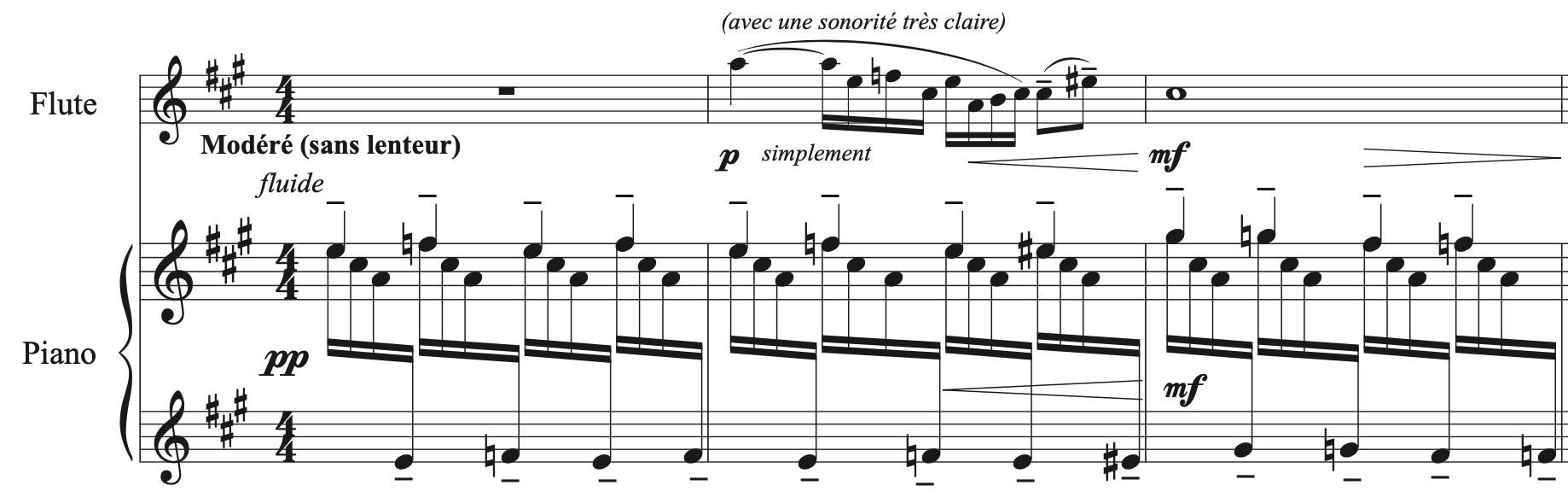
Example 1a. Gaubert, Flute Sonata No. 1 (1904/rev. 1917), 1st mvt., mm. 1–3.
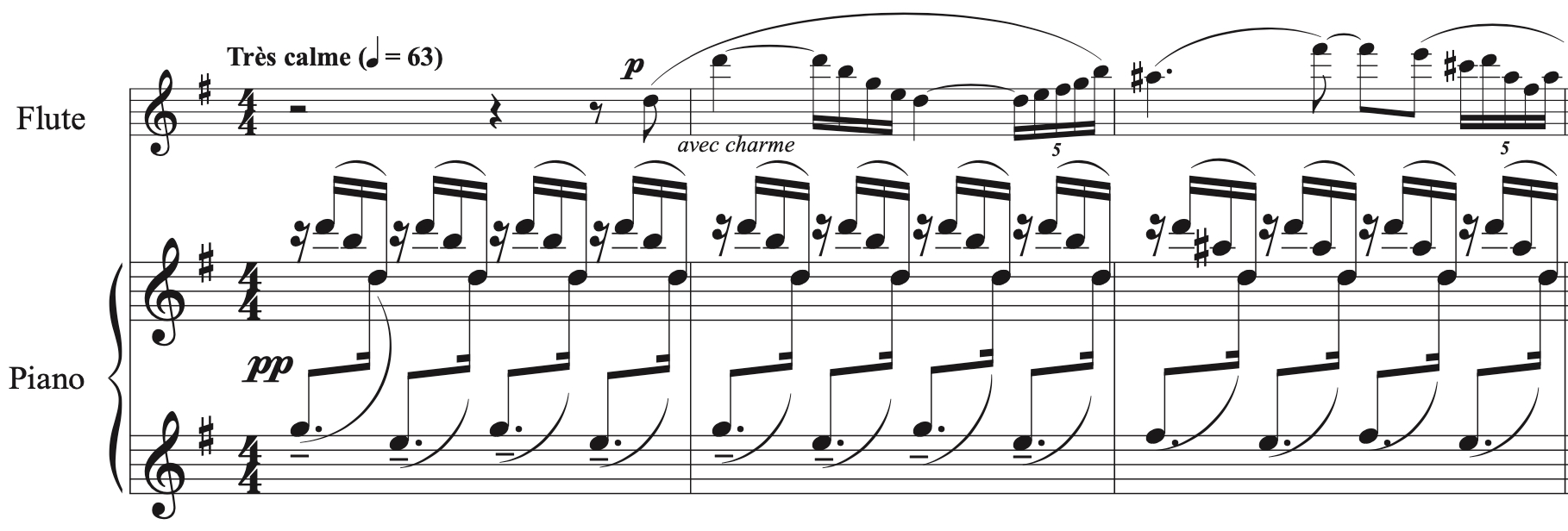
Example 1b. Soulage, Flute Sonata (1920), 1st mvt., mm. 1–3.
Sonata in D Minor for Violin and Piano, op. 36
Soulage completed the Sonata in D Minor for Violin and Piano, op. 36, on September 23, 1920. It was premiered and awarded a prize at the Concours from the Maison de la Musique in December 1920. A handful of violinists took up the work, including its dedicatee Suzanne Sapin-Suter, Henri Dumont (who taught Soulage violin), and Hortense de Sampigny, with whom Soulage often collaborated and who would premiere a few of her chamber works, including the Piano Trio and the Piano Quartet. The Violin Sonata is the most conservative of the set, in regards to harmony and form, which could potentially stem from her desire to appeal to a wider audience of performers. For A.S. (possibly A. Sylvain or André Schaeffner), the Violin Sonata denotes “a certain and agreeable liveliness but also a bit of superficiality.” [21] A.S, “Concerts divers—L’Œuvre Inédite,” Le Ménestrel (Paris), February 25, 1921, 84. While R. Refoulé writes “it is a work both nice and amusing, if not profound; with curious rhythms and some picturesque sound effects.” [22] R. Refoulé, “Le Mouvement musical en Province," Le Ménestrel (Paris : France) 21 Dec 1923, 544. « C’est une œuvre tour à tour agréable et amusante, sinon profonde ; des rythmes curieux et de pittoresques effets de sonorité. »
Sonata for Viola, op. 43
Soulage’s primary violist of the 1920s, Paul-Louis Neuberth, studied at the Conservatoire de Paris under Théophile Laforge, the first viola professor in the institution’s history. [23] Nora Hamme, “L’altiste oublié: A short history of Théophile Laforge and the establishment and influence of the viola studio at the Conservatoire de Paris,” Journal of the American Viola Society 30 no. 1 (Spring 2014): 26. Neuberth went on to be a staunch advocate of the viola-alta in the first half of the twentieth century, concertizing across Europe. Besides Soulage’s Sonata for Viola, dedicated to his viola-alta, Neuberth received dedications from Swan Hennessy (Quatre morceaux, op. 71 [c. 1929], nos. 1 and 4); Pierre Kunc (Sonate pour alto et piano [1921]); and Johannes Palaschko (24 Leichte melodische viola-studien, op. 86 [c. 1930]). In his zealous pursuit to promote the viola-alta, Neuberth also transcribed many works for himself to perform.
The viola-alta, a large-patterned viola “invented” by Richard Wagner and Hector Berlioz, never quite caught on as a solo instrument due to its cumbersome size and advances in viola lutherie and technique. Neuberth’s viola-alta, housed at the Musée de la musique in Paris, has a body length of 483 millimeters and was made by the luthier Paul Kaul in Nantes in 1916. [24] “Alto ‘Viola-Alta,’” Collections du musée, accessed May 6, 2021, https://collectionsdumusee.philharmoniedeparis.fr/doc/MUSEE/0130412. For comparison, a “standard” viola size (if one ever existed) is between 400 and 420 millimeters.
The instrument was often lauded in the press for its “ample and majestic” tone. [25] Robert Dezarnaux, “La musique,” La Liberté (Paris), March 17, 1925, 2. However, during a public concert in 1925 to introduce the audience to the wonders of the viola-alta, things do not go as Neuberth had hoped. Emile Vuillermoz does not mince words in the Excelsior,
It would have been prudent to choose a more eloquent and more persuasive advocate than the honorable Mr Neuberth whose sincere proselytism comes across with difficulty. His performance of the Sonata, by Mlle Soulage—written especially for him by a young vindictive person who just confessed to us ever so gently her treachery—did not give anyone the irresistible urge to learn this croaky instrument. [26] Emile Vuillermoz, “La Viola Alta—La romance,” Excelsior (Paris), December 21, 1925, 3.
Neuberth, despite the review, continued to perform selections from the Solo Sonata.
Composed in August 1921 at Luc-sur-Mer, where Soulage returned to escape the summer heat of the city, the Sonata for Viola, op. 43, is, to my knowledge, the first multi-movement work for solo viola by a French composer. Although a genre of the twentieth century, large-scale works for solo viola are much more prevalent, if not popular, in Germanophone countries. [27] Max Reger’s 3 Suites, op. 131(1916), Hindemith’s many sonatas for solo viola, and Hugo Kauder’s Kleine Suite (1924) are just a few examples. Soulage’s contemporary, Georges Migot, would write a solo sonata in the 1950s. It is not clear if Soulage knew of these works; however, she would have known the Bach Sonatas and Partitas.
Soulage’s Musical Language: Modality and Polymodality
Soulage’s sonatas represent a synthesis of the form and harmonic writing of two major schools of late nineteenth century French music espoused by Gabriel Fauré and Vincent d’Indy: Fauré’s chamber music forms based off classical Viennese composers, harmonic language, fluid shifting between tonality and modality; and d’Indy’s chromatic writing and formal, cyclical, and somewhat programmatic structures. [28] Michel Duchesneau writes that Fauré and d’Indy represent two divergent esthetic paths in France at the end of the nineteenth century. Fauré’s chamber music is characterized by “a lyrism that evolves within the ideal of classical Viennese forms” while d’Indy’s chamber music uses “large cyclic architecture and chromatic harmony.” Michel Duchesneau, L’avant-garde musicale et ses sociétés à Paris de 1871 à 1939 (Sprimont, Belgium: Mardaga, 1997), 210. This synthesis of two antipodal value systems can be attributed, in part, to her close relationship with Nadia Boulanger (a student of Fauré) and her working relationship with d’Indy. [29] D’Indy and Paul Vidal sponsored Soulage’s application to the Société des Auteurs, Compositeurs, et Éditeurs de Musique (SACEM) in 1917. Springing from a vein of French music which can best be described as conservative following World War I, Soulage’s musical language does not aim to break from tradition, like her avant-garde peers in Les Six, but enlarges and modernizes itself by incorporating Maurice Emmanuel’s teaching of modes, polymodality, and rhythm. [30] Emmanuel refers to a plurality of modes that can be drawn upon to enrich one’s musical language, not necessarily the simultaneous use of two different modes that one would perceive in bitonality or polytonality (e.g. Milhaud’s Saudades do Brasil). Franco-Thai composer Eugène Cinda Grassi, a member of Soulage’s social circle via Adèle Clément, would release a treatise or étude in 1926 treating in a similar manner this kind of modality, D’une musique nouvelle: Reconstruire (Paris: Heugel, 1926).
As their titles suggest, most of Soulage’s sonatas were seemingly conceived in a major-minor tonal system. Globally, the use of the major and minor label is indicative of the mode of the work and the tonal areas of major formal landmarks, rather than an implication of character. There is some overlap in what, at the time Soulage wrote them, was considered typical aesthetic characteristics of the major and minor. At the very least, each movement ends on the tonic triad of its respective key, aside from any minor to major transformation over the course of the work.
Soulage’s harmonic language and melodic construction in these works is very flexible, combining elements of modalism, chromaticism, and tonality. While modalism is a major current in composition in late nineteenth century France, Soulage’s interest and use of modes can be directly attributed to Maurice Emmanuel, whose classes inspired many of her peers and contemporaries, including Marcel Dupré, Georges Migot, Germaine Tailleferre, and in the decades following, Olivier Messiaen and Jehan Alain, among others. [31] See Chapter 6 of Jann Pasler, Composing the Citizen: Music as a Public Utility in Third Republic France (Berkeley: University of California Press, 2009). Somewhat ironically, Delibes (whose Jean de Nivelle Pasler uses as an example of modality at the time), who was Emmanuel’s first teacher at the Conservatoire, was so opposed to Emmanuel’s use of modes in his compositions that he barred him from entering the Prix de Rome and subsequently kicked him out of his studio declaring “as long as you write that music, you can stay home!” Emmanuel did, however, find encouragement from Louis Bourgault-Ducoudray (whom he would succeed as Professor of Music History at the Conservatoire) and Ernest Guiraud. As described in René Dumesnil, La musique en France entre les deux guerres 1919-1939, 127–28. See also, Christophe Corbier, Maurice Emmanuel, (Paris: Bleu nuit éditeurs, 2007).
Marcel Dupré, like the eighteenth and nineteenth century theorists who ascribed affective qualities to keys, enumerates the different characteristics and aesthetic properties of the church modes in his 1925 Traité d’improvisation à l’Orgue [Treatise on Improvising on the Organ]. In particular, he claims that the Lydian mode (which he labels as the 1st mode of F) is given a lot of brightness from its raised fourth scale degree, borrowed from the dominant. This borrowing “communicates energy and even enthusiasm: it is, in a certain fashion, the supermajor” [32] Marcel Dupré, Traité sur l’improvisation à l’Orgue: Cours complet d’improvisation à l’Orgue, vol. 2 (Paris: Alphonse Leduc, 1925), 30.
He goes on to detail a non-exhaustive list of different “exotic” modes with examples, including Hindu modes, like those used in Emmanuel’s Sonatine IV, as well as “Gypsy” [Tzigane], Arabic, Far-East pentatonic scales, and others. [33] The Tzigane mode given in Dupré’s treatise is very similar to the mode Soulage uses in the Solo Viola Sonata. The major difference is that the Tzigane mode is only seven pitches with a raised leading tone, whereas the Viola Sonata has 8 pitches with an added raised sixth scale degree and lowered seventh. The influence of Emmanuel is not lost on Dupré’s chapter on rhythms and how Greek poetic meters can influence musical rhythm. This treatise, although intended for organists, is a distillation of theories and ideas taught in Emmanuel’s classes and sheds light on the cultural and intellectual milieu in which Soulage was educated and gleans inspiration.
Emmanuel’s article for the January 1928 Revue musicale, “Polymodality,” provides a direct source from Soulage’s teacher that elaborates and elucidates her education in and application of modes. In terms of character, Emmanuel writes, “until the end of the Middle Ages, music was ‘governed’ by minor scales […] And yet, serious or joyous music from the medieval liturgy, sad or happy [music] from folk traditions, interchange modal scales […] The truth is that modes do not and cannot have an absolute moral meaning.” [34] Maurice Emmanuel, “La Polymodie,” Revue musicale (Paris:), January 28, 1928, 202–3. For example, the last movement of the Op. 25 Viola Sonata, is marked “gayly,” although it is nominally in A Minor.
In regards to Hindu modes, Emmanuel notes the use of two fixed-tone tetrachords (C–F, G–C) wherein the inner notes (D, E, A, and B) have three possible intonations: natural, sharp, or flat, and he indicates a slight alteration that can be applied, which Soulage may have taken to heart by raising the F by a semitone to F-sharp. [35] Emmanuel, “La Polymodie,” 203. The second theme of the Op. 25 Viola Sonata, while not a borrowing of Emmanuel’s Hindu mode, shares some salient features that can be compared with the third movement opening of Emmanuel’s Sonatine IV en divers modes Hindous (1920), in which Emmanuel indicates the pitches of the mode with tenuto marks (G, A-flat, B, C, E) (see Example 2a). Soulage’s Viola Sonata shares those same pitches, including the augmented second between A-flat and B and the melodic third between C and E (see example 2b).
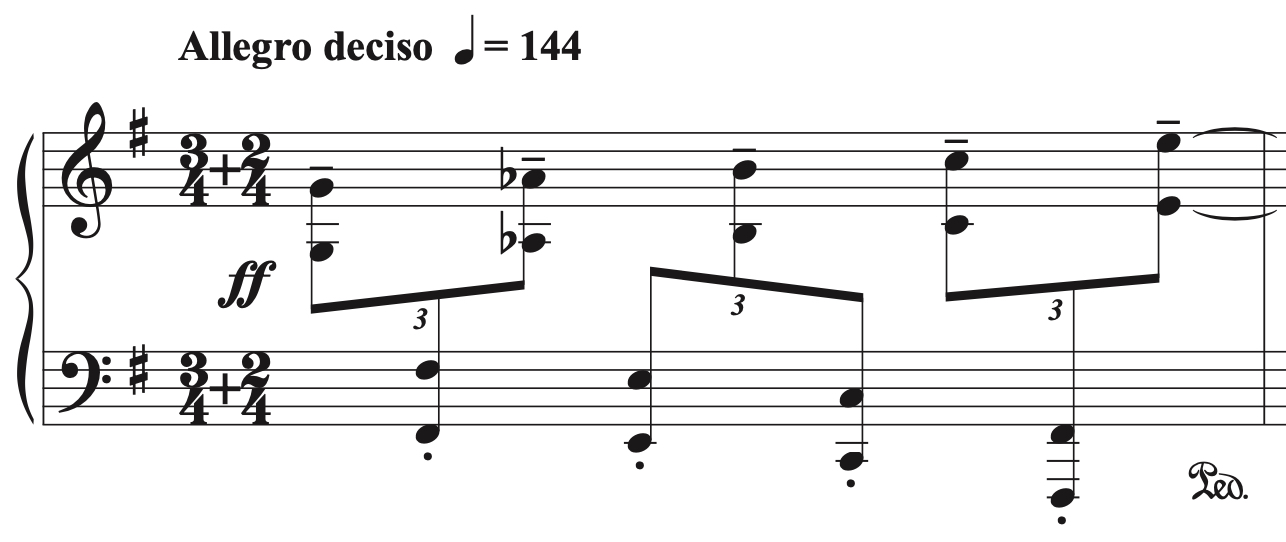
Example 2a. Emmanuel, Sonatine IV (1920), op. 20, 3rd mvt., m. 1.
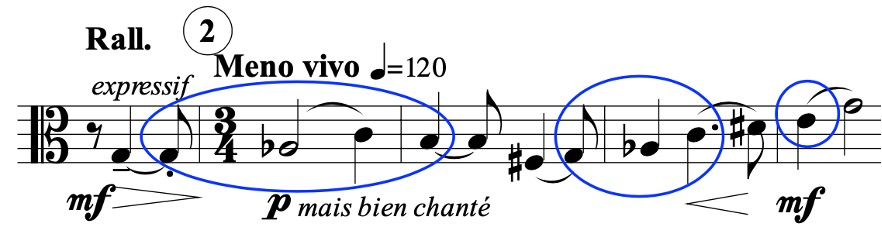
Example 2b. Soulage, Sonata for Viola and Piano, op. 25 (1919), 1st mvt., mm. 48–54.
Another example of a derivation of Emmanuel’s “game” on Hindu modes is from the Trio of the Solo Viola Sonata’s second movement. Here there are two fixed tetrachords: D to G-sharp and A to D, with E and F within the first and B/B-flat and C completing the second tetrachord (see “Minor Modal Superimposition” in Appendix B). [36] The mode created by Soulage is not one of Emmanuel’s Hindu modes, mainly because it utilizes more than eight pitches, but it is related through its fixed structure of two conjunct tetrachords with movable inner notes.
Finally, Emmanuel writes, “for the use of a mode to be perceptible, it must, if the scale does not apply to the entire piece, occupy at least a somewhat large area, be that in the melody, in the contrapuntal lines, or in the underpinning harmonic structure, so that the characters of the mode can be perceived and appreciated. There can be an intentional dissociation between the mode applied to the melody and the one applied to its harmonization.” [37] Emmanuel, “La Polymodie,” 211
Reducing different themes from Soulage’s sonatas into their scalar or modal form highlights Soulage’s application of Emmanuel’s ideas and her preference for a raised second scale degree in a “major” mode and, especially, the raised fourth scale degree in a “minor” mode (see Appendix B). [38] Due to its sharing a raised fourth scale degree, I refer to this minor mode as a minor Lydian mode, regardless of how the 6th and 7th scale degrees are treated chromatically, similar to how composers treat the minor scale. Soulage is rather flexible with the leading tone, sometimes keeping it and other times lowering a semitone to the subtonic. While the pieces are currently lost, in excerpts used in le Guide du Concert of other minor mode works of Soulage, such as the Piano Quartet, op. 58, the raised fourth scale degree in a minor mode is one Soulage’s most salient compositional identifiers.
An analysis in the Guide du Concert describes the Op. 25 Viola Sonata’s material as being derived from the opposition of the diatonic and the chromatic, which ultimately resolves, in the last movement into a hybrid tonality of A Major with F-natural and G-natural, hence the lack of a tonality designation. [39] “Études musicales analytiques—Sonate pour alto et piano de Marcelle Soulage,” Le Guide du Concert, May 2 1924, 442. While this argument of opposition does not apply to the Op. 43 Viola Sonata, it is no coincidence that they share, even ephemerally, the same superimposed mode seen in Appendix B. This indicates the use of this mode as being specific to Soulage’s conception of the viola, as transcribed into her musical grammar. [40] Soulage would return to this mode again in the 1930s for another piece for viola and piano, Thème et variations.
Tempo and Rhythm
The five sonatas demonstrate Soulage’s flexible concept of time at the measure/phrase level and, overall, in her compositional schemas. Generally, subsequent themes and formal areas after the introduction or first theme will be in a different tempo, which Soulage unequivocally indicates with metronome marks. This, in and of itself, is not new, but it explains how Soulage’s ideas that appear in a recapitulation can be transformed by the preceding material, and how motives and themes that return in her cyclic forms act as leitmotifs, subject to the psychological state of the music where they appear. [41] While traditionally relegated to the domain of opera, the use of leitmotifs—motives used to represent a person or idea and, when applied in the strictest sense, inherent to Wagner’s operas, or by extension Wagnerism in French opera of the late nineteenth century—is a device found in works from different generations in Soulage’s milieu. For example, d’Indy’s Fervaal and Lili Boulanger’s La Princesse Maleine (see James Ross, “D’Indy’s ‘Fervaal’: Reconstructing French Identity at the ‘Fin de siècle’,” Music & Letters 84, no. 2 (May 2003), 209–40; Annegret Fauser, “Lili Boulanger’s ‘La princesse Maleine’: A Composer and Her Heroine as Literary Icons,” Journal of the Royal Musical Association 122, no. 1 (1997), 68–108; and Steven Huebner, “Classical Wagnerism,” Journal of Musicology 34, no. 1 (Winter 2007), 115–47.) I think the term is appropriate, given Soulage’s inclination toward operatic gestures (like the recitative indications in the cello and violin sonatas), their formal importance in creating overarching cyclic structures, and their malleability. This approach is exemplified in the return of the berceuse theme in the fourth movement of the Flute Sonata, the recitative of the Violin Sonata, and the transformation of the first theme of the Largo espressivo in the Solo Viola Sonata.
Writing about the use of the metronome, Soulage reveals her own conception of time in relation to performance: “The metronome should not be employed (except to ‘force’ the speed of difficult passages) during the entire performance of a work. Performance, like a speech, must have its breaths, its storms, its moments of calm.” [42] Marcelle Soulage, Le Solfège, 2nd ed. (Paris: Presses universitaires de France, 1969), 116–17.
Soulage’s compositional voice reveals a high degree of rhythmic plasticity. This can be traced to Emmanuel, specifically his research on ancient Greek music, and how poetic meter guides musical rhythm. [43] See Maurice Emmanuel, Histoire de la langue musicale, Tome 1. As she explains decades after the composition of these sonatas in her book Le Solfège, “it is no less true that the rich combinations of paeons, epitrites, etc., can inspire melodies with flexible rhythms, varying the musical language of instrumental music, independent from the ‘word,’ in the sense of a phrase, like vocal music.” [44] Soulage, Le Solfège, 16. A paeon is a metrical foot of one long and three short syllables in any order. An epitrite is a metrical foot of one short and three long syllables, also in any order. Similar to Dupré’s treatise, Soulage includes in Le Solfège a table of metrical feet, alongside paeons and epitrites, used in French poetry: the iamb, trochee, dactyl, and anapest. [45] Soulage, Le Solfège, 17. Using the first theme proper of the Op. 43 Viola Sonata can offer a possible reading of a “rich combination” of different metrical feet (see Example 3).
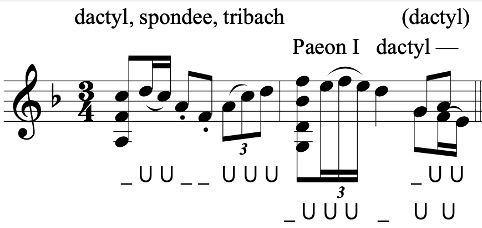
Example 3. Soulage, Op. 43 Viola Sonata, 1st mvt., m. 2. Metrical feet names are listed above and the corresponding long ( _ ) and short ( U ) syllable lengths are listed below.
The combination of the dactyl (long, short, short) and the anapest (short, short, long) creates one of Soulage’s signature rhythmic stamps (see Example 4). [46] Dupré in his treatise also includes an expanded table of these metrical feet as applied in music (from 2 to 8 beats), ascribing specific emotional qualities to each rhythm (e.g. the dactyl introduces a call to action; the anapest brings happiness and a certain nonchalance). Dupré, Traité, 33–36.
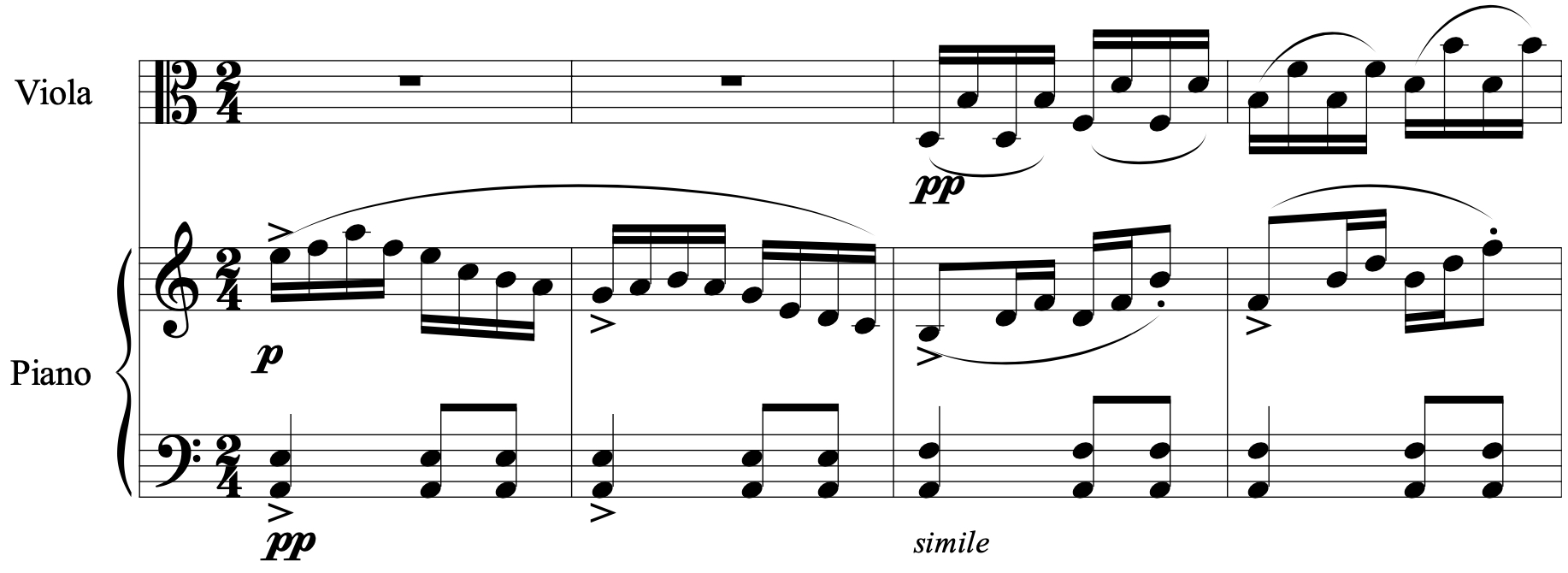
Example 4a. Op. 25 Viola Sonata, 4th mvt., mm. 9–12. Note the dactyl accompaniment in the bass.
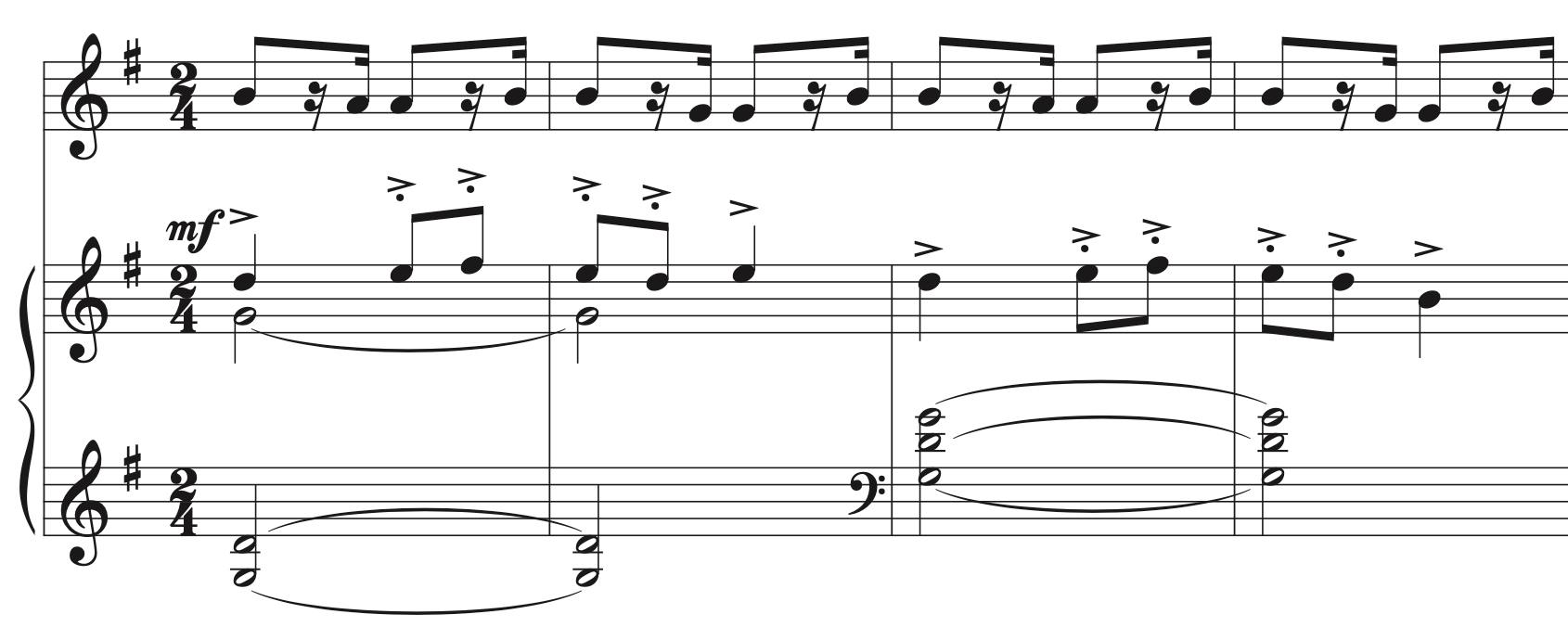
Example 4b. Soulage, Flute Sonata, 4th mvt., mm. 9–15.
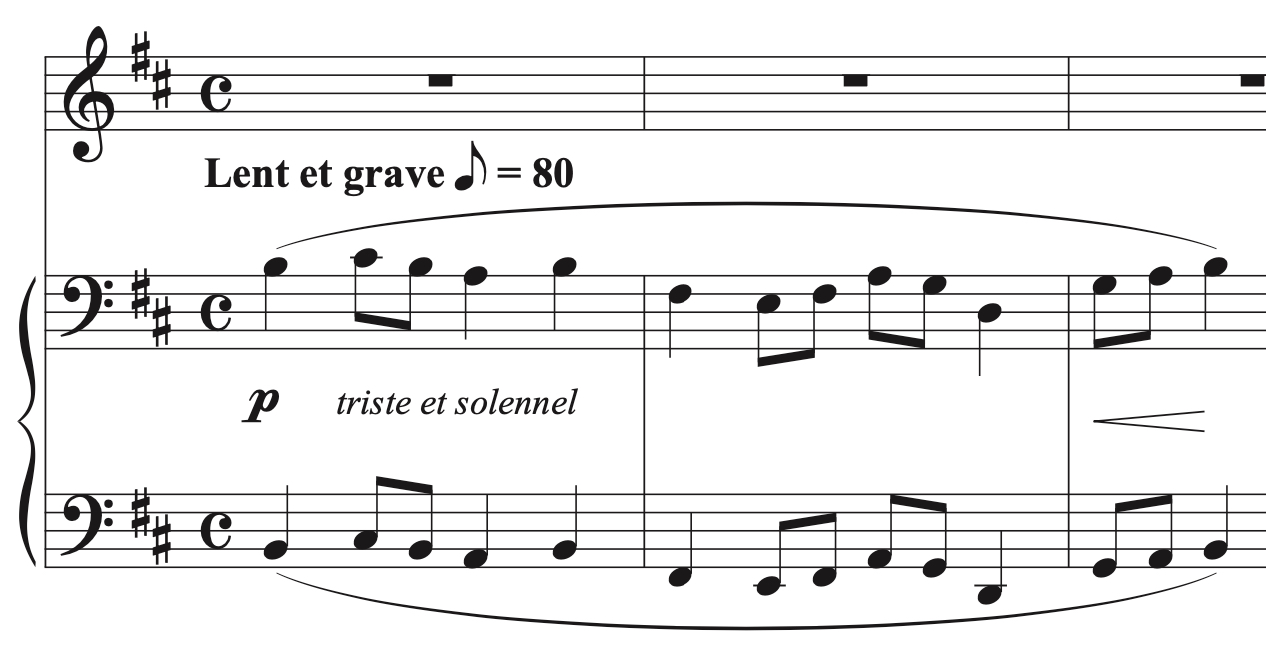
Example 4c. Soulage, Violin Sonata, 3rd mvt., mm. 1–3.
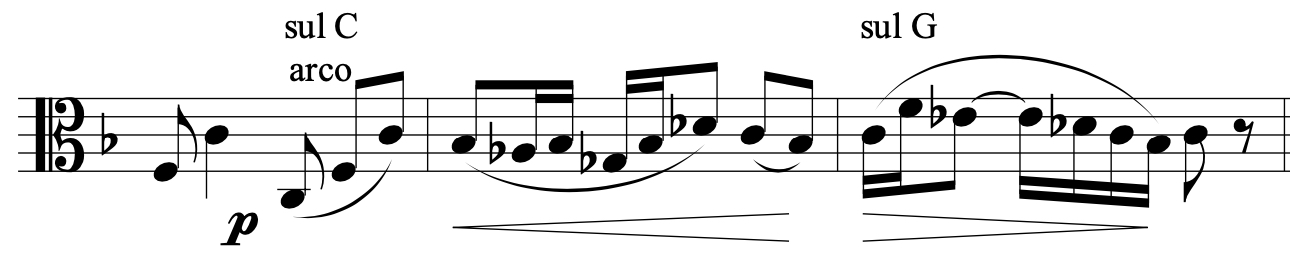
Example 4d. Soulage, Op. 43 Viola Sonata, 1st mvt., mm. 21–23.
Form and Neoclassicism
Although Soulage and Nadia Boulanger’s relationship ended in 1917, there are elements of Boulanger’s teaching, especially after World War I, that may have influenced formal elements of Soulage’s choice of musical structures for these works. Leon Bostein suggests that Boulanger, in her teaching at this time, focused on music from before the Second French Empire (1852–1870), specifically music by composers like Pérotin, Claudio Monteverdi, Jean-Baptiste Lully, Jean-Philippe Rameau, Johann Sebastian Bach, Wolfgang Amadeus Mozart and Franz Joseph Haydn, to help inspire a “cultural renewal” for France through new works grounded in this tradition. [47] Leon Botstein, “Why Music? Aesthetics, Religion, and the Ruptures of Modernity in the Life and Work of Nadia Boulanger,” in Nadia Boulanger and Her World, ed. Jeanice Brooks (Chicago: The University of Chicago Press, 2020), 307. What Botstein describes, in relation to Wheeldon’s work, seems to be Boulanger taking over Debussy’s mantel. She also “stressed the importance of an overarching linear shape in a work of music: la grande ligne. Coherence [is] attained by a structural logic that unified the use of the materials of music in contrast to the aesthetics of late Romanticism that privileged subjectivity, originality, narration, theatricality, and expansiveness.” [48] Idem, 310. See also Chapter 2 of Jeanice Brooks, The Musical Work of Nadia Boulanger: Performing Past and Future between the Wars (Cambridge: Cambridge University Press, 2013). Brooks elucidates the development of Boulanger’s idea of la grande ligne and overarching structural relationships in masterworks, akin to architecture. Jane Fulcher notes that “in the 1920s [Boulanger] supported modernist neo-classicism being espoused by Cocteau, as opposed to the conservative or retrogressive neo-classicism of official circles.” [49] Jane F. Fulcher, “Musical Style, Meaning, and Politics in France on the Eve of the Second World War,” Journal of Musicology 13 no. 4 (Autumn 1995), 436. Soulage’s use of these cyclic and “retrogressive” classical forms could be a reaction to her falling out with Boulanger. [50] Based off Soulage and Boulanger’s correspondence, Soulage never worked on multi-movement works with Boulanger, mostly salon pieces and vocal music. Soulage composed these cyclic, multi-movement sonatas once she developed a closer relationship with d’Indy in 1917.
Some of Soulage’s most important chamber works were premiered at what Michel Duchesneau has described as the bastion of the musical right in France: the Société Nationale de Musique. [51] See Chapter 5 of Michel Duchesneau, L’avant-garde musicale et ses sociétés à Paris de 1871 à 1939 (Sprimont, Belgium: Mardaga, 1997), and Michel Duchesneau, “La musique française pendant la guerre 1914–1918 : Autour de la tentative de fusion de la Société Nationale de Musique et de la Société Musicale Indépendante,” Revue de musicologie 82 No. 1 (1996), 123–53. Some of Soulage’s chamber music premiered there include the Suite in C Minor for Violin Viola, and Piano, op. 16; the Piano Trio, op. 34; the Cello Sonata; the Piano Quartet, op. 58; and the Sonate pastorale. Founded after the Franco-Prussian War to promote French chamber music under the nationalistic motto Ars Gallica, the SNM “ fostered the greatest rash of Teutonizing néoclassicisme in the history of French music.” [52] Richard Taruskin, “Back to Whom? Neoclassicism as Ideology,” in The Danger of Music and Other Anti-Utopian Essays (Berkley: University of California Press, 2010), 386. Duchesneau explains that the SNM favored chamber music with an “attachment to post-romanticism is reflected in a structural conception where thematic unity obeys the principles of the traditional sonata form or is enlarged by the use of cyclic themes.” [53] Duchesneau, L’avant-garde musicale, 189. In line with the inherent conservatism of this official circle, all five of Soulage’s sonatas fit this structural conception, which along with the endorsement of d’Indy, who served as the president of the SNM until his death in 1931, may have aided in her music being performed there.
Marianne Wheeldon highlights the irony caused by the use of neoclassicism after World War I amongst those interested in securing Debussy’s legacy and the anti-debussyist postwar generation (e.g. Les Six): “Had either constituency considered Debussy’s last chamber works, the composer’s artistic priorities would not have been so far removed from those that were emerging in the postwar years: both adopted genres of absolute music, shorn of all programs and picturesque titles, with reduced instrumental forces and stripped-down textures.” [54] Marianne Wheeldon, Debussy’s Legacy and the Construction of Reputation, (New York, Oxford University Press: 2017), 13. Barbara L. Kelly contends that this irony functions as a means to create consensus between these disparate groups, their trends, and the aesthetics of the time. [55] See in particular Chapter 6 of Barbara L. Kelly, Music and Ultra-Modernism in France: A Fragile Consensus, 1913-1939 (Suffolk: Boydell Press, 2013). Regardless of the interpretation, as Scott Messing succinctly puts it, “Neoclassicism was the sign that accommodated both innovation and tradition in composition in the 1920s.” [56] Scott Messing, “Polemic as History: The Case of Neoclassicism,” The Journal of Musicology 9 no. 4 (Autumn 1991), 497. See also Messing, Neoclassicism in Music.
Wheeldon describes some of the features of anti-debussyist music as “instrumental textures stripped down to two or three lines, scored exclusively for wind instruments, and presented as absolute music in the genre of a sonata.” [57] Wheeldon, Debussy’s Legacy, 77. For example, Stravinsky’s 1923 Octet, the quintessential work of anti-debussyist music, Francis Poulenc’s Sonata for Clarinet and Bassoon, and Georges Auric’s Caprice. [58] These are just a few pieces Wheeldon cites in her article, “Anti-Debussyism and the Formation of French Neoclassicism,” that were to be premiered at the Concerts Jean Wiéner in May 1923. As Wheeldon also points out, members of Les Six were quick to lambast the Debussyste aesthetic while simultaneously sparing the composer himself. Others, like Tailleferre were more open about Debussy’s influence (e.g. Tailleferre’s Hommage à Debussy for piano [1920]). Marianne Wheldon, “Anti-Debussyism and the Formation of French Neoclassicism,” Journal of the American Musicological Society 70, no. 2 (Summer 2017), 443–45. While Soulage’s chamber music can fulfill superficially these requirements, her Sonate pastorale (1928) for flute and bassoon would be most representative of a possible, ironic response to this postwar, anti-debussyist neoclassical style: a work stripped down to two lines (by necessity), scored exclusively for winds, and in the abstract genre of the sonata. Soulage even opens the work with an Alberti bass line in the bassoon. [59] Bulletin de déclaration, 17 February 1928, Fonds Marcelle Soulage, Sociétés des Auteurs, Compositeurs, Éditeurs de Musique, Neuilly-sur-Seine, France. The movement titles and tempo markings of Soulage’s chamber music and these five sonatas are indicative of abstract music. The third movements of the Viola and Cello Sonatas only hint at programmatic underpinnings with Complainte and Nocturne. At the same time, the Flute Sonata’s third movement Andante “in the character of a berceuse,” while not overtly programmatic, does create an obvious extramusical association. There is also an element of theatricality in line with other Romantic works in her usage of character indications, including impérieux [imperious], dans le caractère d’un récitatif [in the style of a recitative]; comme une cloche [like a bell] in the Violin Sonata; comme un carillon [like a carillon] in the Flute Sonata; and both comme un glas [like a death knell] and comme un bourdonnement [like a buzzing] in the Op. 25 Viola Sonata.
Of the set, the Solo Viola Sonata is the most emblematic of Soulage’s implementation of neoclassical forms, and no other genre can evoke the music of J.S. Bach better than a sonata for solo string instrument with a fugue. [60] Soulage’s Suite de danses anciennes, op. 32, a ballet from the same time, uses a variety of baroque dance forms and lies squarely in the tradition of Debussy’s (among others’) return to the “Golden Era” of the French baroque (as seen with Debussy’s Pour le piano and Ravel’s Le Tombeau de Couperin). The opening of Soulage’s fugue (see Example 5a) shares a similar rhythm and inverted melodic curve to Bach’s A Minor violin fugue (see Example 5b).
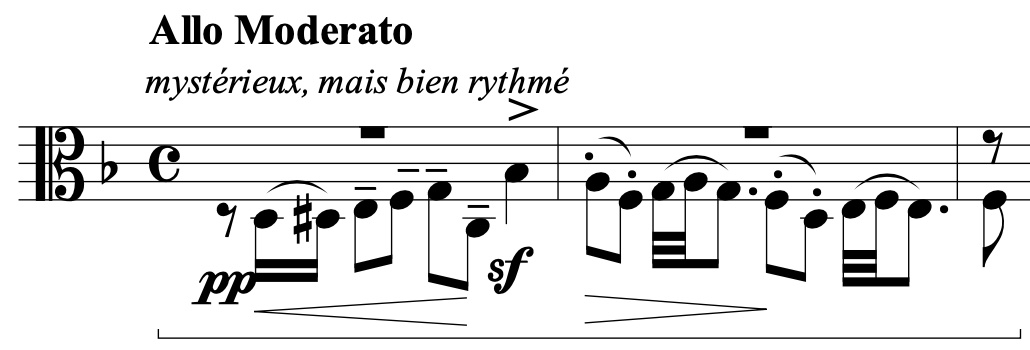
Example 5a. Soulage, Op. 43 Viola Sonata, 4th mvt., mm. 1–3.
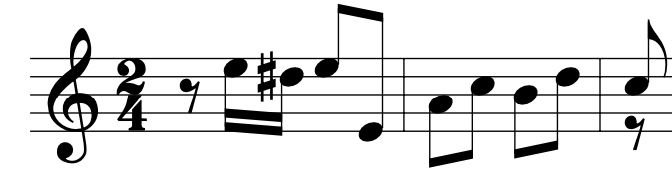
Example 5b. J.S. Bach, Fugue from BWV 1003, mm. 1–3.
Charles Koechlin summarizes what he perceives to be the “directives” of neoclassicism in his 1926 article “Le ‘Retour à Bach’” for La Revue musicale:
Clear themes, like those in some Allegros of Bach (a remonstrance!); — absolutely no beethovenian, franckist, or wagnerian pathos; no fauréan nor debussyist expressionism (decidedly, I cannot write impressionism!); but pure music which does not claim to mean anything. And some fugues. Or rather some sketches of fugues: adapted to the needs of an era where one knows the price of time. [61] Charles Koechlin, “Le ’Retour à Bach,’” La Revue musicale, November 1, 1926), 1–12. Reprinted in Koechlin, Écrits: Esthétiques et Langage musical vol. 1, Michel Duchesneau, ed. (Sprimont, Belgique: Mardaga), 242. See Chapter 3 of Wheeldon’s Debussy’s Legacy for an interesting study in these different and converging trends of debussyism, anti-debussyism and neoclassicism.
Koechlin sees this return to Bach and counterpoint as a means to counter the emotion of debussyism as misguided. Wheeldon elaborates, “By 1926, the notion of counterpoint had concretized in the minds of many critics as a métier capable of counteracting musical emotion and expressionism.” [62] Wheeldon, Debussy’s Legacy, 94. However, Soulage’s use of counterpoint or neoclassical idioms does not aim to counteract emotion in her music, rather they are the conduits that best transmit her ideas and Romantic sensibilities. In response to an inquiry into whether musical talent is hereditary for the newspaper La Volonté, Soulage acknowledged that her musical training—training that led to a First Prix in Counterpoint—allowed her to “translate her emotions, sad or joyous, musically.” [63] Marcelle Soulage, “Existe-il une hérédité musicale?” La Volonté (Paris), October 12, 1930, 5. Soulage does not eschew extramusical imagery, nor romantic harmony (see Example 6).
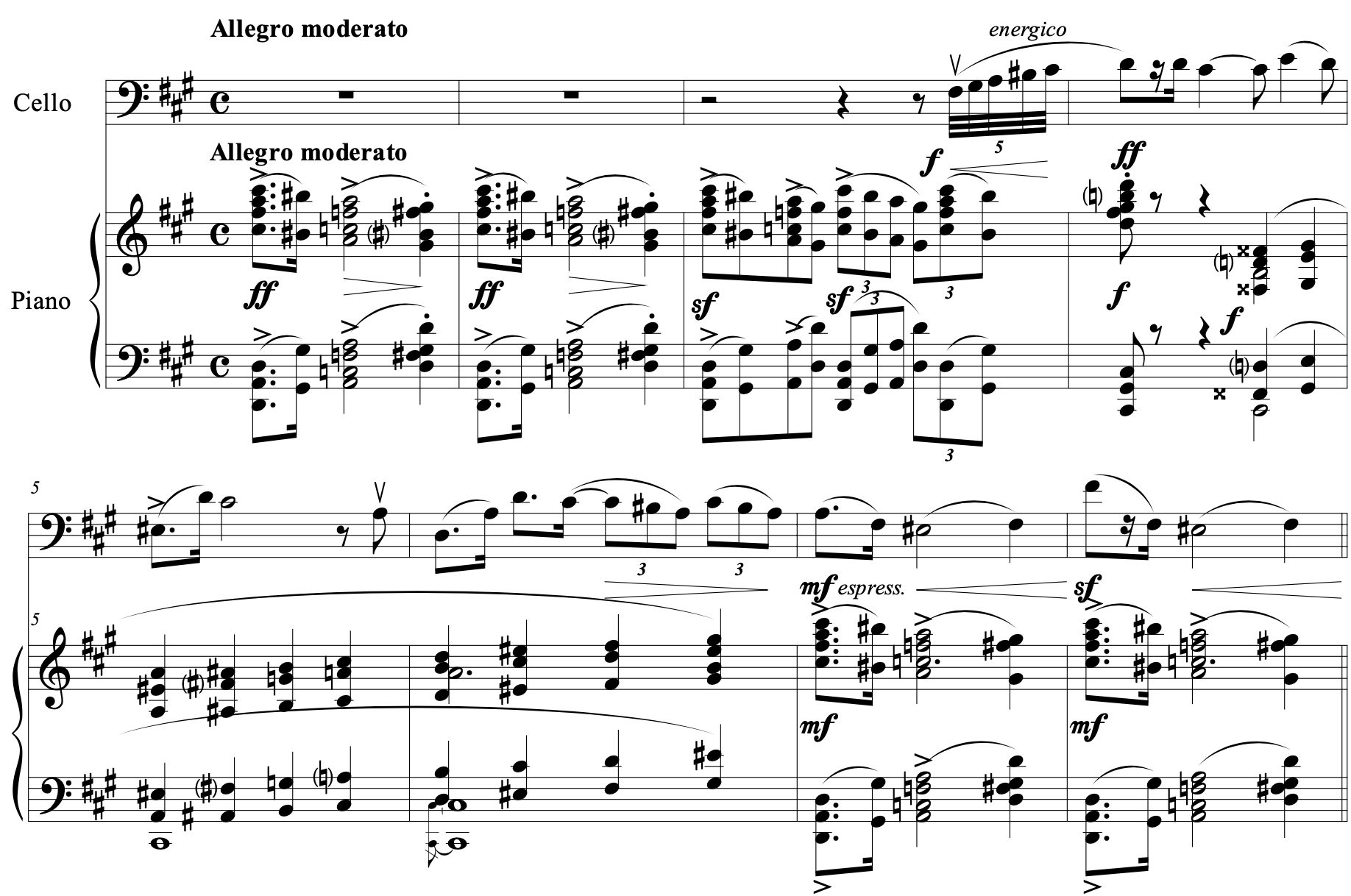
Example 6. Cello Sonata, 1st mvt., mm. 1–8. Of note are its marked dissonance, use of enharmonic spellings (F-natural for E-sharp) and creeping, dense chromatic line of the piano in mm. 4–6.
In line with Fulcher’s description of retrogressive neoclassicism, Soulage’s use of cyclic forms—Koechlin’s franckist pathos—challenges the abstract neoclassical forms used by composers such as those of Les Six. All of her sonatas employ cyclic forms within a post-beethovenian classical sonata form (i.e., the classical minuet is replaced by a scherzo), varying the cyclic material used and the movements from where the material is taken. This use of cyclic form can also provide a means to create Boulanger’s grande ligne. [64] For a detailed look into Boulanger’s pedagogy see, Caroline Potter, “Nadia Boulanger (1887–1979): The Teacher in the Marketplace,” in The Business of Music, Michael Talbot, ed. (Liverpool: Liverpool University Press, 2002), 152–70. Soulage’s Op. 43 Viola Sonata uses different motives to create cohesion, along with its own cyclic thematic material.
Appendix C lists the movement names and their keys (although this is only indicated by the key signature and the last chord). Only the Cello Sonata is in three movements, but all employ a sonata-form first movement, a ternary scherzo (except the Cello Sonata), a lyrical ternary movement, and a Rondo finale (or, in the case of the Op. 43 Viola Sonata, a fugue). Comparing the keys highlights interesting relationships between the sonatas and provides another example of Boulanger’s grande ligne through tonal cohesion for the individual sonatas. [65] See Jeanice Brooks, The Musical Work of Nadia Boulanger, 51. For example, the inverted key relations of the first two movements of the Op. 25 and Op. 43 Viola Sonatas (A minor to F major and vice versa), as well as the Flute and Violin Sonatas. The Flute Sonata’s first two movements are in G major and D minor, while the Violin Sonata’s are in D minor and G major. The Flute Sonata’s keys create a G minor triad while the Violin Sonata’s a G major triad – the common tone (or tonal grande ligne) for both being D. The slow movements of the Op. 25 Viola Sonata and the Cello Sonata are in D minor, which are tertiary relations between the movements which precede them (here A is the common tone).
Ostinato and the Style dépouillé
Jillian C. Rogers describes the prevalence of “repetitive, ostinato-oriented, and rhythmically regular music” as common to French music of the interwar years. [66] Jillian C. Rogers, Resonant Recoveries: French Music and Trauma Between the World Wars (New York: Oxford University Press, 2021), 139. This mechanical aesthetic, which Gurminder Bhogal defines as “a metaphor for a set of musical techniques, which operate on a diminutive scale and are characterized by the expression of simple melodies and tightly knit counterpoint through transparent textures and uniform rhythms,” [67] Gurminder Bhogal, Details of Consequence: Ornament, Music, and Art in Pari. (New York: Oxford University Press, 2013), 305. is related to what Koechlin described above as interwar French composers’ “return to Bach.” Rogers convincingly argues that this style dépouillé served as a means to process trauma after World War I. Although shielded to a certain extent by her class and her gender, Soulage was not immune to this trauma. All the men of age in her family served in the military during the first World War to varying degrees: her uncle Jules fought at the battle of Verdun, and her father Georges would be named Chevalier in the Légion d’honneur for his service. [68] A couple of her vocal works, written shortly after the war’s end, were directly inspired by those who had fought.
Rogers points out that Philippe Gaubert (among many other musicians who served in the war) wrote rhythmically regular music during or shortly after the war. [69] Rogers, Resonant Recoveries, 171. Coincidentally, or intentionally, Soulage’s Flute Sonata, written for Gaubert, demonstrates many features of the style dépouillé. Soulage’s instrumental sonatas use ostinatos to great effect and to serve various functions: a means to create forward motion; a soporific means to suspend time; a means to build tension; and a means to create atmosphere. Appendix D shows a selection of the ostinatos found in Soulage’s sonatas. Particular to the Violin and Flute Sonatas, Soulage takes part of the second theme and transforms it into an ostinato for the first movement’s third theme (Flute Sonata) and development (Violin Sonata).
Conclusion
Soulage remarked in a 1934 interview that she was indifferent to trends, and yet, to Dumesnil’s point, her style is not immune to avant-garde neoclassical trends including the use of ostinatos, the style dépouillé, or the use of fugues. [70] José Bruyr, “Un entretien avec…Marcelle Soulage,” Le Guide du Concert (Paris), March 16 1934, 648. While Emmanuel’s influence is seen through Soulage’s use of polymodality and rhythm, it is filtered through her Post-Romantic harmonic writing and multi-movement forms that combine Fauré’s classical Viennese sonata-form based chamber music with d’Indy’s cyclic architecture. [71] Emmanuel’s ideas and influence would be given more import in the music of later generations, especially in the music of Messiaen and Alain. As for Debussy and his influence, Soulage writes in an article for Vent debout in honor of the 30-year anniversary of the death of the musicien français in 1948, “An essentially French composer, [Debussy] left us a message in which we should steep ourselves. It is absolutely not a question of imitating his language, but of following his path, drawing on centuries past from a tradition made of order, sensibility, taste, and restraint in the borrowing of foreign influences.” [72] Marcelle Soulage, “30ieme Anniversaire de la mort de Debussy; brève étude de sa vie et de ses œuvres,” Vent debout 7/8 (1948), 452. This coincides with “that cluster of values-purity, sobriety, objectivity, grace, impersonal precision” that Richard Taruskin enumerates in his essay on neoclassicism of the time. Richard Taruskin, “Back to Whom? Neoclassicism as Ideology,” 387. Decades after the dust had settled on the anti-debussyist movement of the 1920s, Soulage reaffirmed her compositional ideals through these nebulous qualities. While her sonatas are by no means imitations of Debussy, Soulage situates them in what she views to be the logical continuation of the tradition of her art drawn from eras past: a convergence of Debussy’s turn toward the French baroque, Boulanger’s teaching of the grande ligne, and Emmanuel’s classes at the Paris Conservatoire. [73] Soulage’s deep interest in the “early” music can be more readily observed in her Suite de danses anciennes (a suite of baroque dances) and her transcriptions of many French baroque composers like Marin Marais.
Notes
[1] Robert Dézarnaux “La musique” La Liberté, 17 March 1925, 2. All translations are by the author, unless otherwise indicated.
[2] Soulage never referred to herself as a compositrice, nor a femme compositeur, but as a compositeur de musique. As the term compositrice is more often used in the francophone literature on the subject, I use compositrice. The usage of the feminine form is not settled and there are women composers today who employ compositeur. While not the focus of this article, there is a wealth of literature that explores issues of French compositrices and women composers in general, especially their treatment in the press. See, for example, Laura Hamer, Female Composers, Conductors, Performers: Musiciennes of Interwar France, 1919-1939 (New York: Routledge, 2018); Jacinthe Harbec, “Les femmes et la composition dans le Paris des années trente,” in Musiques et musiciens à Paris dans les années trente, ed. Danièle Pistone, (Paris : Editions Champion, 2000), 45–59; Laure Marcel-Berlioz, ed., Compositrices: L’égalité en acte (Paris: Musica falsa, 2019); Marcia J. Citron, “Gender, Professionalism and the Musical Canon,” Journal of Musicology 8 No. 1 (Winter 1990): 102–17; Hyacinthe Ravet, Musiciennes: Enquête sur les femmes et la musique. (Paris: Editions Autrement, 2011); and Florence Launay, Les compositrices en France au XIXe siècle (Paris: Fayard, 2006) .
[3] Emile Vuillermoz, Claude Debussy (Paris: Flammarion, 1957), 21.
[4] Anne Bongrain, Le Conservatoire national de musique et de déclamation, 1900–1930: Documents historiques et administratifs (Paris: Vrin, 2012), 693.
[5] For a myriad of reasons, these sonatas, as well as any study of Soulage and the place she occupied in the musical milieu of early twentieth century France, have been neglected for nearly 100 years, roughly fifty years after her death. My own “discovery” of Soulage is due to my search for francophone repertoire for viola of the early twentieth century. While her viola sonatas have fared much better in the twenty-first century, this is not the case with her other sonatas, although her Cello sonata was recorded in 2011.
[6] René Dumesnil, La musique en France entre les deux guerres, 1919–1939 (Paris: Éditions du Milieu du Monde, 1946), 24.
[7] It is not known whether this dedication led to any performances by Gaubert of Soulage’s orchestral music from the early 1920s. Based on programs from the Société des Concerts du Conservatoire, Soulage’s music was never performed while Gaubert (or future directors) led the ensemble. She would be performed by other Parisian ensembles, including the Concerts Touche, Colonne, and Lamoureux.
[8] Sapin and Neuberth performed Soulage’s Prix Lépaulle winning work, the Suite in C Minor for Violin, Viola, and Piano, at the Œuvre Inédite in 1920.
[9] A. Sylvain, “La Musique—Compositeurs d’Aujourd’hui. Mlle Marcelle Soulage,” Revue moderne (Paris), July 15, 1922, 30.
[10] Eventually Coolidge broke the tie and decided to award first prize to Bloch’s Suite. It is not known whom the other 70 pieces were by, though there is much speculation. See David Bynog, “The 1919 Berkshire Festival Competition: A Momentous Weekend in the Viola’s History,” https://www.violinist.com/blog/dbynog/20198/27888/ accessed March 25, 2024.
[11] Soulage would go on to compete in 1920 and 1921; she would not pass the first round on those attempts either. Unlike Lili Boulanger in 1913, Marguerite Canal would win the Grand Prix de Rome in 1920 without having to share it with a male competitor
[12] For the purposes of this article, I will refer to the work as the Sonata for Viola and Piano or the Viola Sonata, as Soulage does with her other sonatas for piano and solo instrument. There are many examples of the work being referred to as the “Sonate pour alto et piano” in the press.
[13] The Salon des musiciens français, founded in 1911, was an extremely valuable venue for burgeoning, young French composers to share their work without having to pay.
[14] Stephen Sensbach, “Le violoncelle et les violoncellistes à Paris de 1930 à 1939,” in Musiques et musiciens à Paris dans les années trente, ed. Danièle Pistone (Paris: Editions Champion, 2000), 347. Soulage’s sonata is not included in the list, possibly due to the confusion of her nationality. Soulage was born in Lima, Peru; however, she was born to French parents, maintained French nationality, and considered herself French.
[15] A. Sylvain, “La Musique—Compositeurs d’Aujourd’hui. Mlle Marcelle Soulage,” 30. I have not been unable to identify Sylvain’s first name.
[16] Clément was a trailblazing figure for musiciennes in the early 20th century. As a cellist she gave several tours across the world, including North Africa and East Asia, and she patented her invention of a silent practice cello for travelling. Clément and Soulage would have a fruitful performing career together (when Clément was in France) until Clément’s death in 1958. In 1940 they founded the Groupe Instrumental Féminin.
[17] In her article, “Germaine Tailleferre and Hélène Perdriat’s Le Marchand d’oiseaux (1923): French feminist ballet?” Laura Hamer highlights the notion that two women succeeding in a male-dominated field would create the perception of a feminist work, even if the actual content was hardly so (or like Dezarnaux’s review above, resulting in the work being deemed unbecoming of a woman). Hamer, “Germaine Tailleferre and Hélène Perdriat’s Le Marchand d’oiseaux (1923): French feminist ballet?” Studies in Musical Theatre 4, no. 1(August 2010), 115. See also Florence Launay, Les Compositrices en France, and Laura Hamer, Female Composers, Conductors, Performers.
[18] Soulage would have 10 performances at the SNM between 1919 and 1939. Charlotte Sohy (Marcel Labey’s wife) and Suzanne Demarquez would come in second, with nine performances within the same time frame. Soulage, in contrast, only received three performances at the rival Société Musicale Indépendante, where she would have mélodies premiered at two concerts in the early 1920s and, in the 1930s, a work for viola and piano. See Michel Duchesneau, L’avant-garde musicale et ses sociétés à Paris de 1871 à 1939 (Sprimont, Belgium: Mardaga, 1997).
[19] Trois pièces brèves, op. 9, comprise a Danse, Berceuse, and Scherzo. Originally for flute and piano, these salon pieces were transcribed by Soulage for a spate of melodic instruments: oboe, clarinet, violin, and cello. Although there is no printed version for viola, there is evidence that the Berceuse was performed on viola.
[20] Program April 11, 1919, Fonds René le Roy. Bibliothèque musicale la Grange-Fleuret, Paris, France.
[21] A.S, “Concerts divers—L’Œuvre Inédite,” Le Ménestrel (Paris), February 25, 1921, 84.
[22] R. Refoulé, “Le Mouvement musical en Province," Le Ménestrel (Paris : France) 21 Dec 1923, 544. « C’est une œuvre tour à tour agréable et amusante, sinon profonde ; des rythmes curieux et de pittoresques effets de sonorité. »
[23] Nora Hamme, “L’altiste oublié: A short history of Théophile Laforge and the establishment and influence of the viola studio at the Conservatoire de Paris,” Journal of the American Viola Society 30 no. 1 (Spring 2014): 26.
[24] “Alto ‘Viola-Alta,’” Collections du musée, accessed May 6, 2021, https://collectionsdumusee.philharmoniedeparis.fr/doc/MUSEE/0130412.
[25] Robert Dezarnaux, “La musique,” La Liberté (Paris), March 17, 1925, 2.
[26] Emile Vuillermoz, “La Viola Alta—La romance,” Excelsior (Paris), December 21, 1925, 3.
[27] Max Reger’s 3 Suites, op. 131(1916), Hindemith’s many sonatas for solo viola, and Hugo Kauder’s Kleine Suite (1924) are just a few examples. Soulage’s contemporary, Georges Migot, would write a solo sonata in the 1950s. It is not clear if Soulage knew of these works; however, she would have known the Bach Sonatas and Partitas.
[28] Michel Duchesneau writes that Fauré and d’Indy represent two divergent esthetic paths in France at the end of the nineteenth century. Fauré’s chamber music is characterized by “a lyrism that evolves within the ideal of classical Viennese forms” while d’Indy’s chamber music uses “large cyclic architecture and chromatic harmony.” Michel Duchesneau, L’avant-garde musicale et ses sociétés à Paris de 1871 à 1939 (Sprimont, Belgium: Mardaga, 1997), 210.
[29] D’Indy and Paul Vidal sponsored Soulage’s application to the Société des Auteurs, Compositeurs, et Éditeurs de Musique (SACEM) in 1917.
[30] Emmanuel refers to a plurality of modes that can be drawn upon to enrich one’s musical language, not necessarily the simultaneous use of two different modes that one would perceive in bitonality or polytonality (e.g. Milhaud’s Saudades do Brasil). Franco-Thai composer Eugène Cinda Grassi, a member of Soulage’s social circle via Adèle Clément, would release a treatise or étude in 1926 treating in a similar manner this kind of modality, D’une musique nouvelle: Reconstruire (Paris: Heugel, 1926).
[31] See Chapter 6 of Jann Pasler, Composing the Citizen: Music as a Public Utility in Third Republic France (Berkeley: University of California Press, 2009). Somewhat ironically, Delibes (whose Jean de Nivelle Pasler uses as an example of modality at the time), who was Emmanuel’s first teacher at the Conservatoire, was so opposed to Emmanuel’s use of modes in his compositions that he barred him from entering the Prix de Rome and subsequently kicked him out of his studio declaring “as long as you write that music, you can stay home!” Emmanuel did, however, find encouragement from Louis Bourgault-Ducoudray (whom he would succeed as Professor of Music History at the Conservatoire) and Ernest Guiraud. As described in René Dumesnil, La musique en France entre les deux guerres 1919-1939, 127–28. See also, Christophe Corbier, Maurice Emmanuel, (Paris: Bleu nuit éditeurs, 2007).
[32] Marcel Dupré, Traité sur l’improvisation à l’Orgue: Cours complet d’improvisation à l’Orgue, vol. 2 (Paris: Alphonse Leduc, 1925), 30.
[33] The Tzigane mode given in Dupré’s treatise is very similar to the mode Soulage uses in the Solo Viola Sonata. The major difference is that the Tzigane mode is only seven pitches with a raised leading tone, whereas the Viola Sonata has 8 pitches with an added raised sixth scale degree and lowered seventh.
[34] Maurice Emmanuel, “La Polymodie,” Revue musicale (Paris:), January 28, 1928, 202–3.
[35] Emmanuel, “La Polymodie,” 203.
[36] The mode created by Soulage is not one of Emmanuel’s Hindu modes, mainly because it utilizes more than eight pitches, but it is related through its fixed structure of two conjunct tetrachords with movable inner notes.
[37] Emmanuel, “La Polymodie,” 211
[38] Due to its sharing a raised fourth scale degree, I refer to this minor mode as a minor Lydian mode, regardless of how the 6th and 7th scale degrees are treated chromatically, similar to how composers treat the minor scale. Soulage is rather flexible with the leading tone, sometimes keeping it and other times lowering a semitone to the subtonic. While the pieces are currently lost, in excerpts used in le Guide du Concert of other minor mode works of Soulage, such as the Piano Quartet, op. 58, the raised fourth scale degree in a minor mode is one Soulage’s most salient compositional identifiers.
[39] “Études musicales analytiques—Sonate pour alto et piano de Marcelle Soulage,” Le Guide du Concert, May 2 1924, 442.
[40] Soulage would return to this mode again in the 1930s for another piece for viola and piano, Thème et variations.
[41] While traditionally relegated to the domain of opera, the use of leitmotifs—motives used to represent a person or idea and, when applied in the strictest sense, inherent to Wagner’s operas, or by extension Wagnerism in French opera of the late nineteenth century—is a device found in works from different generations in Soulage’s milieu. For example, d’Indy’s Fervaal and Lili Boulanger’s La Princesse Maleine (see James Ross, “D’Indy’s ‘Fervaal’: Reconstructing French Identity at the ‘Fin de siècle’,” Music & Letters 84, no. 2 (May 2003), 209–40; Annegret Fauser, “Lili Boulanger’s ‘La princesse Maleine’: A Composer and Her Heroine as Literary Icons,” Journal of the Royal Musical Association 122, no. 1 (1997), 68–108; and Steven Huebner, “Classical Wagnerism,” Journal of Musicology 34, no. 1 (Winter 2007), 115–47.) I think the term is appropriate, given Soulage’s inclination toward operatic gestures (like the recitative indications in the cello and violin sonatas), their formal importance in creating overarching cyclic structures, and their malleability.
[42] Marcelle Soulage, Le Solfège, 2nd ed. (Paris: Presses universitaires de France, 1969), 116–17.
[43] See Maurice Emmanuel, Histoire de la langue musicale, Tome 1.
[44] Soulage, Le Solfège, 16. A paeon is a metrical foot of one long and three short syllables in any order. An epitrite is a metrical foot of one short and three long syllables, also in any order.
[45] Soulage, Le Solfège, 17.
[46] Dupré in his treatise also includes an expanded table of these metrical feet as applied in music (from 2 to 8 beats), ascribing specific emotional qualities to each rhythm (e.g. the dactyl introduces a call to action; the anapest brings happiness and a certain nonchalance). Dupré, Traité, 33–36.
[47] Leon Botstein, “Why Music? Aesthetics, Religion, and the Ruptures of Modernity in the Life and Work of Nadia Boulanger,” in Nadia Boulanger and Her World, ed. Jeanice Brooks (Chicago: The University of Chicago Press, 2020), 307. What Botstein describes, in relation to Wheeldon’s work, seems to be Boulanger taking over Debussy’s mantel.
[48] Idem, 310. See also Chapter 2 of Jeanice Brooks, The Musical Work of Nadia Boulanger: Performing Past and Future between the Wars (Cambridge: Cambridge University Press, 2013). Brooks elucidates the development of Boulanger’s idea of la grande ligne and overarching structural relationships in masterworks, akin to architecture.
[49] Jane F. Fulcher, “Musical Style, Meaning, and Politics in France on the Eve of the Second World War,” Journal of Musicology 13 no. 4 (Autumn 1995), 436.
[50] Based off Soulage and Boulanger’s correspondence, Soulage never worked on multi-movement works with Boulanger, mostly salon pieces and vocal music. Soulage composed these cyclic, multi-movement sonatas once she developed a closer relationship with d’Indy in 1917.
[51] See Chapter 5 of Michel Duchesneau, L’avant-garde musicale et ses sociétés à Paris de 1871 à 1939 (Sprimont, Belgium: Mardaga, 1997), and Michel Duchesneau, “La musique française pendant la guerre 1914–1918 : Autour de la tentative de fusion de la Société Nationale de Musique et de la Société Musicale Indépendante,” Revue de musicologie 82 No. 1 (1996), 123–53. Some of Soulage’s chamber music premiered there include the Suite in C Minor for Violin Viola, and Piano, op. 16; the Piano Trio, op. 34; the Cello Sonata; the Piano Quartet, op. 58; and the Sonate pastorale.
[52] Richard Taruskin, “Back to Whom? Neoclassicism as Ideology,” in The Danger of Music and Other Anti-Utopian Essays (Berkley: University of California Press, 2010), 386.
[53] Duchesneau, L’avant-garde musicale, 189.
[54] Marianne Wheeldon, Debussy’s Legacy and the Construction of Reputation, (New York, Oxford University Press: 2017), 13.
[55] See in particular Chapter 6 of Barbara L. Kelly, Music and Ultra-Modernism in France: A Fragile Consensus, 1913-1939 (Suffolk: Boydell Press, 2013).
[56] Scott Messing, “Polemic as History: The Case of Neoclassicism,” The Journal of Musicology 9 no. 4 (Autumn 1991), 497. See also Messing, Neoclassicism in Music.
[57] Wheeldon, Debussy’s Legacy, 77.
[58] These are just a few pieces Wheeldon cites in her article, “Anti-Debussyism and the Formation of French Neoclassicism,” that were to be premiered at the Concerts Jean Wiéner in May 1923. As Wheeldon also points out, members of Les Six were quick to lambast the Debussyste aesthetic while simultaneously sparing the composer himself. Others, like Tailleferre were more open about Debussy’s influence (e.g. Tailleferre’s Hommage à Debussy for piano [1920]). Marianne Wheldon, “Anti-Debussyism and the Formation of French Neoclassicism,” Journal of the American Musicological Society 70, no. 2 (Summer 2017), 443–45.
[59] Bulletin de déclaration, 17 February 1928, Fonds Marcelle Soulage, Sociétés des Auteurs, Compositeurs, Éditeurs de Musique, Neuilly-sur-Seine, France.
[60] Soulage’s Suite de danses anciennes, op. 32, a ballet from the same time, uses a variety of baroque dance forms and lies squarely in the tradition of Debussy’s (among others’) return to the “Golden Era” of the French baroque (as seen with Debussy’s Pour le piano and Ravel’s Le Tombeau de Couperin).
[61] Charles Koechlin, “Le ’Retour à Bach,’” La Revue musicale, November 1, 1926), 1–12. Reprinted in Koechlin, Écrits: Esthétiques et Langage musical vol. 1, Michel Duchesneau, ed. (Sprimont, Belgique: Mardaga), 242. See Chapter 3 of Wheeldon’s Debussy’s Legacy for an interesting study in these different and converging trends of debussyism, anti-debussyism and neoclassicism.
[62] Wheeldon, Debussy’s Legacy, 94.
[63] Marcelle Soulage, “Existe-il une hérédité musicale?” La Volonté (Paris), October 12, 1930, 5.
[64] For a detailed look into Boulanger’s pedagogy see, Caroline Potter, “Nadia Boulanger (1887–1979): The Teacher in the Marketplace,” in The Business of Music, Michael Talbot, ed. (Liverpool: Liverpool University Press, 2002), 152–70. Soulage’s Op. 43 Viola Sonata uses different motives to create cohesion, along with its own cyclic thematic material.
[65] See Jeanice Brooks, The Musical Work of Nadia Boulanger, 51.
[66] Jillian C. Rogers, Resonant Recoveries: French Music and Trauma Between the World Wars (New York: Oxford University Press, 2021), 139.
[67] Gurminder Bhogal, Details of Consequence: Ornament, Music, and Art in Pari. (New York: Oxford University Press, 2013), 305.
[68] A couple of her vocal works, written shortly after the war’s end, were directly inspired by those who had fought.
[69] Rogers, Resonant Recoveries, 171.
[70] José Bruyr, “Un entretien avec…Marcelle Soulage,” Le Guide du Concert (Paris), March 16 1934, 648.
[71] Emmanuel’s ideas and influence would be given more import in the music of later generations, especially in the music of Messiaen and Alain.
[72] Marcelle Soulage, “30ieme Anniversaire de la mort de Debussy; brève étude de sa vie et de ses œuvres,” Vent debout 7/8 (1948), 452. This coincides with “that cluster of values-purity, sobriety, objectivity, grace, impersonal precision” that Richard Taruskin enumerates in his essay on neoclassicism of the time. Richard Taruskin, “Back to Whom? Neoclassicism as Ideology,” 387.
[73] Soulage’s deep interest in the “early” music can be more readily observed in her Suite de danses anciennes (a suite of baroque dances) and her transcriptions of many French baroque composers like Marin Marais.
Archival Material
Fonds Marcelle Soulage. Archives of the Société des Auteurs, Compositeurs, Éditeurs de Musique, Neuilly-sur-Seine, France.
Fonds René Le Roy. Bibliothèque musicale la Grange-Fleuret, Paris, France.
Works Cited
Anonymous. “Alto ‘Viola-Alta.’” Collections du musée. Musée de la musique. Accessed March 25, 2024 https://collectionsdumusee.philharmoniedeparis.fr/doc/MUSEE/0130412
Anonymous. “Etudes musicales analytiques—Sonate pour alto et piano de Marcelle Soulage,” Le Guide du Concert (Paris), May 2, 1924, 442.
Bhogal, Gurminder. Details of Consequence: Ornament, Music, and Art in Paris. New York: Oxford University Press, 2013.
Bongrain, Anne. Le Conservatoire national de musique et de déclamation, 1900–1930: Documents historiques et administratifs. Paris: Vrin, 2012.
Brooks, Jeanice. The Musical Work of Nadia Boulanger: Performing Past and Future between the Wars. Cambridge: Cambridge University Press, 2013.
Botstein, Leon. “Why Music? Aesthetics, Religion, and the Ruptures of Modernity in the Life and Work of Nadia Boulanger.” In Nadia Boulanger and Her World, edited by Jeanice
Brooks, 303–49. Chicago: University of Chicago Press, 2020.
Bruyr, José. “Un entretien avec…Marcelle Soulage.” Le Guide du Concert (Paris:), March 16, 1934, 647–49.
Bynog, David. “The 1919 Berkshire Festival Competition: A Momentous Weekend in the Viola’s History.” Accessed March 25, 2024. https://www.violinist.com/blog/dbynog/20198/27888/
Citron, Marcia J. “Gender, Professionalism and the Musical Canon.” Journal of Musicology, 8, no. 1 (Winter 1990): 102–17.
Corbier, Christophe. Maurice Emmanuel. Paris: Bleu nuit éditeurs, 2007.
Dezarnaux, Robert. “La musique.” La Liberté (Paris), March 17, 1925, 2.
Duchesneau, Michel. L’Avant-garde musicale et ses sociétés à Paris de 1871 à 1939. Sprimont, Belgium: Mardaga, 1997.
Duchesneau, Michel. “La musique française pendant la Guerre 1914–1918: Autour de la tentative de fusion de la Société Nationale de Musique et de la Société Musicale Indépendante.” Revue de musicologie 82, no. 1 (1996): 123–53.
Dumesnil, René. La musique en France entre les deux guerres, 1919–1939. Paris: Éditions du Milieu du Monde, 1946.
Dupré, Marcel. Traité sur l’improvisation à l’Orgue: Cours complet d’improvisation à l’Orgue, vol. 2. Paris: Alphonse Leduc, 1925.
Emmanuel, Maurice. “La Polymodie.” La Revue musicale (Paris), January 28, 1928, 197–213.
Fauser, Annegret. “‘La Guerre en dentelles’: Women and the ‘Prix de Rome’ in French Cultural Politics.” Journal of the American Musicological Society 51, no. 1 (Spring 1998): 83–129.
Fauser, Annegret. “Lili Boulanger’s ‘La princesse Maleine’: A Composer and Her Heroine as Literary Icons.” Journal of the Royal Musical Association 122, no. 1 (1997): 68–108.
Fulcher, Jane F. “Musical Style, Meaning, and Politics in France on the Eve of the Second World War.” Journal of Musicology 13, no. 4 (Autumn 1995): 425–53.
Hamer, Laura. Female Composers, Conductors, Performers: Musiciennes of Interwar France, 1919–1939. New York: Routledge, 2018
Hamer, Laura. “Germaine Tailleferre and Hélène Perdriat’s Le Marchand d’oiseaux (1923): French feminist ballet?” Studies in Musical Theatre 4, no. 1 (August 2010): 113–20.
Hamme, Nora. “L’Altiste Oublié: A Short History of Théophile Laforge and the Establishment and Influence of the Viola Studio at the Conservatoire de Paris.” Journal of the American Viola Society 30, no. 1 (Spring 2014): 21–27.
Harbec, Jacinthe. “Les femmes et la composition dans le Paris des années trente.” In Musiques et musiciens à Paris dans les années trente, edited by Danièle Pistone, 45–59. Paris: Editions Champion, 2000.
Huebner, Steven. “Classical Wagnerism.” The Journal of Musicology, 34, no. 1 (Winter 2007): 115–47.
Kelly, Barbara L. Music and Ultra-Modernism in France: A Fragile Consensus, 1913–1939. Woodbridge, Suffolk: Boydell Press, 2013.
Koechlin, Charles. “Le ‘Retour à Bach,’” La Revue musicale, November 1, 1926, 1–12. Reprinted in Koechlin, Écrits: Esthétiques et Langage musical vol. 1, edited by Michel Duchesneau. Sprimont, Belgique: Mardaga, 2006.
Launay, Florence. Les compositrices en France au XIXe siècle. Paris: Fayard, 2006.
Marcel-Berlioz, Laure, ed. Compositrices: L’égalité en acte. Paris: Musica falsa, 2019.
Messing, Scott. “History as Polemic: The Case of Neoclassicism.” Journal of Musicology 9, no. 4 (Autumn 1991) 481–97.
Messing, Scott. Neoclassicism in Music: From the Genesis of the Concept through the Schoenberg/Stravinsky Polemic. Rochester: University of Rochester Press, 1989.
Pasler, Jann. Composing the Citizen: Music as a Public Utility in Third Republic France. Berkeley: University of California Press, 2009.
Potter, Caroline. “Nadia Boulanger (1887–1979): The Teacher in the Marketplace.” In The Business of Music, edited by Michael Talbot, 157–70. Liverpool: Liverpool University Press, 2002.
Ravet, Hyacinthe. Musiciennes: Enquête sur les femmes et la musique. Paris: Editions Autrement, 2011.
Refoulé, R. “Le Mouvement musical en Province.” Le Ménestrel (Paris), December 21, 1923, 544.
Rogers, Jillian C. Resonant Recoveries: French Music and Trauma Between the World Wars. New York, Oxford University Press: 2021.
Ross, James. “D’Indy's ‘Fervaal’: Reconstructing French Identity at the ‘Fin de siècle’.” Music & Letters 84, no. 2 (May 2003): 209–40. S, A. “Concerts divers—L’Œuvre Inédite.” Le Ménestrel (Paris), February 25, 1921: 84.
Sensbach, Stephen. “Le violoncelle et les violoncellistes à Paris de 1930 à 1939.” In Musiques et musiciens à Paris dans les années trente, edited by Danièle Pistone, 347–57. Paris: Editions Champion, 2000.
Soulage, Marcelle. “30ieme Anniversaire de la mort de Debussy—Brève étude de sa vie et de ses œuvres.” Vent debout, no 7/8 (1948): 443–52.
Soulage, Marcelle. “Existe-t-il une hérédité musicale?” La Volonté (Paris), October 12, 1930, 5.
Soulage, Marcelle. Le Solfège. 2nd ed. Paris: Presses universitaires de France, 1969.
Sylvain, A. “La Musique—L’Œuvre Musicale de Mlle M. Soulage.” Revue moderne (Paris), June 30, 1921, 16–17.
Sylvain, A. “La Musique—Compositeurs d’Aujourd’hui. Mlle Marcelle Soulage.” Revue moderne (Paris), July 15, 1922, 30–31.
Taruskin, Richard. “Back to Whom? Neoclassicism as Ideology.” Reprinted in The Danger of Music and Other Anti-Utopian Essays, 382–405. Berkeley: University of California Press, 2010.
Vuillermoz, Emile. Claude Debussy. Paris: Flammarion, 1957.
Vuillermoz, Emile. “La Viola Alta— La romance.” Excelsior (Paris), December 21, 1925, 3.
Wheeldon, Marianne. “Anti-Debussyism and the Formation of French Neoclassicism.” Journal of the American Musicological Society 70, no. 2 (Summer 2017): 433–74.
Wheeldon, Marianne. Debussy’s Legacy and the Construction of Reputation. New York: Oxford University Press, 2017.
Scores
Bach, Johann Sebastian. Sonata for Solo Violin, BWV 1003. Edited by Alfred Dörffel. Bach-Gesellschaft Ausgabe, Band 27. Leipzig: Breitkopf und Härtel, 1879.
Emmanuel, Maurice. Sonatine IV en divers modes Hindous, op. 20. Paris: Durand, 1923.
Gaubert, Philippe. Sonate pour flûte et piano. Paris: Durand, 1918.
Soulage, Marcelle. Sonate pour piano et alto, op. 25. Paris: Evette et Schaeffer, 1926.
Soulage, Marcelle. Sonate en fa dièse mineur pour violoncelle et piano, op. 31. Paris: Henry Lemoine, 1929.
Soulage, Marcelle. Sonate en sol majeur pour flûte et piano, op. 35. Paris: Evette et Schaeffer,1923.
Soulage, Marcelle. Sonate en ré mineur pour violon et piano, op. 36. Paris: Evette et Schaeffer, 1924.
Soulage, Marcelle. Sonate pour alto, op. 43. Paris: Evette et Schaeffer, 1930.
Appendix A. Composition, Publication, and Premiere Dates of Soulage’s Sonatas.
Sonata for Viola and Piano, op. 25
Composed: June – November 1919
Published: 1926, Evette et Schaeffer
Dedication: Maurice Vieux
Premiere: c. 1921 - possibly by P-L Neuberth or Marie Munch (vla); Soulage (piano)
Prize: 2nd Médaille - Salon des musiciens français (1921)
Sonata in F-sharp Minor for Cello and Piano, op. 31
Composed: 1919
Published: 1929, Henri Lemoine
Dedication: Fernand Pollain
Premiere: April 2, 1921 - Société Nationale de Musique, Jacques Dorfman (vlc); Soulage (pno)
Prize: Société des Amis de la Musique (1920)
Sonata in G Major for Flute and Piano, op. 35
Composed: August – September 1920
Published: 1923, Evette et Schaeffer
Dedication: Philippe Gaubert
Premiere: November 30, 1920 - Salle des Agriculteurs de Paris, René le Roy (fl); Soulage (pno)
Sonata in D Minor for Violin and Piano, op. 36
Composed: September 1920
Published: 1924, Evette et Schaeffer
Dedication: Suzanne Sapin-Suter
Premiere: December 1920 - possibly Henri Dumont or Suzanne Sapin-Suter (vln); Soulage (pno)
Prize: Concours de la Maison de la Musique (1920)
Sonata for Viola, op. 43
Composed: August 1921
Dedication: the viola-alta of Paul-Louis Neuberth
Published: 1930, Buffet Crampon (Evette et Schaeffer)
Premiere: Unknown - most likely P-L. Neuberth
Appendix B. Reductions and Examples of Modes and Scales Employed in Soulage’s Sonatas.
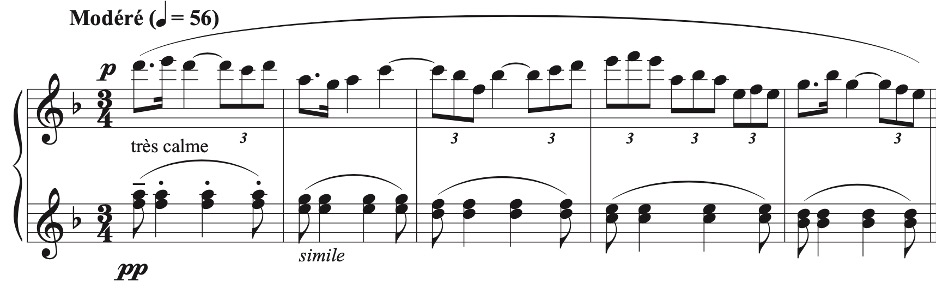
Example B.1. Violin Sonata, 1st mvt., mm. 9–13 (D Aeolian).
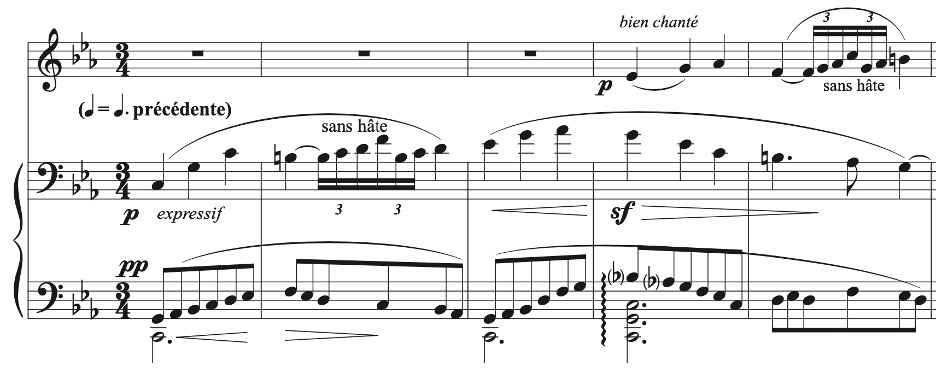
Example B.2. Violin Sonata, 2nd mvt., mm. 99–103 (C harmonic minor).

Example B.3a. C Lydian and a “minor” Lydian mode built on A.

Example B.3b. Modal superimposition (the resultant mode with enharmonic spellings).
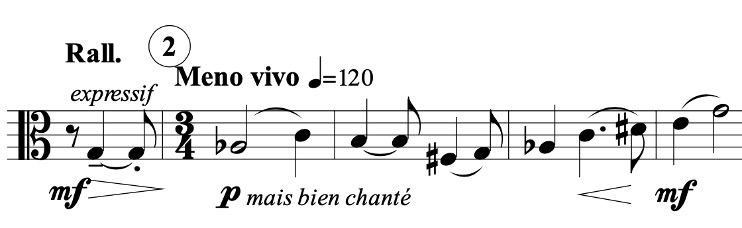
Example B.3c. Op. 25 Viola Sonata, 1st mvt., mm. 48–54 (Modal superimposition).

Example B.4a. “Major” Modal superimposition built on F.

Example B.4b. Op. 43 Viola Sonata, 1st mvt. mm. 96–98 (“Major” Modal superimposition).

Example B.5a. “Minor” Modal superimposition built on D
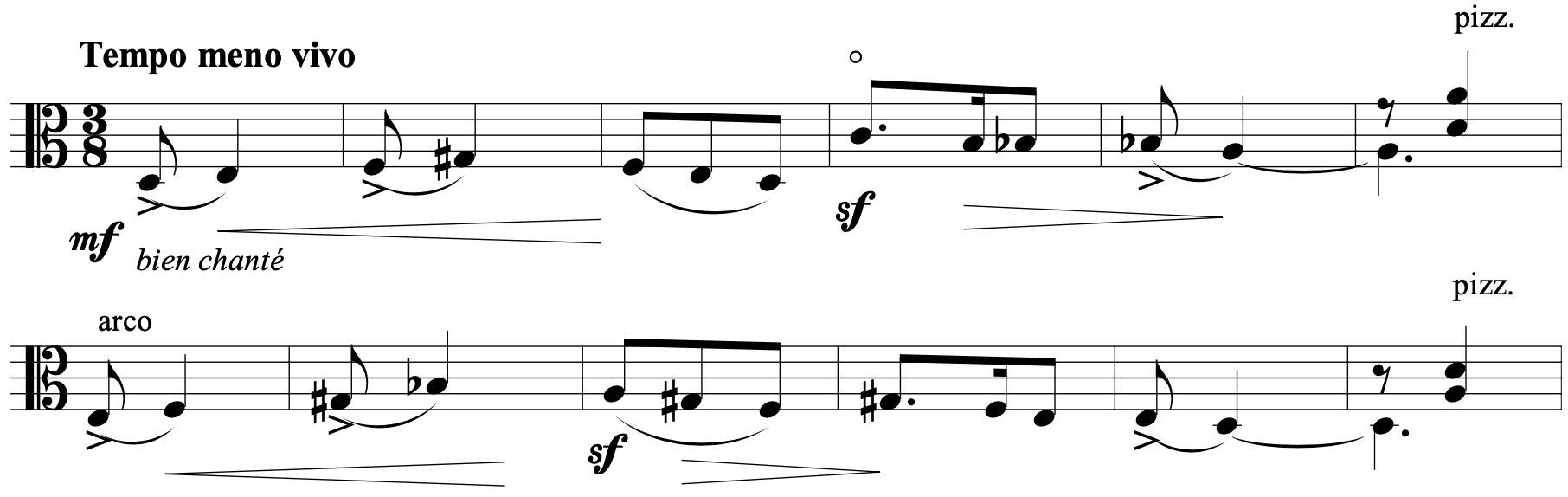
Example B.5b. Op. 43 Viola Sonata, 2nd mvt., mm. 89–100 (“Minor” Modal superimposition).

Example B.6a. G Lydian with a raised second scale degree.
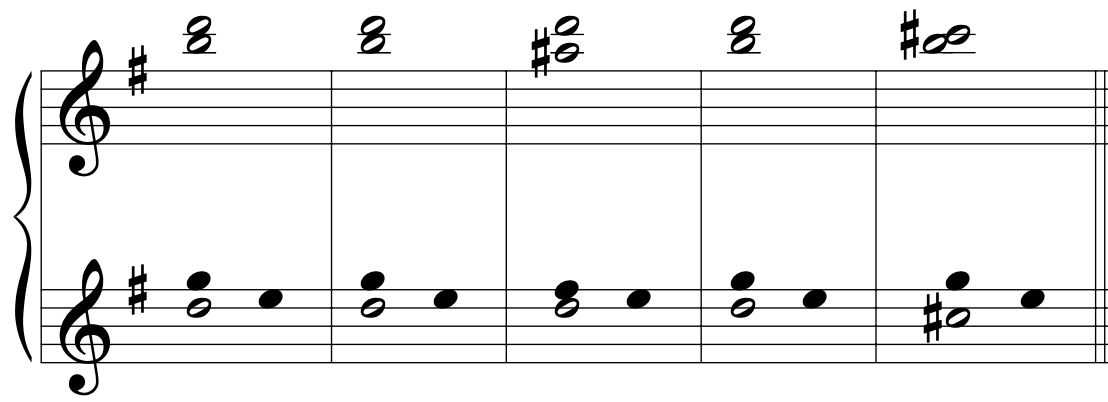
Example B.6b. Flute Sonata, 1st mvt., mm. 1–5 (harmonic reduction of the piano part).
Appendix C. Movement Titles and Keys
Sonata for Viola and Piano, op. 25
I. Allegro – A minor / “Chromatic”
II. Scherzo – F major
III. Complainte – D minor
IV. Ronde – A hybrid
Sonata in F-sharp Minor for Cello and Piano, op. 31
I. Allegro moderato – F-sharp minor
II. Nocturne – D minor
III. Allegro vivo – F-sharp minor
Sonata in G Major for Flute and Piano, op. 35
I. Très calme – Allegro – G major
II. Scherzo – D minor
III. Andante (dans le caractère d'une berceuse) – B-flat major
IV. Final – Vif – G major
Sonata in D Minor for Violin and Piano, op. 36
I. Lent - Modéré - Allegro moderato – D minor
II. Scherzo – G Major
III. Lent et grave – B minor
IV. Final – D major
Sonata for Viola, op. 43
I. Assez animé (dans le caractère d'une improvisation) - Allegro moderato (dans le caractère d'un menuet) – F major
II. Scherzo – A minor
III. Largo espressivo – F minor
IV. Fugue – F major
Appendix D. Selected Examples of Soulage’s Uses of Ostinatos
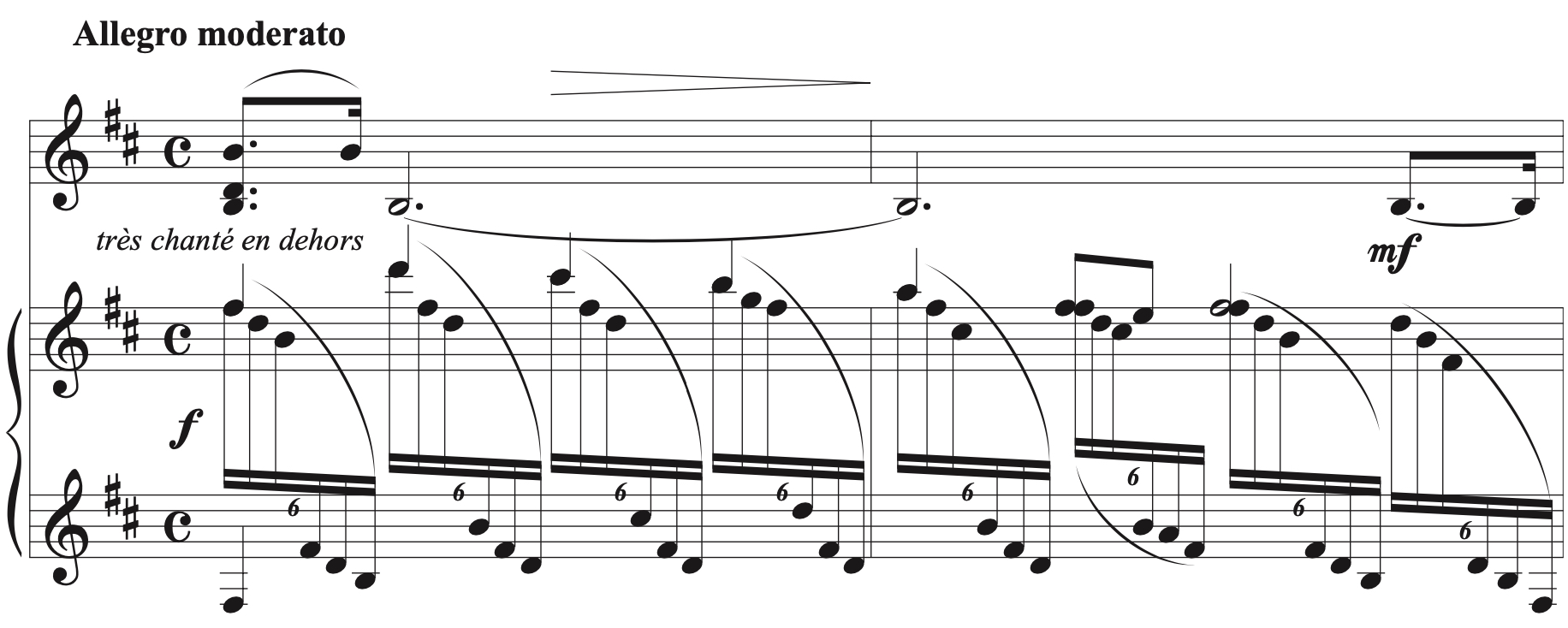
Example D.1a. Violin Sonata, 1st mvt., mm. 35–36.
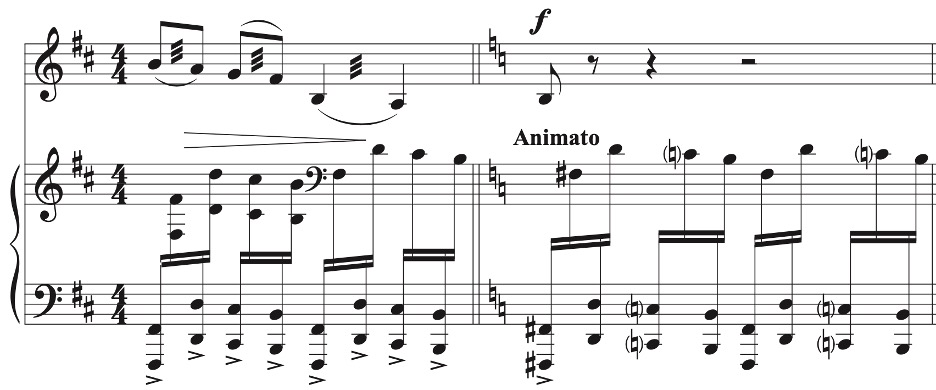
Example D.1b. Violin Sonata, 1st mvt., mm. 55–56 (example D.1a theme modified into an accompanimental ostinato).
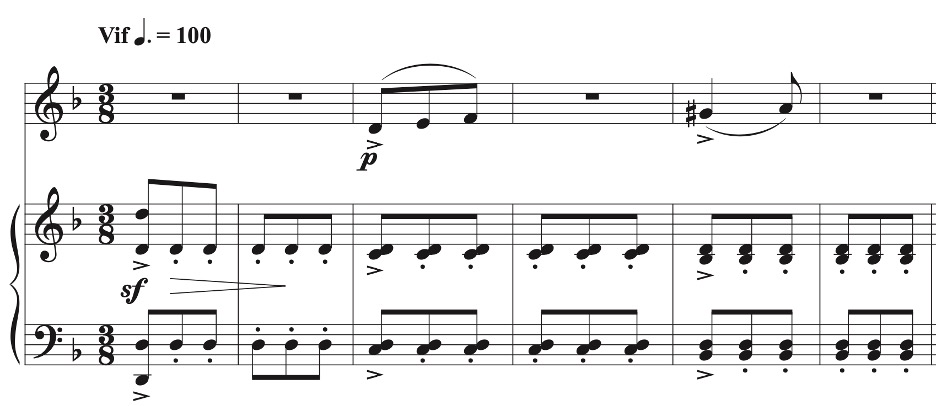
Example D.2. Flute Sonata, 2nd mvt., mm. 1–6 (ostinato to create forward motion).
Example D.3: Flute Sonata, 3rd mvt., mm 1–5 (soporific ostinato).
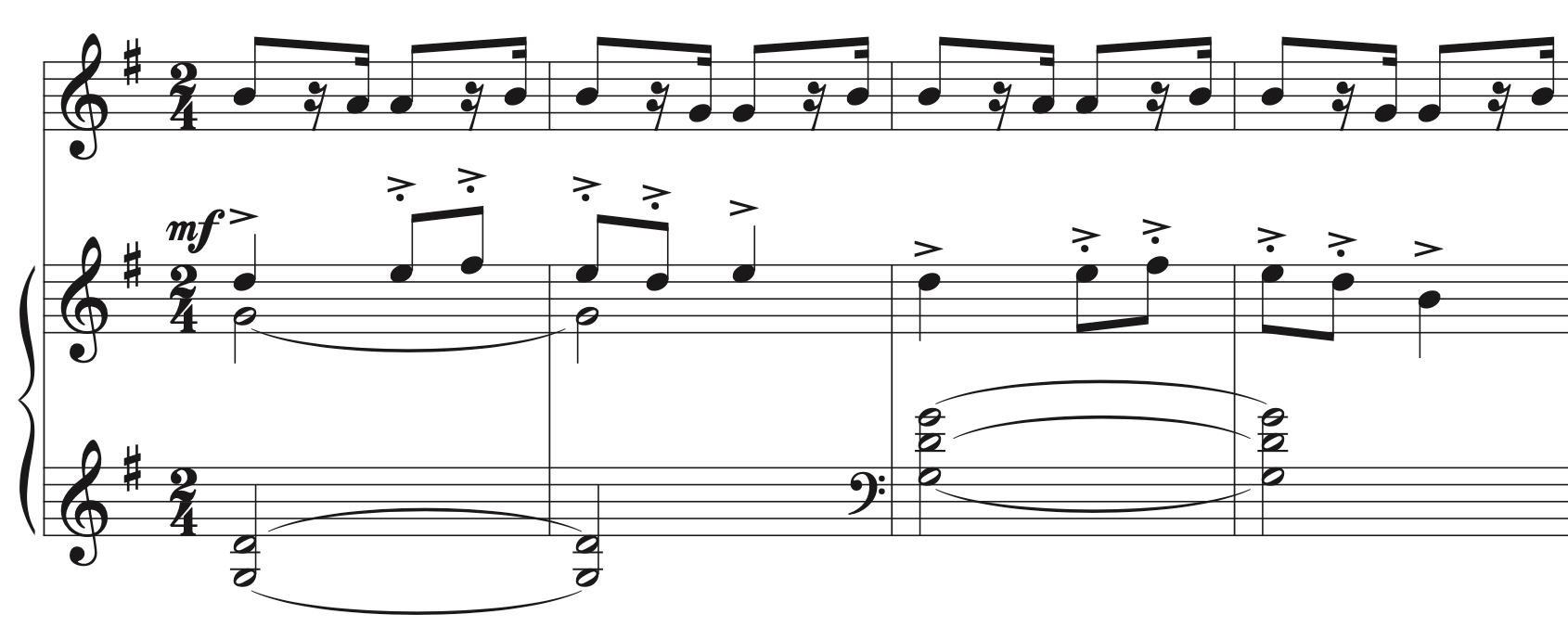
Example D.4a: Flute Sonata, 4th mvt., mm. 9-12 (ostinato derived from motive, used as a means to unite form. This is described in French sources as a “carillon obstiné”).
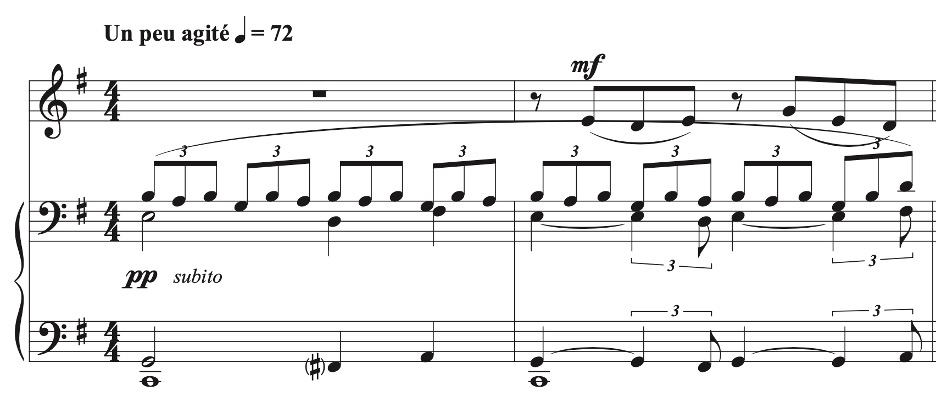
Example D.4b: Flute Sonata, 4th mvt., mm.106–107 (Here the motive (see Ex. D.4a, above) has been rhythmically modified).


 Copyright © The College Music Society. All Rights Reserved.