
Abstract
Pedagogical games serve serious purposes: deepening student engagement, promoting mastery of course content, and increasing motivation through peer support and constructive competition. Although instructors in many disciplines use pedagogical games, no consensus has emerged regarding what constitutes a pedagogical game or how to implement games effectively for student learning. I define pedagogical games as creatively framed thought processes or activities in which students participate, often with an incentive to win a prize, while deepening their understanding of course material. In this article, I outline five categories of pedagogical games, share suggestions for planning pedagogical games, discuss best practices informed by the scholarship of teaching and learning, address potential instructor concerns, present sample games for music theory and aural skills, and consider student responses and pedagogical benefits. I also share detailed directions for a variety of pedagogical games as resources for interested instructors. Students respond enthusiastically to pedagogical games, describing them as “fun” and mentioning them positively in course evaluations. Moreover, pedagogical games foster deep learning as students’ enjoyment and engagement increase their motivation. To explain why pedagogical games are effective for students’ learning, I explore topics of retrieval practice, psychological flow, motivation, and self-determination theory. By actively engaging with course material and building community with their peers, students who play pedagogical games can hone their skills in a low-pressure environment.
Introduction
Pedagogical games serve serious purposes—deepening student engagement, promoting mastery of course content, and increasing motivation through peer support and constructive competition. Although playing games in higher education might initially seem frivolous, instructors in many disciplines employ pedagogical games to boost student engagement and learning. For example, pedagogical games appear in fields such as business management (McMahon 2018), chemistry (Capps 2008), fashion (Gibson, Kincade, and Frasier 2013), and psychology (Vanags et al. 2012). Pedagogical games also span several areas of specialization in the field of music. For instance, music history students develop critical listening skills via listening games (McManus 2014) and examine primary sources and historical artifacts through the role-playing game Reacting to the Past (Burke 2014). Music business-industry explorations range from a single-class-period game (Herzig 2019) to a simulation infused with game elements during a week-long workshop (Brindisi and Sinkovich 2016). Noting psychological and neurological benefits for learning, Lisa Koops and Cynthia Taggart (2011) advocate adopting a playful approach that includes games in undergraduate and graduate music education courses.
Within the subfield of music theory pedagogy, a number of scholars mention pedagogical games. Most of these games focus on topics of music fundamentals, where they enliven repetitive exercises and forge supportive peer communities (Atkins and Murray 2013; Berry 2015; Clarke 2019; Dickinson 2020; Gillespie 2000). For instance, Stefanie Dickinson’s (2020) students use key signatures to spell words in response to verbal clues or race to beam a series of notes correctly in contrasting meters. Some authors present games for both fundamental- and intermediate-level topics (Buchanan and Burt 2019; Rifkin and Urista 2006; Snodgrass 2020), or activities that can adapt to either intermediate or advanced topics (Ripley 2019). For example, Deborah Rifkin and Diane Urista (2006) share games for topics ranging from scale-degree function to modulation. Another cluster of sources features advanced topics of chromatic harmony and pitch-class set theory (Ripley 2016; DeVlieger and Shafer 2019; Gingerich 1991). In pitch-class poker, Lora Gingerich (1991) prepares a custom deck of cards that represent different pitch classes; the game teaches students how to maximize a desired interval class in the interval-class vector created by each poker hand.
Despite this broad array of pedagogical games, no consensus has emerged regarding what constitutes a pedagogical game or how to use games effectively for student learning. By thinking critically about the purposes and contexts of pedagogical games and exploring the reasons why they work, I hope to inspire and equip instructors to use pedagogical games successfully. In this article, I outline five categories of pedagogical games, share suggestions for planning pedagogical games, discuss best practices informed by the scholarship of teaching and learning, address potential instructor concerns, present a variety of sample games for music theory and aural skills, and consider student responses and pedagogical benefits.
Defining Pedagogical Games
Higher education literature teems with terminology for games related to student learning, with terms such as pedagogical game, educational game, game-based learning, serious game, and gamification often appearing without a clear sense of how they overlap or diverge. The terms pedagogical game, educational game, and game-based learning can often be used synonymously, while serious game typically refers to individual, digital gaming. A commonly cited definition of gamification is “the use of game design elements in non-game contexts” (Deterding et al. 2011, 10). Extending this definition into the realm of gamified learning, Richard Landers (2014, abstract) describes gamification as “the use of game attributes…outside the context of a game with the purpose of affecting learning-related behaviors or attitudes.” Because prevailing usage of the term gamification refers to video-game design elements such as points, badges, and leaderboards, I prefer using the term pedagogical game to describe the approach I outline in this article.
I define pedagogical games as creatively framed thought processes or activities in which students participate, often with an incentive to win a prize, while deepening their understanding of course material. I have developed five categories of pedagogical games, which appear in Figure 1. While all five categories combine pedagogical activities and games, the balance between game and pedagogical elements varies for each category.
| Pedagogical Game Categories | Creative Illustrations | Creative Framings of Class Activities | Non-Competitive Pedagogical Games | Competitive Pedagogical Games | Ice-Breaker Games |
| Emphasis on Pedagogical Activities or Games | Strong emphasis on pedagogical activities | Some emphasis on pedagogical activities | Equal emphasis on pedagogical activities and games | Some emphasis on games | Strong emphasis on games |
| Examples of Pedagogical Games | Cadential six-four chord as undercover police detective | Music theory mock trials |
|
|
Sung introductions |
Figure 1: Categories of pedagogical games
Pedagogical games in the first category feature creative illustrations that appeal to students’ imaginations. These illustrations strongly emphasize pedagogical elements over game elements. For instance, I compare the cadential six-four chord to an undercover police detective to emphasize the chord’s dominant function despite its tonic spelling. I also encourage students to develop their own creative illustrations to aid memorization and to enable them to explain music-theoretical concepts to friends and loved ones who are not musicians.[1] As noted by Timothy Chenette (2016), cultivating creativity can yield many benefits for students, including increased engagement in course material and enhanced preparation for career success. Pedagogical games in the second category, creative framings of class activities, emphasize pedagogical activities somewhat more than games. They require active student participation and can generate high levels of enthusiasm among students. For example, I use music theory mock trials to help students analyze pieces whose ambiguous features invite multiple interpretations (Ripley 2019).
Non-competitive pedagogical games generally reflect an equal emphasis on pedagogical and game elements. For instance, in my adaptation of the game Twenty Questions for Theory II, each student receives an index card that specifies a different type of non-chord tone. Working in pairs, students ask each other three yes-or-no questions to reveal the identity of each personified non-chord tone. [2] For example, “Do you resolve down by step?...Are you prepared by common tone?...Are you a suspension?” Rifkin and Urista (2006) suggest several examples of non-competitive games for courses in aural skills, and my own aural skills students play non-competitive games of interval tag by passing a dry-erase marker to their classmates to decide who will identify the next interval they hear. [3] Rifkin and Urista’s (2006) games feature student improvisation and focus on topics of scale-degree function, modulation, and phrase structure. A helpful summary of the specific aural skills (e.g., tonic retention) developed through each game appears in an appendix to their article. In non-competitive games, no one wins or loses, and no prizes are distributed.
In the fourth category are competitive pedagogical games that emphasize game elements somewhat more than pedagogical activities by ending with prizes awarded to the winning students. I will discuss several competitive pedagogical games—including a chord-identification tournament, part-writing relay race, and theory bingo—later in the article. Pedagogical games in the final category place a strong emphasis on game elements. They consist of ice-breaker games that are unrelated, or only loosely related, to course content but which still serve the pedagogical aim of building rapport among students. At the beginning of the semester, for example, I have first-year aural skills students sing improvised introductions that include their names and fun facts (e.g., favorite ice cream flavor or favorite hobby) to help students learn each other’s names and grow accustomed to singing in public.
Categories of pedagogical games often overlap. For example, competitive and non-competitive games include creative framing of class activities, and many pedagogical games employ creative analogies to existing games or television shows. Even the distinction between competitive and non-competitive pedagogical games may be minimized, since degrees of competition can vary from game to game.
Humor can increase the effectiveness of pedagogical games. Among the five categories of pedagogical games described above, humor fits most smoothly into the first and last categories: creative illustrations and ice-breaker games. Humor melds with creative illustrations when amusing similes or stories directly connect to course content. Randall Garner (2006, 178) advocates for this type of humor, arguing that the most effective humor in an academic context is “specific, targeted, and appropriate to the subject matter.” In contrast, humor diverges from course content when it animates introductory ice-breaker activities or when humorous anecdotes shared by the instructor lighten the mood of the class. According to a study by Garner (2006), humor can positively impact students’ enjoyment of the course and their retention of the material covered. The type of humor matters, though—results from a study by Kristie Nienaber, Gwyneth Abrams, and Dan Segrist (2019) found that students are much more likely to engage with professors who use affiliative humor that affirms others and builds a positive class dynamic than with professors whose aggressive humor includes sarcasm and jokes told at the expense of others.
Planning Pedagogical Games
Pedagogical games can be effective at several stages of the learning process. After the initial explanation and early practice of a new topic, peer learning among teammates can fill in gaps in students’ understanding and provide them with social support. Playing pedagogical games at this stage often prompts students to ask questions to clarify their understanding of course material. Later in the learning process, games that incorporate speed-based elements—such as relay races—can motivate students to strive for greater mastery of skills. Finally, pedagogical games can enliven the process of exam preparation while reviewing a variety of topics in a short amount of time. In each of the scenarios I have described, pedagogical games provide immediate feedback and formative assessment for students, which can then be followed by summative assessment through graded assignments, quizzes, or exams. Whitney Berry (2015, 53) notes that, in contrast to the delayed feedback and high stakes of traditional educational assessment, pedagogical games provide opportunities for students to learn from “repeated experimentation and failure within a low-risk environment by keeping feedback cycles rapid and stakes low.”
I rarely permit students to consult their class notes or textbooks during pedagogical games; however, team-based games let students confer with their peers. Playing pedagogical games without access to written or electronic resources helps students practice retrieval by testing their recall of course material. Retrieval practice strengthens the neural pathways that enable students to access information stored in long-term memory for later use in working memory (Lang 2016). The benefits of retrieval practice for student learning exceed those of merely restudying the material, and practicing retrieval can help students accurately assess their understanding of course material (Kenney and Bailey 2021). Applications of retrieval practice in music theory pedagogy and jazz pedagogy respectively prepare students to assimilate new information through creative warm-up exercises (Engelsdorfer 2017) and help students transfer what they learn to new musical contexts (Wellmann and Skillicorn 2023). In sum, pedagogical games promote student learning through retrieval practice without the negative impact of anxiety evoked by traditional quizzes and exams.
When preparing for a pedagogical game, Dickinson (2020) recommends giving students advance notice of the upcoming game day to motivate them to review topics and build speed outside of class. I sometimes take a similar approach, but I usually tell students what to review and say that students should come to our next class prepared to apply their knowledge of these topics. Students’ relief at discovering this application is not a pop quiz increases their enjoyment of the game. On other occasions, I do not make any announcement in advance. My hope is that students who skipped class that day will be motivated to attend more consistently after learning what they missed from their classmates.
While most pedagogical games occur within a single class period, extended games are also possible. For example, my game Set Theory Survivor adapts the television show Survivor to frame a four-week unit on pitch-class set theory (Ripley 2016). In Set Theory Survivor, as on the show, students work together in small groups, or tribes, to complete worksheets called challenges; however, in an important modification to the structure of the show, no students are voted out of their tribes. The tribe that earns the highest cumulative score on the challenges wins the game.
Technology provides additional avenues for pedagogical games, such as Jeopardy!-style review games created with the online resource Factile. [4] See https://www.playfactile.com/. An alternative resource for creating Jeopardy!-style quiz shows (as well as other games) is https://www.flippity.net, which uses information from Google Sheets. Another technology-enhanced game is Kahoot!, which features multiple-choice questions, game-show music, and a continuously updated scoreboard. [5] See https://kahoot.com/schools-u/. Sherlock Licorish and Adriaan Lötter (2022) provide recommendations for how to use Kahoot! effectively for student learning and share research findings that playing Kahoot! positively affects classroom dynamics as well as student motivation and engagement. Technology can also enhance pedagogical games by incorporating creative visual and aural components. For example, I use a customized opening credits video to introduce Set Theory Survivor.
Broadly speaking, pedagogical games may be either non-digital or digital. According to Nitin Naik (2017), non-digital games typically do not require participants to use computers or other digital devices, nor do they rely on electronic means of management. Arguing elsewhere for the use of non-digital pedagogical games, Naik (2014) notes that advantages of adopting non-digital games include ease of learning, absence of technological barriers, and—most importantly for my discussion—social interactions between students and instructor. Digital pedagogical games are amply discussed outside the field of music; however, these games typically accommodate single players rather than groups. [6] See, for example, work by Krouska, Troussas, and Sgouropoulou (2022); Vlachopoulos and Makri (2017); and Westera (2019). While most of the games I use with my students are non-digital, I occasionally incorporate digital aspects, such as having students use their cell phones to respond to questions during a game of Kahoot!. Regardless of whether digital devices are present, I prioritize social interaction by designing games that students can play together in class.
Best Practices
When designing pedagogical games, it is important to consider best practices for using games effectively. The guidelines I have developed reflect my experience using pedagogical games in classes at several institutions in different geographical regions of the United States. These institutions include large and medium public universities, a large private university, and a small liberal arts college. I also draw on interdisciplinary research from the scholarship of teaching and learning. Figure 2 summarizes these best practices, and the following discussion examines each practice in greater detail.
- Explain the rules at the beginning of the game. Don’t assume that everyone already knows how to play, even if the game is widely recognized.
- Emphasize team games to reduce pressure on individual students. Team games balance constructive competition between teams with cooperative support and peer learning among teammates.
- Maintain civility and respect among the players. Encourage team spirit, but curb excessively competitive remarks.
- Give non-academic prizes and keep them small. Students take winning or losing less personally when their grades are not affected by the outcome of the game.
Figure 2: Best practices for effective pedagogical games
First, be sure to explain the rules at the beginning of the game. Because students bring diverse backgrounds and experiences to the classroom, it is important not to assume that everyone already knows how to play, even if the game is widely recognized. Receiving a clear explanation of the rules benefits all students but may be especially important for international students. By explaining game rules clearly, instructors can mitigate student confusion and remain actively involved in students’ engagement and learning (Herzig 2019). The enthusiasm of students who are already familiar with the game tends to be contagious, and, in some cases, students’ engagement with the pedagogical version of a game sparks their interest in the original game or television show. For instance, some of my students reported watching the television show Survivor after their interest was piqued by our class’s Set Theory Survivor game.
Second, emphasize team games to reduce pressure on individual students. Team games balance constructive competition between teams with cooperative support and peer learning among teammates. David Johnson and Roger Johnson (1999) describe this approach as intergroup competition. One benefit of designing pedagogical games as intergroup competitions is that students of different achievement levels can have equal chances of winning the game. When assigning students to teams, I balance overall achievement levels so teams are evenly matched. Besides promoting fairness in the competition, balancing achievement levels among teams makes efficient use of class time by reducing the likelihood that teams will finish their tasks in widely differing amounts of time, leaving some students bored while others feel rushed. Knowing that each team has an equal chance of winning the game encourages students to engage fully with the activity and to put forth their best effort, rather than coasting or giving up prematurely.
Before sharing the team rosters with the students, I use their current course grades to create achievement-balanced teams. When dividing a class into three teams, for example, the three students with the highest grades in the class become the highest-achieving student in their respective teams. The student with the fourth-highest grade is assigned to the same team as the student with the third-highest grade, the student with the fifth-highest grade joins the team of the second-highest-scoring student, and so forth. After every student has been assigned to a preliminary team, I reassign students of similar achievement levels to different teams as needed. When forming these final teams, I break up cliques of students who often work together during class and balance student demographics, such as gender, as much as possible. Finally, I alphabetize the names within each team so students are not singled out as high- or low-achieving members of their teams.
Having teammates sit together during class and naming teams after the institution’s colors and mascot help foster team spirit and a sense of belonging. Intergroup competition can also provide a way to address gender-specific concerns related to competition. Experimental research by Marion Wittchen et al. (2013) found that intergroup competition led to increased effort and more positive affect for women, while the levels of effort and positive affect did not differ between intergroup and interindividual competitions for men. In light of this research, I suggest that team-based games can provide a way to motivate students of different genders without causing excessive competitive stress.
Third, maintain civility and respect among the players. I encourage team spirit but curb excessively competitive remarks. Accordingly, I tell students that it is great to cheer each other on and be proud of their teams, but it is not acceptable to make disparaging remarks about other teams or boast that the other teams are going to lose. Clarifying expectations for collegiality and fair play is especially important when working with students who are very competitive or demonstrate high levels of team spirit, such as two roommates who came to class wearing clothes and make-up in the colors of their respective teams during an extended pedagogical game. When playing extended games, it is also important to provide enough time for the entire class to bond before and after the competition. For instance, I wait to begin Set Theory Survivor until the middle of the semester, when a positive class dynamic is firmly established and students are accustomed to working constructively with their classmates. On the day I announce the winning tribe, I intentionally help students reconnect with classmates from opposing tribes by having the class sit in a circle to debrief the game while sharing doughnuts.
Fourth, and finally, award small, non-academic prizes instead of academic prizes such as extra credit. Students take winning or losing less personally when their grades are not on the line, so non-academic prizes free students to participate and help their teammates without fear of their grades being negatively affected by the outcome of the game (Berry 2015). Prizes can range from “bragging rights” to pencils or candy, items from the dollar store, and, for extended games, modest gift cards. Pencils are the most common and affordable prizes that I give. I collect holiday-related pencils, as well as decorative pencils unrelated to any holiday, throughout the year. Students choose their prizes from an eclectic array of pencils—some students select pencils that match the current season, while others welcome the opportunity to acquire a Valentine’s Day pencil in the fall or a Christmas pencil in the spring. I sometimes combine pencils for the winning team with candy for the entire class. For a review game during the last days of class, I furnish more substantial prizes. Prizes I offered for an early-December game of theory bingo included a miniature stapler with staples, a 50-piece puzzle, small decorations for Christmas and Hanukkah, and other items purchased at the dollar store. I reserve gift cards as prizes for extended pedagogical games that occupy several weeks of the semester. Ten- to fifteen-dollar gift cards for Amazon and Starbucks are especially popular with my students.
Potential Instructor Concerns
Before proceeding to examples of pedagogical games for music theory and aural skills classes, I would like to address some concerns that instructors may have when deciding whether to adopt pedagogical games. Perhaps the foremost concern for instructors is time—both time spent during class and preparation time outside of class. Because of curricular demands to cover a broad array of topics and help students cultivate skills ranging from music literacy to advanced analysis, all within the span of a few semesters (Laitz 2016), some instructors may have misgivings when considering whether to allocate class time for pedagogical games. While every pedagogical decision involves a trade-off in terms of time, I believe that class time spent playing pedagogical games is time well spent. The positive impact of pedagogical games on student learning will be discussed later in this article.
I typically use brief games, most of which require a class period or less, approximately three times during a semester-long course. I vary the types of games played within a single course; for example, Theory II might include a music theory mock trial, a part-writing relay race, and a team-based exam review game. When using an extended pedagogical game that unfolds over several weeks, I limit the number of additional games throughout the semester. My goal is to use pedagogical games to enhance student motivation at key points during the course, without incorporating games so often that they become our typical class activities. [7] Naik (2017, 239) similarly concludes that game-based learning works best as a “co-instructional teaching strategy…not an alternative to lectures or other teacher-student interactional forms.” It is worth noting that my style of teaching already features active-learning approaches with frequent opportunities for students to collaborate during class. When I frame an activity as a game, students perceive that activity as something different from the norm and tend to respond with increased curiosity and attention. Pedagogical games can also replace selected assessments, such as quizzes, reducing grading time for instructors while still providing students with rapid feedback on their work. In this case, the additional class time required for pedagogical games is minimal since games occupy time that would otherwise be reserved for assessment.
In terms of preparation, the amount of time that is necessary depends on the type of game. Games that rely on written course materials (e.g., custom bingo cards for theory bingo or challenge worksheets for Set Theory Survivor) require a fair amount of prior preparation. For instructors embarking on their first exploration of pedagogical games, I suggest adopting resources from this article or from other sources in the literature. [8] See, for example, the games listed in Appendix A or Appendix B. A search for “music theory” on www.playfactile.com brings up several Jeopardy!-style games. Commercially available games include IV–V–I: The Harmony Card Game (https://musicteachertools.myshopify.com/products/iv-v-i) and Escape Tone: A Music Theory Escape Game (https://amygordonmusic.com/product/escape-tone-a-music-theory-escape-game-intermediate/). After instructors and students experience the benefits of pedagogical games, branching out to create new games becomes a more worthwhile investment. Once customized to suit the students and curriculum at an institution, pedagogical games become reusable course materials that provide engaging lessons with very little additional preparation.
Even if time is not a substantial concern, the preferences and temperament of some instructors may make them reluctant to incorporate games into their teaching. Instructors may prefer to focus on making learning engaging for students rather than overtly attempting to make learning fun. For instance, Nicola Whitton (2011, 604–5) proposes a model of learning engagement that encompasses factors of challenge, control, immersion, interest, and purpose, the last of which is especially important for adult learners. A subsequent study of student perceptions of fun and learning found that, while nearly all participating students wanted their educational experience to be fun, students identified a variety of aspects that contribute to a fun learning environment. These aspects—stimulating pedagogy, instructor engagement, safe learning spaces, shared experience, and a low-stress environment—can be present during pedagogical games but may also be cultivated through other dimensions of a course (Whitton and Langan 2019, 1004–5).
Instructors may also have concerns regarding making pedagogical games accessible for students with disabilities. While not an exhaustive list, potential accessibility concerns include limited mobility, visual or hearing impairments, anxiety and performance pressure, the need for extended time, and difficulty understanding instructions. In addition to the solutions I suggest based on my experience teaching students with disabilities, I encourage instructors to explore sources (e.g., McCord 2017) that address a wider range of disabilities. Because each student has unique experiences, strengths, and challenges, the following suggestions must be generalized with care.
To make games that would normally require rapid movement (e.g., relay races) accessible for students with limited mobility, instructors can designate a team scribe who records on the board answers provided by each teammate. Alternatively, Dickinson (2020) suggests having team members sit together and take turns answering questions by rotating an iPad or paper tablet. This approach can also help if limited board space or a large class size makes it impractical for students to race to the board.
While I have not encountered students with visual or hearing impairments that require accommodations through campus disability services, I do permit students who have trouble reading the board from the back of the classroom to stand closer to the board than would usually be allowed during relay races. For helpful resources regarding teaching visually impaired students in music theory and aural skills, see Gillespie (2013) and Saslaw (2009). Kimberly McCord (2017) provides information on working with hearing-impaired music students.
When my students voluntarily disclose their disabilities, they most frequently mention ADHD and anxiety, the latter of which they often link to taking tests or performing in front of the class. The ungraded nature of pedagogical games in my classes, combined with the peer support provided by team-based games, reduces the impact of anxiety on students’ learning and lessens the need for extended time accommodations during these activities. To help students who have difficulty understanding instructions for class activities, I recommend displaying concise written directions for playing each game in addition to giving directions verbally. Questions for games such as theory bingo can also be displayed via classroom technology. While providing visual reinforcement of aurally delivered information may be especially helpful for students with cognitive disabilities, it also benefits the entire class by engaging with multiple learning preferences. Such modifications reflect the principles of Universal Design (Iverson 2020; Quaglia 2015) by enhancing the learning of all students while making class activities more accessible for students with disabilities.
I encourage all instructors to begin by clarifying their goals for using a pedagogical game. Potential goals include re-energizing the classroom, promoting student engagement, building community among students, and connecting with students whose experiences and preferences differ from those of the instructor. Keeping in mind specific reasons for trying a pedagogical game can bolster instructors’ motivation and enable them to demonstrate a level of enthusiasm that helps students “buy in” to the activity. I also recommend involving students in running the game. Students can serve as scorekeepers and timekeepers for their respective teams, while high-achieving students or teaching assistants can provide leadership and peer tutoring within their teams. Students may also help plan pedagogical games; for example, students in my post-tonal theory course developed games of Kahoot! to help their classmates apply material from group presentations.
Examples of Pedagogical Games
Having considered best practices for using pedagogical games effectively and addressed potential concerns, I will now share examples of pedagogical games for music theory and aural skills. Figure 3 lists eighteen pedagogical games that I have developed (except for Kahoot! and Factile) and used successfully in my courses. While instructors may choose to adapt these games from written to aural contexts, and vice versa, an asterisk (*) denotes games that are primarily intended for aural skills courses, while the remaining games are designed for music theory courses.
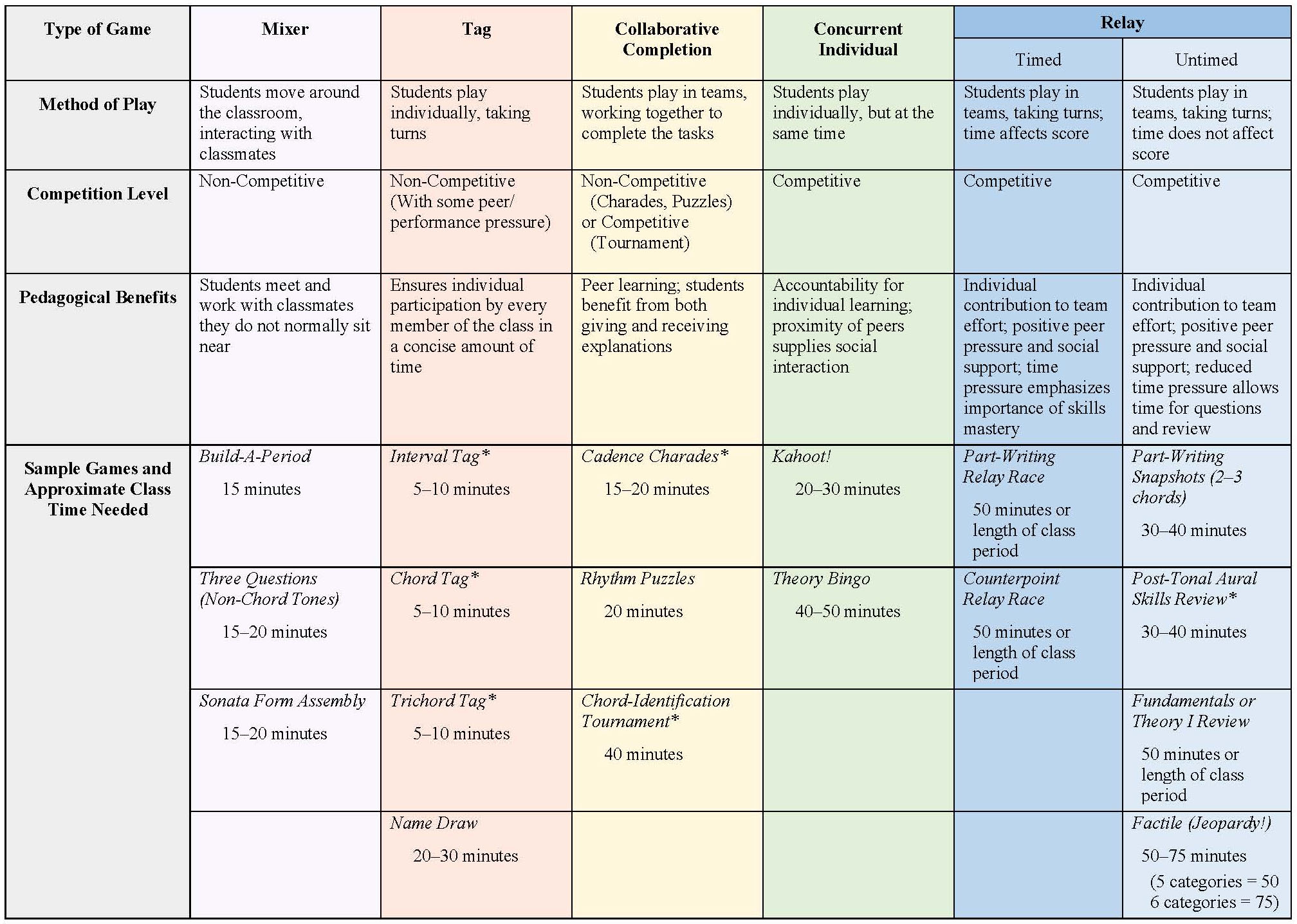
View accessible version
| Type of Game | Mixer | Tag | Collaborative Completion | Concurrent Individual | Relay | |
| Timed | Untimed | |||||
| Method of Play | Students move around the classroom, interacting with classmates | Students play individually, taking turns | Students play in teams, working together to complete the tasks | Students play individually, but at the same time | Students play in teams, taking turns; time affects score | Students play in teams, taking turns; time does not affect score |
| Competition Level | Non-Competitive | Non-Competitive (With some peer/ performance pressure) | Non-Competitive (Charades, Puzzles) or Competitive (Tournament) | Competitive | Competitive | Competitive |
| Pedagogical Benefits | Students meet and work with classmates they do not normally sit near | Ensures individual participation by every member of the class in a concise amount of time | Peer learning; students benefit from both giving and receiving explanations | Accountability for individual learning; proximity of peers supplies social interaction | Individual contribution to team effort; positive peer pressure and social support; time pressure emphasizes importance of skills mastery | Individual contribution to team effort; positive peer pressure and social support; reduced time pressure allows time for questions and review |
| Sample Games and Approximate Class Time Needed | Build-A-Period 15 minutes |
Interval Tag* 5–10 minutes |
Cadence Charades* 15–20 minutes |
Kahoot! 20–30 minutes |
Part-Writing Relay Race 50 minutes or length of class period |
Part-Writing Snapshots (2–3 chords) 30–40 minutes |
| Three Questions (Non-Chord Tones) 15–20 minutes |
Chord Tag* 5–10 minutes |
Rhythm Puzzles 20 minutes |
Theory Bingo 40–50 minutes |
Counterpoint Relay Race 50 minutes or length of class period |
Post-Tonal Aural Skills Review* 30–40 minutes |
|
| Sonata Form Assembly 15–20 minutes |
Trichord Tag* 5–10 minutes |
Chord-Identification Tournament* 40 minutes |
Fundamentals or Theory I Review 50 minutes or length of class period |
|||
| Name Draw 20–30 minutes |
Factile (Jeopardy!) 50–75 minutes (5 categories = 50, 6 categories = 75) |
|||||
Figure 3: Summary of sample pedagogical games
These games reflect two of my previously discussed categories of pedagogical games: non-competitive and competitive games. Nine sample games are competitive; nine are non-competitive. Based on their method of play (e.g., individual, in teams, taking turns, etc.), I further classify these games into five types—mixer, tag, collaborative completion, concurrent individual, and relay (timed or untimed)—and share the pedagogical benefits of each type. To aid instructors in lesson planning, I include the approximate amount of class time needed for each game with the caveat that time varies with the number of students enrolled, particularly in games that require turn taking. [9] In general, aural skills classes tend to be smaller than music theory classes. Smaller class sizes make it more practical, in terms of class time, to play games for which students take turns individually (e.g., tag). However, instructors may still prefer to emphasize team-based games in contexts that could generate performance anxiety among students. When playing a game for the first time, I recommend allocating a few extra minutes to offset the learning curve associated with implementing a new game.
Detailed directions for playing each of the games mentioned in Figure 3 appear in Appendix A. While these sample games are intended for undergraduate students, pedagogical games can also be effective at the graduate level. For instance, master’s and doctoral students respond well to music theory mock trials (Ripley 2019), and Daisy Abbott (2019) reports positive results of a study that created a pedagogical game to teach graduate research skills. Drawing competitive and non-competitive games from the music theory pedagogy literature, Appendix B aligns games mentioned by several authors with the types of games I have identified (including tag, collaborative completion, concurrent individual, and timed relay). These sources supply enough information for instructors to adopt the games without much additional preparation.
I will now discuss in greater detail three competitive games for undergraduate students: chord-identification tournaments, part-writing relay races, and theory bingo. Each of these games can be played within a single fifty-minute class period. Chord-identification tournaments emphasize aural skills, while part-writing relay races and theory bingo focus on written skills.
During chord-identification tournaments, students work together in teams of three or four to identify the quality and inversion of the chords they hear. Teams earn one point for each correctly identified chord, and the team with the most points wins the tournament. By way of illustration, the chords I include in a tournament for my third-semester aural skills class appear in Figure 4.

Figure 4: Chord-identification tournament for Aural Skills III
Each round of the tournament features a different aspect of chord identification. The first round focuses on triad quality and inversion, while the second round asks students to determine whether each chord they hear is a triad or a seventh chord. Round 3 features qualities of root-position seventh chords, and Round 4 focuses on inversions of major-minor seventh chords. Round 5 is cumulative, requiring students to identify a variety of triads and seventh chords by quality and inversion. The extensive practice and peer learning of this tournament can, if desired, prepare students for an individually completed quiz.
For part-writing relay races, I divide the class into teams of five to seven students and specify the key, Roman numerals, and desired rhythm for a chord progression. Students take turns writing chords on the board, and I note the time it takes each team to complete the progression. In a classroom with staff-lined chalkboards on multiple walls, I assign each team to work at a different board. No more than one student per team may write on the board at any given time. Each student, in turn, writes the next chord in the team’s progression while the other team members call encouragement and advice from across the room. When not at the board, students monitor the progress of their team’s chord progression and identify errors to resolve before their team declares itself finished and records its time.
Figure 5 shows a progression I use for a part-writing relay race near the beginning of Theory II. Besides completing the progression, I ask students to identify any second-inversion triads as cadential, passing, or pedal, and to label the final cadence by type.
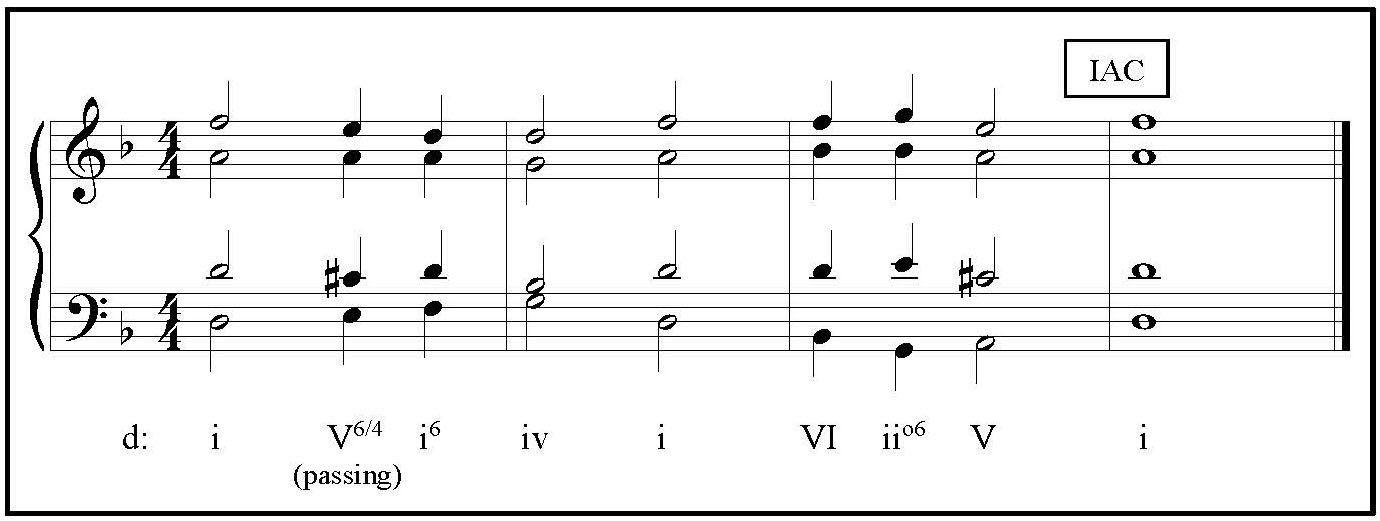
Figure 5: Chord progression for Theory II part-writing relay race
For the sake of fairness, all teams write the same progression. I do not typically encounter problems with students copying the work of opposing teams; students stay engaged with their own team’s work, and voice-leading constraints based on each team’s voicing of the first chord tend to draw teams down diverging paths. The ungraded nature of this activity further reduces the temptation to copy opponents’ work. Once teams finish writing the progression, they trade places for error detection. Errors add to the responsible team’s time—ten seconds for a minor error (e.g., incorrect doubling) and twenty seconds for a major error (e.g., parallel fifths)—and the team with the shortest total time wins the race. To ensure accuracy, I verify the errors students find and determine whether errors are major or minor.
In contrast to the preceding team-based examples, students play theory bingo individually. Each student receives a custom bingo card with a different random arrangement of answers to review questions and an “I love theory” free space. One of my bingo cards for Theory I appears in Figure 6. I use a free online bingo-card generator to prepare these cards. [10] See https://print-bingo.com/.
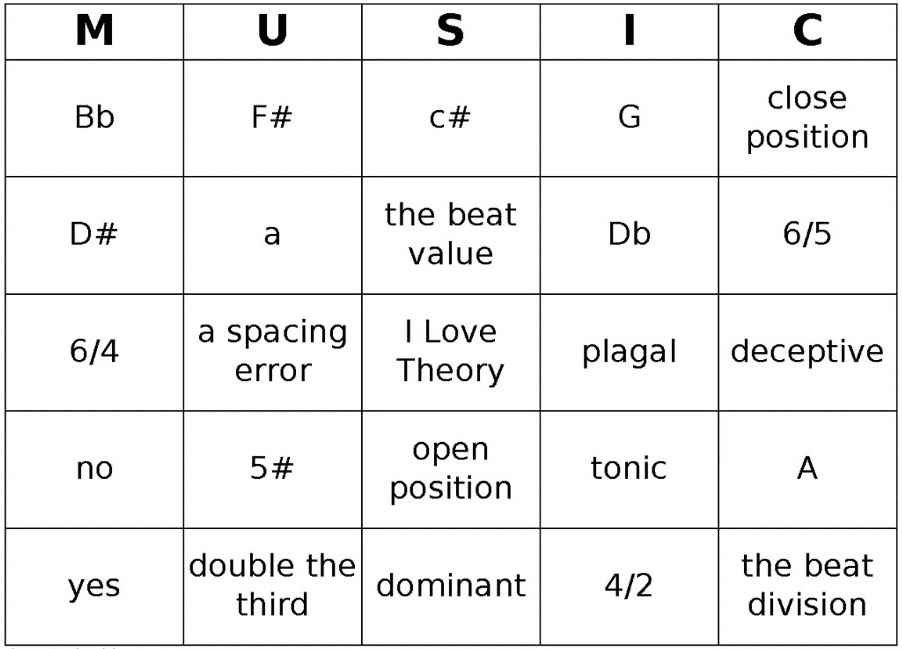
Figure 6: Sample bingo card for Theory I (created at https://print-bingo.com)
Students take turns answering questions such as “What harmonic function does the viio chord have?” and use pieces of candy to mark the answers—in this case, “dominant”—on their bingo cards. Regardless of who answers a question, all students can mark the correct answer (in any column) if it appears on their cards. All students receive prizes for the first bingo they find. A full list of the questions I use when playing theory bingo as part of the final exam review for Theory I is available in Appendix C. Questions span a variety of topics—rhythm and meter, scale degree names, key signatures, intervals, figured bass and chord inversions, harmonic functions and common progressions, and part-writing guidelines—and I switch topics frequently when determining the order of questions. Adding to the festive game-day atmosphere, I invite students to decorate the board before we begin to play. Artwork by my students appears in Figure 7.
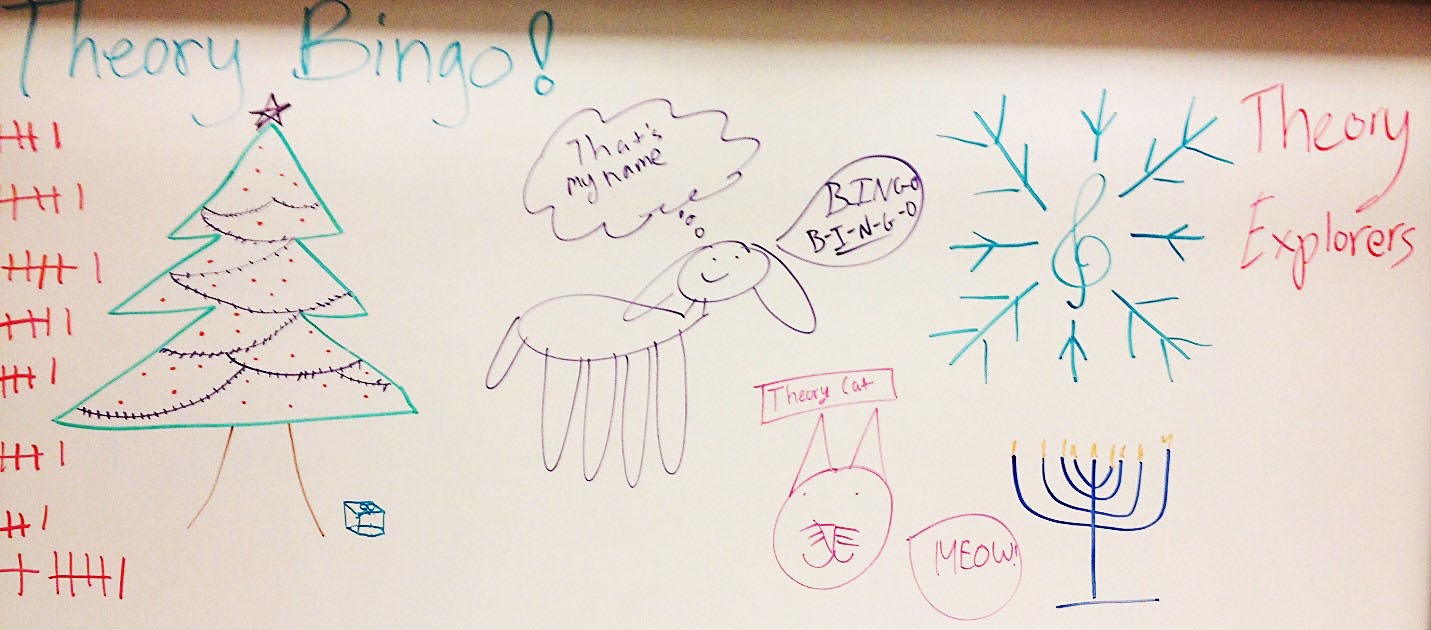
Figure 7: Student artwork for theory bingo
I first encountered theory bingo, including an “I love theory” free space, through work by Jeff Gillespie (2000), who uses pedagogical games during a ten-day intensive course in music fundamentals. The materials and information discussed above were developed for my own course. Alternative approaches to theory bingo also appear in the literature; for instance, Jennifer Snodgrass (2020) creates bingo games for topics related to triads, chromatic chords, and aural skills, while Dickinson (2020) features bingo cards with music notation that students examine to find specific interval or chord qualities in the indicated columns.
It is important to note that the games I have described are pedagogical framings, not content prescriptions. The chord-identification tournament, for example, can become an exercise in aural cadence recognition or aural analysis of small forms. Relay races work for counterpoint as well as part-writing, and theory bingo can feature review questions for early or advanced courses. Extensions of these games beyond music theory and aural skills are also possible. Many of my games emerged as creative framings of topics and exercises that were required within a fixed curriculum. For instructors who teach within a fixed curriculum, I recommend using pedagogical games to add variety while still meeting the shared objectives of the course. I encourage instructors to think creatively as they adapt each game to the needs of their students. Because the ultimate goal of using pedagogical games is to enhance student learning, this purpose ought to guide instructional decisions when planning and playing each game.
Student Responses and Pedagogical Benefits
Students respond enthusiastically to pedagogical games, describing them as “fun” and requesting additional games. In their course evaluations, students frequently mention “creative activities” as the most enjoyable elements of my courses, and some students refer to specific games, such as Set Theory Survivor, when praising the creative course design. As an instructor, I consistently find that pedagogical games raise class energy levels and reinvigorate students. For example, my Theory I class played theory bingo during the last week of classes. Instead of the stress and weariness that are all too common among students as finals approach, students exhibited high levels of energy during the game as we reviewed for the final exam. I can also safely say that I have never seen my Theory II students more passionate about part-writing at 8:30 in the morning than when they were running a part-writing relay race. Dana DeVlieger and Jennifer Shafer (2019) similarly conclude that starting each class period with a brief review game motivates students to arrive punctually and be alert during early morning classes. Reasons for the positive effects of pedagogical games emerge through further examination of sources from the literature in music theory pedagogy and the scholarship of teaching and learning.
Students’ heightened engagement may be at least partially attributed to the psychological experience of flow, which often emerges while playing games and creates favorable conditions for learning (Csikszentmihalyi 1997). I frequently observe signs of flow—such as intense, undistracted focus on the activity at hand and a sense of time moving quickly (Nakamura and Csikszentmihalyi 2014)—in my students when we play pedagogical games. Research by Şeyma Özhan and Selay Kocadere (2020) found that students’ experience of flow and emotional engagement in a gamified online learning environment sparked motivation and led to student success. Regina Conti (2001) similarly connects losing track of time and experiencing time as passing quickly with intrinsic motivation. The experience of fun and a sense of flow during pedagogical games is not solely the purview of students; pedagogical games can also make teaching more enjoyable for instructors (McMahon 2018) and provide a respite for instructors and students from the mid-semester doldrums.
Students can benefit emotionally from playing pedagogical games because these ungraded activities encourage students to celebrate progress and cope with failure by recasting failure as a normal part of the learning process (Berry 2015). In the field of mathematics pedagogy, Naik (2014) argues that game-based learning can help overcome students’ resistance to studying academic subjects with which they have previously had negative experiences. Because of similarities between music theory and mathematics (Barroso et al. 2019; VanHandel 2012), this benefit of playing pedagogical games may be significant for undergraduates enrolled in core music theory courses, especially for students who must retake one or more courses before passing. [11] Citing similarities such as an abstract system of representation and the need to balance skill building with understanding how concepts interrelate, Leigh VanHandel (2012) applies research-informed strategies for teaching mathematics to music theory pedagogy. Research by Connie Barroso et al. (2019) further confirms a link between music theory and mathematics by discovering that students’ ACT math scores and math course experience were important predictors of students’ course grades in Music Theory I and II.
Pedagogical games can also aid in class bonding and relieve stress during difficult circumstances such as the COVID-19 pandemic (Cavanagh 2021; Krouska, Troussas, and Sgouropoulou 2022). These benefits remain available during temporary disruptions of face-to-face instruction. For instance, my Theory II students played a cadence-focused game of Kahoot! via Zoom when winter weather conditions prompted our institution to hold classes remotely. The fun activity tempered students’ disappointment at not having a snow day and enabled us to keep making progress in our coverage of course material.
Turning to effects of pedagogical games on student learning, Douglas Buchanan and Patricia Burt (2019) describe a fundamentals-level Music Theory Olympics that includes a variety of pedagogical games in both written and aural domains. [12] Following a series of team-building activities throughout the semester, the final Music Theory Olympics event includes the following games: scale-spelling relay, solfège that tune, interval bingo, rhythm composition challenge, and three-legged triad spelling race. A comparison of student scores from one year to the next shows that students who participated in the Music Theory Olympics scored an average of eleven percentage points higher on identical fundamentals exam questions than did students from the previous group who did not take part in the Music Theory Olympics. Students reported that the Music Theory Olympics also had a strong positive impact on community among classmates, comprehension and fluency with fundamentals, and motivation to practice fundamentals. Similarly, empirical results of my classroom-based study of Set Theory Survivor reveal that students’ participation in this game led to statistically significant increases in their level of comfort using set theory to analyze post-tonal music and their self-reported ability to perform specific set-theoretical operations (Ripley 2016). More than 90% of students enjoyed the game, and students described Set Theory Survivor as a “bonding experience” that promoted an increasingly open dialogue among members of the class.
Research beyond the field of music theory corroborates these results. An empirical study of non-digital pedagogical games in a first-year mathematics course observed increased class scores in units that employed pedagogical games, noting that students were particularly motivated by incentives and by games that emphasize social interaction (Naik 2017). Research by Nergiz Cagiltay, Erol Ozcelik, and Nese Ozcelik (2015) shows that students who played individual, digital games with an element of competition between players learned more and were more motivated than students who played these games without the aspect of competition. While this difference may partially reflect the importance of social interaction among students, instructors might wish to emphasize competitive pedagogical games more than non-competitive ones.
The seemingly independent results of pedagogical games—student enjoyment and student learning—are actually intertwined. Jason Davis and Suriamurthee Maistry (2017) found that the elements of involvement and fun produced by playing pedagogical games led to deeper learning of challenging course material and application of material to real-world contexts. Jerry Brindisi and Justin Sinkovich (2016) also conclude that pedagogical games help students develop skills in critical thinking, creativity, and teamwork.
Richard Ryan and C. Scott Rigby (2020) view the connection between enjoyment and learning through the lens of self-determination theory, which associates fulfilment of the basic psychological needs for autonomy, competence, and relatedness with increased intrinsic motivation. According to Ryan and Rigby (2020, 162), “[t]he circumstances and environments that facilitate learning are, happily, also those that deepen enjoyment through autonomy and competence satisfactions, leading to sustained engagement.” Investigating student engagement in broader terms (i.e., not focused on pedagogical games), results of a study whose participants included more than one thousand undergraduate students at fourteen colleges and universities reveal that “student engagement is linked positively to desirable learning outcomes such as critical thinking and grades,” with the greatest benefits of engagement accruing to low-ability students (Carini, Kuh, and Klein 2006, 23, 16). It therefore appears that students’ engagement and sense of fun are not merely side benefits of pedagogical games; on the contrary, these are the motivational drivers that inspire deeper learning.
Conclusion
Confronting a large body of information and the need for extensive practice to build fluency in music-theoretical and aural skills, undergraduate music students may find the process of acquiring these skills tedious or overwhelming. Pedagogical games can help by framing challenging course material in enjoyable ways. Students respond enthusiastically to pedagogical games, requesting additional games and mentioning games favorably in their course evaluations. Reinvigorating the class and providing students and instructors with a welcome reprieve from the pressures of the term, pedagogical games can evoke a sense of flow and enhance motivation. Pedagogical games also facilitate class bonding and promote resilience by creating an environment in which students are free to experiment, fail, and try again—without hurting their grades. Moreover, empirical research from several disciplines, including music theory, shows improvements in the learning of students who play pedagogical games.
I conclude with words from the innovative, albeit fictional, educator Mary Poppins: “In ev’ry job that must be done, there is an element of fun. You find the fun and snap! The job’s a game” (Sherman and Sherman 1964). Students who play pedagogical games deepen their learning and hone their skills in a low-pressure environment. By actively engaging with course material and building community with their peers, students who play pedagogical games can all finish as winners.
Notes
[1] As noted by Timothy Chenette (2016), cultivating creativity can yield many benefits for students, including increased engagement in course material and enhanced preparation for career success.
[2] For example, “Do you resolve down by step?...Are you prepared by common tone?...Are you a suspension?”
[3] Rifkin and Urista’s (2006) games feature student improvisation and focus on topics of scale-degree function, modulation, and phrase structure. A helpful summary of the specific aural skills (e.g., tonic retention) developed through each game appears in an appendix to their article.
[4] See https://www.playfactile.com/. An alternative resource for creating Jeopardy!-style quiz shows (as well as other games) is https://www.flippity.net, which uses information from Google Sheets.
[5] See https://kahoot.com/schools-u/.
[6] See, for example, work by Krouska, Troussas, and Sgouropoulou (2022); Vlachopoulos and Makri (2017); and Westera (2019).
[7] Naik (2017, 239) similarly concludes that game-based learning works best as a “co-instructional teaching strategy…not an alternative to lectures or other teacher-student interactional forms.”
[8] See, for example, the games listed in Appendix A or Appendix B. A search for “music theory” on www.playfactile.com brings up several Jeopardy!-style games. Commercially available games include IV–V–I: The Harmony Card Game (https://musicteachertools.myshopify.com/products/iv-v-i) and Escape Tone: A Music Theory Escape Game (https://amygordonmusic.com/product/escape-tone-a-music-theory-escape-game-intermediate/).
[9] In general, aural skills classes tend to be smaller than music theory classes. Smaller class sizes make it more practical, in terms of class time, to play games for which students take turns individually (e.g., tag). However, instructors may still prefer to emphasize team-based games in contexts that could generate performance anxiety among students.
[10] See https://print-bingo.com/.
[11] Citing similarities such as an abstract system of representation and the need to balance skill building with understanding how concepts interrelate, Leigh VanHandel (2012) applies research-informed strategies for teaching mathematics to music theory pedagogy. Research by Connie Barroso et al. (2019) further confirms a link between music theory and mathematics by discovering that students’ ACT math scores and math course experience were important predictors of students’ course grades in Music Theory I and II.
[12] Following a series of team-building activities throughout the semester, the final Music Theory Olympics event includes the following games: scale-spelling relay, solfège that tune, interval bingo, rhythm composition challenge, and three-legged triad spelling race.
References
Abbott, Daisy. 2019 (June). “Game-based Learning for Postgraduates: An Empirical Study of an Educational Game to Teach Research Skills.” Higher Education Pedagogies 4 (1): 80–104.
Atkins, Rebecca, and Michael Murray. 2013. “Revisiting Theory Camp: Improving Student Success in Freshman Theory.” Music Theory Pedagogy Online 1: 1–15.
Barroso, Connie, Colleen M. Ganley, Sara A. Hart, Nancy Rogers, and Jane P. Clendinning. 2019. “The Relative Importance of Math- and Music-Related Cognitive and Affective Factors in Predicting Undergraduate Music Theory Achievement.” Applied Cognitive Psychology 33: 771–83.
Berry, Whitney. 2015. “Beyond Survival: Using Games to Thrive in Lecture.” In Exploring Learning & Teaching in Higher Education, ed. Mang Li and Yong Zhao, 45–68. Berlin: Springer.
Brindisi, Jerry, and Justin Sinkovich. 2016 (June). “Implementing Game Pedagogy into Music Business Curriculum: The Music Industry Immersion.” College Music Symposium 56.
Buchanan, Douglas, and Patricia A. Burt. 2019 (May). “Game Design for the Music Theory Classroom.” Poster presented at Pedagogy into Practice: Teaching Music Theory in the Twenty-First Century, Santa Barbara, CA.
Burke, Kevin R. 2014 (Fall). “Roleplaying Music History: Honing General Education Skills via ‘Reacting to the Past.’” Journal of Music History Pedagogy 5 (1): 1–21.
Cagiltay, Nergiz Ercil, Erol Ozcelik, and Nese Sahin Ozcelik. 2015. “The Effect of Competition on Learning in Games.” Computers & Education 87: 35–41.
Capps, Ken. 2008 (April). “Chemistry Taboo: An Active Learning Game for the General Chemistry Classroom.” Journal of Chemical Education 85 (4): 518.
Carini, Robert M., George D. Kuh, and Stephen P. Klein. 2006 (February). “Student Engagement and Student Learning: Testing the Linkages.” Research in Higher Education 47 (1): 1–32.
Cavanagh, Sarah Rose. 2021. “How to Play in the College Classroom in a Pandemic, and Why You Should.” https://www.chronicle.com/article/how-to-play-in-the-college-classroom-in-a-pandemic-and-why-you-should. Accessed January 28, 2024.
Chenette, Timothy K. 2016 (September). “Creativity in the College Music Classroom: Guidelines for Effective Integration.” College Music Symposium 56.
Clarke, Sabrina. 2019 (April). “Preparing Music Theory Students for the Big Exam: Strategies for Building Learning-Centered Study Guides.” College Music Symposium 59 (1).
Conti, Regina. 2001 (February). “Time Flies: Investigating the Connection Between Intrinsic Motivation and the Experience of Time.” Journal of Personality 69 (1): 1–26.
Csikszentmihalyi, Mihaly. 1997. Finding Flow: The Psychology of Engagement with Everyday Life. New York: Basic Books.
Davis, Jason Stratton, and Suriamurthee M. Maistry. 2017 (December). “‘Involvement’ and ‘Fun’ as Potential for Deep Learning: Unusual Suspects in a Higher Education Economics Programme.” Alternation 24 (2): 34–55.
Deterding, Sebastian, Dan Dixon, Rilla Khaled, and Lennart Nacke. 2011. “From Game Design Elements to Gamefulness: Defining ‘Gamification.’” In Proceedings of the 15th International Academic MindTrek Conference: Envisioning Future Media Environments, 9–15. New York: Association for Computing Machinery.
DeVlieger, Dana, and Jennifer Shafer. 2019. “Weighed in the Balance but Not Wanting: Short Daily Review Games for Content Retention and Reinvigoration of Tired Students.” Poster presented at Pedagogy into Practice: Teaching Music Theory in the Twenty-First Century, Santa Barbara, CA.
Dickinson, Stefanie. 2020. “Music Fundamentals Games.” In The Routledge Companion to Music Theory Pedagogy, ed. Leigh VanHandel, 37–43. New York: Routledge.
Engelsdorfer, Amy Lynne. 2017. “Embracing ‘the Teachable Moment’: Creative Warm-Ups, Pre-Teaching, and Their Role in the Music Theory Curriculum.” Journal of Music Theory Pedagogy 31: 135–52.
Garner, Randall L. 2006. “Humor in Pedagogy: How Ha-Ha Can Lead to Aha!” College Teaching 54 (1): 177–80.
Gibson, Fay Y., Doris H. Kincade, and Pamela Y. Frasier. 2013 (February). “Using Classroom Competitions to Prepare Students for the Competitive Business World.” The Journal of Effective Teaching 13 (1): 64–77.
Gillespie, Jeff. 2000. “Welcome to Theory Camp! More Than Simple Remediation.” Journal of Music Theory Pedagogy 14: 47–62.
Gillespie, Jeffrey L. 2013. “Serving Musicians with Visual Impairment in the College Classroom – Building Bridges Toward Understanding.” Journal of Music Theory Pedagogy 27: 165–210.
Gingerich, Lora L. 1991 (Fall). “Pitch-Class Poker.” Journal of Music Theory Pedagogy 5 (2): 161–78.
Herzig, Monika. 2019 (December). “Fame and Fortune: Developing a Simulation Game for the Music Industry Classroom.” Journal of the Scholarship of Teaching and Learning 19 (5): 105–22.
Iverson, Jennifer. 2020. “Designing for Access in the Classroom and Beyond.” In The Routledge Companion to Music Theory Pedagogy, ed. Leigh VanHandel, 397–406. New York: Routledge.
Johnson, David W., and Roger T. Johnson. 1999. Learning Together and Alone: Cooperative, Competitive, and Individualistic Learning. 5th ed. Boston: Allyn and Bacon.
Kenney, Kevin L., and Heather Bailey. 2021 (June). “Low-Stakes Quizzes Improve Learning and Reduce Overconfidence in College Students.” Journal of the Scholarship of Teaching and Learning 21 (2): 79–92.
Koops, Lisa Huisman, and Cynthia Crump Taggart. 2011. “Learning Through Play: Extending an Early Childhood Music Education Approach to Undergraduate and Graduate Music Education.” Journal of Music Teacher Education 20 (2): 55–66.
Krouska, Akrivi, Christos Troussas, and Cleo Sgouropoulou. 2022. “Mobile Game-Based Learning as a Solution in COVID-19 Era: Modeling the Pedagogical Affordance and Student Interactions.” Education and Information Technologies 27: 229–41.
Laitz, Steven. 2016 (January). “Current Pressure Points, Curriculum, and Moving Forward.” College Music Symposium 56.
Landers, Richard N. 2014 (December). “Developing a Theory of Gamified Learning: Linking Serious Games and Gamification of Learning.” Simulation & Gaming 45 (6): 752–68.
Lang, James M. 2016. Small Teaching: Everyday Lessons from the Science of Learning. San Francisco: Jossey-Bass.
Licorish, Sherlock A., and Adriaan L. J. Lötter. 2022 (Summer). “When Does Kahoot! Provide Most Value for Classroom Dynamics, Engagement, and Motivation?: IS Students’ and Lecturers’ Perceptions.” Journal of Information Systems Education 33 (3): 245–60.
McCord, Kimberly. 2017. Teaching the Postsecondary Music Student with Disabilities. New York: Oxford University Press.
McMahon, Joan M. 2018 (March). “An Organizational Structure Game (and BINGO! Is Its Name-O).” Management Teaching Review 3 (1): 62–70.
McManus, Laurie. 2014 (Fall). “Playing by Ear: Listening Games in the Music History Classroom.” Journal of Music History Pedagogy 5 (1): 23–39.
Naik, Nitin. 2014 (October). “A Comparative Evaluation of Game-Based Learning: Digital or Non-Digital Games?” In The 8th European Conference on Games Based Learning (ECGBL 2014) 2: 437–45. Reading, UK: Academic Conferences and Publishing International.
Naik, Nitin. 2017. “The Use of GBL to Teach Mathematics in Higher Education.” Innovations in Education and Teaching International 54 (3): 238–46.
Nakamura, Jeanne, and Mihaly Csikszentmihalyi. 2014. “The Concept of Flow.” In Flow and the Foundations of Positive Psychology: The Collected Works of Mihaly Csikszentmihalyi, 239–63. Dordrecht, Netherlands: Springer.
Nienaber, Kristie, Gwyneth Abrams, and Dan Segrist. 2019 (December). “The Funny Thing Is, Instructor Humor Style Affects Likelihood of Student Engagement.” Journal of the Scholarship of Teaching and Learning 19 (5): 53–60.
Özhan, Şeyma Çağlar, and Selay Arkün Kocadere. 2020. “The Effects of Flow, Emotional Engagement, and Motivation on Success in a Gamified Online Learning Environment.” Journal of Educational Computing Research 57 (8): 2006–31.
Quaglia, Bruce W. 2015 (March). “Planning for Student Variability: Universal Design for Learning in the Music Theory Classroom and Curriculum.” Music Theory Online 21 (1): [1.1–6.10].
Rifkin, Deborah, and Diane Urista. 2006. “Developing Aural Skills: It’s Not Just A Game.” Journal of Music Theory Pedagogy 20: 57–78.
Ripley, Angela. 2016. “Surviving Set Theory: A Pedagogical Game and Cooperative Learning Approach to Undergraduate Post-Tonal Music Theory.” Music Theory Pedagogy Online 6: 1–35.
Ripley, Angela. 2019. “Mock Trials in the Music Theory Classroom.” Journal of Music Theory Pedagogy 33: 205–31.
Ryan, Richard M., and C. Scott Rigby. 2020. “Motivational Foundations of Game-Based Learning.” In Handbook of Game-Based Learning, ed. Jan L. Plass, Richard E. Mayer, and Bruce D. Homer, 153–76. Cambridge, MA: MIT Press.
Saslaw, Janna. 2009 (August). “‘Teaching Blind’: Methods for Teaching Music Theory to Visually Impaired Students.” Music Theory Online 15 (3–4): [1–21].
Sherman, Richard M., and Robert B. Sherman. 1964. “A Spoonful of Sugar,” from Mary Poppins. Film by Robert Stevenson.
Snodgrass, Jennifer. 2020. Teaching Music Theory: New Voices and Approaches. New York: Oxford University Press.
Vanags, Thea, Amanda M. George, Diana M. Grace, and Patricia M. Brown. 2012 (January). “Bingo!: An Engaging Activity for Learning Physiological Terms in Psychology.” Teaching of Psychology 39 (1): 29–33.
VanHandel, Leigh. 2012. “What Can Music Theory Pedagogy Learn from Mathematics Pedagogy?” Journal of Music Theory Pedagogy 26: 191–213.
Vlachopoulos, Dimitrios, and Agoritsa Makri. 2017. “The Effect of Games and Simulations on Higher Education: A Systematic Literature Review.” International Journal of Educational Technology in Higher Education 14 (1): 1–33.
Wellmann, Mario, and Alexa Torres Skillicorn. 2023. “Research-to-Resource: Introducing Retrieval Practice in Jazz Pedagogy.” Update: Applications of Research in Music Education 00 (0): 1–9.
Westera, Wim. 2019 (January). “Why and How Serious Games Can Become Far More Effective: Accommodating Productive Learning Experiences, Learner Motivation and the Monitoring of Learning Gains.” Journal of Educational Technology & Society 22 (1): 59–69.
Whitton, Nicola. 2011 (October). “Game Engagement Theory and Adult Learning.” Simulation & Gaming 42 (5): 596–609.
Whitton, Nicola, and Mark Langan. 2019 (November). “Fun and Games in Higher Education: An Analysis of UK Student Perspectives.” Teaching in Higher Education 24 (8): 1000–1013.
Wittchen, Marion, Anna Krimmel, Mischa Kohler, and Guido Hertel. 2013 (August). “The Two Sides of Competition: Competition-Induced Effort and Affect during Intergroup Versus Interindividual Competition.” British Journal of Psychology 104 (3): 320–38.
Appendix A
Build-A-Period
- The instructor reviews the concept of period form in general terms, emphasizing the hierarchical relationship between cadences (less conclusive followed by more conclusive).
- Each student receives an index card that specifies a different type of cadence (e.g., PAC, inverted IAC, DC, HC, etc.). Duplicates are possible in large classes.
- Students stand and move around the room, joining classmates to create pairs of cadences that form periods (3-phrase periods are also possible). Groups of student “periods” line up around the room so the instructor can check periods for accuracy and so the class can see a wide range of options for period formation.
- The instructor invites student questions and reviews concepts as needed.
Three Questions (Non-Chord Tones)
- Students review a handout that provides definitions for a variety of non-chord tones. If desired, the instructor may permit students to consult this handout during the game.
- Each student receives an index card that specifies a different type of non-chord tone (e.g., passing tone, neighbor tone, appoggiatura, etc.). Duplicates are possible in large classes. Students can look at their own cards but may not look at each other’s cards.
- Students stand and move around the room to find a classmate they have not previously worked with, introducing themselves if they have not already met.
- In an adaptation of Twenty Questions, pairs of students ask each other three yes-or-no questions to reveal the identity of each personified non-chord tone (e.g., “Do you resolve down by step?...Are you prepared by common tone?...Are you a suspension?”).
- Possible topics for questions include the direction (up or down) and type of motion (common tone, step, leap) that prepare and resolve each non-chord tone.
- For non-chord tones that are guessed successfully, the students who hold the cards surrender their cards to the instructor and return to their seats.
- Students whose cards have not been guessed come to the front of the classroom. For these cards, the students first summarize the questions already asked and their answers. The instructor asks the class for volunteers who think they can identify a non-chord tone after one more question. If the non-chord tones are successfully guessed at this time, the students surrender the cards. If not, the students reveal the identity of their non-chord tones.
- The instructor invites student questions and reviews concepts as needed.
Sonata Form Assembly
- Each student receives a sheet of paper that lists one of the main sections of a sonata form (exposition, development, recapitulation) or an index card that lists a subsection of sonata form (e.g., first tonal area, transition, closing, etc.). Color-coding distinguishes items that appear in the exposition from their counterparts in the recapitulation.
- Students stand and move around the room, lining up according to the order in which their given elements usually appear in a sonata form.
- The instructor checks the order and makes any necessary corrections. This role can also be shared by a student consultant for each main section (if there were not enough form elements for all students in the class).
- Students speak briefly about their respective elements, highlighting points of interest (e.g., how an element in the recapitulation differs from its counterpart in the exposition).
Appendix A1: Mixer. Students move around the classroom, interacting with classmates.
Interval Tag
- Students pass a dry-erase marker to determine who will identify the next interval played by the instructor.
- The instructor plays the interval once (a second playing is available by request).
- The student holding the marker identifies the interval.
- If the interval is identified correctly, the student passes the marker to another student (anyone who has not yet had a turn) and the instructor plays a new interval.
- If the interval is identified incorrectly, the student passes the marker to another student and the instructor repeats the same interval.
- The game continues until every student has had a chance to answer.
Chord Tag
- Students pass a dry-erase marker to determine who will identify the next chord played by the instructor.
- The instructor plays the chord once (a second playing is available by request).
- The student holding the marker identifies the quality and/or inversion of the chord.
- If the chord is identified correctly, the student passes the marker to another student (anyone who has not yet had a turn) and the instructor plays a new chord.
- If the chord is identified incorrectly, the student passes the marker to another student and the instructor repeats the same chord.
- The game continues until every student has had a chance to answer.
Trichord Tag
- Students pass a dry-erase marker to determine who will identify the prime form of the next trichord played by the instructor.
- The instructor plays the trichord once (a second playing is available by request).
- The student holding the marker identifies the trichord.
- If the trichord is identified correctly, the student passes the marker to another student (anyone who has not yet had a turn) and the instructor plays a new trichord.
- If the trichord is identified incorrectly, the student passes the marker to another student and the instructor repeats the same trichord.
- The game continues until every student has had a chance to answer.
Name Draw
- The instructor draws student names out of a hat to determine who will answer the next question or do the next skills-based exercise.
- This approach ensures that every student (not just the most talkative or well prepared) has an opportunity to participate.
- Since names are drawn randomly, no student is singled out for a particularly easy or hard question.
- Names are not repeated until the whole class has participated.
Appendix A2: Tag. Students play individually, taking turns.
Cadence Charades
- Students work in pairs.
- Each pair receives an index card that indicates a type of cadence (e.g., PAC, DC, etc.).
- Students determine appropriate soprano and bass lines for a two-chord progression that demonstrates this cadence.
- Students take turns singing their two-voice frameworks on solfège or scale degrees.
- The rest of the class guesses the type of cadence.
Rhythm Puzzles
- Students work in pairs.
- Each pair receives a zip-top bag or envelope with assorted notes and rests notated on separate slips of paper.
- Students arrange the puzzle pieces to compose a rhythm, given a meter and the number of measures (e.g., two full measures of 4/4). All pieces must be used, with no extra additions.
- When students finish their puzzle, they copy the rhythm onto staff paper, adding appropriate beaming and bar lines.
- If time permits, students practice their rhythm and perform it for the class.
- If desired, the instructor can also share a possible solution to highlight the diverse compositional options that are available while using the same materials.
Chord-Identification Tournament
- Students work in teams of three or four.
- The instructor plays chords on the piano (once if students only identify quality or inversion, twice if students identify both). Students discuss and identify the quality and/or inversion of the chords they hear; each team records its answers on a single sheet of paper.
- The tournament includes five rounds, with three to five chords in each round. Each round has a different focus. For example, in a third-semester aural skills course, the rounds are (1) Triad quality and inversion, (2) Triads vs. seventh chords, (3) Quality of root-position seventh chords, (4) Inversion of major-minor seventh chords, and (5) Mixed triads and seventh chords (quality and inversion). For notated examples of the chords I use for this tournament, see Figure 4.
- At the end of the tournament, each team takes a picture of its completed answer sheet (in case discrepancies arise) before trading answer sheets with another team. The instructor reads the correct answers and plays each chord again while teams mark incorrect answers and calculate their opponents’ scores. Each correctly identified chord earns one point, with partial credit possible for chords whose quality and inversion were both identified. The team with the highest score wins the tournament.
Appendix A3: Collaborative Completion. Students play in teams, working together to complete the tasks.
Kahoot!
- Create customized games at https://kahoot.com/schools-u/.
- Questions are projected on the screen; available types include quiz (multiple-choice), true/false, and images as answers (other question types are available by subscription).
- Students answer questions via their phones or other electronic devices.
- After each question, a slide displays the correct answer and shows the number of players who selected each option.
- A scoreboard slide (updated after each question) ranks players based on the points they have earned and keeps track of “streaks” of correct answers. Students can use nicknames if they prefer to play anonymously.
- Game show music contributes to the playful atmosphere.
- At the end of the game, a podium slide celebrates the players with the top three scores.
Theory Bingo
- Each student receives a custom bingo card with a different random arrangement of answers to review questions and an “I love theory” free space. Duplicate cards are possible in large classes. For an example of a custom-designed bingo card for Theory I, see Figure 6.
- Use an online bingo-card generator (such as https://print-bingo.com/) to create the cards with a custom word list comprising the answers to a series of review questions. The minimum number of questions is 24, but additional questions increase the variety among students’ bingo cards (I recommend using at least 33 questions). If desired, change the column headings to read “MUSIC” instead of “BINGO.”
- The instructor reads review questions aloud, drawing names out of a hat so each student answers at least one question. Once an answer is confirmed or corrected, students look for that answer on their bingo cards (in any column) and mark the square if the answer is present. If desired, students can use pieces of candy—provided by the instructor—to mark answers on their cards.
- To save time, the instructor may distribute in advance an alphabetized list of all the answers, permitting students to select answers to the review questions from this list.
- When a student has correctly marked five answers in a row on the bingo card (horizontally, vertically, or diagonally), the student shouts “Bingo!” (or “Music!”) and comes to the front of the room to claim a prize. All students receive prizes for the first “bingo” they find.
- Suggested prizes include items from the dollar store, such as games, office supplies, and holiday decorations.
- To prevent attempts to claim more than one prize, the instructor can keep a list of students who have already received prizes.
Appendix A4: Concurrent Individual. Students play individually, but at the same time.
Part-Writing Relay Race
- Students work in teams of five to seven.
- The instructor specifies the key, Roman numerals, and desired rhythm for the chord progression. For a sample progression, see Figure 5.
- If the classroom has enough boards with staff lines, each team works at a different board. If not, the available space is divided among the teams.
- One student from each team serves as timekeeper, using the stopwatch feature on their phones (the instructor tells students when to start; phones remain at the front of the room).
- Students in each team take turns writing the next chord in the progression, passing the chalk or marker like a baton to the next team member. Only one student per team may be at the board at any given time. Other team members check for errors and call encouragement and advice from across the room. Students are not permitted to obstruct opponents’ path to the board.
- When the progression is finished and the team has corrected errors as needed, the timekeeper stops the timer and informs the instructor of the team’s current time, which the instructor records on the board. The team surrenders its chalk or marker and is not permitted to make additional changes.
- Once all teams have finished, teams trade places for error detection of their opponents’ work, marking any errors they find with a different color than what was originally used.
- Teams return to their own work and review the marked errors. The instructor confirms each valid error and determines the appropriate time penalty for each team (10 seconds per minor error; 20 seconds per major error). Penalty time is added to each team’s working time, and the team with the shortest total time wins the race.
Counterpoint Relay Race
- Students work in teams of four to six to write species counterpoint.
- Each team receives the same cantus firmus (c.f.) and is told the species and whether to write above or below the c.f.
- If the classroom has enough boards with staff lines, each team works at a different board. If not, the available space is divided among the teams.
- One student from each team serves as timekeeper, using the stopwatch feature on their phones (the instructor tells students when to start; phones remain at the front of the room).
- Students in each team take turns writing counterpoint for one note in the c.f., passing the chalk or marker like a baton to the next team member. Only one student per team may be at the board at any given time. Other team members check for errors and call encouragement and advice from across the room. Students are not permitted to obstruct opponents’ path to the board.
- When the counterpoint is finished and the team has corrected errors as needed, the timekeeper stops the timer and informs the instructor of the team’s current time, which the instructor records on the board. The team surrenders its chalk or marker and is not permitted to make additional changes.
- Once all teams have finished, teams trade places for error detection of their opponents’ work, marking any errors they find with a different color than what was originally used.
- Teams return to their own work and review the marked errors. The instructor confirms each valid error and determines the appropriate time penalty for each team (10 seconds per minor error; 20 seconds per major error). Penalty time is added to each team’s working time, and the team with the shortest total time wins the race.
Appendix A5: Relay (Timed). Students play in teams, taking turns; time affects score.
Part-Writing Snapshots (2–3 chords)
- This game works well in small classes of ten to fifteen students.
- Students play in teams of five or six.
- Brief chord progressions focus on a particular skill, such as preparing and resolving diatonic seventh chords.
- The key and Roman numerals for each progression are written on an index card, sometimes with blanks to indicate that students should choose an appropriate chord to complete the progression (e.g., D: V4/2 ___ ).
- Students take turns part-writing their progressions at the board.
- Premium questions (available upon request) feature progressions that are more difficult—and sometimes more open-ended—than the regular progressions (e.g., in E minor, prepare and resolve viio7 [3 chords total] in 2 minutes).
- Regular questions are untimed; premium questions are timed by a student timekeeper.
- The instructor checks each progression as it is written and assigns points (2 points for each correct regular progression, 3 points for each correct premium progression, partial credit possible), updating team scores in real time. Since premium questions are worth more points, they offer opportunities to catch up to opposing teams with higher scores.
- The team with the most points wins the game.
Post-Tonal Aural Skills Review
- Students play in large teams (two teams per class).
- At the front of the room, hats or bags hold questions for each team (each question is printed on a small piece of paper and folded so the question is not legible before it is drawn).
- Alternating between teams, students take turns coming up to the front, drawing a question, reading it aloud, and completing the indicated task. Students must complete their tasks without help from teammates.
- The game includes two rounds: identification and performance. Each student participates in both rounds. When proceeding to the next round, the instructor replaces the questions in the hats.
- For the identification round, the instructor plays examples on the piano. Questions invite students to identify the prime form of the trichord they hear or to identify the scale they hear (scales include diatonic modes and pentatonic, whole-tone, octatonic, and hexatonic scales). To ensure fairness in the competition, the instructor determines an order of items in each category before the game begins; thus, students are not singled out for easy or hard examples.
- For the performance round, students sing trichords in prime form and a variety of scales (direction specified as ascending, descending, or both). If desired, the instructor may play a starting note for the student.
- A limited number of premium (more challenging) questions are available by request in lieu of drawing a question from the hat (e.g., “This scale changes modes [different ascending than descending]. Identify both modes.”). For dramatic effect, the instructor can call for a drumroll before reading the question (“Drumroll for the premium question!”). When a premium question is used, a regular question is removed from that team’s hat to balance the number of questions for each team.
- The instructor checks answers for accuracy and monitors the score for each team (a running tally on the board). Each correctly answered regular question earns one point; each correctly answered premium question earns two points. Since premium questions are worth more points, they offer opportunities to catch up to an opposing team with a higher score.
- The team with the highest score wins the game.
Fundamentals or Theory I Review
- Students play in large teams (two or three teams per class).
- At the front of the classroom, a hat or bag for each team holds that team’s questions (each question is printed on a small piece of paper and folded so the question is not legible before it is drawn).
- Students in each team take turns coming up to the front, drawing a question, reading it aloud, and answering the question. Teams play concurrently, with each team always having a member present at the front of the room. Students may not take a second turn until every member of the team has already had a turn.
- Students must answer questions without help from their teammates except when using a “lifeline” (represented by a brightly colored index card). Using a lifeline enables the student to consult with one teammate before answering the question. After a lifeline has been used, the card must be surrendered to the instructor. Each team has a total of two lifelines.
- Various types of questions respectively require students to write on the board (e.g., “Notate a one-octave ascending Gb major scale on the staff in treble clef, using accidentals instead of a key signature”), provide an oral explanation of a concept (e.g., “Explain how adding a dot changes the rhythmic value of a note”), or perform on keyboard or voice (e.g., “Play B2 on the piano”).
- The relay is not timed; however, each team has the same number of questions to answer (of equal difficulty levels).
- A limited number of premium (more challenging) questions are available by request instead of drawing a question out of the hat (e.g., “What pitch is the subdominant of the major key that has two sharps in its key signature?”). When a premium question is used, a regular question is removed from that team’s hat to balance the number of questions for each team.
- The instructor checks answers for accuracy and monitors the score for each team (a running tally on the board). Each correctly answered regular question earns one point; each correctly answered premium question earns two points. Since premium questions are worth more points, they offer opportunities for teams to catch up to opposing teams with higher scores.
- When each team’s questions have been answered, the team with the highest score wins the game.
Factile (Jeopardy!)
- Create customized games at https://www.playfactile.com/.
- In the free version, questions and answers appear in all uppercase letters during game play, which can make it challenging to convey some types of information (e.g., the flat symbol, “m” to refer to a minor interval or chord, etc.). Advanced formatting options are available by subscription.
- Students play in teams; every team receives the same number of turns, and participation rotates among members of each team.
- There are six categories, with five questions in each category; questions appear in order of increasing difficulty, with a corresponding value for each question ($100–$500). For a 50-minute class period, having five categories works better; a 75-minute class period can accommodate six categories.
- Some questions are phrased as questions that students answer; others are phrased as answers for which students supply the questions.
- Students select the category and value for each question they answer. For a correctly answered question, the value is added to the team’s score; for an incorrectly answered question, the value is subtracted from the team’s score.
- When all the questions on the board have been answered, the game proceeds to “Final Factile.” Each team places a wager (up to the amount the team currently has) before viewing one additional question. The teams write down their answers and submit them to the instructor. Teams win or lose the wagered amounts based on their correct or incorrect answers.
- The team with the highest remaining dollar amount wins the game.
Appendix A6: Relay (Untimed). Students play in teams, taking turns; time does not affect score.
Appendix B

View accessible version
| Type of Game | Tag | Collaborative Completion | Concurrent Individual | Relay | ||
| Timed | ||||||
| Method of Play | Students play individually, taking turns | Students play in teams, working together to complete the tasks | Students play individually, but at the same time | Students play in teams, taking turns; time affects score | ||
| Pedagogical Benefits | Ensures individual participation by every member of the class in a concise amount of time | Peer learning; students benefit from both giving and receiving explanations | Accountability for individual learning; proximity of peers supplies social interaction | Individual contribution to team effort; positive peer pressure and social support; time pressure emphasizes importance of skills mastery | ||
| Competition Level | Non-Competitive | Non-Competitive | Competitive | Non-Competitive | Competitive | Competitive |
| Sources and Sample Games (Topics in Parentheses) |
Rifkin and Urista (2006):
|
Rifkin and Urista (2006):
|
Berry (2015):
|
Rifkin and Urista (2006):
|
Dickinson (2020):
|
Buchanan and Burt (2019):
|
|
Buchanan and Burt (2019):
|
Gillespie (2000):
|
DeVlieger and Shafer (2019):
|
||||
|
DeVlieger and Shafer (2019):
|
Gingerich (1991):
|
Dickinson (2020):
|
||||
|
Dickinson (2020):
|
Gillespie (2000):
|
|||||
|
Ripley (2016):
|
||||||
Appendix B: Games from the music theory pedagogy literature (asterisk denotes aural skills games)
Appendix C
| Topic | Question | Answer |
| Rhythm and Meter | What does the bottom number of a compound time signature represent? | the beat division |
| What does the bottom number of a simple time signature represent? | the beat value | |
| Scale Degree Names | What pitch is the mediant in D major? | F# |
| What pitch is the supertonic in F major? | G | |
| What pitch is the leading-tone in C minor? | B | |
| Key Signatures | What is the key signature for F# minor? | 3# |
| What is the key signature for B major? | 5# | |
| What is the key signature for Eb major? | 3b | |
| What is the key signature for G minor? | 2b | |
| What major key has three sharps in its key signature? | A | |
| What major key has five flats in its key signature? | Db | |
| What minor key has no sharps or flats in its key signature? | a | |
| What minor key shares a key signature with E major? | c# | |
| Intervals | What note is a M6 down from C#? | E |
| What note is a M3 up from G#? | B# | |
| What note is a m2 down from E? | D# | |
| What note is a P4 up from F? | Bb | |
| Figured Bass and Chord Inversions | What is the inversion symbol for a third-inversion seventh chord? | 4/2 |
| What is the inversion symbol for a second-inversion triad? | 6/4 | |
| What is the inversion symbol for a first-inversion seventh chord? | 6/5 | |
| Harmonic Functions and Common Progressions | What harmonic function does the ii chord have? | predominant |
| What harmonic function does the I chord have? | tonic | |
| What harmonic function does the viio chord have? | dominant | |
| What is the progression from V–vi (V–VI) called? | deceptive | |
| What is the progression from IV–I (iv–i) called? | plagal | |
| Part-Writing Guidelines | What is it called when the soprano and tenor are an octave or more apart? | open position |
| What is it called when the soprano and tenor are less than an octave apart? | close position | |
| What is it called when the alto and tenor are more than an octave apart? | a spacing error | |
| Is it acceptable for the tenor and bass to be more than an octave apart? | yes | |
| Is it acceptable to double the third of the V chord? | no | |
| In general, when part-writing root-position triads, which member of the chord should you double? | double the root | |
| When the viio chord is in first inversion, which member of the chord should you double? | double the third | |
| When the IV chord is in first inversion, which member of the chord should you double? | double the root or fifth |
Appendix C: Theory bingo questions (Theory I final exam review)


 Copyright © The College Music Society. All Rights Reserved.