
 意大利语歌剧脚本字对字精准解析系列丛书 [Yi da li yu ge ju jiao ben zi dui zi jing zhun jie xi xi lie cong shu] = Italian Opera Librettos with Precise Word-by-Word Explanation Series. Carlo Alberto Petruzzi and Chen Guo (eds. and trans.). Publisher not identified, 2021-.
Volumes reviewed:
《爱的甘醇》字对字精准解析 [ "Ai de gan chun" zi dui zi jing zhun jie xi] = L'Elisir d'Amore: Word-by-Word Explanation. Libretto by Felice Romani, music by Gaetano Donizetti. 2021. 164 pp. ISBN: 9798496099462. $21.76;
《茶花女》字对字精准解析 [“Cha hua nü” zi dui zi jing zhun jie zi] = La Traviata: Word-by-Word Explanation. Libretto by Francesco Maria Piave, music by Giuseppe Verdi. 2021. 180 pp. ISBN: 9798485299330. $21.76;
《蝴蝶夫人》字对字精准解析 ["Hu die fu ren" zi dui zi jing zhun jie xi] = Madama Butterfly: Word-by-Word Explanation. Libretto by Luigi Illica and Giuseppe Giacosa, music by Giacomo Puccini. 2023. 180 pp. ISBN: 9798873123186. $21.98;
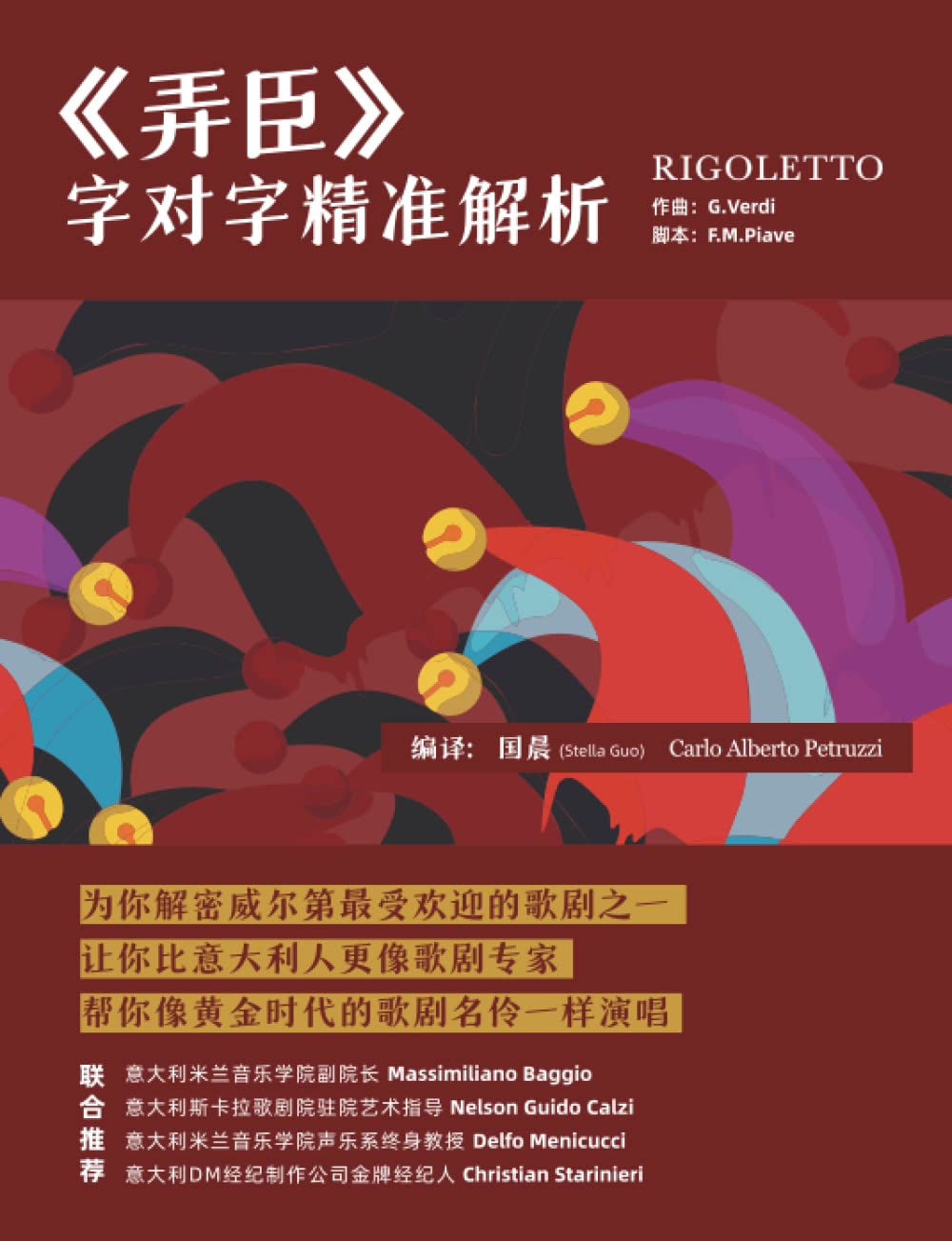
《弄臣》字对字精准解析 ["Nong chen" zi dui zi jing zhun jie xi] = Rigoletto: Word-by-Word Explanation. Libretto by Francesco Maria Piave, music by Giuseppe Verdi. 2022. 176 pp. ISBN: 9798441536820. $21.10;
《托斯卡》字对字精准解析 ["Tuo si ka" zi dui zi jing zhun jie xi] = Tosca: Word-by-Word Explanation. Libretto by Giuseppe Giacosa and Luigi Illica, music by Giacomo Puccini. 2022. 198 pp. ISBN: 9798365336124. $20.44;
《艺术家的生涯》字对字精准解析 ["Yi shu jia de sheng ya" zi dui zi jing zhun jie xi] = La Bohème: Word-by-Word Explanation. Libretto by Giuseppe Giacosa and Luigi Illica, music by Giacomo Puccini. 2021. 254 pp. ISBN: 9798496111751. $26.13;
《乡村骑士》《丑角》字对字精准解析 ["Xiang cun qi shi—Cho jue" zi dui zi jing zhun jie xi] = Cavalleria Rusticana—I Pagliacci: Word-by-Word Explanation. Librettos by Giovanni Targioni-Tozzetti, Guido Menasci, and Ruggero Leoncavallo, music by Pietro Mascagni and Ruggero Leoncavallo. 2021. 167 pp. ISBN: 9798493641701. $20.80;
《游吟诗人》字对字精准解析 ["You yin shi ren" zi dui zi jing zhun jie xi] = Il Trovatore: Word-by-Word Explanation. Libretto by Salvadore Cammarano, music by Giuseppe Verdi. 2023. 172 pp. ISBN: 9798851387500. $20.95.
To date, the series 意大利语歌剧脚本字对字精准解析系列丛书 [Yi da li yu ge ju jiao ben zi dui zi jing zhun jie xi xi lie cong shu = Italian Opera Librettos with Precise Word-by-Word Explanation) consists of eight volumes containing a total of nine opera librettos, with additional volumes expected. Each volume includes the text in the original Italian and in Chinese translation, as well as a detailed plot synopsis and annotations that provide insights into the translations and Italian cultural references. This series is an invaluable resource for Chinese-speaking opera professionals and audiences, particularly those not fluent in Italian.
The direct translation effort in this series stands out as a pioneering achievement, benefiting both Chinese opera students and enthusiasts. Historically, translators in China have often used the French or German versions of Italian operas as the source texts, due to the higher number of French-Chinese and German-Chinese translators compared to Italian-Chinese translators. By contrast, translating directly from the original Italian into Chinese helps to preserve the unique linguistic particulars that might be lost in intermediary languages. Petruzzi and Guo emphasize the literary properties of the librettos and focus on their expressive, dramaturgical functions, rather than on the musicality and rhyme of the original language. This method prioritizes clarity and comprehension over literal fidelity to the original texts. The Italian used in opera librettos from the seventeenth to the nineteenth centuries is significantly different from modern Italian. Petruzzi and Guo’s translations effectively explain the cultural contexts behind the original texts, making them accessible to readers unfamiliar with the Italian language and culture. For example, an annotation in the Rigoletto volume (49) discusses the word “signor,” which has multiple meanings in Italian. It can refer to a simple “sir,” a “nobleman” (which is how it is used in the libretto), or even “God” when the word is capitalized. This clarity also enhances the Chinese opera student’s understanding of the background stories and characters’ mentalities, enabling a deeper emotional connection during performances. For opera students without formal training in Italian, the series provides clear explanations of abbreviations and special phrases, fostering a more engaging and motivating learning experience.
Guo is a Chinese opera singer, Petruzzi is a renowned Italian linguist, and their collaboration reflects a deep understanding of both Italian and Chinese literary traditions. This is evident in the translations, which are fluent and easy to read. This delicate balance maintains the integrity of the original works while making them accessible to a Chinese-speaking audience.
While the series is highly commendable, there are some translation errors and consistency issues. For example, in Rigoletto (21), the titles “Conte di Monterone” and “Conte di Ceprano” are translated as “蒙特罗内的伯爵” and “切普拉诺伯爵,” respectively. Although the original Italian phrases share the same syntactical structure, the first translation includes the additional character “的” which means “of” in Chinese but is often omitted in titles. This inconsistency is small but notable. Translating proper names of persons and places between Chinese and a foreign language is challenging. For instance, in La Traviata (23), the name “de Letorières” is left untranslated. Since “Letorières” is ostensibly the name of a place, but lacks a standard translation in modern Chinese, it would be preferable to use the French transliteration chart from the appendix of The World Dictionary of Personal Names. (In this case, the name could be translated as “勒托里埃.”) Additionally, there is some scholarly debate about the word “muta” in the famous aria “La donna è mobile” from Rigoletto. Petruzzi and Guo interpret “muta” as a verb referring to women often changing tones and thoughts, while it can also be considered an adjective, suggesting that women are simple in speech and simple in mind. (See http://forum.accademiadellacrusca.it/forum_8/interventi/3149.shtml.html.) Including both possible interpretations in the translations could help opera singers find their own understanding of their roles for staging and provide readers with space for critical reflection.
Despite these minor imperfections, the overall quality of the translations is outstanding, and the series holds extraordinary significance for the Chinese opera community. It will undoubtedly help more Chinese opera students and young singers prepare and confidently step onto the world opera stage. Petruzzi and Guo’s work also serves as a useful reference for Chinese opera enthusiasts. It helps non-Italian-speaking readers engage more vividly with the opera stage, understand the stories’ backgrounds, and appreciate the corresponding stage design. By breaking language barriers and bridging cultural gaps, Petruzzi and Guo’s translations allow readers to fully immerse themselves in the operatic experience. I highly recommend this series to anyone interested in opera, translation studies, or cultural exchange. Petruzzi and Guo’s work is a significant addition to the world of opera and translation.
References
2007. 世界人名翻译大辞典 [Shi ji ren ming fan yi da ci dian] = Names of the World’s Peoples: A Comprehensive Dictionary of Names in Roman-Chinese. Proper Names and Translation Services, Xinhua News Agency. Beijing: 中国对外翻译出版公司.


 Copyright © The College Music Society. All Rights Reserved.