
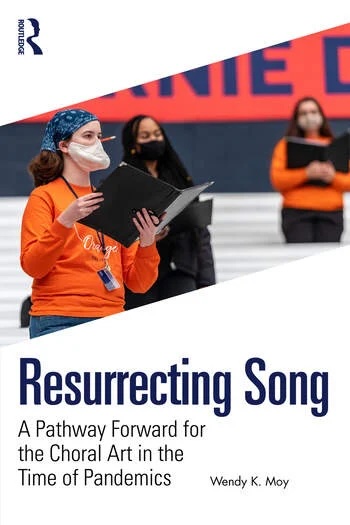
 Resurrecting Song: A Pathway Forward for the Choral Art in the Time of Pandemics. Wendy K. Moy. New York: Routledge, 2024. 162 pp. $44.99. ISBN: 9781032361505.
Wendy Moy’s book, Resurrecting Song, documents how the choral community in the United States and Canada responded to and coped with the SARS Covid-19 pandemic. This volume is the result of Moy’s interviews with choral leaders and singers from a variety of American choral traditions. Moy’s book, in recording the choral responses to an historic, global event, serves as a valuable document for choral communities both present and future.
The primary focus of this book is how individual groups and conductors coped with the changes brought by the pandemic. Starting with the direct threats to singers’ health and with the public health restrictions on singing and choral community activities, the book shares strategies used by choirs, choir leaders, conductors, and singers throughout the pandemic, with an emphasis on tactics that proved positive and continue to be used. In her concluding chapter, Moy suggests that “collaboration and community” are the most significant factors in the survival of choral traditions in the global pandemic (161). She also briefly argues for the notion that disruptions such as those brought about by Covid-19 serve as tools in continuing the art form (161-62).
Many of Moy’s interviewees point out links to co-occurring social movements, particularly increased visibility of BIPOC (Black, Indigenous, People of Color) composers. Whilst many promisingly diverse concert programs were cancelled, multiple interviewees in the book also highlight that, post-pandemic, greater diversity of choral repertory continues to decolonise the rehearsal room and the music classroom. New creative directions and collaborations involving broader representation, new identities for ensembles as their memberships changed, and cross-platform / cross-media collaborations are positive themes that surface repeatedly in the book. The role of technology is another key theme. Opportunities afforded by technological developments, and the pressures to use technology, are discussed by both choral leaders and professional singers.
Another issue that arises throughout the volume is the motivation to continue to create music during this challenging time. Church-affiliated and other religious groups seemed to have found it easier, on an emotional level, to continue through the pandemic than did secular groups. One participant suggests this was because they were providing music for worship and continuing a tradition of hundreds of years. Church groups also had a tangible advantage in that they had ready-made “humongous” spaces to sing in in greater safety, and some had already embraced livestreaming technologies (12). Many of the educationalists speak movingly of their motivation to stay connected to students and shepherd them through the pandemic not just as musicians but as young people living through difficult times.
The experiences of the choral leaders interviewed here will undoubtedly make this book essential reading for those facing similar challenges in the future. Of particular importance are the ingenious solutions those leaders found in what seemed to be “silo” situations in which each group was working to develop solutions without reference or access to the experiences of other groups, as was certainly the case at the beginning of the pandemic. Despite the emphasis on the importance of community within each choir, this book highlights how each organization found its way forward alone and independently. Although not explicitly discussed in the volume, the evidence within the documented interviews raises a question for readers about whether choirs connected to broader organizations (such as churches) found it easier to share solutions. Choral leaders who themselves worked through the pandemic may find their own experiences echoed in the interviews, which convey burnout (63), feeling that “most people probably just want to forget” (42), and an inability to “even [watch videos] that were by my friends anymore” (38). Some readers may find they are not yet ready to revisit their own memories of the pandemic through reading these detailed, and at times quite emotional, accounts. However, the leaders of tomorrow will benefit from understanding the situation-based problem-solving of Covid-19, particularly as a basis for creating more cohesive and cooperative strategies for future, similar challenges.
As a collection of case studies, this book gives an overview of individual experiences from which the reader can draw out patterns and trends. Beyond the brief but useful introductory and concluding chapters, Moy does not give a thematic analysis, relying instead on the utility of this book as an historical document that collates these unique experiences. Moy presents her transcribed, semi-structured interviews in groups according to type of ensemble and has collated the responses to “best answer the questions” (4). Moy uses her prompt questions to structure each chapter. The cases chosen provide coverage of a wide range of choir types distributed across the United States and Canada; these include church choirs, youth choirs within a variety of educational contexts, college-level choirs, amateur ensembles, and professional singers and choruses
As amongst the first published collections of interviews with choral leaders and singers regarding the Covid-19 pandemic, this book is uniquely important. In comparison to other collections of interviews with conductors (e.g., Chesterman’s Conductors in Conversation), it is narrower in focus—not necessarily due to the specific focus on the pandemic, but in focusing particularly on the American and Canadian choral communities. The depth of information extracted by Moy from the interviewed conductors, however, gives a profound insight into a landmark era in choral music.
Although the book’s Introduction references the “choral community” (1) and mentions that the interviewees “cover the ecosystems of the choral world” (2), this volume focuses on the United States, with some interviews with Canadian subjects. Readers expecting or looking for a more international perspective may be frustrated by the book’s limited geo-cultural scope. Although a broader focus or comparison (for example, with the well-established choral traditions in the UK) may have been unwieldy in a single-author volume, a clearer statement of this focus would be useful. For non-American readers, acronyms and educational terminology familiar to choral experts in the US or Canada occasionally render comments somewhat impenetrable. The terms “pandemic” and “post-pandemic” are briefly, but helpfully, problematized in the foreword, and it may have been useful had the author provided a similar discussion, albeit perhaps requiring more depth, around the term “choral community” and the geographic limitations of the study. However, overall this volume is hugely important when viewed as documentation of the innovation, frustration, challenge, and triumph of choral leaders faced with the history-making impact of the Covid-19 pandemic.
References
Chesterman, Robert. 2010. Conductors in Conversation. London: Kahn & Averill.


 Copyright © The College Music Society. All Rights Reserved.