
Although I have been in orchestra and glee club a long time, I have learned more in these few weeks than ever before.
This is what one student wrote after beginning a course with Mildred Trevvett at the Governor Thomas Johnson High School in Frederick, Maryland, based on the Yale Music Curriculum Project.
Music Literature is the only course I know of in our school which had top students giving up fifth subjects such as calculus in order to study the arts.
So wrote William A. Faunce, principal of Atlantic City High School, after the Yale course had been tried there for a year by Elsie C. Mecaskie one of the cooperating teachers in the Yale project.
The post-Sputnik emphasis on science, mathematics, and languages, the scramble to impress college admission officers, and the anxiety to rate high on college entrance board examinations has squeezed the elective music course out for many college-bound students. Without enrolling these students, few high schools can support such a course. Yet for those not headed for college this is the last chance to learn about music.
High school music programs are overwhelmingly addressed to performers—singers and players of band and orchestra instruments. One of the principal reasons for the dearth of elective introductory courses such as are available in most colleges is that teaching materials for an academically respectable high school course have been lacking. Moreover most music teachers are not prepared to teach such courses; they are trained either as choral or instrumental conductors. Although many of them are very proficient and sensitive musicians, few have sufficient competence in music history and analysis to devise courses of their own. Textbooks have been of little help, since they offer mainly easy surveys that enlighten neither teacher nor student.
The Yale project attacks this problem with self-study guides for teachers that can also serve as manuals for the classroom lesson, and the student is given every possible visual and auditory stimulus and aid to learning. Tapes contain musical examples for classroom discussion; overhead projector transparencies summarize musical analyses in schematic diagrams and in annotated pages of reduced or complete scores; filmstrips add pictorial material. Teacher's guides provide analytical and factual data as well as lesson plans to coordinate the audio-visual material. Students in their manuals receive short readings coordinated with the lessons, simplified scores, technical explanations, composers' preliminary sketches, documentary material of various kinds, and occasional workbook-type exercises. The teacher is also supplied with prepared test-tapes and questions.
These materials relieve the harassed music teacher, who often must drive from school to school to supervise elementary teachers or direct rehearsals at all times of the day and evening, of the huge task of research and coordination required in such a course. The materials invite the student through careful listening, score-study, and reading to discover for himself what the music contains for a studious ear and analytic mind. Classroom sessions are for collective discovery, comparison of views, and for fixing certain concepts and ideas through discussion. Never obliged to lecture, the teacher is free to stimulate, guide, and moderate the flow of response from the multi-media presentations.
The material is packaged into nine units, each of which studies in depth a single major musical work or, in a few cases, several related works. A teacher meeting a class five days a week is expected to choose six or seven of the nine units for one year. Each unit takes about twenty class sessions to complete. Written and compiled by specialists, the units are products of exhaustive research on the works and topics presented. Although the units are organized around genres or categories of music, the works and composers were selected to include the major styles and figures in western music from the eighteenth century to the present. The order is non-chronological, and after the third unit a teacher may take the remaining units in any order, timing them with local events, studies in other departments, or the requirements of joint humanities programs.
The following is an outline of the units and principal authors:
- Music for the Dance: Stravinsky, Petroushka, by Claude V. Palisca.
- Music for the Keyboard: Schubert's Impromptu and Chopin's Ballade in g minor, by Leon B. Plantinga.
- Chamber Music: Haydn, String Quartet, op. 76, no. 3, by C.V. Palisca.
- The Symphony: Beethoven, Symphony No. 3, "Eroica," by C.V. Palisca and Jan LaRue.
- The Concerto: Bach, Brandenburg No. 5; Brahms, Violin Concerto, by C.V. Palisca.
- The Opera: Verdi, Otello, by Victor Yellin.
- The Oratorio: Handel, Saul, by C.V. Palisca.
- Program Music: A survey from Vivaldi to Schönberg, by L.B. Plantinga.
- American Music: jazz, Charles Ives, Gunther Schuller, James Drew, by James Drew.
Classroom discussion is stimulated through a series of graded problems, mainly in the form of taped musical examples, often coordinated with scores or other visual aids. These problems are largely analytical, but not entirely so. Students in introductory music courses cannot take close analysis for long without backing up for a broader view. Various strategies are used to change the range of field and focus and to recapture interest. For example, during the study of Schubert's Impromptu, an excursion is made into the history of the piano. The second movement of Beethoven's Eroica Symphony, a funeral march, invites comparison with French revolutionary marches for dead heroes; and what connection there may be between the symphony and Napoleon is discussed in the light of every document that has been found linking the composer and Bonaparte, all of which are in the Student Manual. During the unit on Haydn's string quartet we pause to consider the minuet as a dance with the help of a motion picture film and to reconstruct Haydn's steps in composing the Kaiser hymn, the theme of the second movement. A short cadenza in Brahms' Violin Concerto leads us to consider the correspondence of Brahms with the violinist Joachim concerning some fine points in the writing of this passage. Handel's oratorio, Saul, occasions a discussion of numerous representations of episodes in the story of Saul and David in painting, sculpture and other media. The class uses this evidence to define the limitations of each medium. They then apply this understanding to characterize the medium of the oratorio.
The origin of the project goes back to discussions at the Seminar on Music Education, a meeting of 31 leaders in the musical professions, which I directed at Yale University under the auspices of the U.S. Office of Education. This was the first of that Office's developmental conferences in the arts seeking to plot goals and paths for research and development in pre-college arts education. One of the conclusions of the twelve-day conference was that there was a pressing need for a curriculum and materials to present music to the listener. Although conferees agreed that participation in performance, composition, and improvisation was the most effective way of developing interest and achievement in music in the elementary grades, a committee under the chairmanship of Professor William J. Mitchell judged the upper high school level as a time when music could be studied as a literature apart from performance. To deepen understanding and commitment to music, we were convinced, there is nothing like intimacy with important works that may be beyond the playing ability of high school youngsters. These works have to be approached through listening and study.
Kenneth Wendrich, Assistant Professor of Music Education, Luther Noss, Dean of the Yale School of Music, and I in 1964 proposed to the Office of Education a research project that would develop such a curriculum: The proposal was accepted and a contract was signed on February 28, 1965 between Yale University and the Office of Education with $160,267 as the federal contribution to the project. The approved plan included a year of testing of the curriculum in several Connecticut high schools in 1966-67, an institute in the Summer of 1967 for teachers who would test the curriculum nationally, a year of testing by the institute participants at their schools in 1967-68, and an evaluation conference in June, 1968. All of these took place according to the plan, except that delays in writing and production prevented teachers from getting all the material for 1967-68. Consequently a second year of testing by the same teachers is continuing in 1968-69.
As the project developed it became obvious that no materials of parallel scope and quality were available for college introductory courses in music. We decided to test an adaptation of the curriculum for college classes in two sophomore seminars at Yale and in classes at Brigham Young University in Provo, Utah, and in a limited way at New York University. So far the results have been encouraging.
In addition to Professor Wendrich, who is Project Director, and myself, several of our Yale colleagues have been involved in the research and writing. Professor Leon Plantinga has written units on keyboard music and program music; Professor James Drew has developed a unit on American music, including Afro-American, jazz, and contemporary music; and Professor Allen Forte has been a consultant on theoretical problems. Several graduate students in history of music have been employed as research assistants: Patricia Brown, Henrietta Hock, Howard Serwer, and Kerala Snyder. Three outside consultants have contributed to the curriculum: Professor Victor Yellin of New York University, who developed a unit on opera, Professor Jan LaRue of New York University, who was a consultant on a unit on the symphony, and Professor Meredith Ellis of Oakland University, Michigan, who produced the film on the minuet.
At the basis of the organization of the curriculum has been a philosophy about musical explanation. We have not asked what makes people enjoy music and then pursued an elusive set of behavioral patterns, as some educational experimenters have done. In this sense our goal is not "appreciation." Rather we searched for ways to reach an understanding of music, assuming that with understanding comes enjoyment, and even if it does not, the knowledge gained is valuable in itself. There are many ways of understanding a work of art. A positive intuitive reaction is understanding if it is rich in immediate reception of meanings. Such a reaction, however, usually depends on prior acquaintance with the language of the artist. For most neophytes a work they enjoy is a mystery that, given a chance, they are eager to unravel. We take advantage of this curiosity by offering students an opportunity to perceive a work from many points of view and to consider explanations of every possible aspect of it. It is treated not only as a unique product of an ordering mind solving a compositional problem, but also as a product of a tradition and cultural context. This approach requires that a work be studied exhaustively.
The student must probe deeply into compositional technique. For this he needs a vocabulary and analytic methods. What is usually taught in elementary theory and harmony must be learned not so much as a means for exercising it in composition but for the sake of sharpening observation. College curricula in "music appreciation" have long recognized the need for a theoretical foundation, and a frequently encountered pattern is one semester of general principles of music followed by a one-semester historical survey. Or the teaching of the fundamentals may run concurrently with the historical survey as it does in History of Music 10 at Yale. We saw quite early in the curriculum project that the genres and works and aspects of them studied in the first months had to be graded so that the student accumulated technical facility step by step. Much of the technical material is taught in a spiral fashion, with the subject—intervals, for example—being introduced in the first unit, explained more fully in the second, and the information applied in more difficult contexts in subsequent units. Each time the subject returns it is dealt with greater penetration, always, however, within the context of a piece that is known as a whole as well as in its parts.
It goes without saying that every student has to learn to read musical notation. What is meant by reading here has to be qualified. The student needs to master notation only to the extent that he can draw from it information he seeks for analytical purposes and enough to follow a line or two as he listens. It does not mean that he can sight-sing or play the score, though some have or develop this ability. The teachers were doubtful at first of requiring students to learn to read even to this degree in a course in listening. But the following comment by Sister Mary Flaherty of Marycliff High School, Spokane, Washington, transcribed from a tape of the evaluation conference in June 1968, is typical of their conversion:
As far as score reading went . . . I think it was something that was very successful. In going from the Petroushka—where they were sure they couldn't do a thing with those notes that were printed there—and at the end this was one of the big thrills. It makes a difference to them. One girl said, "I was surprised that it made a difference to me that I had the notes," so that, for instance, when we listened to the Stamitz she would rather have the notes in front of her. And she said, "I never knew it could make any difference in my life."
Analysis in the precise terms possible with a score is not an end in this course, but a means for developing analytical listening. Listening tests devised for each of the early units try the student's ability to hear with the unaided ear the concepts and relationships, particularly structural, that in class were discovered with the help of visual data. The assumption is that the student after he leaves the course will rarely have a score before him. We aim not so much at musical literacy as, if I may coin a word, musical auralcy. By probing deeply into a few exemplary pieces that are rich in opportunities for analysis, the student, we hope, will enlarge his possibility for reacting to all music and meeting and composer's thought.
By means of taped excerpts and simplified scores the student is trained to observe essential details, for example to recognize cadences of varying degrees of finality, which permits him to perceive the main structural points or closes of sections. In one typical problem for aural study, the student hears the opening theme of the Eroica symphony (Example 1),
Ex. 1
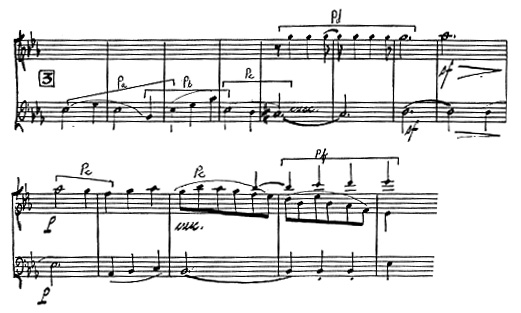
the fortissimo statement some measures later, a development of the theme that first appears in the closing section of the exposition (Example 2),
Ex. 2
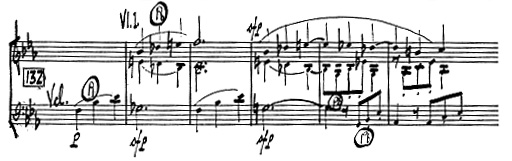
and finally the so-called "new theme" of the development section (Example 3). (Transparencies are supplied with Unit IV).
Ex. 3
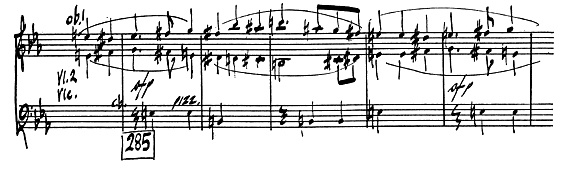
The last two examples strain the listener's ability to relate what he hears to the opening theme. He is forced to consult the score for a sharper view, and finally Beethoven's sketches for the section that became the "new theme." He there finds in place of the "new theme," not the famous oboe melody, but the melody that appears in the published version of the score in the second violins and cellos. Beethoven planned to arrive at this climactic point—in e minor, the most distant tonally from the  major that began the development—at a decorated version of the opening theme. Later he conceived the beautiful countermelody in the oboe, obscuring the thought process that had led to this event. (Example 4), taken from one of the overhead transparencies, helps reveal that the "new theme" is not new but a counterpoint to an elaboration of the main theme.
Ex. 4
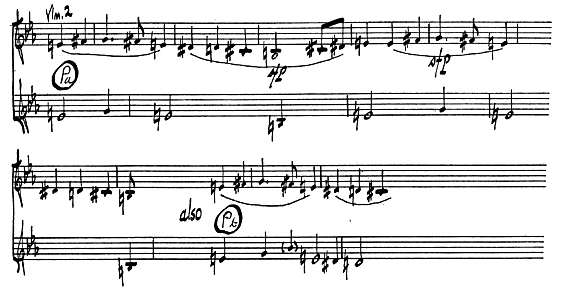
The detailed analysis expected in some of the units encountered some opposition in student critiques. "Picking the music apart" decreased their enjoyment, some felt. All of the teachers, however, were convinced that the eventual benefits outweighed the painful moments. Richard A. Disharoon, the teacher at Pikesville High School in Baltimore, put this very concretely:
The crowning point was a little girl who came in about two weeks ago [the end of the year] who—in her terms—told me she'd "made the big switch." I asked her what she meant, and she said that she'd been studying the piano for quite some time, which I knew, and she played mostly the pop tunes—Broadway show tunes—and the "big switch" for her was to Haydn, Bach, Mozart, and "all those guys," as she said. She was playing the Mozart Sonata and she said, "You know I really can see the organization." I asked her what she meant. "The development . . . the recapitulation . . ." She was just very, very enthused about it.
There is more to understanding a musical work, however, than accurate, analytical hearing. This curriculum is founded on the conviction that a work of art is not an isolated object but is fully revealed only by knowing all that contributed to its making.
A composer often starts with musical material not of his own invention. Up to the sixteenth century it was rare for a composer to invent his primary material or melody. He often borrowed it from some plainchant, popular or folk song, or a standard tune for singing poetry or dancing. We lead the student to examine the process through which a composer takes possession of such raw material and makes it a vehicle for his personal designs. Handel's Saul offers several excellent models in the choruses based on Antonio Urio's Te Deum. From a study of these examples, the student is led back in history to the sixteenth century to examine a motet by Mouton and a parody mass built upon it by Arcadelt. Through "flash-backs" of this kind the student is given a historical perspective on both changing styles and methods and on the continuity of compositional procedures. For Stravinsky's Petroushka, eight such pieces of pre-composed material are furnished the student: five Russian folk songs, two nineteenth-century waltzes, and one French popular song. Each song appears in the Student Manual in musical notation with an English translation for singing while the tape records a performance in the original language. In connection with one of the songs the student hears not only Stravinsky's arrangement but also others by Tchaikowsky and Balakirev and is asked to compare the attitude of a romantic and a modern composer toward the material, particularly as it reflects his interest in preserving the folk spirit of the song.
Sometimes a composer bases a passage not on a particular melody or piece but on a style of music, as Haydn does in a passage in the first movement of Op. 76, no. 3, where he imitates a bagpipe. The student is asked to compare it to a bagpipe piece recorded by Bartok in Hungary, where Haydn wrote the quartet.
Another time a composer may borrow only the sound of an instrument foreign to his medium, as Stravinsky does in Petroushka in a passage in which he imitates, in turn, a barrel-organ, hurdy-gurdy, and music box. Except for the last, these are instruments no longer heard in the street; so we bring them into the classroom by way of tape to introduce a short lesson on orchestration. What does it take to imitate a barrel-organ through a symphony orchestra? Only careful listening can isolate the instruments Stravinsky chose.
Thus is introduced the topic of medium as both limitation and stimulus for the composer. The medium very much affects the style of the message, if it is not the message. How it does is asked several times in the course, first in Unit 2 on piano music. The problem posed is to circumscribe the limits, capabilities, and characteristics of the piano. Students are asked to compare the sound of Schubert's Impromptu in  , D. 935, no. 2, played on a harpsichord, modern piano without pedaling, with pedaling, and an Andreas Stein piano of 1820.
The question of medium is approached with ever maturing sophistication in later units of study. In Unit 4, on Beethoven's Eroica Symphony, the theme of the final movement is studied in four versions, as a contradance, written in 1801, as ballet music in The Creatures of Prometheus, opus 43 of the same year, as a theme for the Fifteen Variations with Fugue for Klavier, opus 35 of 1802, and finally in the Eroica of 1804. Students are asked to consider how the medium affected the composer's attitude toward the sound-potential of the theme. So the medium is seen not only as a limiting factor but as an inspiration, because the dance, written originally for a ballroom orchestra of strings, acquires unexpected grandeur when scored and rewritten for symphony orchestra.
The place, audience, or function for which a composer writes also determine his ideas and how he develops them. Students are asked to come to a definition of chamber music by searching into its past. They are shown a series of pictures of ensembles, beginning with modern musicians in tails on a stage to informal groups of amateurs playing in salons of the eighteenth, seventeenth, and earlier centuries. From the discussion emerges the realization that there was once true "chamber" music; that behind the concert chamber music of today there was a tradition of playing for fun as well as for informal audiences; and that for music to be fun certain things had to happen in each of the parts. They find in listening to a Ricercar by Andrea Gabrieli that it is like a game, each player taking his turn at the melody. They hear it first played on viole da gamba, then on brass instruments. The brasses introduce another variable into the equation: is it still chamber music? The discussion leads to a clarification of the chamber music tradition and of how it persists in today's formal concert setting.
The function for which a musical work was written may be determined even more specifically by non-musical factors if it is a work for the dance. The choreographer may lay down a general or specific framework for the composer. In the case of Petroushka, the scenario was a collaboration of the artist Alexander Benois and Stravinsky; so the composer was limited only by the theme, a set of characters and an approximate sequence of events. At times, nevertheless, Stravinsky's music is quite literal in its reference to the actions on the stage. To appreciate all the allusions demands an acquaintance with his theatrical conception. To this end the student is supplied a detailed scenario cued to the score, and he sees the original Benois sketches for scenery and costumes and a set of photographs of a performance by the Royal Ballet of England that sought to restore the original production.
Borrowed material, medium, and function are partly external influences on a composer's thought that, when revealed, add to the understanding of his work. Similarly the composer's versions prior to the finished one, his relation to certain events and people, the prevailing attitudes toward the psychology of emotions or toward the purpose of art in his age: these too may illumine some dark areas of our knowledge of a work. When such external aspects of the aura around a piece of great music, which purists scorn as irrelevant, can add understanding, we have not hesitated to include them.
In evaluating the success of the curriculum we have purposely avoided the usual experimental procedures and instruments: control groups, standard tests, statistical samplings. These lend only an illusion of scientific precision in a subjective field such as ours. Rather we have compiled as much information as possible on the students in the testing classrooms. The Project Director visited as many of the schools and classes as he could manage on one extended trip. We have come to know the teachers, their qualities and limitations. The teachers have collected in many schools detailed student critiques and some made up elaborate questionnaires for students to answer either anonymously, or, when the data about the student was relevant, in signed statements. This wide range and great quantity of evaluative material will be weighed in planning revisions for publication and suggesting special adaptations.
Perhaps the surest sign of the success of the course is that it has affected students' out-of-class lives. Many have begun going to concerts and collecting records. Ralph A. Bowie the teacher at Lebanon High School in Lebanon, New Hampshire spoke eloquently of the effect of the course:
I had a youngster who bought all the records. . . . There are kids who just started record collections, though, as a result of this, and started to go to concerts—kids who had no background in music whatsoever before. . . . What amazed me too was kids that had no background whatsoever were all of a sudden really quite an authority on music. They could sit and they could verbalize with you. They could talk with you about it and they felt Petroushka was theirs. They felt that the Eroica . . . . They knew this piece, this was one thing they could really zero in on and talk about. And this is why I'm so much in favor of a minimum amount of material and as much depth as you can get away with. Compare this with if you just gave a chronological order of a lot of material. . . . They were really quite learned listeners at the end of the year. And these were kids with no music background at all.
One of my favorites of the many tributes we received from students is this one from Reba Gliksman, a sophomore at Atlantic City High School:
I find that I can hardly begin to tell you what this course has done for me. Before I signed up for the Yale Project Music Course I had no idea what I'd gain from it. I feel as if I've gained more than the students who have had instruments to play on or who have just studied instruments. Because I can't read music nor have I ever played an instrument before. Yet I was interested in knowing how compositions were put together and the way in which they are formed. I must admit that there were many times I found myself completely lost, but this was only when we started naming the notes and so forth. Taking this course and being exposed to this type of music has showed me how really interesting, wonderful, and exciting this music is. I never cared about piano sonatas or ballades or chamber music or anything like that until now. I've simply fallen in love with Beethoven's Eroica. All I can say is that this course is full and rich with the most beautiful music in the world and whoever hasn't enjoyed this type of music should take this course and they'd surely change their minds. I'd like to thank the person who thought of this project because I never would have known what "good" music was if it hadn't been for this course.
Another student view to ponder is this one from Clayton Albright, in Magdalen York's class at Bethlehem Central High School in Delmar, New York. It answers those who accuse us of imposing a European adult high-culture on American youth, who, it is said, should be studying their own music:
I have enjoyed this course immensely, although that is not the objective . . . The course has opened up an entire new field of music for me. Before the course, I thought "classical" music was just that, something to be put up with as a relic of the "old" society. Trying to show up this falsehood is like trying to describe the ocean to someone who has never seen anything larger than a puddle.


 Copyright © The College Music Society. All Rights Reserved.