
Abstract
The technical and musical difficulties of Franz Liszt’s piano music are well known to pianists and non-pianists alike. Such difficulties have been discussed in diverse venues from musicological scholarship (Walker 1983, 1989, 1996; Gooley 2004; Doran 2020) to Reddit forums (MaximusCapacitance 2023). These conversations often focus on elements such as rapid octave work, tricky leaps, and sustaining large musical structures bound by thematic transformation (Backus 1987; Samson 2003). However, I argue that these discussions often undervalue another pair of avenues for virtuosity and expression in Liszt’s music: rhythm and meter.
Consider, for instance, the opening of Liszt’s Mephisto Waltz No. 4 (Audio Example 1), to which I invite the reader to listen without viewing the score.
Audio Example 1: Franz Liszt, Mephisto Waltz No. 4, mm. 1–12, from a lecture-recital given by the author at the University of Mary Washington on January 27, 2024.
An initial listening may suggest one of the “heard” metric interpretations presented in Figure 1a—namely, 2/4 or 3/4 meter with a two-eighth-note anacrusis.
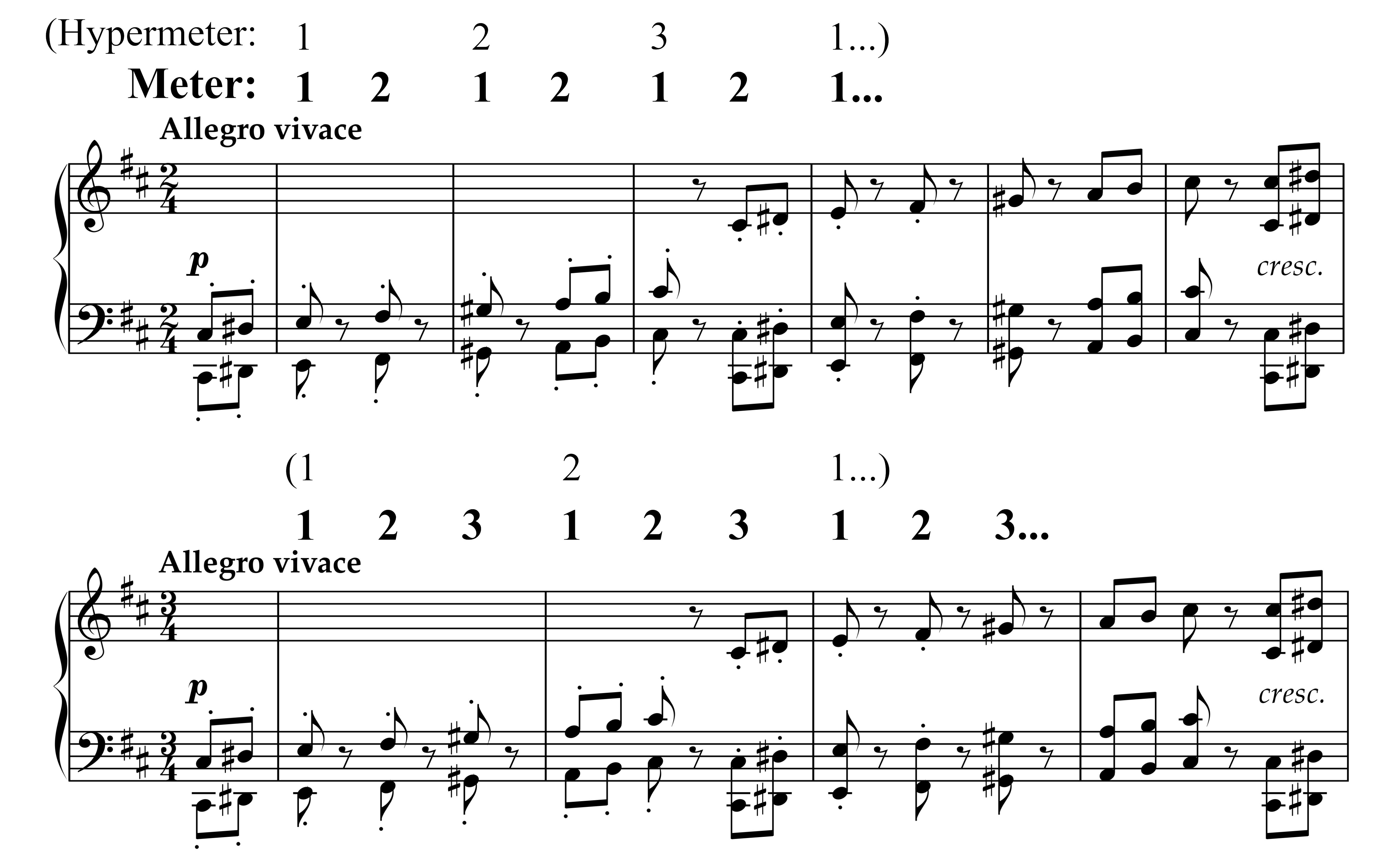
Figure 1a: Two possible metric interpretations of the opening of Liszt’s Mephisto Waltz No. 4.
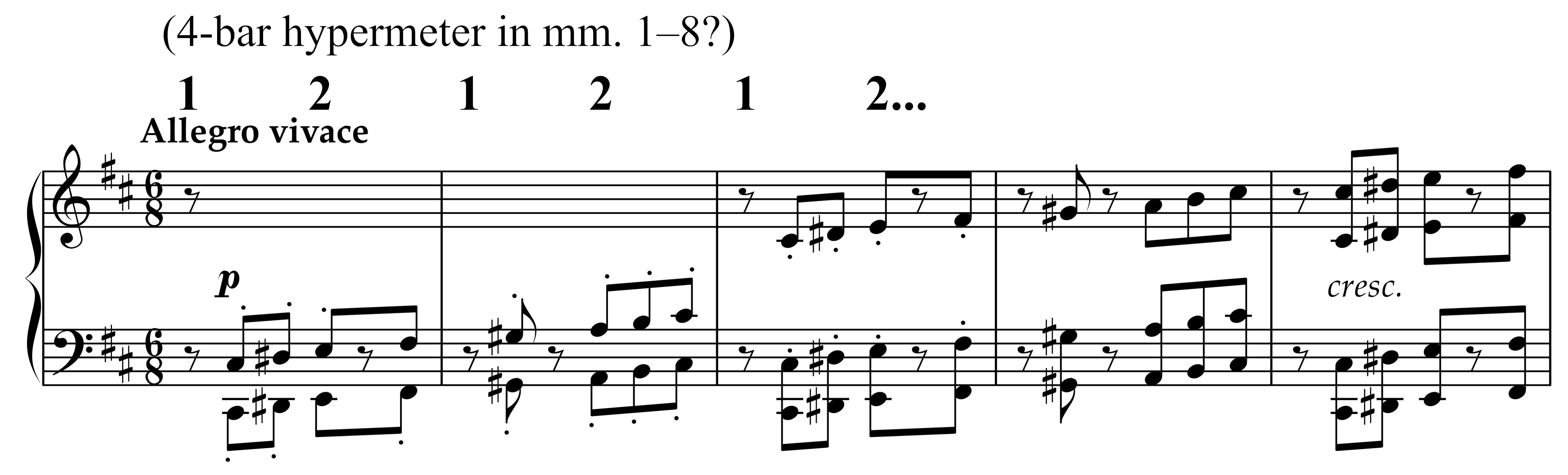
Figure 1b: Franz Liszt, Mephisto Waltz No. 4, mm. 1–5.
However, as shown in Figure 1b, Liszt actually notates the opening in 6/8, starting with a single eighth-rest. The consistently silent notated downbeat creates a disorienting effect for listeners until “true” 6/8 meter is established in measure 9.[1] Liszt’s opening suggests what Sullivan (2021), adapting Mirka’s (2009) eighteenth-century metrical theories to twentieth-century music, refers to as “opening imbroglio”—specifically, where a repeated counter-metric motive prevents establishment of the opening notated meter (Sullivan 2021, 133). Such passages create a quandary for performers: how should we count this music? Which meters (notated and/or heard) should we try to convey to the audience? Must we definitively choose one metric interpretation over another?
These questions encompass a phenomenon called metrical dissonance or metric conflict—topics that have received considerable scholarly attention in recent decades (Krebs 1999; Ng 2006; Mirka 2009; Wells 2017; Gotham 2021).[2] In this article, I generally refer to metric(al) “conflict” rather than “dissonance,” as many Liszt works challenge the notated meter from the start and/or leave “dissonances” unresolved. “Metric conflict” better captures the idea of metrical layers engaged in a dispute in which neither has clear priority—a perspective with noteworthy performance applications. Simply stated, metric conflict involves two simultaneous, irreconcilable metrical counting patterns that do not easily nest within one another (as a duple metric interpretation might be superimposed onto quadruple, for instance). In particular, the current discussion will distinguish between metrical counting patterns indicated by notated time signatures and bar lines (“notated meter”) and those musically implied by rhythmic cues, phrasing, accent patterns, and so forth (“heard meter”). While notated and heard meters normally align in common-practice music, the Liszt passages examined below exhibit marked disagreement between them.[3] In other words, the metric conflicts discussed in this article exemplify Krebs’s (1999) “subliminal dissonances,” in which “all musical features—accents, groupings, etc.—establish only one interpretive layer, while the context and the metrical notation imply at least one conflicting layer” (46). On relationships between aural cues and metric perceptions, see Lerdahl and Jackendoff 1983 and Temperley 2001.
Moreover, all examples of metric conflict examined in this article will exemplify one of two main metrical dissonance types codified by Krebs (1999): “grouping dissonances,” which involve distinct metrical layers “whose cardinalities are different and are not multiples/factors of each other” (31), and “displacement dissonances,” which involve “different positioning of congruent layers” (33). A common example of a grouping dissonance is the standard hemiola—for instance, where the time signature is 3/4, but musical cues and phrasing temporarily suggest a “2/4” hearing. A displacement dissonance, on the other hand, could involve notated duple meter where beat two feels like the downbeat, creating the effect of duple meter shifted one beat to the right.
Both metrical dissonance types have been widely discussed in scholarly literature, often in terms of their interactions with harmony and large-scale structure (Krebs 1999; Cohn 1992a, 1992b, 2001; Ng 2006). However, the presence of metric conflict in Liszt, specifically, has been less discussed, with the primary examples being the work of Szász (1984) and myself (2015; 2017). Szász suggests that Liszt’s “negated strong beats” are often symbols for the diabolical or the macabre (Szász 1984, Exx. 29–30), while I emphasize mathematical transformations between conflicts on different metric hierarchical levels and demonstrate the potential structural significance of metric conflict in Liszt’s music.
As Parmer (2022) observes, however, much of the published discourse (including many of the aforementioned sources) prioritizes the listener’s perspective over the performer’s, creating a “gross disjuncture between theory and practice” (2). He further argues that “a discourse about especially Western classical music grounded on the experience of having to perform it will look very different from a discourse about the same music that is confined to listener-spectatorship” and demands that “academics perform the music they write about in ways that they can assess if what they have to say about musical works actually works in real-world musical practice” (33). In the vein of Parmer, then, this article will have a performative emphasis, seeking to explore the following questions:
- What practical strategies can facilitate effective performances of metric conflict in Liszt’s piano music?
- What musical stories does Liszt tell through rhythm and meter, and how can our performance decisions help convey and sustain these narratives?
While the discussion will be performance-oriented, effective performances of metrically conflicting music (in Liszt and beyond) support scholarly considerations, as well, by musically manifesting theoretical/analytical observations. Moreover, while I explore the strategies from Question 1 in the context of Liszt’s piano music, these strategies could also apply to non-piano instrumentalists, vocalists, and conductors, as well as to music beyond Liszt.
To answer the two guiding questions above, this article will investigate metrical problems in four major Liszt piano works: Mephisto Waltz Nos. 3 and 4, Pensée des morts (from Harmonies poétiques et religieuses), and the solo piano version of Totentanz. These examples will motivate five broad performance strategies with relevance beyond the given works.[4] I derived these performance strategies while researching and preparing these Liszt works for performance in a series of lecture-recitals given at the University of Mary Washington, Randolph-Macon College, and the College Music Society Mid-Atlantic Chapter’s 52nd Annual Conference, as well as a solo recital performed at Furman University. This research was supported by a University of Mary Washington Jepson Fellowship for the 2023–2024 academic year. Additionally, I demonstrate how interpreting metric conflicts via these performance strategies can help convey Liszt’s narrative content. Lastly, I suggest how these results might be extended to other composers, styles, and musical contexts.
Emphasizing the Notated Meter
Liszt’s first Mephisto Waltz was inspired by an episode from the German legend of Faust, who sells his soul to the devil in exchange for boundless wisdom and earthly desires.[5] For an overview of the Faust legend and various literary adaptions, see Encyclopedia Britannica, “Faust: Literary Character,” last updated July 19, 2025, https://www.britannica.com/topic/Faust-literary-character. Liszt’s waltz is drawn not from Goethe’s famous dramatic interpretation of the legend, but from a version by Austrian poet Nikolaus Lenau (1836). This Mephisto Waltz was published in two versions in the 1860s: as a standalone solo piano composition (1862) and as the second episode, Der Tanz in der Dorfschenke [The Dance in the Village Inn], of the orchestral set Zwei Episoden aus Lenaus Faust [Two Episodes from Lenau’s Faust] (1866). While the piano version was long thought to be a transcription of the orchestral version, scholars have more recently argued that the piano version came first (Burger 1989; Pesce, Eckhardt, and Mueller 2001). Larkin (2015) suggests that since the two versions were composed during the same approximate time frame, they can be seen as “two slightly different treatments of the same material” (196)—in other words, the question of which version came “first” may be irrelevant.
Both versions of the waltz are based on a scene in Lenau’s poem in which Faust and Mephistopheles (the devil’s representative) encounter a wedding party in the forest with dancing villagers. Seeing that Faust is smitten by a girl at the party but is hesitant to approach her, Mephisto borrows a musician’s violin and begins to play a wild, erotic dance. Faust and the villagers dance feverishly in response, and Faust and the girl ultimately drift into the woods while a nightingale sings, after which “with nature furthering the devil’s devices,” they “consummate their passion” (Larkin 2015, 198).
While the first Mephisto Waltz is the most well known and widely performed, three more Mephisto Waltzes would appear between 1881 and 1885. These new waltzes, composed nearly two decades after the first waltz, are based on the same episode from Lenau’s poem, although Barrington (1992) argues that they adhere less strictly to the poetic program (28; 61). Mephisto Waltz No. 4 (Audio Example 1 and Figure 1b) is an especially interesting case, as Liszt apparently intended to add a middle Andantino section, generating a common perception that the piece is incomplete (Barrington 1992, 52; Merrick 2004, 291). Sulyok and Mező (2015), however, argue that since Liszt’s missing Andantino section was an unrealized edit, the piece can be considered complete without it.[6] Sulyok and Mező (2015) note that Liszt only completed an “unfinished draft of about 70 bars” of the intended Andantino insert; they therefore deem the waltz “complete and finished in spite of the fact that catalogues consistently list it in the category of the unfinished compositions” (9).
As suggested previously, the opening of Mephisto Waltz No. 4 presents a metrical performance problem: namely, should I, as the performer, try to emphasize one of the heard (but illusory) meters depicted in Figure 1a, or the bizarre notated 6/8 meter? One solution would simply be to ignore the bar lines and perform the heard meter,[7] Interpretations of “the” heard meter may vary between performers. Even when specific hearings of metrically conflicting passages differ, most performers would at least agree that these passages challenge the notated meter. as has long been the tradition for Baroque hemiolas (Wintersgill 1936; Tell 1951–52; Cone 1985). However, Liszt’s metrical usage is more radical than a typical hemiola, as it occurs before the notated meter has been established. Sullivan (2021) discusses a similar situation in the last movement of Beethoven’s Piano Sonata No. 10 in G Major, op. 14, no. 2, which is in 3/8 meter but opens with repeating three-note motives that suggest 2/8 (Figure 2).
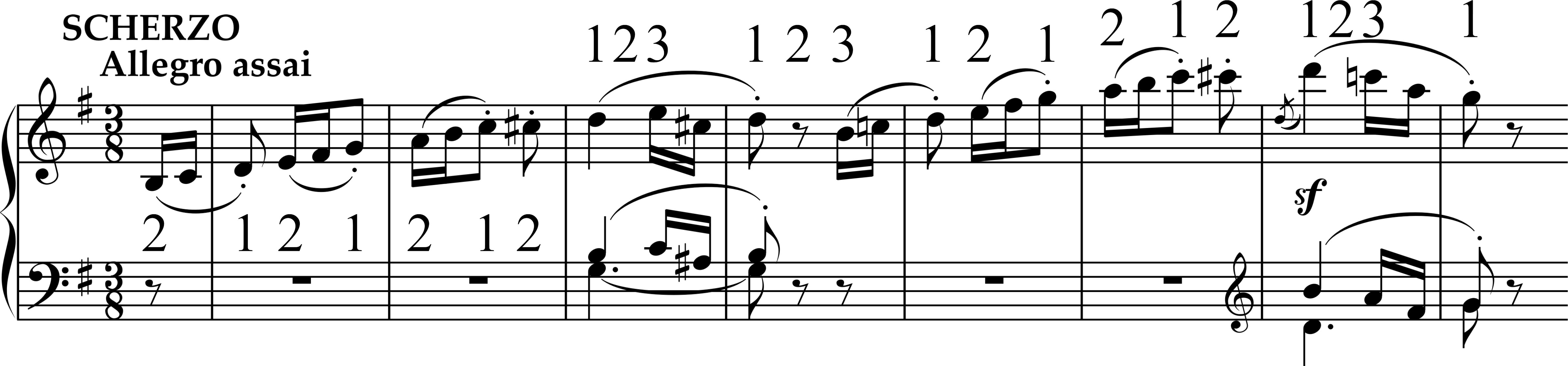
Figure 2: Ludwig van Beethoven, Piano Sonata No. 10 in G Major, Op. 14, No. 2, 3rd mvt., mm. 1–8.
Sullivan emphasizes that metrical dissonance arises when Beethoven’s “true primary meter finally appears” (133), suggesting that to create a sense of dissonance, one need only perform the respective 2/8 and 3/8 heard meters.[8] Sullivan hears dissonance where the 2/8 and 3/8 metrical interpretations occur in immediate succession—what Krebs (1999) calls an “indirect dissonance” (45). For more on indirect metrical dissonances, see the discussion of Liszt’s Totentanz below.
In preparing Mephisto Waltz No. 4 for performance, however, I found simply playing an alternative implied meter (“2/4” or “3/4”) to be somewhat unsatisfying, given the idiosyncratic nature of Liszt’s metrical usages. While the temporary dissonance generated when “true” 6/8 meter begins at measure 9 is striking, to simply perform measures 1–8 in an alternative meter misses the sense of bubbling energy that the empty notated downbeats generate, as well as the missing downbeats’ diabolical symbolism (Szász 1984). Instead, I argue that radical programmatic music invites a radical performance approach, leading to this article’s first strategy for performing metric conflict in Liszt.
Strategy 1: In a passage where there is conflict between notated and heard meters, the performer should generally emphasize the notated meter.
Effectively, Strategy 1 invites performers to highlight the less audible metric layer in conflicting passages, with occasional exceptions.[9] Ito (2020) notes that a hemiola in the first movement of Brahms’s Clarinet Quintet, op. 115 only weakly challenges the notated meter. The performer thus can increase the sense of disorientation by bringing out the heard meter, in opposition to Strategy 1 (269–70). This strategy may seem counterintuitive. Indeed, when I was a piano student, my teachers generally advised performing the heard meter in metrically conflicting passages, temporarily ignoring the bar lines. While this could be useful advice for interpreting Bach and Mozart, whose notated time signatures do not change frequently mid-movement, this technique is less justifiable for Liszt, who would freely change the notated time signature for expressive purposes. Consider, for instance, the excerpt from Pensée des morts in Figure 3, where six time signature changes appear over nine bars.[10] The 7/4 indication in measure 20 marks the first time signature change, as measures 1–19 were in 5/4.
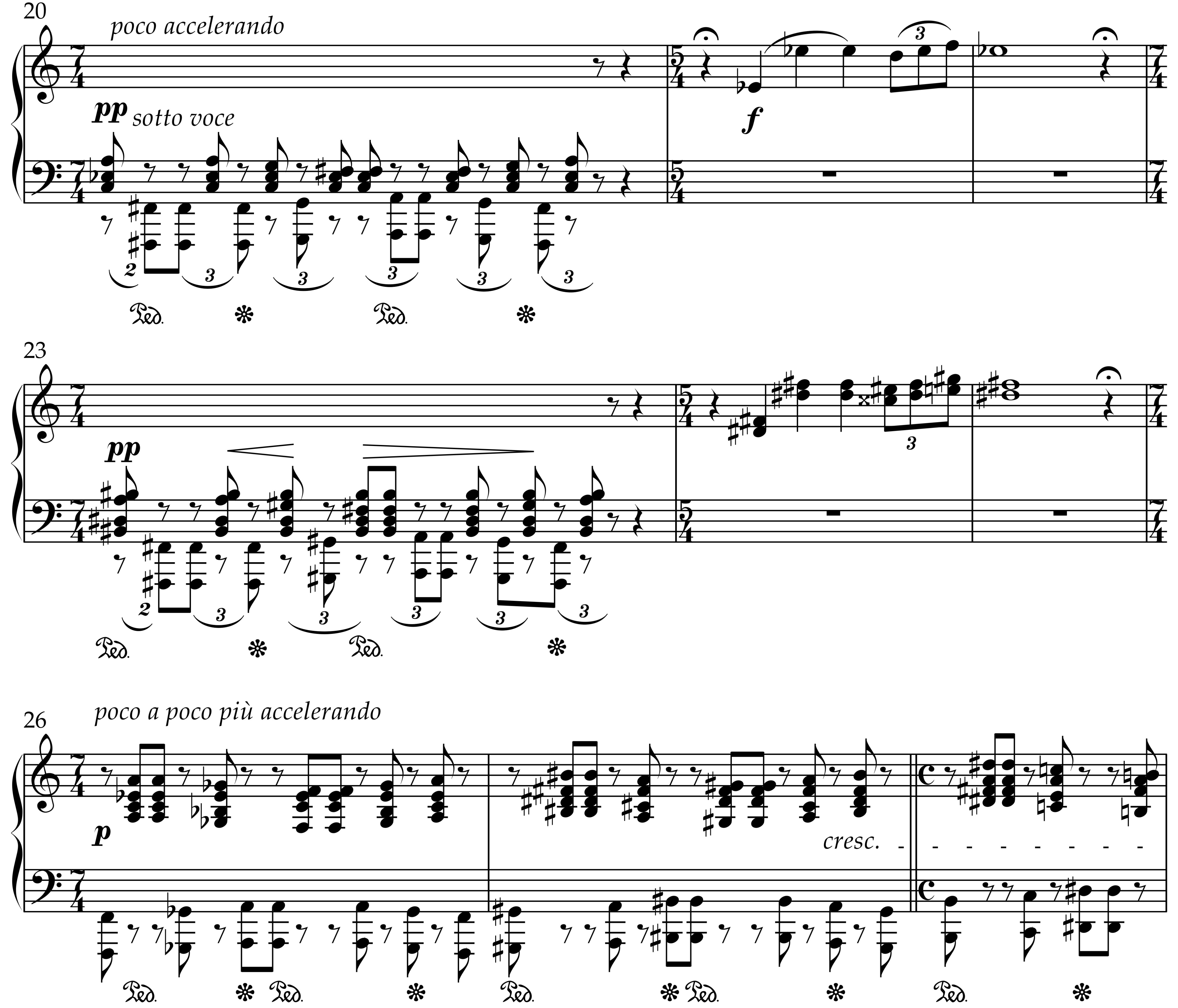
Figure 3: Franz Liszt, Pensée des morts, mm. 20–28.
Thus, when Liszt’s heard meters contradict the notated meter, he seems to be seeking something beyond an unwritten time signature change. In particular, if the performer exclusively bases phrasing, grouping, and accent patterns on the heard meter, both performer and listener can become too comfortable; there is no sense of metric tension. In contrast, if we follow Strategy 1 and emphasize the “hidden” notated meter, then a true sense of conflict occurs. Namely, while the performer consciously brings the notated meter into relief, the heard meter arises on its own, resulting in a complex metrical experience.
This said, Sullivan (2024) notes that the notion of “emphasizing” a meter is inherently imprecise—what, specifically, is this asking the performer to do (2.8)? Krebs (1999), in discussing how to perform metrical dissonances in Robert Schumann’s music, argues that we might “apply subtle stresses to the metrical layers, particularly to the notated downbeats, when they are contradicted” (179). This option seems straightforward, but interpretive challenges can arise when stresses occur in awkward mid-phrase locations. Moreover, in passages like the opening of Mephisto Waltz No. 4 (Figure 1b), it is unclear how one might “stress” a downbeat rest. Barrington (1992) addresses this waltz’s perplexing opening by arguing that light accents on each E, followed by a small crescendo through the end of each even-numbered measure, can help listeners hear the underlying 6/8 meter (54).[11] Interestingly, rather than hearing an implied 2/4 or 3/4 where the E’s mark heard downbeats, Barrington (1992) hears a false 6/4 meter where the first note of the piece is a heard downbeat (see p. 54, Example 5.3). The point remains, though, that the notated 6/8 meter is difficult to perceive without access to the score.
The phrasing, accent, and dynamic decisions suggested by Krebs and Barrington are certainly helpful, but Sullivan (2024) argues that adjusting individual musical parameters to convey metric interpretations misses a more holistic, gesture-based view of performance (2.11). Instead, his motive-based approach to performing metric conflict in post-tonal music relies on Ito’s (2020) theory of focal impulses. Essentially, a focal impulse is a muscular contraction that organizes physical motion over a span of musical time (67–68). For instance, to mark a metrical unit, a violinist might employ strategic bowing, a wind player might adjust their breath, or a pianist might employ a wrist gesture. The frequency of such actions might result, for example, from a performer feeling a 4/4 piece “in two” vs. “in four”; the former would involve two focal impulses per bar, while the latter would involve four (23–24). Focal impulses can interact in varied ways with musical parameters like accent, phrasing, timing, etc., and their specific manifestations might differ between performers. Significantly, the notion of “emphasizing” the notated meter in Strategy 1 could involve aligning focal impulses with the notated (rather than heard) meter.
Beyond physical strategies, the seemingly disparate tradition of South Indian Carnatic (classical) music can underscore the importance of the performer’s internal, psychological tracking of the underlying meter. In Carnatic performances, singers mark the background meter, or tala, using standardized hand gestures (kriyās), often while performing vocal phrases that express tension with the tala.[12] The common Ādi tāḷa, for instance, is an eight-beat cycle consisting of the gestures, “Clap—Pinky Finger—Ring Finger—Middle Finger—Clap—Wave—Clap—Wave.” Strikingly, there are no audible metric accents to indicate this tala to the listener, but performer and audience “feel” this often-hidden meter via the hand gestures. Percussionists whose hands are busy must also internally trace the tala, even when they are playing rhythms and phrases that seem to oppose tala groupings.[13] A full introduction to Carnatic music is beyond the scope of this article. For more information on this music’s cultural and theoretical underpinnings, see Pesch 1999, Catlin 2000, Nelson 2000, and Viswanathan and Allen 2004. The key takeaway is the potential value of mentally sustaining the underlying meter, whether or not the performer is explicitly sounding this meter. For Western classical performers, a psychological conflict between notated and heard meters may impact micro-timing, dynamic subtleties, physical gestures, and articulation in ways that could vary between performers.
How, then, might one practice internally tracking the notated meter while playing musical gestures that contradict this meter? Ito (2020) attests to the power of rehearsing metrically dissonant passages by conducting first the heard meter, and then the notated meter, while singing the melody. Mastering both can yield a “state of balance” between conflicting meters that translates readily to one’s instrument or voice (137–38). I have also found two mainstays of traditional piano teaching useful: the metronome and counting out loud. For instance, in learning the opening of Mephisto Waltz No. 4, I would reify the notated 6/8 meter either by setting the metronome to the dotted-quarter-note beat or by counting the 6/8 meter out loud (“one, two, one, two…”)— much more difficult tasks than one might expect. After several weeks of practicing this way, I was struck by how deeply I had internalized the opening metric conflict, and how I could freely oscillate between attending to notated and heard meters. Moreover, the opening acquired an effervescent energy that was lacking when I only attended to the heard meter—an energy that filtered into my performances of the piece.
Responding to the Notated Downbeat’s “Gravity”
While the opening of Mephisto Waltz No. 4 is striking, the initial metric conflict does not continue indefinitely. Figure 4 illustrates how “true” 6/8 meter emerges at measure 9 following a crescendo to forte. Measures 7–8 serve as a metrically disorienting transition, regardless which heard meter one experiences.
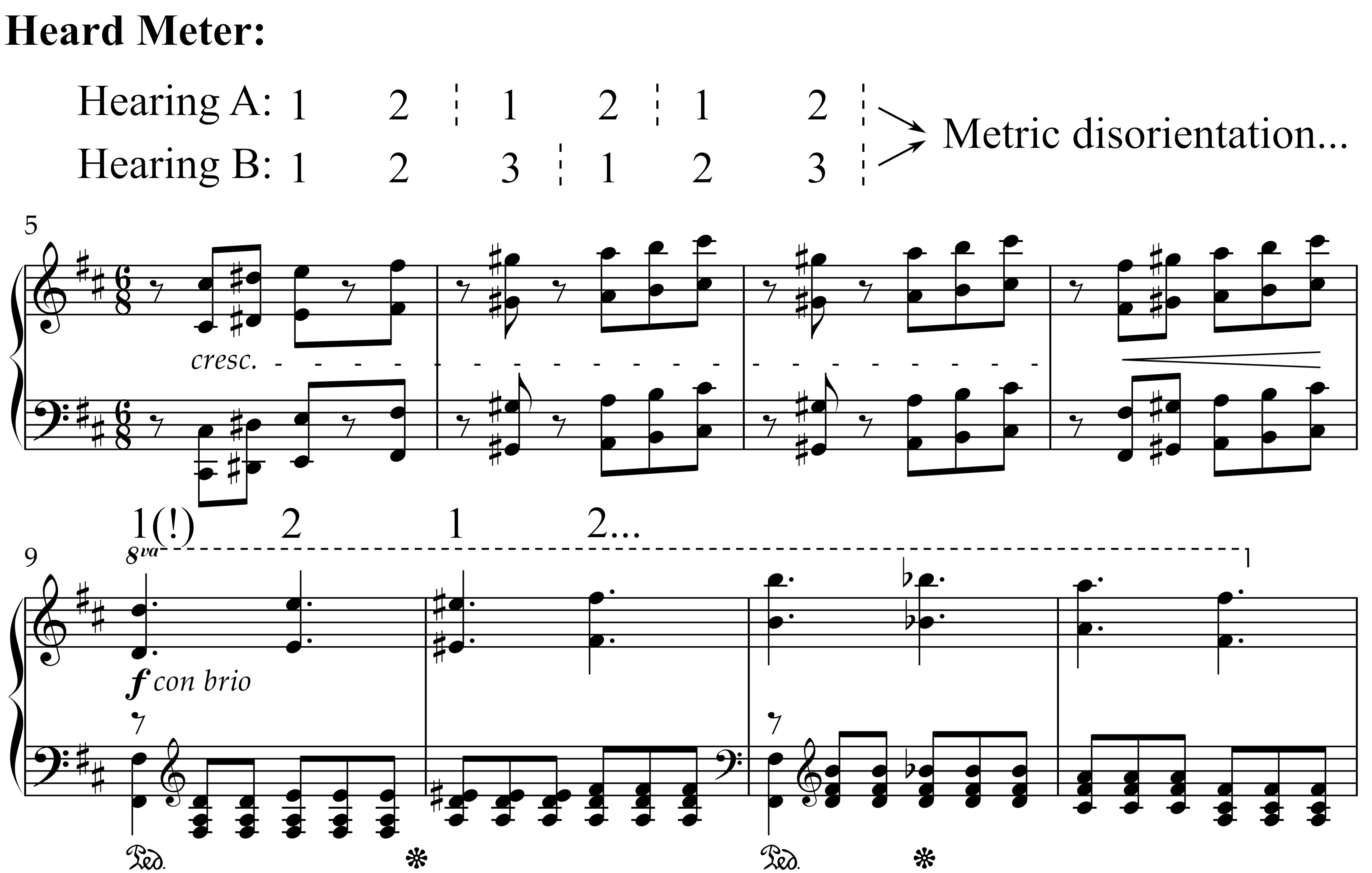
Figure 4: Franz Liszt, Mephisto Waltz No. 4, mm. 5–12.
Comfortable 6/8 meter persists through tonally unstable statements of the main theme in D Major and E-flat Major.[14] In measures 9–24 (two-sharp key signature), a repeated four-bar phrase in D Major gives way to a new four-bar phrase (also repeated) that moves from B Minor to B Major. Measures 25–40 (three-flat key signature) are an exact transposition of measures 9–24 up a semitone, with a repeated E-flat Major phrase moving to a pair of C Major/Minor phrases. However, the appearance of a new key signature in measure 41 ushers the return of the opening metric conflict (this time in the left hand) in E Lydian followed by C-sharp Dorian, as Figure 5 illustrates.

Figure 5: Franz Liszt, Mephisto Waltz No. 4, mm. 39–50.
Particularly striking are measures 48–49, where the notated downbeat briefly reappears in the melody, suggesting a possible return of unambiguous 6/8. The notated meter’s attempted assertion fails, however, as the metric conflict resumes from measure 49 until the notated downbeat returns in measure 55.[15] Although the notated meter is only briefly reestablished, the downbeat of measure 49 is noteworthy as both a metrical and tonal arrival (in C-sharp Major). This integration of metric and harmonic parameters mirrors Brahms’s practice. Smith (2001), for instance, demonstrates how metrical dissonance and consonance processes interact with harmonic tension and resolution in Brahms’s wind trios.
The remainder of the piece can be seen, from a rhythmic standpoint, as a struggle between two opposing metrical states: the metrically conflicted state present in measures 1–8 and 41–54, and the metrically stable state in passages where the notated 6/8 meter is affirmed. Intriguingly, the piece does not end in stable or metrically-conflicted 6/8, but in a different meter entirely, as shown in Figure 6.
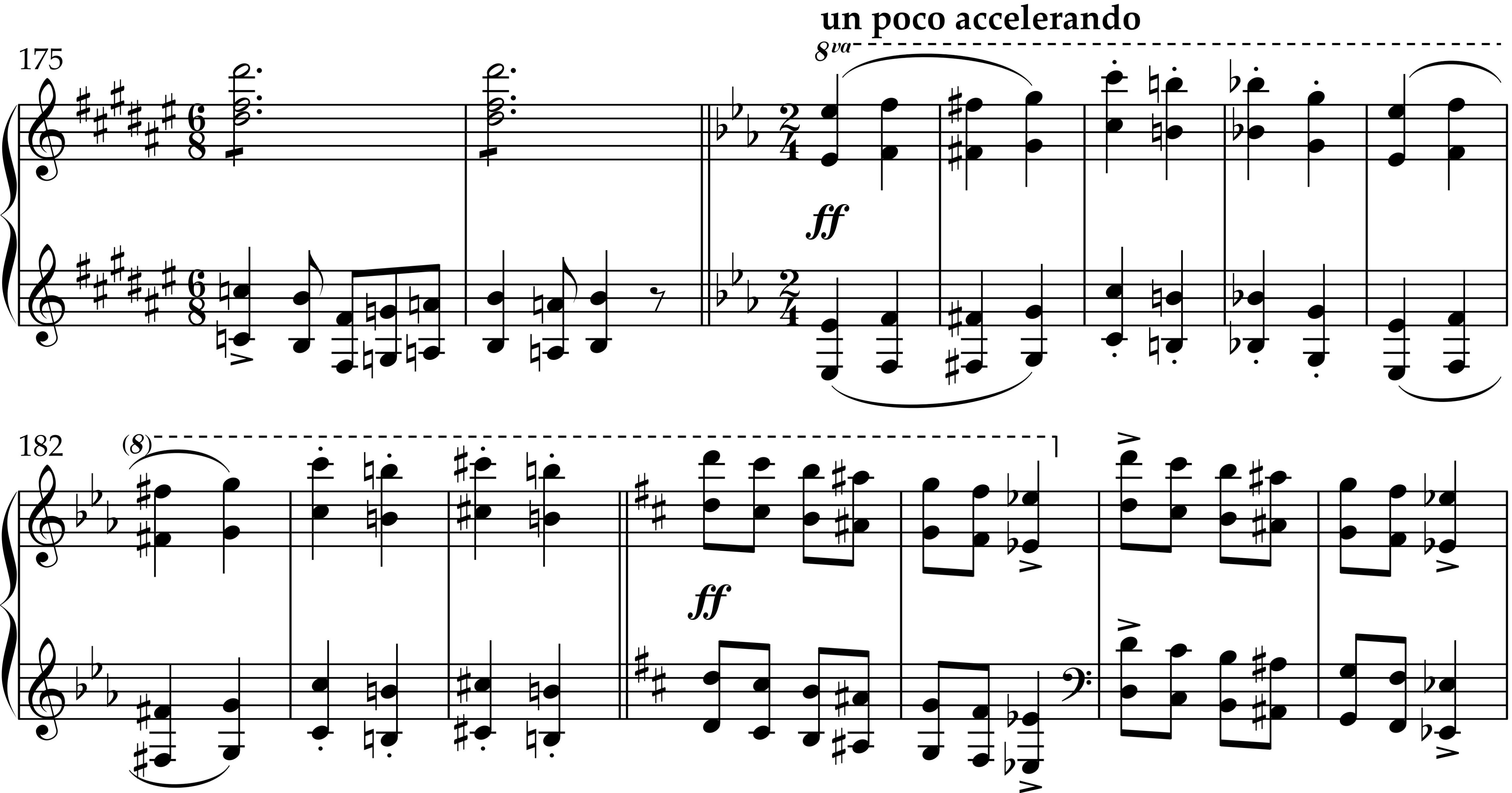
Figure 6: Franz Liszt, Mephisto Waltz No. 4, mm. 175–88.
Indeed, the piece ends, somewhat surprisingly, in notated 2/4—a shift foreshadowed in measures 135–36 and possibly in the metrically conflicting regions’ heard “2/4.”
How might the two main metrical oppositions and curious ending reflect aspects of Lenau’s poetic episode? While many interpretations are possible, I hear each return of the confusing rhythms of the opening as Mephistopheles wielding his corrupting influence over Faust, Faust’s dance partner, and the other villagers. Indeed, the metrically conflicting passages tempt the performer to feel a volatile simple meter (“2/4” or “3/4”) instead of stable, compound-meter (6/8) dance music. The closing 2/4 section, in which simple meter fully overtakes the dominant compound meter, then suggests Mephisto’s ultimate triumph. Other musical factors—like the return of the unison texture that often accompanied the earlier metric conflicts; the perversion of the opening scale motive through descending contour and an unusual mode; and the evening out of previously asymmetrical rhythms—reinforce the sense of Mephisto’s victory.
Table 1 summarizes these considerations, demonstrating the metrical states’ trading off across the piece and suggesting broad narrative connections.
|
Passage |
Metrical State |
Narrative Implications |
|
mm. 1–8 |
Conflicted (“2/4” or “3/4” vs. 6/8) |
Mephistopheles playing the violin |
|
mm. 9–40 |
Stable (6/8) |
Dance music |
|
mm. 41–54 |
Conflicted (with attempted return of 6/8) |
Mephistopheles playing (corrupting influence) |
|
mm. 55–104 |
Stable (6/8); mm. 73–104 more reserved (piano and espressivo) |
Dance music; dance theme transformed → Mephisto’s erotic influence |
|
mm. 105–118 |
Conflicted (with attempted return of 6/8) |
Mephisto playing (corruption) |
|
mm. 119–134 |
Stable (6/8) |
Dance music |
|
mm. 135–136 |
Stable (2/4) |
Foreshadowing of Mephisto’s victory |
|
mm. 137–176 |
Stable (6/8); unrestrained ff section in F-sharp Major |
Dancing becomes increasingly ecstatic |
|
mm. 177–210 |
Stable (2/4) |
Mephisto’s erotic, corrupting influence triumphs |
Table 1: Sequence of metrical states across Liszt’s Mephisto Waltz No. 4, with possible narrative connections.
It is important to note that Table 1 presents just one possible narrative interpretation of the piece’s metric trajectory. No matter which narrative connections the performer envisions, though, Strategy 1 helps bring the story into greater dramatic relief. If the performer internalizes each instance of metric conflict and attempts to convey the notated meters audibly or through focal impulses, the pieces’ metrical contrasts will be more powerful, tangible, and broadly affecting over the course of a performance.
Mephisto Waltz No. 3, while based on the same broad poetic program as No. 4, presents a different sort of metrical challenge. I invite the reader to listen to the opening of this waltz (Audio Example 2) without viewing the score, paying special attention to the sequence of chromatically descending first-inversion triads occurring after the second long hold.
Audio Example 2: Franz Liszt, Mephisto Waltz No. 3, mm. 1–19, from a recital given by the author at Furman University on June 20, 2024.
In this case, the listener is likely to hear the piece in quadruple meter (after possible temporary confusion generated by the opening rest), and the notation this time agrees: the piece opens in common time, followed by a change to “12/8 (4/4)” in measure 11. However, as Figure 7 illustrates, the passage after the aforementioned hold may not be notated exactly as the listener expects.
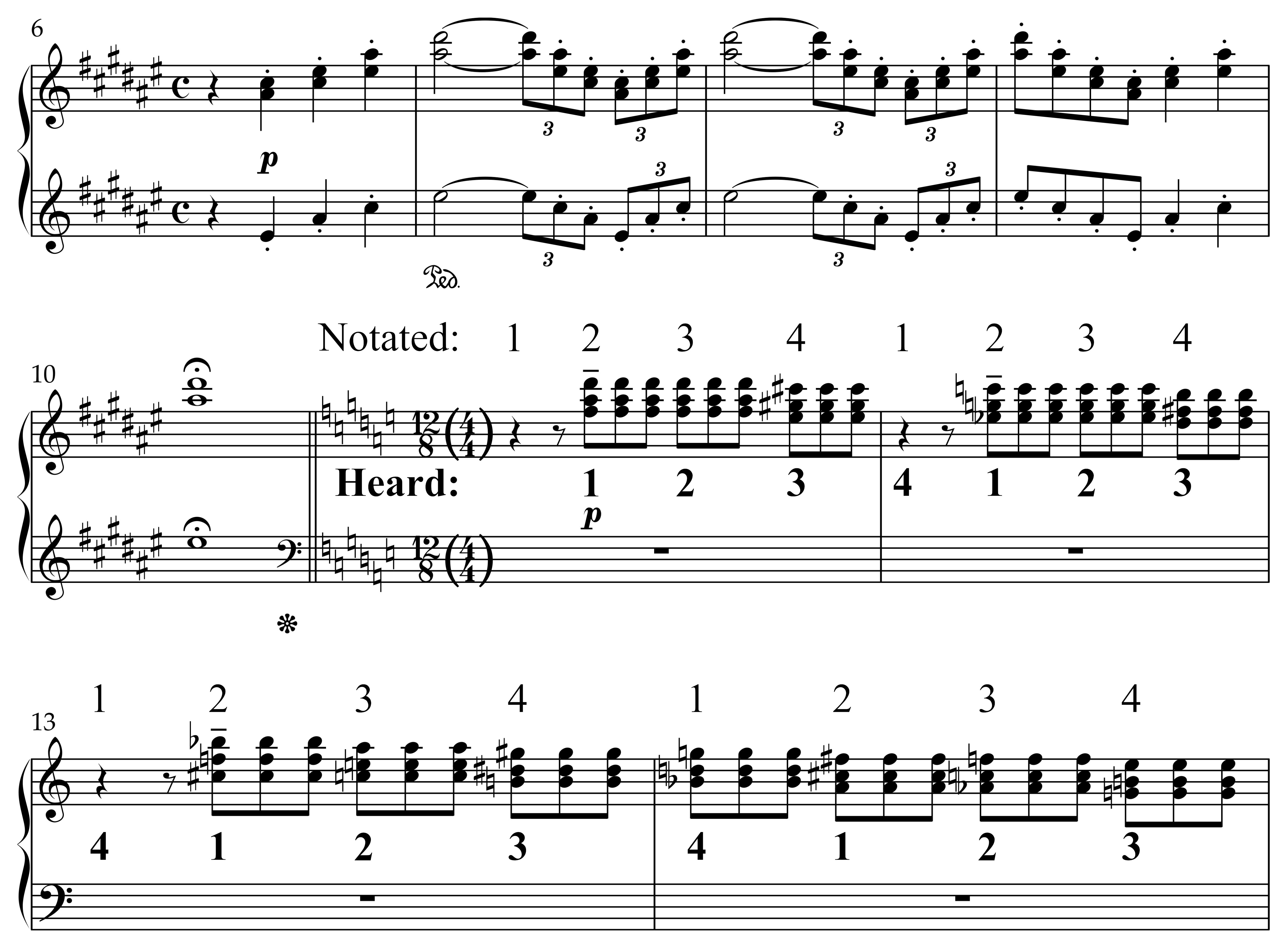
Figure 7: Franz Liszt, Mephisto Waltz No. 3, mm. 6–14.
Indeed, what sounds like a downbeat in the 12/8 (4/4) section is actually beat 2, so that Liszt essentially establishes a shifted quadruple meter—what Krebs (1999) would call a “displacement dissonance” (33), in contrast to the “grouping dissonances” (31) found in the fourth Mephisto Waltz. Certainly, Strategy 1 could still be useful here, especially if the performer internalizes the notated meter by counting out loud, using a metronome, or conducting. Conveying the notated meter at measure 11 is especially challenging, though, as the chord on the second beat after the downbeat rest bears a tenuto. Hence, emphasizing the notated meter by stressing beat 3 would result in two consecutive stresses, inviting confusion rather than metrical clarity.
Similar displacement dissonances occur throughout Mephisto Waltz No. 3, suggesting that this piece demands a metrical performance strategy beyond Strategy 1. The following strategy, while potentially useful for grouping dissonances, is particularly valuable for performing displacement dissonances.
Strategy 2: In metrically conflicting passages, the performer should attempt to feel, and convey to the audience, the “pull” of the notated downbeat.
Strategy 2 invites the performer to imagine the notated downbeat as having a sort of gravitational attractive force, even when this downbeat is marked by a rest.[16] Hatten (2012) similarly explores gravitational metaphors, describing metrical “gravity” as a “continuous field re-instantiated by each downbeat” (21). Practically speaking, in the Mephisto Waltz No. 3 passage beginning at measure 11 (Figure 7), the performer might manifest this force through a slight crescendo to each downbeat rest, followed by an abrupt silence. Gieseking and Leimer (1972), in their classic book on piano technique, suggest a subtler procedure for clarifying the notated meter in such situations: purposeful damper pedal implementation. Namely, in discussing a notoriously syncopated passage in the first movement of Beethoven’s Piano Sonata No. 4 in E-flat Major, op. 7, they argue that a “pedal tread on the heavy beat” (emphasis theirs) can clarify the notated 6/8 meter (139). When performing Mephisto Waltz No. 3, I adapt their idea by pedaling as in Figure 8.[17] For the remainder of this article, old-style pedal markings (“Ped” followed by an asterisk, as in Figures 3, 4, 5, and 7) are Liszt’s, while modern pedal markings (“Ped” followed by a horizontal line and change/lift symbols, as in Figure 8) are my own suggestions.
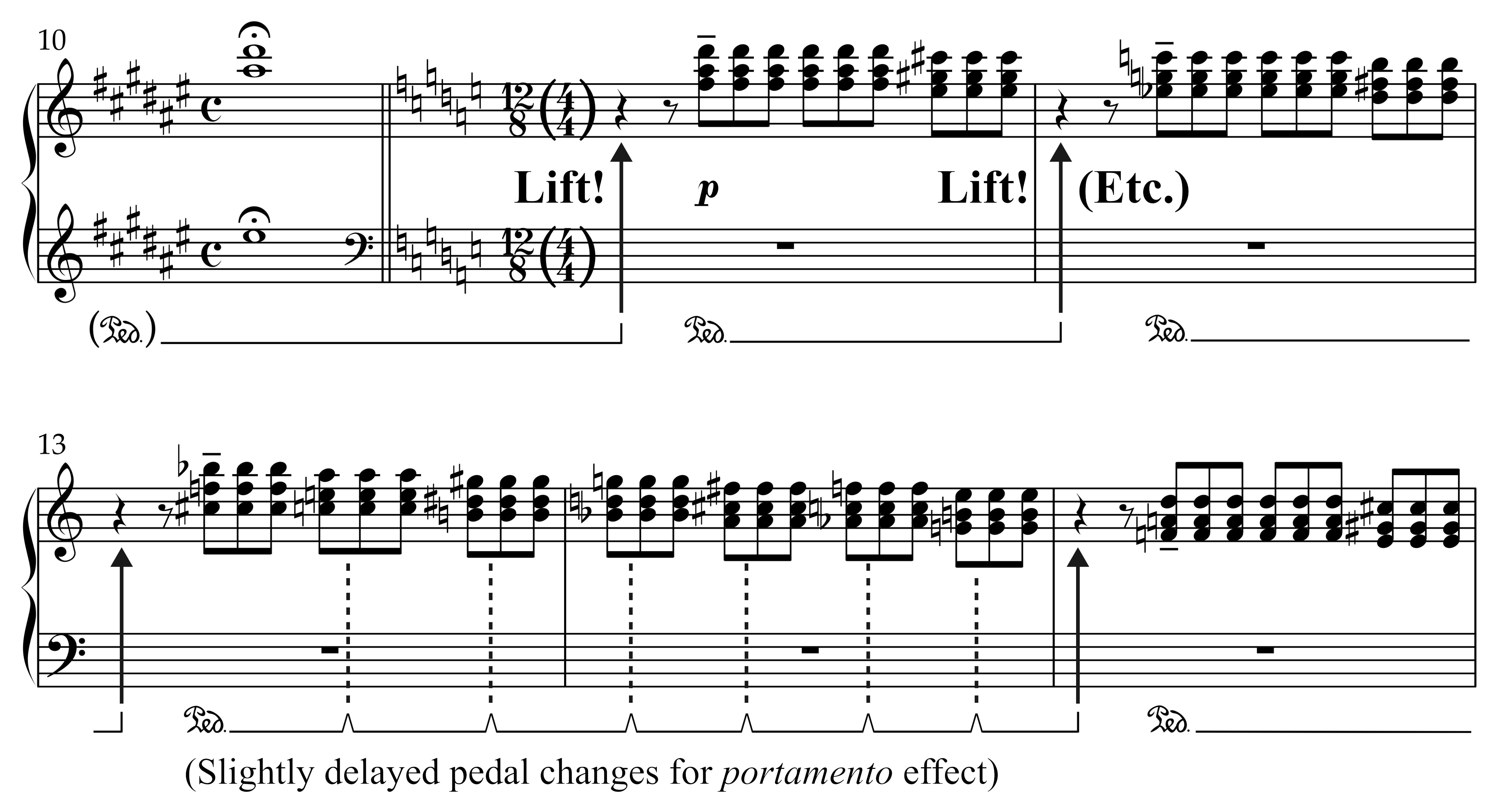
Figure 8: Franz Liszt, Mephisto Waltz No. 3, mm. 10–15, with suggested pedaling.
Lifting the pedal on the downbeat in measures 11–13 not only facilitates the aforementioned crescendos, but marks the notated downbeat both physically (through the abrupt lifting of the foot) and sonically (by suddenly clearing the sound)—a uniquely pianistic focal impulse possibility beyond those Ito (2020) suggests.[18] We should note that the specific piano and performance space will dictate how much sound carries into the rest following the pedal release. The performer could also incorporate Strategy 2 without relying on the pedal by envisioning “loud rests” (London 2012, 107–8) on the downbeats and implementing downbeat focal impulses involving hand/arm gestures, breath intake, etc. Also observe that in measures 13–14, I change the pedal slightly after striking each new triad to achieve a sort of portamento effect, as if Mephistopheles is garishly sliding his hand down the violin’s fingerboard. Another downbeat pedal release then occurs in measure 15.
Liszt’s uses of displaced quadruple meter in this waltz do not always involve downbeat rests, however. Audio Example 3 and Figure 9 present a subsequent passage in which Strategy 2 is useful despite the consistent appearance of downbeat chords. While the initial downbeat rest at measure 27 recalls the rests that initiated the themes at measures 1 and 11—rests that could, in all cases, be marked by focal impulses such as sharp inhalation and/or upward wrist motion—this phrase’s character is much different.
Audio Example 3: Franz Liszt, Mephisto Waltz No. 3, mm. 26–36, performed by the author (June 20, 2024, Furman University).
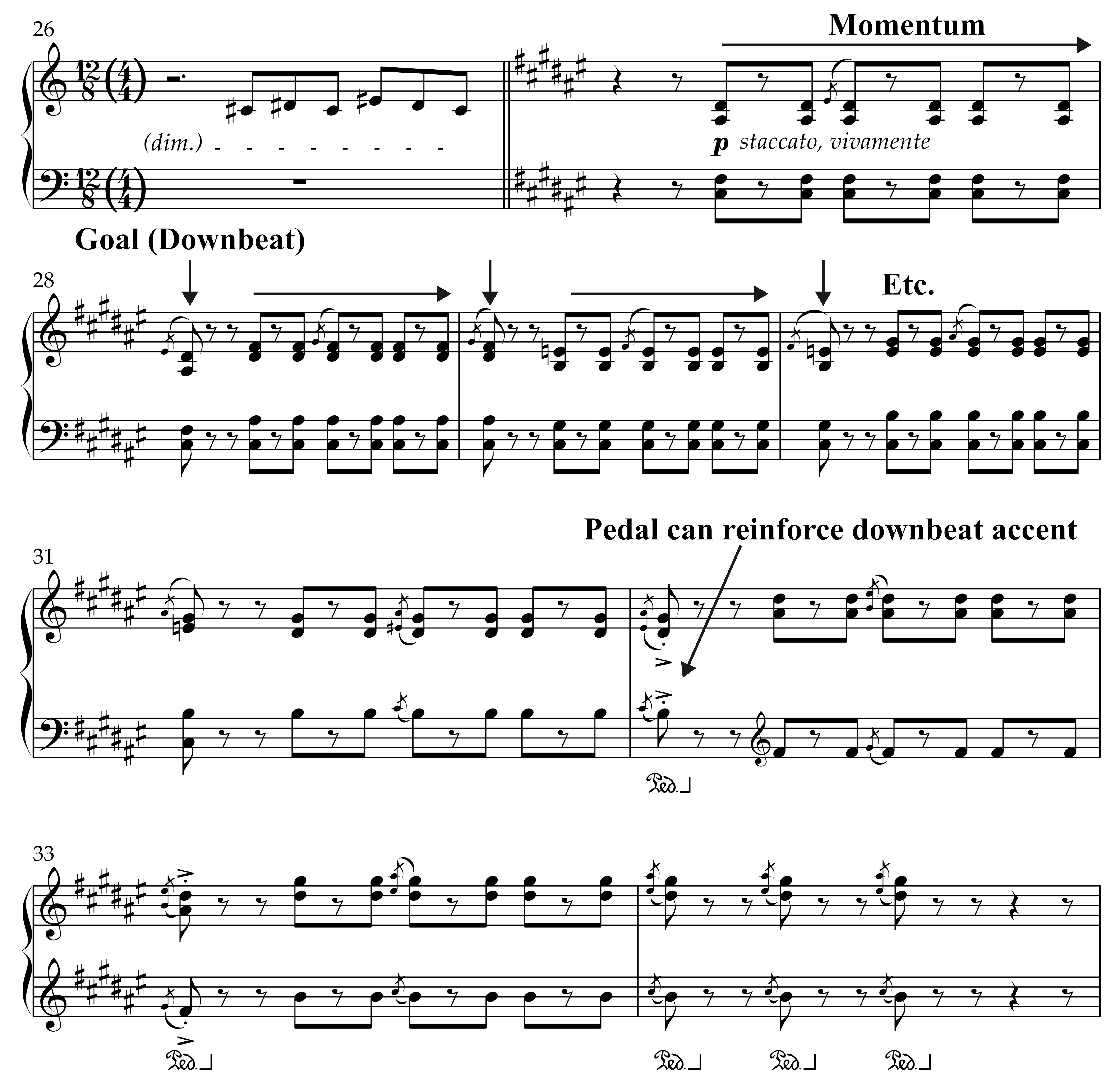
Figure 9: Franz Liszt, Mephisto Waltz No. 3, mm. 26–34.
Curiously, while the grace notes do subtly accent beats 1 and 3, the phrases’ metrical dispositions (starting on notated beat 2) cause these accents to sound more like backbeats in contemporary popular music than genuine metrical accents. The theme’s accents and bouncy rhythms create the first sustained sense of “dance,” in contrast to the earlier, less stable themes. The performer can remind the listener of the true downbeat here by directing each phrase toward beat 1, as suggested by the arrows in Figure 9.[19] In other words, the performer can evoke “end-accented phrases,” for which “the strongest beat is at or near the end” (Temperley 2003, 125). The downbeat could certainly be marked by a focal impulse, as well (Ito 2020). While a subtle crescendo to each downbeat would again be appropriate, pedaling as in Figure 8 would be less effective here due to the scherzo-like affect and staccato articulation. A better alternative could be to mark downbeats with brief pedal emphases, which the pianist could do throughout measures 27–34 or, as depicted in Figure 9, in the latter part of the passage where notated accents appear.
The meter in Mephisto Waltz No. 3 is not always displaced, of course; in fact, most of the piece consists of square quadruple meter. As in the fourth Mephisto Waltz, the metrically conflicting passages can be connected to Lenau’s poetic narrative. In my reading of the piece, the metrically displaced passages, which disrupt a comfortable four-beat dance pattern and contribute to the piece’s general disjointedness, could again embody Mephisto’s progressive corrupting influence on the other characters and point toward his ultimate triumph. Implementation of Strategies 1 and 2 can help bring this reading to life for an audience.
Long-Range Transformations and Metrical Realignment
While metric conflict certainly helps convey the diabolical subject matter in the Mephisto Waltzes, Liszt also used meter as an expressive tool in more intimate, spiritual settings, such as Pensée des morts [In Memory of the Dead], from the ten-piece set Harmonies poétiques et religieuses [Poetic and Religious Harmonies] (1848–53). The set takes its title from an 1830 collection of poems by French poet Alphonse de Lamartine, and multiple pieces in the set—including Pensée—are based on poems from Lamartine’s collection.
The poem on which Pensée is based is a stark, spiritual elegy that can be divided into three sections reflecting distinct psychological states (Backus 1987, 19). In the first section, the narrator reflects on lost loved ones amidst autumn imagery, while in the subsequent section, the narrator cries out to God, pleading that God bless the lost loved ones and asking if the dead have forgotten the living amidst the splendors of heaven. The final section shifts from petition to praise, contemplating God’s infinitude through natural imagery.[20] The full text of Lamartine’s “Pensée des morts,” in the original French, can be found at https://www.poetica.fr/poeme-483/alphonse-de-lamartine-pensee-des-morts/.
Liszt’s Pensée similarly exhibits a three-part structure,[21] Backus (1987) suggests that “Liszt’s music corresponds to the general outline of the poetic expression—a description of doubt and sadness, an appeal to God (i.e. the introduction of the ‘De profundis’) and, finally, acceptance and trust” (19). but arguably intensifies Lamartine’s emotional content. In the opening, for instance, Liszt heightens the sense of mourning through suspended, harmonically and rhythmically ambiguous figures and plaintive recitativo gestures. I invite the reader to experience this ambiguity by listening, without the score, to the opening excerpt in Audio Example 4, and then examine Liszt’s notation in Figure 10.
Audio Example 4: Franz Liszt, Pensée des morts, mm. 1–4, performed by the author (June 20, 2024, Furman University).
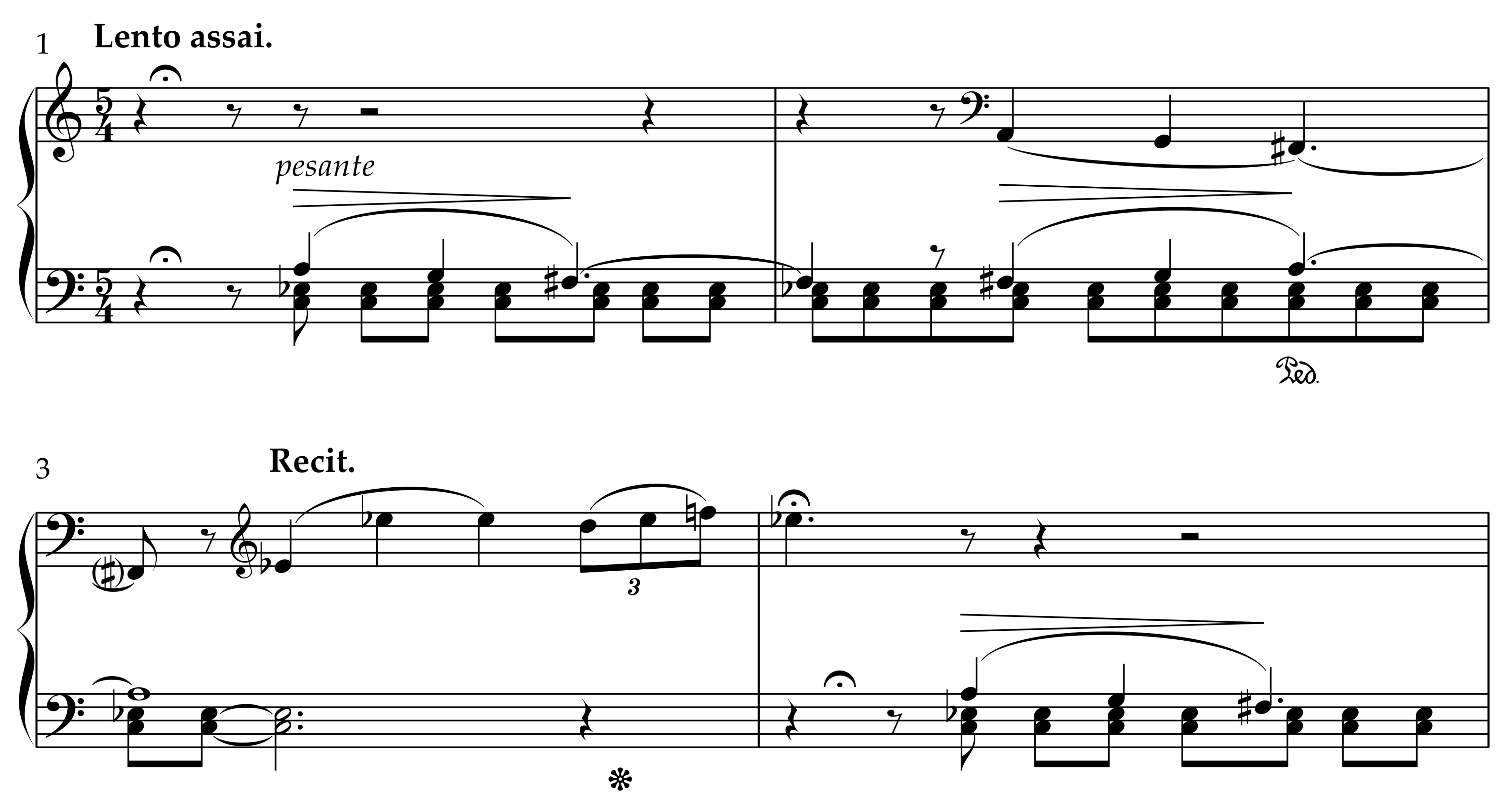
Figure 10: Franz Liszt, Pensée des morts, mm. 1–4.
Unlike the Mephisto Waltz examples, where conflicting heard meters are fairly easy to entrain (“2/4” or “3/4” meter, displaced quadruple meter, etc.),[22] London (2012) argues that meter is “a musically particular form of entrainment or attunement, a synchronization of some aspect of our biological activity with regularly recurring events in the environment” (4). the opening of Pensée provides little metric clarity at all. Even if one hears the opening note as a downbeat, the slow five-beat phrases and sudden metric shift when the recitativo theme enters make a definitive metric hearing difficult to pin down. The key of the opening passage is also relatively undefined, with unrelenting diminished-seventh harmonies suspended within what Merrick (2004) calls Liszt’s “blank key signature”—a device Liszt frequently employs in pieces or passages evoking death (299).
The second section of the piece, corresponding to the cry to God in Lamartine’s poem, is marked by increasing virtuosic turbulence leading to a climactic, ametric chant theme in E-flat Major, over which are written the words of Biblical Psalm 130: “De profundis clamavi ad te, Domine… [Out of the depths, I cry unto you, O Lord…].”[23] In addition to suggesting declamatory operatic recitative, the De profundis section foreshadows twentieth-century compositions that abandon meter entirely (e.g., Messiaen, Quatuor pour la fin du temps, mvt. 3.; Ginastera, Piano Sonata No. 2, op. 53, mvt. 2; etc.). Following this shattering climax, the intensity dissipates, leading to the piece’s contemplative final section. While Lamartine emphasizes praise and spiritual reflection, Liszt’s closing music—a transfigured, G Major version of the chant theme, now set in slow 3/4 meter with rippling triplet gestures that Backus (1987) calls an “overt parody of Beethoven’s ‘Moonlight’ sonata” (18)—seems to suggest divine comfort following the angst of the preceding sections.[24] The historical religious significance of musical threes deserves emphasis here. Berger (2002), for instance, describes the centrality of the triple-subdivided beat in 13th-century theorist Franco of Cologne’s influential Ars cantus mensurabilis (ca. 1280), for Franco “associated [ternary divisions] with the Holy Trinity” (632). The devoutly Catholic Liszt may have envisioned similar associations in the final section of Pensée. Like other works from the 1840s–50s, though, the piece ends with what Marta Grabócz (2009) calls “l’équivoque d’une coda interrogative” [the ambiguity of an interrogative coda] (230)—a sort of musical question mark, perhaps reflecting the mysteries of life and death. Audio Examples 5a and 5b and Figures 11a and 11b present representative excerpts from the piece’s second and third sections.
Audio Example 5a: Franz Liszt, Pensée des morts, mm. 58–59, performed by the author (January 27, 2024, University of Mary Washington).
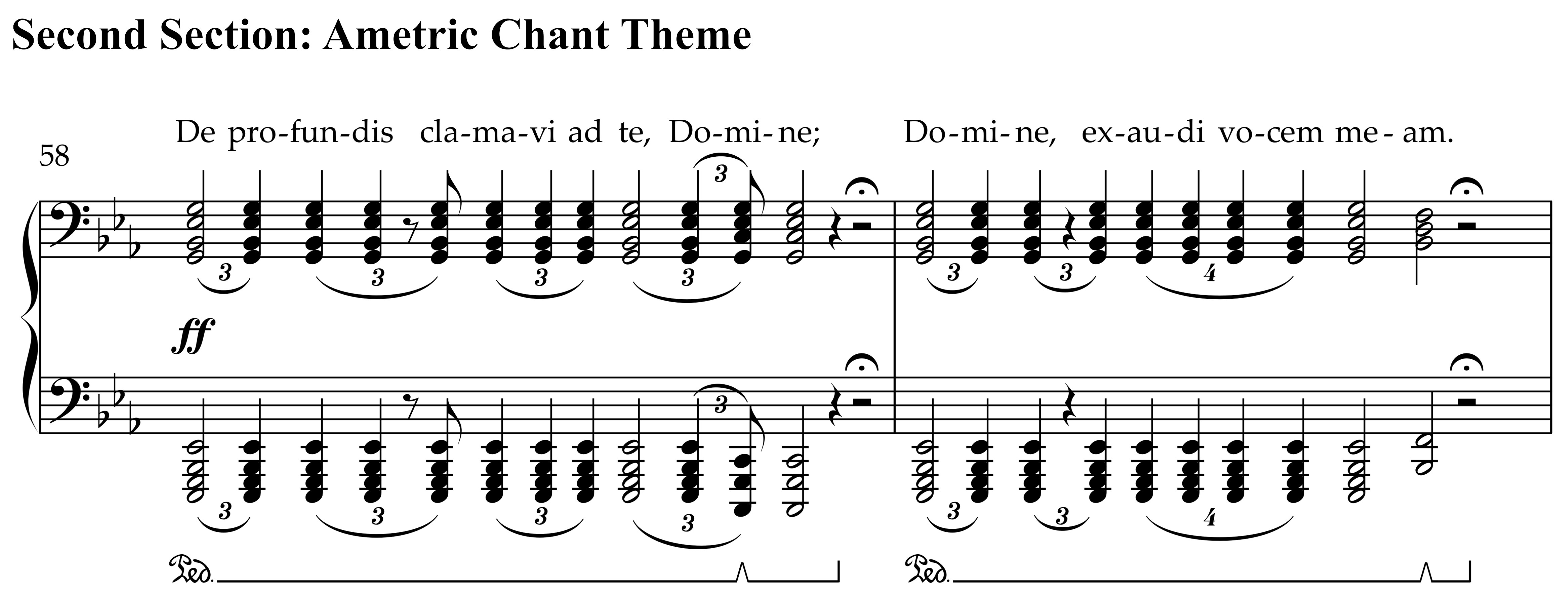
Figure 11a: Franz Liszt, Pensée des morts, mm. 58–59.
Audio Example 5b: Franz Liszt, Pensée des morts, mm. 84–91, performed by the author (January 27, 2024, University of Mary Washington).
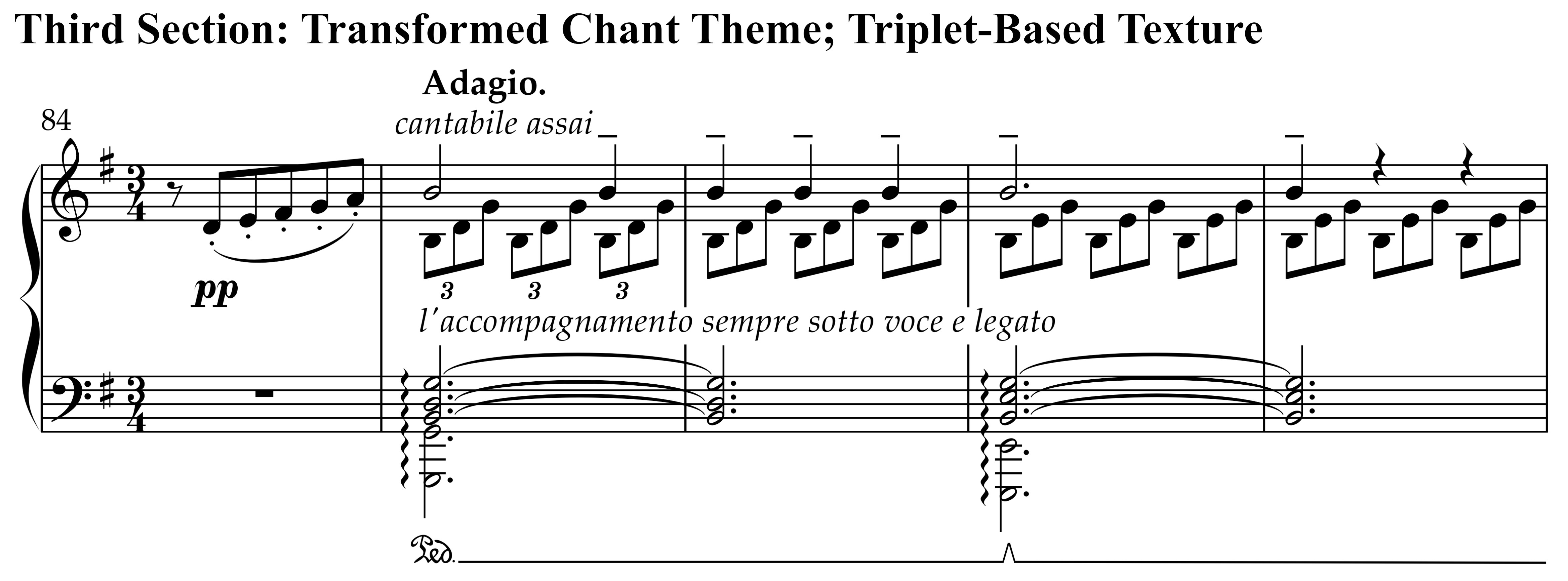
Figure 11b: Franz Liszt, Pensée des morts, mm. 84–88.
Figures 10 and 11 also show how Liszt’s music conveys the poem’s narrative trajectory by progressing from opening metric confusion to closing clarity. This observation suggests a third strategy for performing metrically conflicting Liszt works—a strategy implicit in the earlier discussions of Mephisto Waltzes 3 and 4.
Strategy 3: In preparing a metrically conflicting piece for performance, the performer should seek out and interpret long-range rhythmic/metric transformations of thematic material.
Embedded in Strategy 3 is an assumption that good performers already complete some degree of analysis (whether implicit or explicit) when preparing a piece for performance. The strategy’s distinguishing factors are its foregrounding of rhythm and meter (rather than pitch-based elements like melody, harmony, and counterpoint)[25] Cohn (2015) notes the marked bias in music theory curricula toward “tonality,” which “studies how we process, interpret, and ascribe meaning to pitched sounds,” as opposed to “meter,” which “studies how we might do the same for sounds in time” (5). Pro-tonality bias can easily filter into performance concerns, as well. This said, we should not ignore pitch-based processes altogether, for rhythmic/metric transformations form but one dimension of Liszt’s thematic transformations. and its global focus (moving beyond local rhythmic concerns). While broad musical processes involving metrical dissonance have been thoroughly discussed in music scholarship (Krebs 1999; Ng 2006; Wells 2017), the interpretive component of Strategy 3 invites the performer to experience, and convey to the audience, how changing metric contexts can suggest new musical, emotional, and narrative connotations. This said, Rink (2023a) cautions that the performer need not try to highlight every motivic connection in a piece, which could have “dubious musical outcomes” (160).
To illustrate Strategy 3, let us consider some key rhythmic/motivic processes that define Pensée des morts. Figure 12 presents three excerpts from the piece—one from each of the main sections.
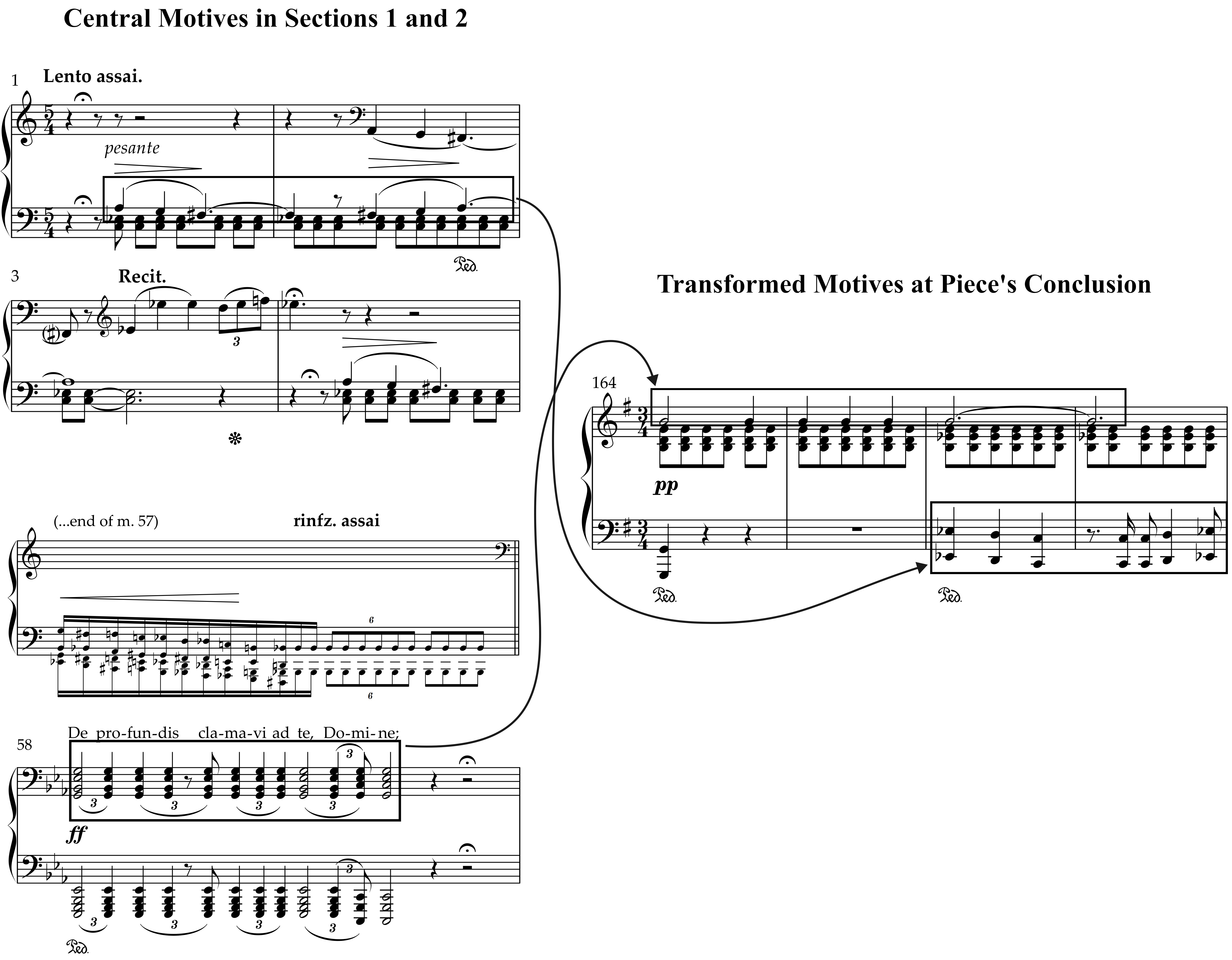
Figure 12: Franz Liszt, Pensée des morts, mm. 1–4, 57–58, and 164–67.
These excerpts signify the initial quiet mourning, subsequent uncontrolled grief, and final divine peace, respectively. In the opening, it is essential that the player internalize the notated, non-displaced 5/4 meter and feel the “pull” of the measure 4 downbeat at the end of the recitativo (Strategies 1–2). The De profundis excerpt, however, does not exhibit clear notated or heard meters, given its imitation of text declamation. The performer should convey the lack of metric structure here, taking full advantage of the freedom Liszt affords to provide audible contrast with the foregoing music. Otherwise, the image of the poetic narrator’s raw loss of control may not be adequately communicated.
To fully evoke this section’s contrasting metrical status and overall affect, the pianist should first observe that there is no tempo marking, and the rhythmic groupings (notated using quarter-note-based tuplets) suggest improvisatory thinking. Thus, the pianist might intensively experiment with the overall tempo, rubato within each phrase, lengths of fermatas, cutoffs, etc., to ensure that the music never feels too metrical. Melodic, harmonic, and dynamic considerations can inform temporal decisions, as well; for instance, I find I can best convey the climactic fortissimo dynamic in measure 58 if I enact a substantial ritardando over the rinforzando in measure 57 (the repeated notes near the beginning of Audio Example 5a) and then adopt a relatively slow declamatory style for the chords. I have heard other interpretations (e.g., Brendel 2011) whose De profundis chords are in a fairly rapid tempo, perhaps to achieve a breathless quality. In either case, the effect should resemble unmetered speech.
The third portion of Figure 12 is from the piece’s finale, where the meter is an uninterrupted 3/4. Two striking motivic transformations appear here. First, in the right hand, we see the aforementioned transfigured version of the De profundis theme, residing comfortably in triple meter and now accompanied by eighth-note chords. Then, in the left hand, we hear a variant of the opening three-note motive that not only fits squarely within 3/4, but is metrically aligned, with each descending gesture starting on the notated downbeat. It is almost as if the constant triple-meter environment of the piece’s third section has exerted divine influence, encouraging the two motives to take on new, more stable forms. In shaping and voicing these motives, the performer might aim to forge a connection to the motives’ original states. For instance, if the pianist employed a decrescendo followed by a crescendo over the initial descending/ascending third motive in measures 1–3, they might imitate this dynamic shape when the left hand presents the transformed version in measures 166–67. Additionally, the performer should feel (and convey) the significant emotional weight of this motivic transformation, appreciating how far the motive has come from its initial state.[26] When considering long-term relationships and transformations like these, the performer must develop an ability to listen across a piece’s whole temporal space, with each musical moment affected by previous ones and impacting those to come. This perspective resembles Lewin’s (1986) exploration of contextual listening, in which overlapping musical perceptions extend forward and backward in time as one listens to a piece.
As a final note on Pensée des morts, there is a striking passage in the third section in which the left hand supports the notated meter while the right hand departs from it. Figure 13a shows the opening of this passage, where the right-hand chordal melody is displaced an eighth note to the right, recalling the off-beat gestures from the opening of the piece.
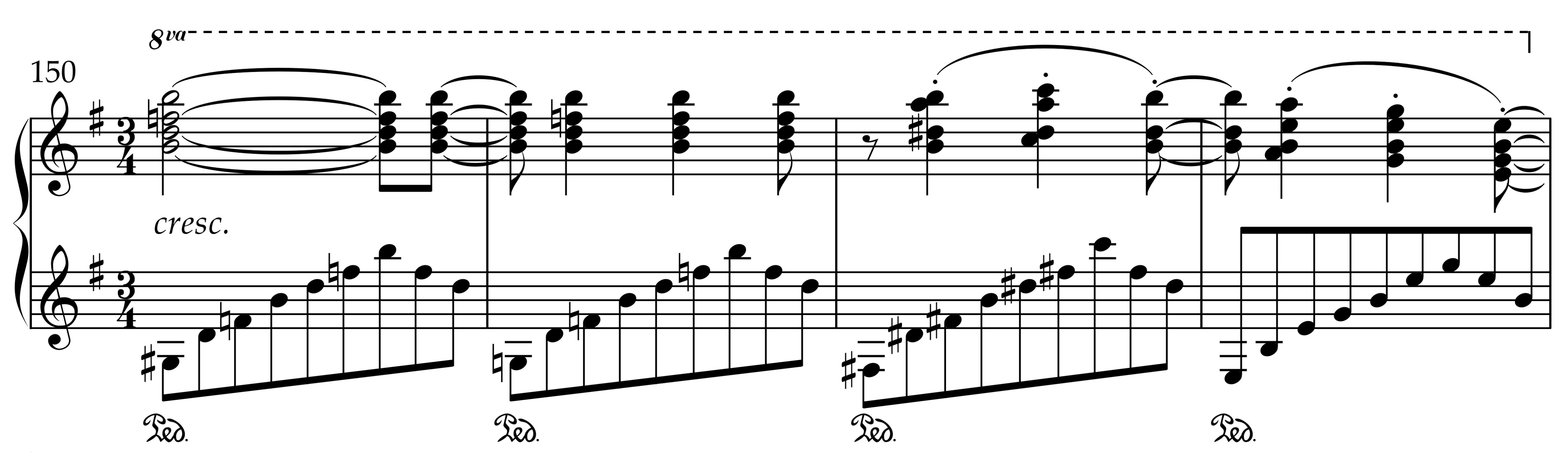
Figure 13a: Franz Liszt, Pensée des morts, mm. 150–53.
Krebs (1999) addresses similar performance problems in Robert Schumann’s music, pointing out that one can “reshape the conflicted passage by aligning the layers,” and after practicing the aligned version, restore the passage to its original form to “bring the character of the passage as Robert wrote it into focus for you” (179). This technique can certainly be applied to Liszt, implying another performance strategy.
Strategy 4: To make decisions involving phrasing, shaping, release points, and rubato in metrically displaced passages, the performer should practice the passages in an aligned manner.
Essentially, Strategy 4 clarifies Krebs’s formulation by emphasizing specific musical parameters to which the pianist may attend. (While Krebs’s goal of “[bringing] the character of the passage” through realignment is admirable, it is also ambiguous: what is the “character” of a passage, and how does it relate to practical choices a pianist needs to make?)[27] Ito (2020) similarly suggests, in Brahms’s Capriccio, op. 116, no. 7, aligning a shifted hemiola with the notated downbeat to internalize the melody’s phrasing and expressive shape (265–67), although his method involves singing the melody while conducting the notated meter rather than aligning hands at the piano.
Figure 13b shows a revised version of Liszt’s passage in which the displaced right-hand chords are shifted an eighth note to the left. Without the significant distractions created by hand misalignment, the pianist can more easily work out how to shape and time the lengthy phrases in this part of the piece. Once the pianist can successfully “hear” the melody in aligned form (which may require numerous practice sessions), the passage can be played in its original form, with timing and dynamic shaping maintained from the aligned version. The resulting effect, then, resembles what one might hear in a jazz or pop performance where the soloist employs “back-phrasing” against the accompaniment—the soloist is slightly behind the beat, but still communicates an expressive, cohesive melody.
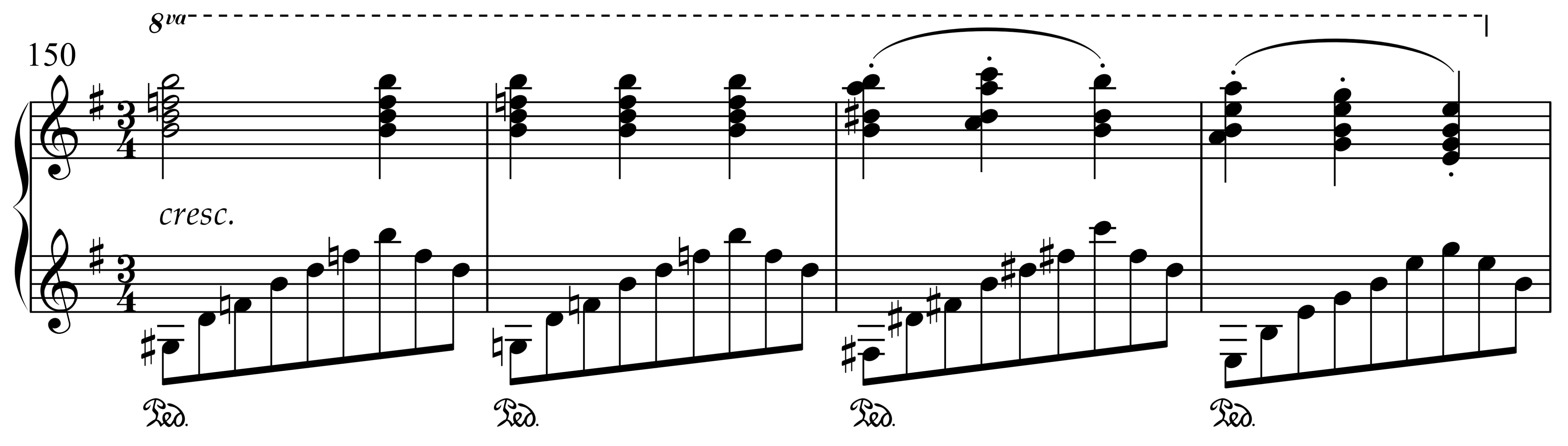
Figure 13b: Practice strategy for Liszt’s Pensée des morts, mm. 150–53.
Avoiding Rubato at Metrical Junctions
While Pensée des morts is a contemplative, spiritual meditation on death, Liszt’s Totentanz [Dance of Death] is a set of variations on the Dies irae chant that presents a feverish, apocalyptic rendering of the macabre. While Liszt originally composed Totentanz for piano and orchestra, a piano solo version quickly followed, with both appearing in print in 1865.[28] An 1839 diary entry first mentions Liszt’s plan for two death-themed works, which merged into a plan for a single piece by 1847. The published versions of Totentanz emerged from an extensive development and revision process into the 1860s (Kaczmarczyk 2018, 8–9). Liszt’s rapid completion of the solo version can be partly explained by the brief (seven-page) autograph manuscript, which only notates passages that differ from the piano solo part of the original concerto (Kaczmarczyk 2018, 9).
Liszt’s inspirations for Totentanz were wide-ranging, with the composer’s presence at the premiere of Berlioz’s Symphonie fantastique in 1830 likely one of the earliest. Other influences came from the visual arts—namely, a macabre series of etchings by Hans Holbein the Younger called Todtentanz, and a fresco in Pisa by Buonamico Buffalmacco called Trionfo della Morte [The Triumph of Death] (Pesce, Eckhardt, and Mueller 2001; Kaczmarczyk 2018, 8). While the Holbein etchings depict Death visiting individuals from all sectors of Renaissance society,[29] For digital photos of Holbein’s etchings, see Pennant-Rea 2018. the Buffalmacco fresco depicts a sort of cosmic battle, with angels and demons fighting over the souls of the dead.
Liszt’s writing in Totentanz is tremendously varied, from spine-tingling cadenzas (opening section) and glissandos (Variation 2 and coda) to quieter moments imitating Renaissance counterpoint or suggesting heavenly bliss (Variation 4). Perhaps the most startling and disorienting passages derive their effect from Liszt’s bold metric usages. Consider two excerpts from the opening of the piece (Audio Example 6) and a set of mini-variations marked Sempre allegro ma non troppo occurring late in the piece (Audio Example 7). Once more, I invite the reader to listen to each excerpt without viewing the score and try to aurally interpret the meter in each case. In particular, for the first excerpt, I encourage the reader to anticipate when the Dies irae theme will enter after the pounding introductory chords. For the second excerpt, the reader should try to interpret the meter when a new melody begins after a fermata.[30] Kaczmarczyk (2002) suggests that this new melody comes from a preexisting tune drawn from the French liturgical tradition. In Liszt’s “Tasso” Sketchbook, this tune appears between verses of the familiar Dies irae chant, serving as a sort of refrain (55–57).
Audio Example 6: Franz Liszt, Totentanz, mm. 1–7, performed by the author (June 20, 2024, Furman University).
Audio Example 7: Franz Liszt, Totentanz, mm. 458–77, performed by the author (January 27, 2024, University of Mary Washington).
The opening excerpt (Audio Example 6) forms a disconcerting start to the piece, for the main Dies irae theme feels like it enters a beat too early. The score excerpt in Figure 14 demonstrates why this is the case.
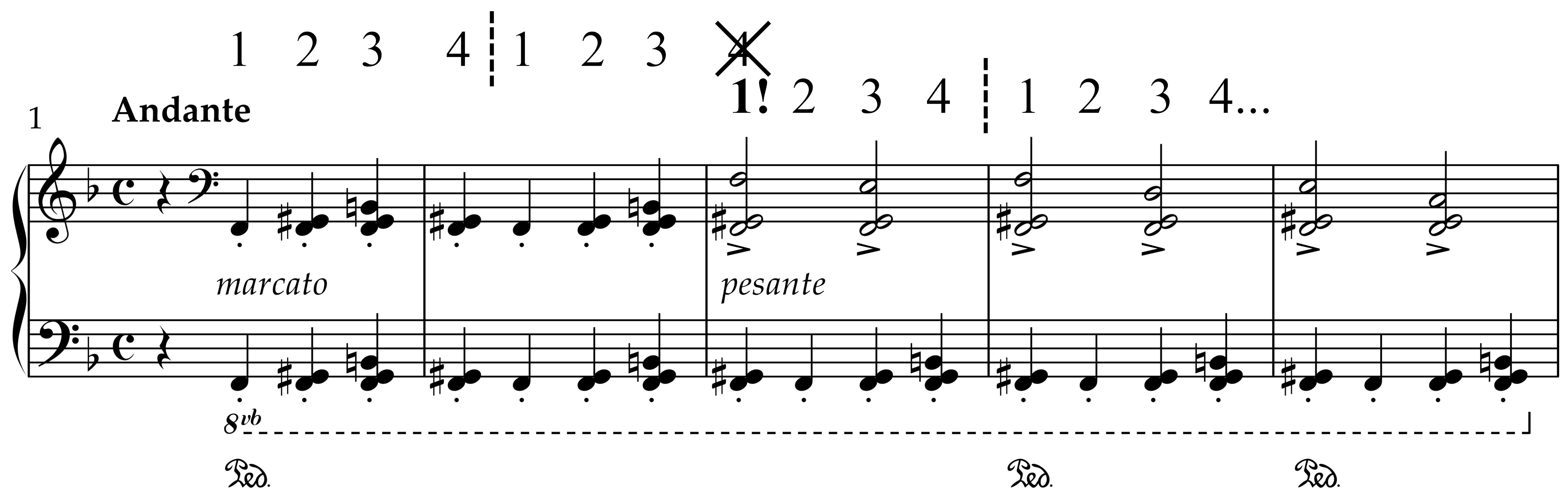
Figure 14: Franz Liszt, Totentanz, mm. 1–5, with heard counts.
Once again, Liszt has placed a rest on the opening downbeat, leading the listener to believe that the first note (on beat 2) is the downbeat. Reinforcing this illusion is a diminished triad pattern moving in four-quarter-note cycles from beat 2. However, the pesante entry of the melody on the notated downbeat of measure 3 suddenly forces the listener to revise their metric interpretation and adjust to the true notated meter. This is a striking instance of an “indirect [metrical] dissonance” (Krebs 1999, 45), in which the boundary between consecutive, contrasting metric interpretations creates a brief perceptual conflict. Many more indirect dissonances will emerge in Totentanz from stark juxtapositions between aligned and displaced meters. For instance, as Figure 15 (in the next section) illustrates, the theme after the fermata in Audio Example 7 does not begin on a downbeat, but on beat 2 of 2/4, despite what our ears may tell us. Without warning, Liszt has placed this new theme, and the variations that follow, in a metrically displaced state.
When metrically displaced passages suddenly appear, Krebs (1999) helpfully notes that “it is important to avoid delay at their inceptions” (182). Taken literally, however, his directive is not applicable to the opening of Totentanz, where the metrically displaced music is not preceded by metrical consonance. Nevertheless, we might extend Krebs’s idea to accommodate not just transitions from metrical alignment to displacement, but the reverse, as well. In fact, the notion of maintaining the tempo when moving from metrical consonance to dissonance, or vice versa, might be applied to situations involving metrical grouping dissonances, as well. I summarize the foregoing considerations in a fifth metric conflict performance strategy.
Strategy 5: When entering or exiting metrically conflicting regions, the performer should avoid taking expressive time.
“Expressive time” here could include not only rubato, but also expressive musical “breaths” that might undermine the drama of a metrical juxtaposition. While time had “quasi-dramatic function” in nineteenth-century music and Liszt was “violently opposed to a metronomic rigidity of musical time” (Rink 2023b, 82–83), I argue that the “metronomic” aspect of Strategy 5 has expressive purposes. For instance, in the opening of Totentanz (Audio Example 6 and Figure 14), the Dies irae theme’s startling entry in measure 3 would be enervated if I employed even a slight ritardando or preparatory breath. In the later passage (Audio Example 7 and Figure 15), I should similarly observe Liszt’s precise rhythmic notation. Namely, rather than seeing the fermata in measure 465 as an excuse to stop time until the next chord appears, I should observe that the rest on the downbeat of measure 466 does not bear a fermata and is in a new tempo. Thus, I should mark the downbeat of measure 466 through a precise release of the fermata-bearing chord, give the rest exactly one beat in the new tempo, and continue playing in this tempo. In these and other metrical juxtapositions throughout Totentanz, Strategy 5 allows the performer to sustain rhythmic impulse and intensity as metric states change, thereby assisting in conveying the powerfully macabre imagery in Holbein’s prints and Buffalmacco’s fresco.
While the Totentanz excerpts demonstrate how Strategy 5 might be applied when displaced and non-displaced meters are juxtaposed (in either order), a previously-discussed passage from Mephisto Waltz No. 4 (Figure 5) suggests the strategy’s usefulness when metrical grouping dissonances are involved. In measures 41–48, the left hand revisits the metrically conflicted opening theme (Figure 1b), while the right hand provides a pulsating, metrically agnostic accompaniment. The end of measure 48 through the downbeat of measure 49, however, suddenly (and only briefly) gives in to the underlying 6/8 meter and emphasizes the notated downbeat, after which the prior theme resumes in both hands in measure 49. To achieve the full effect of the conflicting meters, which I previously suggested could represent Mephistopheles’s corrupting influence (Table 1), it is essential that the pianist keep relatively strict tempo in measures 48–49. Admittedly, a small breath may be necessary to allow both hands time to move from the high C-sharp Major chord to the low octave an eighth note later, but this breath should be kept as short as possible. Otherwise, the pianist risks suggesting that the high chord and low C-sharp octaves are separated by an eighth rest, which would ruin the metrical effect.
Conclusions and Extensions
In summary, the current investigation has suggested five primary strategies for performing metric conflict in Liszt’s piano music:
- Strategy 1: In a passage where there is conflict between notated and heard meters, the performer should generally emphasize the notated meter.
- Strategy 2: In metrically conflicting passages, the performer should attempt to feel, and convey to the audience, the “pull” of the notated downbeat.
- Strategy 3: In preparing a metrically conflicting piece for performance, the performer should seek out and interpret long-range rhythmic/metric transformations of thematic material.
- Strategy 4: To make decisions involving phrasing, shaping, release points, and rubato in metrically displaced passages, the performer should practice the passages in an aligned manner.
- Strategy 5: When entering or exiting metrically conflicting regions, the performer should avoid taking expressive time.
While each of these is potentially valuable in its own right, these strategies are perhaps most useful when implemented in tandem. Consider, for instance, the previously discussed Totentanz excerpt that presents a new theme in displaced 2/4 meter (Audio Example 7). Figure 15 illustrates Liszt’s notation for the passage, along with annotations indicating the multiple, interwoven strategies a performer might use.
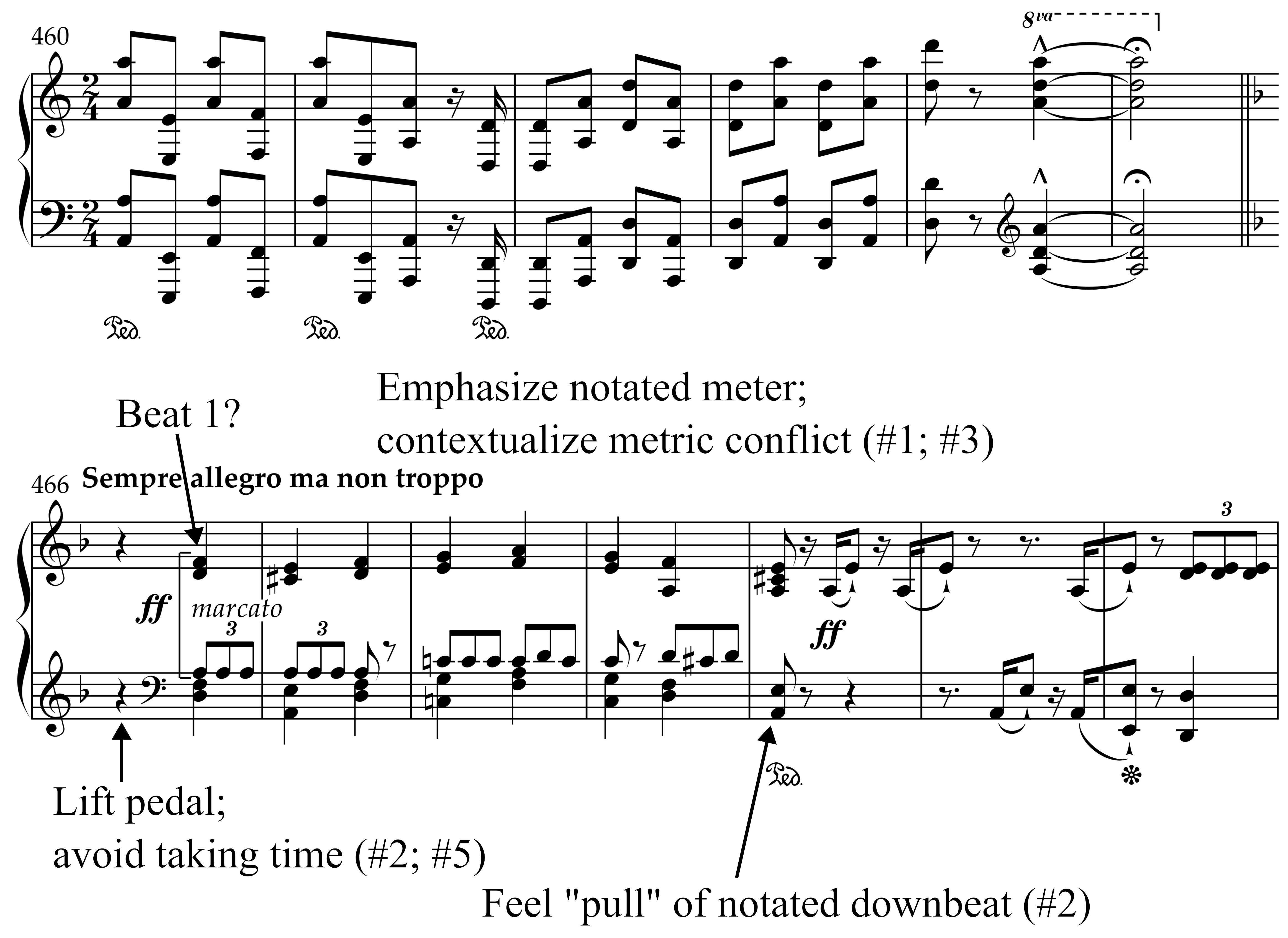
Figure 15: Franz Liszt, Totentanz, mm. 460–72, with possible performance strategies.
The performer can employ Strategy 1 throughout the displaced 2/4 passage, phrasing and accenting according to the “hidden” notated meter (and perhaps practicing while counting the notated duple meter aloud). Additionally, following Ito (2020), the half-bar displacements can be performed with lighter, “upward-inflected” focal impulses on notated downbeats and weightier, “downward-inflected” focal impulses on notated upbeats (199–200). Hence, while the performer might be tempted to drop the wrist on heard downbeats (beat 2) and lift on heard upbeats (beat 1), the metric conflict will be better realized through a lift on beat 2 and drop on beat 1.
Furthermore, in measures 466 and 470, the pianist can implement Strategy 2, feeling the weight of these prominent notated downbeats. Specifically, in measure 466, the pianist can sharply lift the pedal on the downbeat rest, which should be strictly in time (Strategy 5), and can then enact a slight crescendo from measure 469 into the downbeat of measure 470. Finally, the pianist needs to contextualize the displaced 2/4 theme within the piece as a whole (Strategy 3), interpreting the theme’s relation to earlier metrically conflicting material and its impact on the piece’s ultimate trajectory.
Variation 3 of Totentanz (Figure 16 and Audio Example 8) represents another opportunity to employ multiple strategies, with even thornier metrical challenges than the previous excerpt.
Audio Example 8: Franz Liszt, Totentanz, mm. 93–111, performed by the author (January 27, 2024, University of Mary Washington).
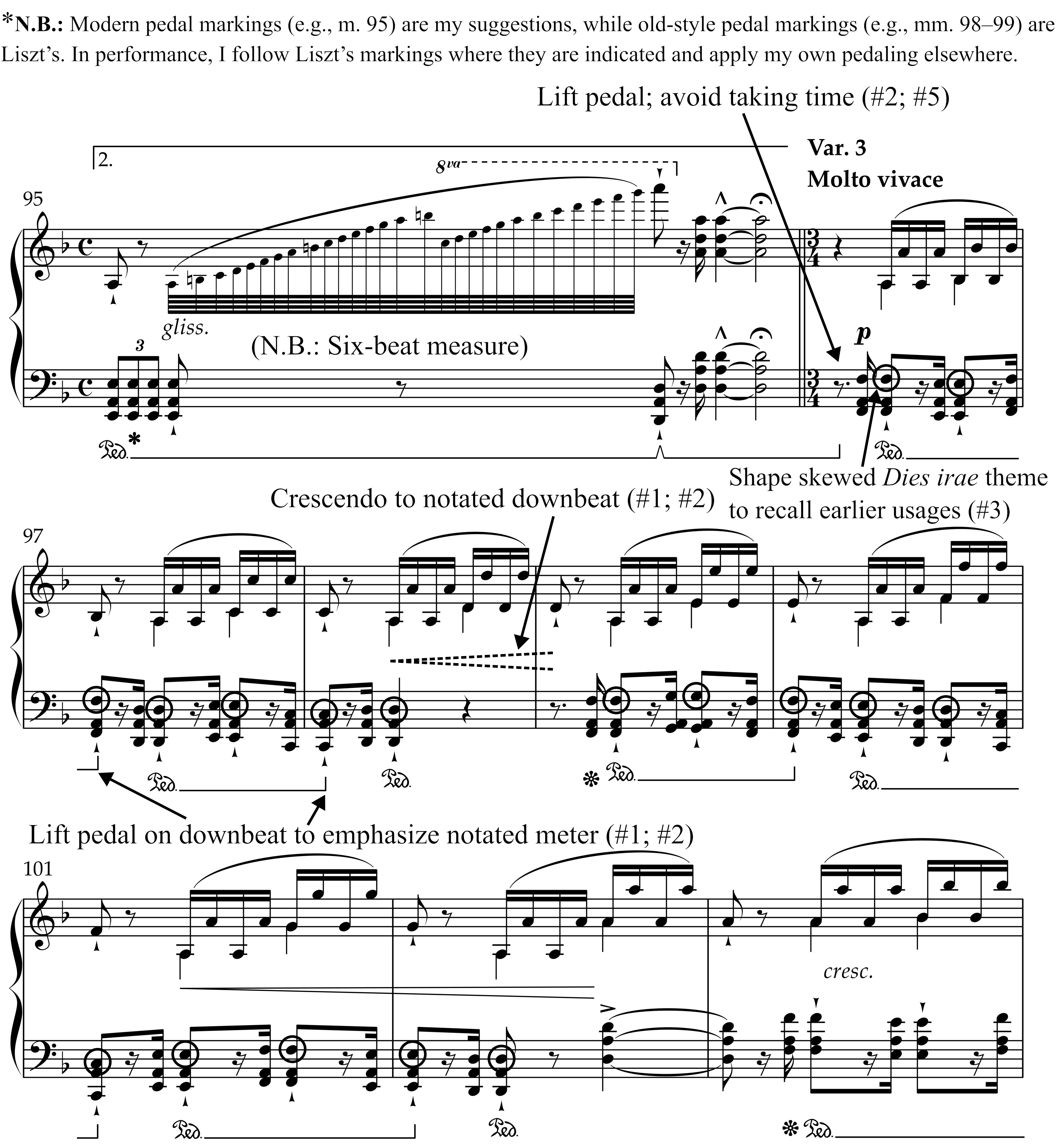
Figure 16a: Franz Liszt, Totentanz, mm. 95–103, with possible performance strategies.
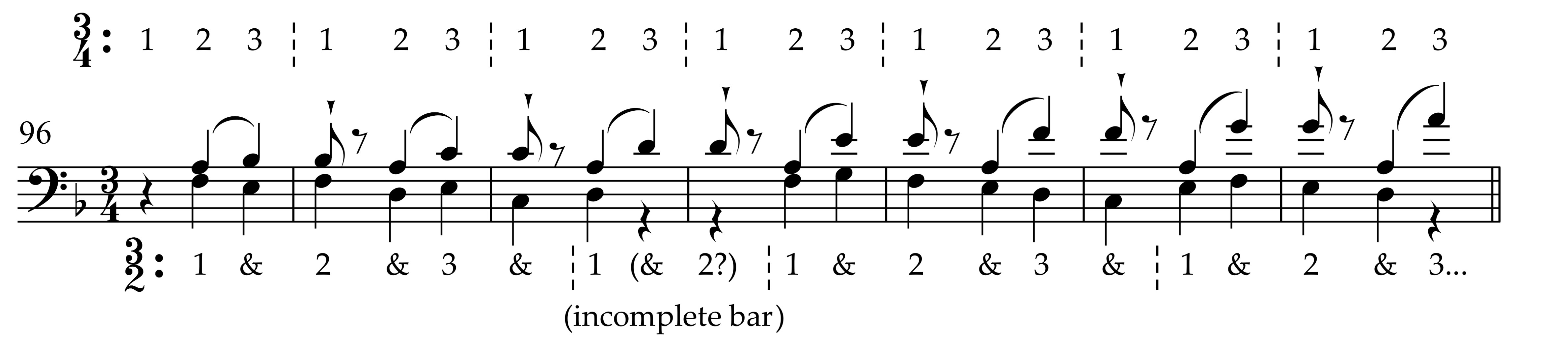
Figure 16b: Rhythmic reduction of Liszt,’s Totentanz, mm. 96–102.
Variation 3 is particularly confusing to interpret because the right hand’s phrases fit comfortably within the notated 3/4 meter, while the left hand’s melody initially suggests a skewed “3/2” meter (where beat 2 of measure 96 feels like a downbeat), as shown in Figure 16b. Once again, though, thoughtful pedaling can provide a solution. At the start of the variation, the pianist can quickly lift the pedal to mark the silent downbeat in measure 96 following the fermata (Strategy 2) and then proceed in the new tempo without additional expressive time (Strategy 5). Then, the performer might implement the pedaling shown in Figure 16a to highlight the notated downbeat via a pedal lift (except where Liszt’s pedal indications indicate otherwise)—a pedaling that also complements the right hand’s end-accented phrases (Strategy 2).[31] See note 19, above.
Significantly, this pedaling allows the pianist to audibly and physically manifest the notated 3/4 meter (Strategy 1) even while shaping the left hand’s metrically conflicting Dies irae variant to recall earlier, metrically aligned instances of this theme (Strategy 3). In particular, accenting the notated downbeats in the left hand would sound awkward and unmusical; it makes more sense to drive each phrase to its end without internal accents. A crescendo from measure 98 into the downbeat of measure 99 can affirm notated 3/4 after the first left hand phrase ends (Strategies 1 and 2). More broadly, the entire variation can benefit from practicing while counting the notated meter out loud (Strategy 1), which is difficult to sustain, but valuable for understanding the passage’s metric expression.
Any example in this article could similarly benefit from multiple metric conflict performance strategies, even where I have only emphasized one. It is also important to recognize that my list of strategies is both subjective and noncomprehensive; these are simply the techniques I found especially beneficial as I prepared the discussed Liszt works for performance. I encourage the reader to consider how the list of strategies might be altered or supplemented to accommodate other pieces or performance goals.
Moreover, while the strategies given in this article work well for Liszt’s piano music, their applications need not be limited to Liszt. Indeed, these and similar strategies might be adapted for other romantic composers, or even modern or contemporary repertoires.[32] While beyond the scope of this article, the piano works of Native American composer Louis W. Ballard (Cherokee/Quapaw) could provide a rich contemporary case study, with powerful instances of metric conflict with ties to Indigenous music. See Frisbie 2001, Crappell 2008, and Wells 2024. Non-piano instrumentalists or vocalists could also adapt these strategies in ways appropriate to their medium. Orchestral performance could form yet another interesting application, as the conductor provides a constant reminder of the notated meter even when metric conflict is occurring.
While beyond the scope of the current study, additional questions concerning Liszt’s uses of musical time remain. Liszt clearly pushes the boundaries of the waltz genre in his Mephisto Waltzes; how might performing metrical dissonances in these and other dance-based works be informed by historical dance practices? Moreover, in Liszt’s spiritually influenced works, how might Liszt’s temporal strategies parallel his conceptions of eternity and the afterlife? (Might metric conflict in ethereal works like Invocation, for instance, allow the pianist to break the usual metrical restrictions and reach a higher experiential plane?) Lastly, to what extent might Liszt’s pianistic metric conflicts provide insights into virtuosic pianism in Brahms and Schumann?[33] Krebs (1999) suggests that Schumann might have made up for his lack of Paganini-esque virtuoso technique by “[outdoing Paganini] as a composer” through “ingenious and resourceful [manipulation] of metrical dissonance” (156).
I can remember, as a college student, devoting most of my Liszt practice time to concerns such as fast notes, resonant chords, accurate octaves, proper voicing, and so forth, only cursorily noting Liszt’s curious uses of meter. I now understand that substantial, intensely focused practice time must be devoted to rhythm, as well, especially when metric conflict arises.[34] There is evidence that Liszt expected his own students to carefully practice rhythm, meter, and accent. His American student William Mason (1901) recounts that at his first lesson with Liszt, the composer was “very fond of strong accents in order to mark off periods and phrases, and he talked so much about strong accentuation that one might have supposed that he would abuse it, but he never did” (99). Initially, the difficulties of playing music that feels like one meter while the notation suggests another may tempt one to give up and move on to other pianistic concerns. My hope, though, is that the reader sees the value in exploring metric conflict and its narrative role in Liszt’s music, and understands that such study can facilitate greater depths of expression, excitement, and musical communication in Liszt’s imaginative piano works.
[1] Liszt’s opening suggests what Sullivan (2021), adapting Mirka’s (2009) eighteenth-century metrical theories to twentieth-century music, refers to as “opening imbroglio”—specifically, where a repeated counter-metric motive prevents establishment of the opening notated meter (Sullivan 2021, 133).
[2] In this article, I generally refer to metric(al) “conflict” rather than “dissonance,” as many Liszt works challenge the notated meter from the start and/or leave “dissonances” unresolved. “Metric conflict” better captures the idea of metrical layers engaged in a dispute in which neither has clear priority—a perspective with noteworthy performance applications.
[3] In other words, the metric conflicts discussed in this article exemplify Krebs’s (1999) “subliminal dissonances,” in which “all musical features—accents, groupings, etc.—establish only one interpretive layer, while the context and the metrical notation imply at least one conflicting layer” (46). On relationships between aural cues and metric perceptions, see Lerdahl and Jackendoff 1983 and Temperley 2001.
[4] I derived these performance strategies while researching and preparing these Liszt works for performance in a series of lecture-recitals given at the University of Mary Washington, Randolph-Macon College, and the College Music Society Mid-Atlantic Chapter’s 52nd Annual Conference, as well as a solo recital performed at Furman University. This research was supported by a University of Mary Washington Jepson Fellowship for the 2023–2024 academic year.
[5] For an overview of the Faust legend and various literary adaptions, see Encyclopedia Britannica, “Faust: Literary Character,” last updated July 19, 2025, https://www.britannica.com/topic/Faust-literary-character.
[6] Sulyok and Mező (2015) note that Liszt only completed an “unfinished draft of about 70 bars” of the intended Andantino insert; they therefore deem the waltz “complete and finished in spite of the fact that catalogues consistently list it in the category of the unfinished compositions” (9).
[7] Interpretations of “the” heard meter may vary between performers. Even when specific hearings of metrically conflicting passages differ, most performers would at least agree that these passages challenge the notated meter.
[8] Sullivan hears dissonance where the 2/8 and 3/8 metrical interpretations occur in immediate succession—what Krebs (1999) calls an “indirect dissonance” (45). For more on indirect metrical dissonances, see the discussion of Liszt’s Totentanz below.
[9] Ito (2020) notes that a hemiola in the first movement of Brahms’s Clarinet Quintet, op. 115 only weakly challenges the notated meter. The performer thus can increase the sense of disorientation by bringing out the heard meter, in opposition to Strategy 1 (269–70).
[10] The 7/4 indication in measure 20 marks the first time signature change, as measures 1–19 were in 5/4.
[11] Interestingly, rather than hearing an implied 2/4 or 3/4 where the E’s mark heard downbeats, Barrington (1992) hears a false 6/4 meter where the first note of the piece is a heard downbeat (see p. 54, Example 5.3). The point remains, though, that the notated 6/8 meter is difficult to perceive without access to the score.
[12] The common Ādi tāḷa, for instance, is an eight-beat cycle consisting of the gestures, “Clap—Pinky Finger—Ring Finger—Middle Finger—Clap—Wave—Clap—Wave.”
[13] A full introduction to Carnatic music is beyond the scope of this article. For more information on this music’s cultural and theoretical underpinnings, see Pesch 1999, Catlin 2000, Nelson 2000, and Viswanathan and Allen 2004.
[14] In measures 9–24 (two-sharp key signature), a repeated four-bar phrase in D Major gives way to a new four-bar phrase (also repeated) that moves from B Minor to B Major. Measures 25–40 (three-flat key signature) are an exact transposition of measures 9–24 up a semitone, with a repeated E-flat Major phrase moving to a pair of C Major/Minor phrases.
[15] Although the notated meter is only briefly reestablished, the downbeat of measure 49 is noteworthy as both a metrical and tonal arrival (in C-sharp Major). This integration of metric and harmonic parameters mirrors Brahms’s practice. Smith (2001), for instance, demonstrates how metrical dissonance and consonance processes interact with harmonic tension and resolution in Brahms’s wind trios.
[16] Hatten (2012) similarly explores gravitational metaphors, describing metrical “gravity” as a “continuous field re-instantiated by each downbeat” (21).
[17] For the remainder of this article, old-style pedal markings (“Ped” followed by an asterisk, as in Figures 3, 4, 5, and 7) are Liszt’s, while modern pedal markings (“Ped” followed by a horizontal line and change/lift symbols, as in Figure 8) are my own suggestions.
[18] We should note that the specific piano and performance space will dictate how much sound carries into the rest following the pedal release. The performer could also incorporate Strategy 2 without relying on the pedal by envisioning “loud rests” (London 2012, 107–8) on the downbeats and implementing downbeat focal impulses involving hand/arm gestures, breath intake, etc.
[19] In other words, the performer can evoke “end-accented phrases,” for which “the strongest beat is at or near the end” (Temperley 2003, 125). The downbeat could certainly be marked by a focal impulse, as well (Ito 2020).
[20] The full text of Lamartine’s “Pensée des morts,” in the original French, can be found at https://www.poetica.fr/poeme-483/alphonse-de-lamartine-pensee-des-morts/.
[21] Backus (1987) suggests that “Liszt’s music corresponds to the general outline of the poetic expression—a description of doubt and sadness, an appeal to God (i.e. the introduction of the ‘De profundis’) and, finally, acceptance and trust” (19).
[22] London (2012) argues that meter is “a musically particular form of entrainment or attunement, a synchronization of some aspect of our biological activity with regularly recurring events in the environment” (4).
[23] In addition to suggesting declamatory operatic recitative, the De profundis section foreshadows twentieth-century compositions that abandon meter entirely (e.g., Messiaen, Quatuor pour la fin du temps, mvt. 3.; Ginastera, Piano Sonata No. 2, op. 53, mvt. 2; etc.).
[24] The historical religious significance of musical threes deserves emphasis here. Berger (2002), for instance, describes the centrality of the triple-subdivided beat in 13th-century theorist Franco of Cologne’s influential Ars cantus mensurabilis (ca. 1280), for Franco “associated [ternary divisions] with the Holy Trinity” (632). The devoutly Catholic Liszt may have envisioned similar associations in the final section of Pensée.
[25] Cohn (2015) notes the marked bias in music theory curricula toward “tonality,” which “studies how we process, interpret, and ascribe meaning to pitched sounds,” as opposed to “meter,” which “studies how we might do the same for sounds in time” (5). Pro-tonality bias can easily filter into performance concerns, as well. This said, we should not ignore pitch-based processes altogether, for rhythmic/metric transformations form but one dimension of Liszt’s thematic transformations.
[26] When considering long-term relationships and transformations like these, the performer must develop an ability to listen across a piece’s whole temporal space, with each musical moment affected by previous ones and impacting those to come. This perspective resembles Lewin’s (1986) exploration of contextual listening, in which overlapping musical perceptions extend forward and backward in time as one listens to a piece.
[27] Ito (2020) similarly suggests, in Brahms’s Capriccio, op. 116, no. 7, aligning a shifted hemiola with the notated downbeat to internalize the melody’s phrasing and expressive shape (265–67), although his method involves singing the melody while conducting the notated meter rather than aligning hands at the piano.
[28] An 1839 diary entry first mentions Liszt’s plan for two death-themed works, which merged into a plan for a single piece by 1847. The published versions of Totentanz emerged from an extensive development and revision process into the 1860s (Kaczmarczyk 2018, 8–9).
[29] For digital photos of Holbein’s etchings, see Pennant-Rea 2018.
[30] Kaczmarczyk (2002) suggests that this new melody comes from a preexisting tune drawn from the French liturgical tradition. In Liszt’s “Tasso” Sketchbook, this tune appears between verses of the familiar Dies irae chant, serving as a sort of refrain (55–57).
[31] See note 19, above.
[32] While beyond the scope of this article, the piano works of Native American composer Louis W. Ballard (Cherokee/Quapaw) could provide a rich contemporary case study, with powerful instances of metric conflict with ties to Indigenous music. See Frisbie 2001, Crappell 2008, and Wells 2024.
[33] Krebs (1999) suggests that Schumann might have made up for his lack of Paganini-esque virtuoso technique by “[outdoing Paganini] as a composer” through “ingenious and resourceful [manipulation] of metrical dissonance” (156).
[34] There is evidence that Liszt expected his own students to carefully practice rhythm, meter, and accent. His American student William Mason (1901) recounts that at his first lesson with Liszt, the composer was “very fond of strong accents in order to mark off periods and phrases, and he talked so much about strong accentuation that one might have supposed that he would abuse it, but he never did” (99).
References
- 1987. “Liszt’s Harmonies Poétiques et Religieuses: Inspiration and the Challenge of Form.” Journal of the American Liszt Society 21: 3–21.
- 1992. “The Four Mephisto Waltzes of Franz Liszt.” Ph.D. Diss., University of British Columbia.
- 2002. “The Evolution of Rhythmic Notation.” In The Cambridge History of Western Music Theory, 628–56. Cambridge University Press.
- 2011. Liszt: Artist’s Choice. Decca 478 2825, 3 compact discs.
- 1989. Franz Liszt: A Chronicle of His Life in Pictures and Documents. Translated by Stewart Spencer. Princeton University Press.
- 2000. “Karnatak Vocal and Instrumental Music.” In The Garland Encyclopedia of World Music, Vol. 5: South Asia: The Indian Subcontinent, edited by Alison Arnold, 209–35.
- 1992a. “Metric and Hypermetric Dissonance in the Menuetto of Mozart’s Symphony in G Minor, K. 550.” Intégral 6: 1–33.
- 1992b. “The Dramatization of Hypermetric Conflicts in the Scherzo of Beethoven’s Ninth Symphony.” 19th-Century Music 15 (3): 188–206.
- 2001. “Complex Hemiolas, Ski-Hill Graphs and Metric Spaces.” Music Analysis 20 (3): 295–326.
- 2015. “Why We Don’t Teach Meter, and Why We Should.” Journal of Music Theory Pedagogy 29 (1): 5–24. 10.71156/2994-7073.1175.
- 1985. “Musical Form and Musical Performance Reconsidered.” Music Theory Spectrum 7:149–58.
- 2008. “Native American Influence in the Piano Music of Louis W. Ballard.” D.M.A. Diss., The University of Oklahoma.
- 2020. Liszt and Virtuosity. Eastman Studies in Music. University of Rochester Press.
- 2001. “Ballard, Louis W(ayne) [Honganózhe].” In Grove Music Online. 10.1093/gmo/9781561592630.article.48581.
- 1972. Piano Technique. Dover Publications.
- 2004. The Virtuoso Liszt. New Perspectives in Music History and Criticism. Cambridge University Press.
- 2021. “Towards a Cognitively Based Quantification of Metrical Dissonance.” In The Oxford Handbook of Time in Music, Edited by Mark Doffman, Emily Payne, and Toby Young, 277–302. Oxford University Press.
- 2009. Musique, narrativité, signification. Paris: Harmattan.
- 2012. “Musical Forces and Agential Energies: An Expansion of Steve Larson’s Model.” Music Theory Online 18 (3). https://mtosmt.org/issues/mto.12.18.3/mto.12.18.3.hatten.html.
- 2020. Focal Impulse Theory: Musical Expression, Meter, and the Body. Indiana University Press. ProQuest Ebook Central.
- 2002. “Liszt, Lamennais Und Der Totentanz.” Studia Musicologica Academiae Scientiarum Hungaricae 43 (1/2): 53–72.
- 2018. Preface to Totentanz—Danse Macabre, by Franz Liszt. Translated by Balázs Mikusi. Edited by Imre Sulyok and Imre Mező. Editio Musica Budapest.
- 1999. Fantasy Pieces: Metrical Dissonance in the Music of Robert Schumann. Oxford University Press.
- 2015. “Dancing to the Devil’s Tune: Liszt’s Mephisto Waltz and the Encounter with Virtuosity.” 19th-Century Music 38 (3): 193–218. 10.1525/ncm.2015.38.3.193.
- 1836. Faust: Ein Gedicht. J.G. Cotta.
- 1983. A Generative Theory of Tonal Music. MIT Press.
- 1986. “Music Theory, Phenomenology, and Modes of Perception.” Music Perception: An Interdisciplinary Journal 3 (4): 327–92. 10.2307/40285344.
- 2012. Hearing in Time: Psychological Aspects of Musical Meter. 2nd ed. Oxford University Press.
- 1901. Memories of a Musical Life. The Century Co.
- 2023. “Franz Liszt: More than a Virtuoso.” Reddit. https://www.reddit.com/r/classicalmusic/comments/13q28rr/franz_liszt_more_than_a_virtuoso/.
- 2004. “Liszt’s sans Ton Key Signature.” Studia Musicologica Academiae Scientiarum Hungaricae 45 (3/4): 281–302.
- 2009. Metric Manipulations in Haydn and Mozart: Chamber Music for Strings, 1787-1791. Oxford University Press.
- 2000. “Karnatak Tala.” In The Garland Encyclopedia of World Music, Vol. 5: South Asia: The Indian Subcontinent, edited by Alison Arnold, 138–61.
- 2006. “2005 Patricia Carpenter Emerging Scholar Award: The Hemiolic Cycle and Metric Dissonance in the First Movement of Brahms’s Cello Sonata in F Major, Op. 99.” Theory and Practice 31:65–95.
- 2022. “Defying the Conventional: Musical Performance, Embodied Cognition, and the Reconfiguration of Institutional Discourse.” Music & Musical Performance 1 (2). https://digitalcommons.fiu.edu/mmp/vol1/iss2/5.
- 2018. “Hans Holbein’s Dance of Death (1523–5).” The Public Domain Review. 2018. https://publicdomainreview.org/collection/hans-holbeins-dance-of-death-1523-5/.
- 2001. “Liszt, Franz.” In Grove Music Online. 10.1093/gmo/9781561592630.article.48265.
- 1999. The Illustrated Companion to South Indian Classical Music. Oxford University Press.
- 2023a. “Playing in Time.” In Music in Profile: Twelve Performance Studies, 159–86. Oxford University Press. 10.1093/oso/9780197565391.003.0008. Oxford Academic.
- 2023b. “Translating Musical Meaning: The Performer as Narrator.” In Music in Profile: Twelve Performance Studies, 81–98. Oxford University Press. 10.1093/oso/9780197565391.003.0005. Oxford Academic.
- 2003. Virtuosity and the Musical Work. Cambridge University Press.
- 2001. “Brahms and the Shifting Barline: Metric Displacement and Formal Process in the Trios with Wind Instruments.” Brahms Studies 3: 191–229.
- 2021. “Metric Manipulations in Post-Tonal Music.” Music Theory Spectrum 43 (1): 123–52.
- 2024. “Performing Meter: Toward a Motive-Oriented Performance Practice for Post-Tonal Music.” Music Theory Online 30 (4). https://mtosmt.org/issues/mto.24.30.4/mto.24.30.4.sullivan.html.
- 2015. Preface to Fünf Mephisto-Walzer; Mephisto-Polka, by Franz Liszt. Translated by Erzsébet Mészáros. Revised by Adrienne Kaczmarczyk and Paul Merrick. Edited by Imre Sulyok and Imre Mező. Editio Musica Budapest.
- 1984. “Liszt’s Symbols for the Divine and Diabolical: Their Revelation of a Program in the B Minor Sonata.” Journal of the American Liszt Society 15: 39–95.
- 1951–52. “Die Hemiole Bei Bach.” Bach-Jahrbuch 39: 47–53.
- 2001. The Cognition of Basic Musical Structures. MIT Press.
- 2003. “End-Accented Phrases: An Analytical Exploration.” Journal of Music Theory 47 (1): 125–54. 10.1215/00222909-47-1-125.
- 2004. Music In South India: The Karnatak Concert Tradition and Beyond: Experiencing Music, Expressing Culture. Oxford University Press.
- 1983. Franz Liszt: The Virtuoso Years, 1811-1847. Vol. 1. Knopf.
- 1989. Franz Liszt: The Weimar Years, 1848-1861. Vol. 2. Knopf.
- 1996. Franz Liszt: The Final Years, 1861-1886. Vol. 3. Knopf.
- 2015. “A Generalized Intervallic Approach to Metric Conflict.” Ph.D. Diss., Eastman School of Music, University of Rochester.
- 2017. “A Generalized Intervallic Approach to Metric Conflict in Liszt.” Music Theory Online 23 (4). https://mtosmt.org/issues/mto.17.23.4/mto.17.23.4.wells.html.
- 2024. “Performing Metrical Dissonances: A Rhythmic Investigation of Franz Liszt’s Mephisto Waltz No. 4 and Louis Ballard’s A City of Silver (1981).” Lecture-recital presented at the College Music Society Mid-Atlantic Chapter 52nd Annual Conference, Williamsburg, VA. April 6.
- 1936. “Handel’s Two-Length Bar.” Music & Letters 17 (1): 1–12.


 Copyright © The College Music Society. All Rights Reserved.