
Abstract
The curriculum overhaul described in this essay was the result of a practical and intellectual collaboration with three departmental colleagues, whom I acknowledge with gratitude: Robert Cowles, Charity Lofthouse, and Mark Olivieri.
Music certainly does not need to be defended. It reveals itself, in cave paintings and fossilized bone flutes, as the product of a primal, instinctive urge within all humans. Some 60,000 years after the first such artifacts were created, music is alive and well at festivals and concerts, in taxi cabs and living rooms, on street corners, and, to be sure, on college campuses. On my campus last year, music accompanied the celebration of the sun as it emerged from a rare total eclipse, just as music continues to accompany perennial celebrations such as orientation, commencement, and convocation. It can be heard wafting out of dorms, fraternity houses, and locker rooms; and music and musicians from Hildegard of Bingen to Elvis Presley and Bob Marley are the subjects of study in courses spanning Africana studies, psychology, public health, and comparative religion. On my campus, the senior scholar day reveals each year how curious students are about music, as experiments, ethnographic studies, lesson plans, and research papers in all four divisions (arts, humanities, social sciences, and natural sciences) incorporate music into their projects.
The centrality of music to the intellectual, ceremonial, and social life of colleges and universities would seem to offer some protection in times of broad institutional stress, but evidence suggests that this is not the case. News headlines in recent years confirm a grim reality for music in higher education: “Oxford Brookes University Scraps Music Department” (Pearce, 2003); “Jacksonville University Cuts Music and Theatre Programs and Lays off 40 Faculty Members” (Scanlan, 2025); “McNally Smith College of Music Closing Due to Lack of Funds” (Lager, 2017). This contradiction between the evident value of music in higher education and its diminishing presence as an area of formal academic inquiry highlights an uncomfortable reality: in times of uncertainty, market-based elements of higher education can come to dominate decision making.
To be sure, music is not the only discipline whose practitioners are on the defensive. Numerous polls and studies reveal a decline in public trust in higher education more broadly. According to the Deloitte Center for Government Insights, the share of Americans who express high confidence in the value of higher education fell in the last decade from 57% to 36% (Brenan, 2024). Among college graduates, just half believe their education was worth the cost, that it helped them achieve their goals, and that they earn significantly more than high school graduates (Pew Research Center, 2016). Meanwhile, the cost of college has steadily increased over the last three decades; adjusting for inflation, college in the US is, on average, 100% more expensive than it was thirty years ago (McGurran, 2023). And having absorbed those cost increases, we are now facing a crisis of student debt: nearly 60% of all college students in the United States graduate with educational debt, averaging $28,950 per student (Institute for College Access and Success, 2020). Combining federal and private loans, this amounts to 1.75 trillion dollars in student loan debt in the United States.
Given all of this, along with the uncertain trajectories of the national and global economies, it is understandable that prospective students and their families are increasingly focused on an institution’s return on investment (ROI). US News and World Report, in addition to their highly influential “Best Colleges Ranking,” recently published a list of colleges with the best 40-year earning potential, as this is an increasingly central consideration in students’ college selection process (Kerr & Wood, 2022). These circumstances also influence students’ major selection: preprofessional programs are on the rise, while arts and humanities degrees are on steady decline. Depending on which poll you consult, that decline is measured between 14% and 36% (Goldstein, 2021).
Ironically, research suggests that arts and humanities degrees do, in fact, offer valuable return on investment (Detweiler, 2021). Beyond this, one might argue that education is about more than earning potential, and that its value should not be reduced to a single and singularly crude metric such as ROI. Nevertheless, these perceptions of value do sometimes matter to students, parents, donors, administrators, board members, etc., and advocates of music would do well to think strategically within the paradigm that makes it vulnerable, frustrating though it may be. How can we harness all of the interest in music that permeates our campuses and translate it into security and resources to pursue our educational mission, as we persist in higher education in the 21st-century?
My department at Hobart and William Smith Colleges is like many music departments at small, private liberal arts colleges throughout the United States. We have four full-time faculty lines and 16 budget-neutral adjunct instructors. We have a keyboard technology lab and two performance spaces within a modern building that houses all of the performing arts. We also have vulnerability; both as a department with a historically small number of majors and minors, the need for applied instructors to lead ensembles, and relatively large budget requirements for instrument maintenance and repair, technology and software needs, etc.; and more broadly as an institution facing the imminent demographic cliff, still reeling from COVID, and operating in a highly competitive marketplace.
After several years of low enrollments at my institution, the faculty to student ratio fell to below 9:1, and the administration instituted college-wide program reviews amidst fears of department closures. Each department or program on campus was asked to comment on their enrollment, their significance to the institution’s mission and values, and their connection to the sustainability and future of the college. Following these reviews, nine departments were categorized as having significant curricular challenges, but music was not one of them.
Ironically, we may have COVID to thank for finding ourselves in “good standing.” While other departments and programs muddled along during the pandemic, our department suffered dramatic, catastrophic losses. Music manifests literally through the movement of air, and few things could be more injurious to the solvency of that practice than a deadly, global airborne pandemic. Furthermore, music is a fundamentally social endeavor and is therefore, unlike English or Math, especially vulnerable to social distancing protocols. Almost immediately after the pandemic’s onset, enrollments plummeted; majors shifted away from music; courses failed to meet minimum targets. We thus began to strategize a bit before the rest of the institution moved into its defensive posture.
Beginning in 2022, we moved away from many of the time-honored precepts of a western conservatory-style music education in order to create a curriculum that could withstand the pressures that we were facing. At the same time, we recognized that attracting students is not the same thing as serving them, and we needed to balance practical concerns and interests with our objectives for our students and the integrity and intentionality of our mission. This latter effort was supported by a rich body of research on educating the 21st century musician. Prominently, The College Music Society convened a task force in 2014 to identify strategies to improve outcomes for music majors toward “successful participation and leadership in contemporary and evolving music cultures” (Campbell, et. al., 2014, iii). Notwithstanding the varied approaches and strategies that emerged from this work, the general problems and possibilities are clear: in the traditional curriculum (1) creativity is subordinated to the interpretation of canonical works; (2) the dominant repertories support a western monoculture; and (3) subdisciplines are disconnected so that meaning cannot easily be made across history, theory, and performance. The task force’s recommendation, in its most abstract articulation, is to promote a curriculum that foregrounds creativity, diversity, and integration (Ibid., 4).
Our department’s task was to negotiate these findings, and others, with the perilous circumstances that we faced and our urgent need to coordinate ideological change with more immediate concerns. What we found was that these two beacons—namely, increasing enrollment and contemporizing best practices—were largely one and the same. Although we began by focusing narrowly on attracting students, the changes were largely consistent with the recommendations outlined above. In what follows, I present an overview of our curriculum overhaul—the result of an intellectual and practical collaboration among me and my three departmental colleagues.
I do want to note that I do not present our overhaul as a panacea. These changes worked at a particular moment in time at a single institution with a specific group of colleagues. There were massive trade-offs that I do not deny: I have archived topics—indeed, entire courses—that I loved teaching and still believe in. Nevertheless, as much as I miss these conversations, I enjoy the new ones I am having and the confidence that we are offering a 21st century music education that achieves both substance and sustainability.
Assessment
When I started at my institution in 2013, our music major included a four-course hierarchical theory and musicianship sequence that moved through the basics of tonal harmony, form and analysis, chromatic harmony and 20th-century music theory; a three-course chronological history sequence through the western European tradition; ensemble and lesson requirements, a capstone research project, and electives such as “Power, Privilege, and Popular Music,” “Women and Music,” and “Rock N Roll” (See Figure 1). Because our concerns centered on low student enrollments, we began by looking at the curriculum through the students’ eyes.
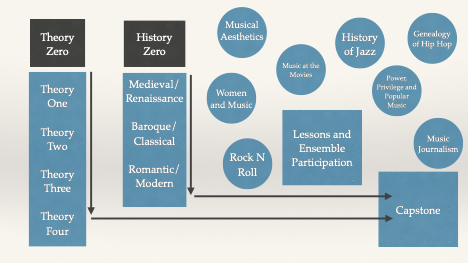
Figure 1. Original Music Curriculum at Hobart and William Smith
Perhaps most glaringly, the coursework was uncritically western in focus. In this way, we were out of step with trends in higher education, contemporary museum culture, youth culture, and, upon reflection, our own values. I had actually been teaching elective courses about power and privilege in music for a number of years; I found myself toggling back and forth between core courses that celebrated the western European musical tradition and electives that problematized the imperialist underpinnings of our cultural heritage. We needed to adopt a more coherent message about Eurocentricity, imperialism, whiteness, maleness, and literacy in music and its history.
We also had to acknowledge that our curriculum focused almost entirely on music that our students were not passionate about. Without the resources to support a symphony orchestra or other large classical ensemble, we did not have a culture of classical music performance that could give life to this coursework, and it became increasingly difficult to justify working to inculcate students into this particular musical tradition. Many of the most passionate music lovers on our campus were not even musically literate in the traditional sense but had experience and even notoriety as producers, DJs, and music creators of other kinds. Our curriculum did not speak to these musicians.
Thirdly, our curriculum offered no clear trajectory for those students who wanted to pursue music professionally. We are neither large enough nor well-resourced enough to provide a competitive performance education, and yet our academic offerings were largely consistent with institutions that did. It was not clear what we wanted students to do with this knowledge, divorced as it was from a rich culture of performance. As such, even our most devoted students—those who enjoyed studying chromatic harmony and medieval music history—felt compelled to divide their course selections between their passion for music and their professional plans.
Lastly, without many interdisciplinary connections to other departments, music lovers that chose not to major or minor had few access points into our courses. Each semester they had to choose between courses in music and those that satisfied requirements in their majors and minors.
Curricular Reform
Having identified key weaknesses of our curriculum, our task was now to translate them into priorities for positive change. Those priorities may be summarized as follows:
- Avoiding technical jargon in course descriptions;
- Expanding the repertoire beyond western classical music;
- Decolonizing the music history sequence;
- Streamlining the curriculum to facilitate second majors, study abroad, internships, and other competing opportunities;
- Minimizing bottlenecks that discouraged students from minoring, or pursuing a second major, in music;
- Cross-listing courses to promote interdisciplinary connections;
- Expanding pre-professional offerings in music.
I offer a brief discussion of each priority below.
Avoiding Technical Jargon. Our earliest revisions focused on individual courses. We recognized, for example, that we needed to think carefully about how we describe and discuss technical musical competencies. Anecdotally, we had a number of students who took elective courses but resisted the minor or major for fear of the “mathy” theory curriculum. We rebranded the introductory theory course (previously called Tonal Theory and Aural Skills I) as How Music Works with a course description that invites students into the mysterious world of this art form (see Table 1).
|
Old Course Description |
New Course Description |
|
MUS 120 Tonal Theory and Aural Skills I This course uses an integrated approach to develop the theoretical knowledge and aural skills necessary to become a listener/performer who can perceive sound in meaningful patterns, express these concepts musically, and think critically and artistically about musical form, style, and content. Review of diatonic scales, intervals, triads, and keys is followed by principles of voice leading, Roman numeral analysis and functional harmony, and non-harmonic figuration. Harmonic topics include tonic, dominant, subdominant, submediant, and supertonic triads in functional contexts; the dominant-seventh chord and its inversions; the leading-tone diminished seventh chord; and the cadential six-four chord. |
MUS 120 How Music Works How much of your day revolves around listening to music? Do you ever wonder why you can’t stop singing the melodies to your favorite songs? What exactly are the reasons that one musical style sounds so different from another? Why do certain pieces of music evoke melancholy and nostalgia, while others make you want to get up and dance? This course seeks to answer these kinds of questions through a hands-on approach, showing students how music works by focusing on listening, analyzing, and playing music. Students 1) learn the basic elements of music and how they can be combined to form patterns and styles, 2) develop the theoretical knowledge and aural skills necessary to perceive musical details and concepts, 3) listen to music critically and play it musically, and 4) think artistically about musical form and content. By the end of this course, students will be actively integrating thinking, hearing, and playing, and they will be developing skills in musical notation, songwriting, keyboard proficiency, and musical analysis. |
Table 1. Old and New Course Descriptions for MUS 120.
Expanding the Repertoire. Not only is the revised description free from technical jargon, the theoretical concepts—notation, form, keyboard proficiency, style features, etc.—though essential, can be studied in any number of repertories. This acknowledgement became a touchstone of our reform: rather than taking standard repertoire (within the western monoculture) for granted, we identified the learning outcomes that we have for students and then located them, in this course and across the curriculum, in the music and media that are most attractive to students. In our revised curriculum, students study polyrhythms, hypermeter, chromatic harmony, and form, just as they would in a traditional curriculum, but they learn these concepts as they manifest in video game music, jazz, and popular styles in the U.S. and around the world. We also collapsed the three-course western history sequence into a two-course module in which students spend one semester on the western tradition and one semester studying nonwestern music, thus expanding the repertoire that students engage with. Harvard University’s 2017 music curriculum overhaul similarly enacted a move away from the “coverage” model of repertory and instead embraced inevitable gaps as opportunities for lifelong student learning. (Robin 2022).
Decolonizing Music History. We focused the course on western music history with a postcolonial lens and the apparatus of remix, inviting students to rewrite the most problematic aspects of western music history with pluralistic, anti-racist, and anti-imperialist voices. Remixes, being dialogic and participatory, create opportunities for students to bring the past into the present and to grapple constructively with questions of who we were and are (Walker, 2023). Not only does this align with the rich literature on decolonizing efforts in music and higher education more broadly (Stanton, 2018; Fricker, 2023), the course also engages history students in the creative process and, in this way, aligns with recommendations of the aforementioned task force: “A reconceived model of music history studies might begin with harvesting the fruits of historical and cultural inquiry in the creative process itself, asking students to reflect on its personal meaning and its relationship to today’s musical world and social, cultural, political, and economic conditions and developments beyond music” (Campbell, et. al., 2014, 41-42). Remixing provides an apparatus for contemporizing history and engaging students in the creative process itself, as articulated in the course description:
MUS 210: Remixing Western Music History
The word “remix” calls to mind the technological practice of altering, contorting or otherwise reconceiving a cultural artifact, appropriating and changing it to make something new. Remixes are spaces in which authorship is broadened, authority is questioned, power is redistributed, and the past is reinterpreted. If we can remix a song, why not a history? Reconceiving (or remixing) remix as an intellectual, rather than technological, practice, this course rewrites European music history with pluralistic, anti-racist! and anti-imperialist voices. Deconstructing the longstanding dichotomy between “the West and the rest,” we'll examine the centrality of othering in the construction of European selfhood, as well as music's participation in that project. In the process, we will consider Western music’s ambivalent relations with popular, folk, and non-Western music; its role in the formation of national and racial identities; and issues of representation and difference in jazz, blues, and world music. Remixes often claim to preserve the "aura of the original"; in this case, with reverence for the music itself, it is precisely the aura of imperialism, patriarchy, colonialism, and slavery-that is being contested.
Streamlining the Curriculum. Having revised and reconsidered individual courses, we now had to remove unnecessary barriers to completing the major or minor in music. Our first step was to critically evaluate any course that did not satisfy requirements for the degree. We had two such courses, Theory Zero and History Zero, which provided remedial introductions to music theory and literature, respectively. These courses often filled with first years and sophomores who were yet undeclared and still “shopping” for a major. Nevertheless, the courses themselves—operating outside of our curriculum—did not give them purchase on a music credential. After taking one of these courses, a student was no closer to satisfying the major or minor. We eliminated these courses and folded essential content into the aforementioned introductory course, How Music Works. This course now serves as a prerequisite to numerous other courses and puts interested students directly on the path toward the major or minor.
Minimizing Bottlenecks. At an institution like ours, music lovers often pursue the music credential as a “second” major or minor. For example, a student might be an economics major and music minor with a plan to earn an MBA after college. When stressors are placed on the students’ schedule, music is relinquished to other demands. Additionally, we could not justify offering upper-level courses each semester because of low enrollments, and offering required-courses sometimes as seldom as every other year compounded the difficulties students faced when trying to complete our curriculum. We thus created a less hierarchical structure to make it easier for students to plan their studies and accommodate second majors, study abroad opportunities, and other competing interests. There is now only one standard prerequisite for the majority of the curriculum, How Music Works. We do encourage students to take the courses sequentially by listing them at the 200, 300, and 400 levels, respectively. A natural progression guides the students’ trajectory through the curriculum, but an alternate order is not prohibited for students who need it.
There are inevitable tradeoffs in relinquishing the traditional hierarchy through the major; however, a body of scholarship on teaching and learning supports the decision to relax the implicit emphasis on mastery and specialization in favor of breadth and experiential education (Detweiler, 2022; Lorkovic, 2016) . Music educators have taken note. The curricular reform at Ohio State University, for example, “represents a move away from the concept of ‘mastery’ that has prevailed in music studies” in favor of “threshold concepts—a set of ‘interpretive approaches’ they want their students to think with and have in their possession” (American Council of Learned Societies, 2024). Threshold concepts, which by definition are transformative, integrative, and bounded to the discipline, create space in the curriculum for elevating creativity, collaboration, entrepreneurship, and social change to a position alongside or even above technical mastery (Meyer, Land, and Baillie, 2010).
Following this model, the revised curriculum at Hobart and William Smith (see Figure 2) has three two-course modules, all of which can be taken in any order after How Music Works (see Appendix). Theory and musicianship have been disambiguated, and the theory module introduces essential concepts through global pop and video game music, respectively. As stated above, the traditional three-course music history sequence is reimagined as a two-course structure (to be taken in any order), in which students spend one semester looking (critically and creatively) at the western European tradition (Remixing Western Music History) and one semester on non-western music (People Making Music). In the musicianship module, which is focused on popular music and jazz, students develop skills on keyboard, voice, and ukulele.
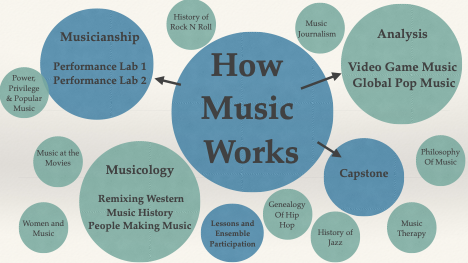
Figure 2. Revised Music Curriculum at Hobart and William Smith. Courses with a blue background are disciplinary and those with a green background are interdisciplinary.
In our modular approach, we are not alone: A team at George Mason University recently revised the theory sub-curriculum to feature a menu of courses at the 200 level that are differentiated primarily by repertoire; the courses can be taken in any order, following the 100-level intro course (Lavengood, 2019). This “bespoke” curriculum caters to students’ individual interests, thus mitigating retention issues, honoring the diversity of the student body, and creating choice around a traditionally stressful element of the music core, thus supporting students in progressing through the curriculum.
Cross-Listing Courses. Of course, not every music lover will complete the major or minor, so we also prioritized creating interdisciplinary connections across campus. It turned out that our institutional colleagues were already encountering student interest in music, and many such colleagues were enthusiastic about cross-listing courses. Our music criticism course is now an elective in the English department; Introduction to Music Therapy is cross-listed with public health; Women in Music, with gender, sexuality, and intersectional justice; Film Music, with media and society; hip hop and jazz courses, with Africana studies. At my institution, cross-listing courses can support positive outcomes for departments and for students who are pulled in multiple directions.
Expanding Pre-professional Offerings. Ultimately, a central goal was to increase the number of committed music students, enrolled in the major or minor. Despite students’ perceptions to the contrary, there are viable career options for music graduates, and we wanted to do a better job orienting students toward them (see Figure 3).
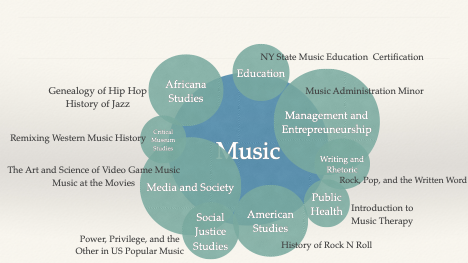
Figure 3. Interdisciplinary Connections from campus to other disciplines across campus
The first preprofessional offering we created was a minor in Music Entrepreneurship and Administration. We already offered a Guest Artist Concert Series, and we saw an opportunity to create internships for students to work on this annual concert series. We also had strong relationships with local music organizations and could develop further internship opportunities without too much investment. With willing partners in the Management and Entrepreneurship department on campus, we created an interdisciplinary minor in which students take essential courses in economics, management, and entrepreneurship; a music core, and a capstone internship (See Appendix). We only had to develop one additional course that bridged the two disciplines. We call this course Rock, Pop, and the Written Word, and it does double duty as an introduction to popular music criticism and a foundational course for aspiring agents and arts promoters in the popular music arena.
MUS 214 Rock, Pop, and the Written World
This course invites students into the professional world of music critics, journalists, agents, and publicists, who use language as a tool to characterize and promote music of all kinds. As emerging critics, students will learn to generate and articulate intellectually grounded responses to a variety of examples from the popular music canon, including commercial pop, indie, rock, hip hop, jazz, blues, and R&B, in dialog with the aesthetic principles studied over the course of the semester. As developing agents, publicists, and promoters, they will learn to harness the resources of social media, create one-sheets for record releases, gather content for crowdfunding, and draft press releases, bios, and website content. Through these combined efforts, students will deepen their appreciation and understanding of music, while enlisting that knowledge in a broader study of cultural and commercial enterprises that support it.
The minor in Music Entrepreneurship offers a new career trajectory for music students, who can go on to pursue careers as arts administrators, music agents, and managers, marketers, or fundraisers for music and arts organizations.
We also collaborated with education studies to create a New York state music education certification program. For this, students take courses in educational theory and music and complete a multi-semester, on-site teacher training through the teacher education program. The education department does the heavy lifting for much of this curriculum; they are used to working with disciplines across campus to develop future teachers in history, English, Spanish, mathematics, etc. Our role is to offer required competencies in music in alignment with the New York State teacher certification requirements.
Lastly, I drew on my own undergraduate education in psychology and entered a parti-time board certification program in music therapy. Although we do not have the capacity to offer an AMTA approved music therapy major, we—like many small private colleges—can offer a pre-music therapy pathway for students interested in pursuing graduate studies and/or board certification after college. Interested students take a selection of courses in psychology and music, including a new Introduction to Music Therapy; they also take lessons on guitar, piano and voice. We have now graduated several students who are going on to pursue board certification in music therapy.
Results and Discussion
The early data about our curriculum overhaul (as collected and published in 2023 in our ten-year self-study) has been encouraging. After near-continuous decreases in course enrollment between 2016 and 2021, with median semesterly enrollments falling to a low of 6 students and reaching a high of only 12, median course enrollments for the 2022–2023 academic year were 25 (fall) and 23 (spring). In the same year, we outperformed enrollments in similarly sized departments on our campus for the first time in the period of review (2016–2022), including Chemistry, Geoscience, Dance, and Spanish. Indeed, out of 47 majors and minors on our campus, music courses are currently the sixth highest enrolling, and more than a third of all Hobart and William Smith students will study music during their undergraduate college experience. In addition, BIPOC representation in our courses spiked in the year of the curriculum overhaul, well exceeding representation on the campus as a whole. Nevertheless, while our numbers of majors and minors has held steady in the years since the curriculum overhaul, we have not yet seen an increase in the numbers of students majoring or minoring in music. It is reasonable to assume that course enrollments will correct more quickly than major or minor enrollments, and we are hopeful that the revitalization of interest in taking music courses will soon result in an increased interest in majoring or minoring in music.
Although our curriculum overhaul was a strategic success for our department, it has been controversial. In evaluating our curriculum at our regular 10-year review, external reviewers described it, with great skepticism, as radical, experimental, and unapologetically focused on commercial music. But behind these criticisms were fundamental differences between their circumstances and ours — our reviewers work at better-resourced colleges; their music departments have at least twice as many full-time faculty members and—in the case of one reviewer, less than half as many majors and minors. The reviewers did not report having the enrollment minimums that we have, nor pressures to justify their departments’ value in objective, calculable ways. Courses at their institutions run with four or five students, whereas ours are canceled with an expectation that we will offer something else that attracts more students. Moreover, the reviewers still teach primarily the western European canon in an uncritical and arguably underexamined way. Not only has our curriculum-overhaul helped us find our footing at a moment of institutional stress, it is helping us to distinguish ourselves from other music programs, while also aligning our curriculum with student interest as well as our (collectively-drafted) departmental goals, as articulated in our new mission statement:
- To provide a professional education for music majors and minors that develops their competency in all aspects of the discipline and prepares them for various professional pursuits.
- To forge interdisciplinary connections across campus that allow students to bridge their music studies to other academic and intellectual pursuits.
- To provide an education for the greater colleges’ community through general curriculum courses and performances, thus developing an informed group of advocates and affirming that music is an integral part of a liberal arts education.
- To foster an academic community that values music both as a fundamental part of one’s education and as an essential expression of the human spirit (CITE).
Returning to the findings of the CMS task force discussed at the beginning of the essay, our focus on attracting students proved largely compatible with their recommendations: our diversified curriculum, which includes the study of global popular and art music, video game music, jazz, and hip hop, responds both to student interest and the call to situate music studies within our complex, global contemporary world; our curriculum also foregrounds creativity, whether through body percussion activities in Introduction to Music Therapy, MIDI and production work in Remixing Western Music History, or ukelele technique in How Music Works. Lastly, our curriculum is also integrated, not only through shared approaches and philosophies across courses and subdisciplines, but also across the campus through interdisciplinary courses and pre-professional programs. There is no question that our curriculum would look different were we not facing institutional enrollment pressures, but the goal of attracting students and supporting their professional and personal interests has proven to be a successful starting point for creating a curriculum that is also progressive and purpose-driven.
Appendix
Music Major Requirements at Hobart and William Smith
MUS 120 – How Music Works
Two Musicology Courses
- MUS 208 – People Making Music: Introduction to Ethnomusicology
- MUS 210 – Remixing Western Music History
Two Analysis Courses
- MUS 211 – Science, History, and Art of Video Games
- MUS 311 – Analysis of Global Pop Music
Two Musicianship Courses
- MUS 220 – Performance Lab One
- MUS 221 – Performance Lab Two
Two Music Electives
Two Performance Course Credits
- One credit earned through participation in a major choral or instrumental ensemble for two semesters
- One course credit earned through two semesters of private lessons.
MUS 460 – Capstone Internship or Research Project
Music Minor Requirements
MUS 120 – How Music Works
One Musicology Course, selected from the following:
- MUS 208 – People Making Music: Introduction to Ethnomusicology
- MUS 210 – Remixing Western Music History
One Analysis Course, selected from the following:
- MUS 211 – Science, History, and Art of Video Games
- MUS 311 – Analysis of Global Pop Music
One Musicianship Course, selected from the following:
- MUS 220 – Performance Lab One
- MUS 221 – Performance Lab Two
One Music Elective
One Performance Course Credit
- Earned through participation in a major choral or instrumental ensemble for two semesters, through two semesters of lessons, or through a combination of the two.
Music Entrepreneurship Minor Requirements
MGMT 101 – Entrepreneurial Leadership
MGMT 120 – Economic Principles or Principles of Economics
MGMT 201 – Quantitative Tools
One MGMT Elective Course
MUS 214 – Rock, Pop, and the Written Word
One MUS Elective Course
MUS 460 – Internship focused on Music Entrepreneurship
References
- (2024). “Ohio State University Music BA: How One Department Embraced Heterogeneity in its Core Curriculum and in its Approach to Expertise.” October 2, 2024. Accessed April 4, 2025, https://www.acls.org/resources/the-ohio-state-university-music-ba/.
- Humanities in the Twenty-First Century: Beyond Utility and Markets. New York City, NY: Palgrave and Macmillan.
- (July 11, 2023). “Americans’ Confidence in Higher Education Down Sharply.” Gallup News. Accessed October 9, 2024, https://news.gallup.com/poll/508352/americans-confidence-higher-education-down-sharply.aspx.
- (November, 2014). “Transforming Music Study from its Foundations: A Manifesto for Progressive Change in the Undergraduate Preparation of Music Majors.” College Music Society. Accessed May 20, 2025, https://www.music.org/pdf/pubs/tfumm/TFUMM.pdf.
- (2022). Responsible Pedagogy: Moving Beyond Authority and Mastery in Higher Education. First;1; ed. University Park, PA: The Pennsylvania State University Press.
- (2021). The Evidence Liberal Arts Needs: Lives of Consequence, Inquiry, and Accomplishment. Boston: MIT Press.
- (2023). “Decolonising the Music Classroom: Five Ways Forward,” Australian Journal of Music Education, 55, no. 2: 3-14. Accessed April 12, 2025, https://files.eric.ed.gov/fulltext/EJ1438594.pdf.
- (2022). “McGill Conservatory of Music to Close After More than 100 Years.” The Globe and Mail. June 23, 2022. Accessed October 9, 2024, https://www.theglobeandmail.com/canada/toronto/article-mcgill-conservatory-of-music-to-close-after-more-than-100-years/.
- (2021) “The Decline of the Humanities: Where Does it STEM From?” The Cornell Diplomat. Fall 2021. Accessed October 9, 2024, https://journals.library.cornell.edu/index.php/tcd/article/view/635/612.
- (2020). “Student Debt and the Class of 2019.” The Institute for College Access and Success: 15th Annual Report, October 2020. Fall, 2020. Accessed October 9, 2024, https://ticas.org/wpcontent/uploads/2020/10/classof2019_embargoed.pdf.
- (2022). “Colleges with the Best Return on Investment.” US News Education. November 28, 2022. Accessed October 9, 2024, https://www.usnews.com/education/best-colleges/paying-for-college/slideshows/national-universities-liberal-arts-colleges-with-the-best-roi.
- (2017). “McNally Smith College of Music is Shutting Down Due to a Lack of Funds.” MPR News. December 14, 2017. Accessed October 9, 2024, https://www.mprnews.org/story/2017/12/14/mcnally-smith-college-of-music-shutting-down.
- (2019). “Bespoke Music Theory: A Modular Core Curriculum Designed for Audio Engineers, Classical Violinists, and Everyone in Between.” Engaging Students: Essays in Music Pedagogy 7. Accessed April 24, 2025, https://engagingstudentsmusic.org/index.php/engagingstudents/article/view/7362/5716.
- "A Crisis of Ends: University Education as Formative Reading." New Blackfriars 97, no. 1071 (2016): 610-623.
- (2023). “College Tuition Inflation: Compare the Cost of College Over Time.” Forbes Advisor. May 9, 2023. Accessed October 9, 2024, https://www.forbes.com/advisor/student-loans/college-tuition-inflation/.
- (2010). Threshold Concepts and Transformational Learning. Boston, Brill Academic Publishing.
- (2023). “Oxford Brookes to close music department,” Music Teacher. November 20, 2023. Accessed May 20 2025. https://www.musicteachermagazine.co.uk/content/news/oxford-brookes-to-close-music-department/.
- (2016). “The Value of a College Education,” Pew Research Center: The State of American Jobs. October 6, 2016. Accessed October 9, 2024, https://www.pewresearch.org/social-trends/2016/10/06/5-the-value-of-a-college-education/.
- “What Controversial Changes at Harvard Mean for Music in the University.” National Sawdust. 2022. Accessed 3 June 2025. https://www.nationalsawdust.org/thelog/2017-04-25-what-controversial-changes-at-harvard-means-for-music-in-the-university.
- (2025). “Jacksonville University Cuts Music and Theatre Programs and Lays Off 40 Faculty Members.” WUSF Public Media 16 April 2025. Accessed 29 May 2025, https://www.wusf.org/education/2025-04-16/jacksonville-university-cuts-music-and-theater-programs-and-lays-off-40-faculty-members.
- (2018). “Musicking in the Borders toward Decolonizing Methodologies.” Philosophy of Music Education Review 26, no. 1: 4-23. Accessed 10 April 2025, 10.2979/philmusieducrevi.26.1.02.
- (2023). “Remixing Western Music History.” College Music Symposium 63, no. 1: 40–54. Accessed May 20, 2025, https://www.jstor.org/stable/48784754.


 Copyright © The College Music Society. All Rights Reserved.