
Abstract
I thank Taylor DiClemente, Lex Eisenhardt, Ellwood Colahan, Stephan Etcharry, Emad Vashahi, Amir Houshangi and Theodora Psychoyou whose insights were foundational to this study. I am deeply grateful to my anonymous reviewers, whose thoughtful feedback strengthened the rigor of this paper. Finally, I would like to express my heartfelt thanks to my companion, Bita Garshasbi, whose support and encouragement was invaluable throughout this work.
Introduction
From an organological perspective, the baroque guitar—often referred to as the five-course guitar—bears a closer resemblance to the modern classical guitar than instruments like the lute or theorbo, whose repertoires are frequently performed and widely recognized by classical guitarists.[1] Gérard Rebours, “Guitar, Vihuela, Lute, Archlute & Theorbo,” Les cahiers de la guitare 29 (January 1989), revised 2020, http://g.rebours.free.fr/articles/tableau-chronologique-engl.pdf. Despite this similarity, the repertoire of the baroque guitar remains significantly underexplored within classical guitar education and performance.[2] Eléna Ivanova, “De la guitare baroque a la guitare moderne: Instruments, notations et enjeux de l’arrangement de pièces baroques sur la guitare moderne (Gaspar Sanz, Robert de Visée)” (Master’s thesis, Sorbonne University, 2022), 85–90. This oversight is not due to a lack of technical or compositional quality in baroque guitar music, as many composers of this repertoire were highly esteemed court musicians. Instead, the primary challenges lie in the differences in notation and tuning between the baroque period and today.[3] James Tyler, A Guide to Playing the Baroque Guitar (Bloomington: Indiana University Press, 2011), viii.
These issues have been extensively discussed by baroque guitar researcher-performers in recent decades.[4] For detailed discussions on the baroque guitar’s tuning, notation, and performance practice, see especially Gary Boye, “Performing Seventeenth-Century Italian Guitar Music: The Question of an Appropriate Stringing,” in Performance on Lute, Guitar, and Vihuela: Historical Practice and Modern Interpretation, ed. Victor Anand Coelho (Cambridge: Cambridge University Press, 2005), 180–195; Lex Eisenhardt, Italian Guitar Music of the Seventeenth Century: Battuto and Pizzicato (Rochester: University of Rochester Press, 2015); Monica Hall, Baroque Guitar Stringing: A Survey of the Evidence (Guildford: Lute Society, 2010); Sylvia Murphy, “The Tuning of the Five-Course Guitar,” The Galpin Society Journal 23 (August 1970): 49–63, https://doi.org/10.2307/842063; and James Tyler, A Guide to Playing the Baroque Guitar (Bloomington: Indiana University Press, 2011). However, there is still untapped potential in transcribing this repertoire for the modern classical guitar. Historically, the baroque guitar has not received the same level of scholarly attention as other period instruments,[5] Tariq Harb, “The Unlimited Guitar: Arranging Bach and Britten as Means to Repertoire Expansion” (PhD diss., University of Toronto, 2014), 22, https://tspace.library.utoronto.ca/bitstream/1807/68434/7/Harb_Tariq_201411_DMA_thesis.pdf. highlighting the need for transcriptions and arrangements to expand the classical guitar repertoire.[6] Carlo Guillermo Fierens, “Transcribing for Classical Guitar: History and Examples from Literature, with Three Essays from Different Styles and Instruments” (DM thesis, Indiana University, 2019), 9–15, https://hdl.handle.net/2022/23005. Although academic interest in the baroque guitar is growing, a considerable gap remains in the adaptation and transcription of its works for the modern classical guitar.
This gap is particularly evident in the music of the French school, which is characterized by re-entrant and semi re-entrant tuning—tuning systems in which one or more strings are pitched higher than the strings located below them, creating a break in the usual descending order of string pitches. In the French baroque guitar, this often meant that the fourth and fifth courses were tuned higher than the third course. Another hallmark of this repertoire is its “mixed style,” which fuses alfabeto[7] Baroque guitar chord symbols. See
Gary R. Boye, “Corbetta 1639,” Nicholas Erneston Music Library, Appalachian State University, accessed March 24, 2025, https://music.library.appstate.edu/guitar/corbetta-1639.—a shorthand chord notation system using letters to indicate harmonies—with lute-style counterpoint.[8] Monica Hall, “Francesco Corbetta—The Best of All,” 2020, https://monicahall.co.uk/wp-content/uploads/2020/07/corbetta-section-i-2020-p.1-161revised.pdf, 30. As Gideon Brettler explains, alfabeto emerged in early seventeenth-century Italy as a way to facilitate chordal accompaniment and persisted into later French sources, where it coexisted with more complex polyphonic writing.[9] Gideon Brettler, “Revisiting the Music-Printing Market in Seventeenth-Century Italy and the Peculiar Case of Pietro Millioni’s Guitar Books,” Journal of Musicology 39:1 (Winter 2022): 1–34, https://doi.org/10.1525/jm.2022.39.1.1. The mixed style, which emerged prior to 1670 and was pioneered by Italian composers such as Angelo Michele Bartolotti (c. 1615–before 1682) and Francesco Corbetta (c. 1615–1681), continued to influence the works of Robert de Visée (c. 1655–1732/1733).
Visée’s music, with its balance of polyphonic texture and harmonic richness, is especially suitable for classical guitar performance practice, making it a promising candidate for transcription. However, the unique tuning of the French baroque guitar poses significant challenges for transcription. This article aims to identify and analyze these challenges, focusing on the translation of baroque tuning for the modern classical guitar. It argues that effective transcription of French baroque guitar music for the modern classical guitar requires a nuanced understanding of how semi re-entrant tuning affects voice leading, bass realization, and harmonic structure. Through a comparative analysis of existing transcriptions of Visée’s Suite in D Minor (1686), this study contributes to the ongoing dialogue about how best to preserve the stylistic integrity and expressive intent of baroque guitar music in contemporary performance, offering practical solutions and a framework for future transcriptions that remain faithful to Visée’s original approach.
Baroque Guitar Tuning
Five-course guitars of the 17th century were strung with gut, with most courses typically consisting of a pair of strings. However, the first (highest-pitched) course often featured just a single string, usually tuned to E4 or D4.[10] In this paper, scientific pitch notation is employed to designate octaves. This top string, known for its clarity, was referred to as the “cantino” or “chanterelle.” Although alternative tunings were also popular,[11] Craig H. Russell, “Radical Innovations, Social Revolution, and the Baroque Guitar,” in The Cambridge Companion to the Guitar, ed. Victor Coelho (Cambridge: Cambridge University Press, 2003), 156–58. the intervals between the courses generally followed the same pattern as a modern classical guitar: perfect fourths between the 5th and 4th courses, the 4th and 3rd, and the 2nd and 1st, with a major third separating the 3rd and 2nd courses. The two strings of the first course were typically tuned in unison, as were the two strings of the second course. The two strings of the third course were also commonly tuned in unison, though exceptions can be found in two Italian manuscripts: I.Bc Ms. AA 360 (ca. 1660) and I.MOe Ms. Campori 612 (undated), both of which provide an example of octave tuning on the third course.[12] Thomas F. Heck, Harvey Turnbull, Paul Sparks, James Tyler, Tony Bacon, Oleg V. Timofeyev, and Gerhard Kubik, “Guitar,” Grove Music Online, 2001, https://doi.org/10.1093/gmo/9781561592630.article.43006. The two strings of the fourth and fifth courses could be tuned in unison or in octaves, depending on the region or the specific style of the composer.
In the introduction to his work Musica sobre la guitarra española (1674), Gaspar Sanz describes regional tuning preferences as follows:
In stringing there is variety, because in Rome musicians string the guitar only with thin strings, without a bourdon [a low-octave string] on either the fourth or fifth course. In Spain the opposite is the case, since some use two bourdons on the fourth course and another two on the fifth, and at least, as is usual, one on each course. These two methods of stringing are good, but for different effects.[13] Gaspar Sanz, Instrucción de música sobre la guitarra española, vol. 1 (Zaragoza: Por los herederos de Diego Dormer, 1674), f. 8r. Translated in Eisenhardt, Italian Guitar Music of the Seventeenth Century, 143.
Sanz’s text on tuning, which has been a topic of debate among scholars,[14] Scholars have debated the interpretation of Sanz’s tuning instructions due to ambiguities in his language. For instance, Monica Hall has argued for the presence of three distinct tunings, while others, like James Tyler and Lex Eisenhardt, have offered differing views on the number and nature of these tunings. suggests two, or according to Monica Hall, three tuning methods: re-entrant; semi re-entrant, with an octave in the fourth course (commonly known as “French tuning”); and a bourdon tuning with octaves in the fourth and fifth courses, to which Hall refers as “conventional” tuning (see Table 1).[15] Monica Hall, “The Stringing of the 5-Course Guitar,” 2012, https://monicahall2.files.wordpress.com/2012/03/stringing2012.pdf.
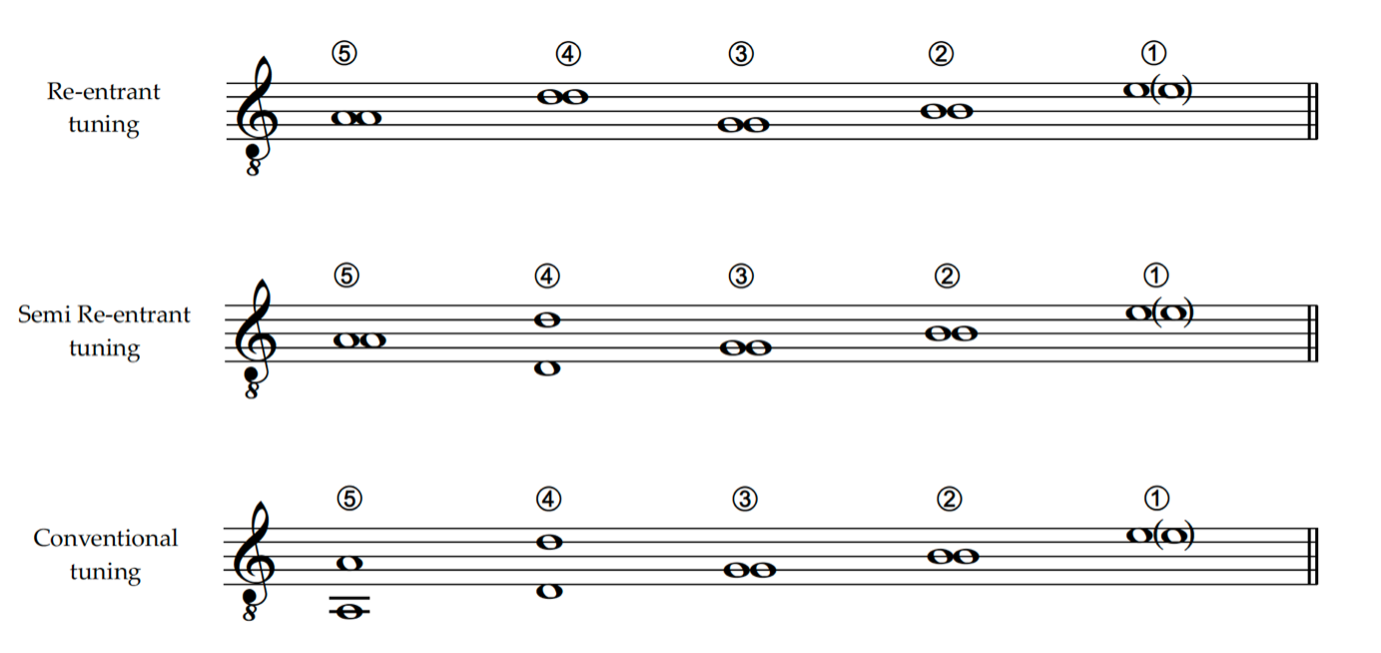
Figure 1: Three primary baroque guitar tunings.
Many French guitarists of the time seem to have favored a semi re-entrant tuning, typically A3-A3/D3-D4/G3-G3/B3-B3/E4-E4.[16] Nicolas Derosier, Les principes de la guitarre (Amsterdam: Antoine Pointel, 1689), 4. According to Michael A. Bane, Francesco Corbetta was “the first to call for this tuning” in his La Guitarre Royalle (1671).[17] Michael A. Bane, introduction to Pièces de guitairre, à battre et à pinser, by François Martin (Web Library of Seventeenth-Century Music, 2020), https://doi.org/10.53610/LNUR3890. Antoine de Carrée, in his Manière de toucher sur la partie de basse continue (1671), and Visée, in his Livre de guittarre dédié au roy (1682), provided similar guidance, with Visée advising, “Don’t forget an octave on the fourth string, it’s very necessary.”[18] Robert de Visée, Livre de guittarre dédié au roy (Paris: Bonneüil, 1682), 6. All French-to-English translations in this article, including those of Robert de Visée, are by the author.
The semi re-entrant tuning popularized by musicians such as Corbetta and Visée played a significant role in the development of the French baroque guitar school.[19] Eisenhardt suggests that Corbetta significantly shaped the French baroque guitar style with his La guitarre royalle (1671) (Italian Guitar Music of the Seventeenth Century, 41). In contrast, Gérard Rebours argues that Corbetta should not be considered a French guitarist, and credits Robert de Visée with creating the distinctly French style by removing Italian and Spanish influences (“The Baroque Guitar in France, and Its Two Main Figures: Robert de Visée & François Campion,” Michaelsteiner Konferenzeberichte 66 [2013], http://g.rebours.free.fr/articles/baroque-guitar-in-france-2.pdf). Eisenhardt offers a more nuanced perspective, pointing out that Visée was influenced by the Italian-born Lully, while Corbetta’s style integrated both French and Italian elements. The choice of tuning has been crucial in shaping baroque guitar traditions, and even today, the selection of an appropriate tuning—if such a definitive option exists—remains essential when performing or arranging baroque guitar music. The question of tuning, however, is still a subject of debate. With the exception of a few sources that provide precise tuning charts, most sources lack detailed information, leading to an ongoing scholarly discussion. Lex Eisenhardt, in his article “Robert de Visée and the French Tuning,” challenges the commonly accepted notion that Visée used semi re-entrant tuning exclusively, instead suggesting that Visée may have preferred conventional tuning.[20] Lex Eisenhardt, “Robert de Visée and the French Tuning,” 2023, https://lexeisenhardt.com/file/Visée's_tuning.pdf.
Since the 1970s, scholars have rigorously examined the various tunings and stringing techniques employed during the baroque era, seeking to clarify the historical evidence surrounding these practices.[21] Lex Eisenhardt, “A String of Confusion,” n.d., https://lexeisenhardt.com/file/A_String_of_Confusion.pdf. Yet, our understanding of tuning practices for the baroque guitar continues to evolve, particularly with the discovery of new sources. For instance, the identification of two books by Italian guitarist and composer Ferdinando Valdambrini, published in 1646 and 1647, has revealed that the tuning practices of the baroque guitar are more varied and complex than previously thought.[22] Monica Hall, “Francesco Corbetta,” 152.
This paper adopts the most widely accepted tuning for Visée’s baroque guitar music, while recognizing that a more in-depth examination of this topic would necessitate a separate study. The following table aims to serve as a foundational reference for identifying significant works that may have employed semi re-entrant tuning, offering arrangers a preliminary basis for their interpretations.
|
Composer |
Title |
Year |
|
Francesco Corbetta |
Varii scherzi di sonate per la chitara spagnola* |
1648 |
|
François Martin |
Pièces de guitairre, à battre et à pinser* |
1663 |
|
Francesco Corbetta |
La guitarre royalle |
1671 |
|
Antoine Carré |
Livre de guitarre |
1671 |
|
Giovanni Battista Granata |
Novi capricci armonici* |
1674 |
|
Francesco Corbetta |
La guitarre royalle |
1674 |
|
Lelio Colista |
Brussels, Conservatoire Royal de Musique, MS 5.615, 116–17 |
1675 |
|
Antoine Carré |
Livre de pieces de guitarre et de musique* |
1675 |
|
Médard Remy |
Pièces de guitarre* |
1676 |
|
Henry Grenerin |
Livre de guitare* |
1680 |
|
Robert de Visée |
Livre de guittarre dédié au roy |
1682 |
|
Robert de Visée |
Livre de pieces pour la guittarre |
1686 |
|
Nicolas Derosier |
Les principes de la guitare |
1689 |
|
Ludovico Roncalli |
Capricci armonici sopra la chitarra spagnola* |
1692 |
|
François Campion |
Nouvelles découvertes sur la guitarre* |
1705 |
|
Santiago de Murcia |
Resumen de acompañar la parte con la guitarra* |
1714 |
|
François le Cocq |
Recueil des Pièces de Guitarre* |
1730 |
Table 2: Chronological list of baroque guitar publications with possible semi re-entrant tuning.[23] Hall, Baroque Guitar Stringing, Murphy, “The Tuning of the Five-Course Guitar,” Tyler, A Guide to Playing the Baroque Guitar, and James Tyler, The Early Guitar: A History and Handbook (London: Oxford University Press, 1980).
As Eisenhardt has noted, “from most countries, there are only a few sources with unambiguous information, and from those, it soon becomes clear that musical practices varied.”[24] Lex Eisenhardt, “The Guitar in the Sixteen-Seventies: Baroque Guitar Stringing for the Works of Francesco Corbetta and Gaspar Sanz, 2021,” https://www.lexeisenhardt.com/file/The_guitar_in_the_1670s.pdf. Sources in Table 2 marked with asterisks indicate uncertainty, as scholars have not reached a consensus regarding the tuning practices of these works. Nonetheless, the possibility of semi re-entrant tuning remains a strong consideration, based on both the time of publication and the musical characteristics of these compositions. It is important to note that this table should not be considered definitive, as the available evidence is inconclusive. Multiple tunings may have been used for a single source, and it is essential to recognize that “there was no standardized set of baroque performance conventions across Europe.”[25] Frederick Neumann, “The Use of Baroque Treatises on Musical Performance,” Music and Letters 48:4 (October 1967): 315–24, https://doi.org/10.1093/ml/XLVIII.4.315
The semi re-entrant tuning likely employed by numerous French baroque guitarists, including Visée, constitutes a significant element of the repertoire associated with this instrument. The widespread use of this tuning presents unique challenges in the transcription process, which remain ongoing to this day.
Transcription Challenges
Transcribing baroque guitar music for modern classical guitar involves challenges that go far beyond tuning. Baroque guitar works feature stylistic elements such as strummed chords (batterie), ornaments, embellishments, and polyphony—textures that are difficult to notate precisely in tablature. Strummed chords, in particular, are central to the rhythmic and harmonic identity of this music. When they are altered or omitted, the transcription risks losing the vitality and character of the original. At the same time, the classical guitar's expanded capabilities—such as its sixth string and broader bass range—can be thoughtfully used to enrich the transcription, provided that these additions are handled with sensitivity to the original instrument’s limitations and aesthetic.
In addition to these stylistic concerns, transcription also demands attention to technical issues. As Alon Schab writes in A Performer’s Guide to Transcribing, Editing, and Arranging Early Music, “It is also important that those aspects of the text, such as tuning discrepancies, missing bass notes, or ambiguous chord inversions, should be decided upon in advance.”[26] Alon Schab, A Performer’s Guide to Transcribing, Editing, and Arranging Early Music (New York: Oxford University Press, 2022), 33. Schab’s principle, though focused on performance, is equally vital for transcribers. Thus, before analyzing the transcriptions of Visée’s Suite in D Minor, we must first identify the primary technical challenges related to the semi re-entrant tuning.
The Fourth and Fifth Courses
Studies of baroque guitar music and various contemporary references to its tuning and stringing reveal that, unlike the lute or classical guitar, the baroque guitar was not designed to have a true bass range. Its actual range spanned from tenor to low treble.[27] Tyler, A Guide to Playing the Baroque Guitar, 3. Additionally, while most baroque guitars have a range extending to D5, some, like the one attributed to Matteo Sellas, reach up to E5.[28] The Metropolitan Museum of Art, “Guitar, Attributed to Matteo Sellas (German, active Italy, ca. 1630–50),” last modified 2024, https://www.metmuseum.org/art/collection/search/503385. Lacking a true bass range and having a narrow overall range, particularly when played with re-entrant or semi re-entrant tuning, the baroque guitar exhibits a higher tessitura compared to the classical guitar. This presents our first challenge: the baroque guitar’s restricted range may pose difficulties when arranging music for an instrument like the classical guitar, which has a wider range (see Figure 2). This limitation can lead to challenges in voice leading, especially in semi re-entrant tuning, due to its limited bass range.
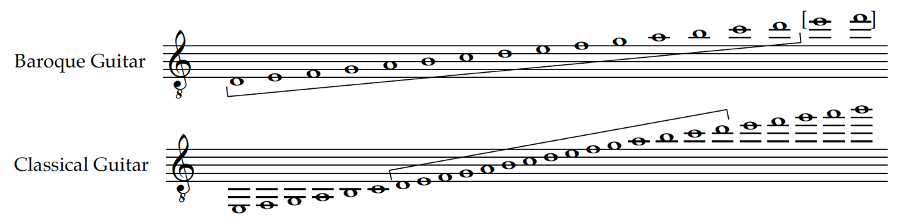
Figure 2: The tessituras of the baroque guitar and modern classical guitar.
Among the various tuning practices that emerged between the late 16th and early 18th centuries, the semi re-entrant tuning of the baroque guitar is particularly noteworthy due to its distinctive characteristics and the transcriptional challenges it poses for modern guitarists. In this tuning, the first three courses are analogous to those of the modern classical guitar. However, the remaining two courses differ in tonal range. Notably, the fourth course consists of strings tuned an octave apart, while the fifth course is tuned an octave higher than its equivalent on the classical guitar (see Figure 3).
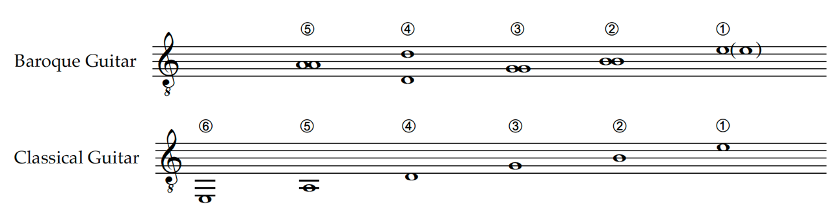
Figure 3: The tuning of semi re-entrant baroque guitar and modern classical guitar strings.
The second challenge lies in the proper treatment and interpretation of the two bass courses. In regards the fourth course, it is often unclear whether the composer intended the higher-pitched note to be played, the lower note to sound as part of the bass line, or both. As Eisenhardt explains,
The bass line in Robert de Visée’s Prelude in D Minor [see Figure 4], for example, is ambiguous with respect to octave position, and many notes on the fourth course seem to be intended to sound in the high octave. The first bass note D (m. 2) would probably work best in the high octave. However, in other places there is no easy answer, and uncommon leaps seem unavoidable.[29] Lex Eisenhardt, “Campanelle in Seventeenth-Century Guitar Music, Bells and Riddles,” 2018, https://www.lexeisenhardt.com/file/Campanelle.pdf.
Moreover, tuning the fifth course higher than the fourth presents several challenges for transcription. One of the most significant issues is the frequent occurrence of six-four chords and unresolved bass notes in cadences.
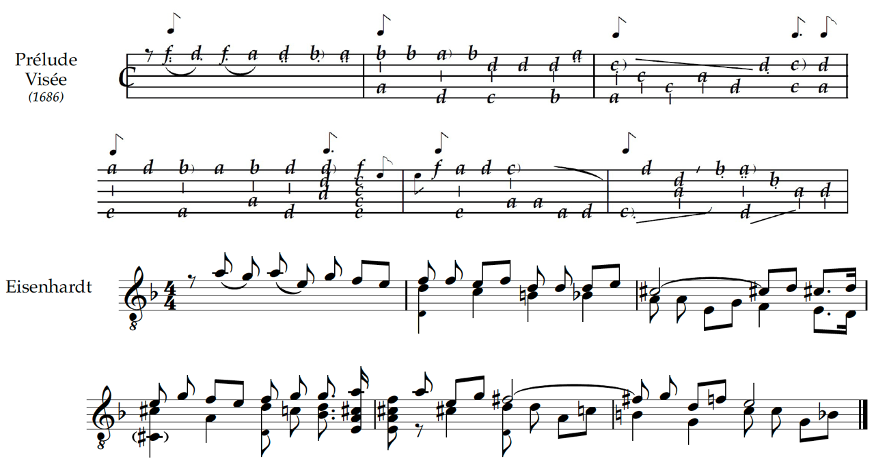
Figure 4: Robert de Visée, Prelude from Suite in D Minor (Livre de pièces pour la guitare), mm. 1–6, in the original tablature and in Lex Eisenhardt’s transcription.[30] For a brief clarification regarding French tablature, see Tyler, A Guide to Playing the Baroque Guitar, 4.
Campanelle
The octave tuning of the fourth course not only offered the advantage of providing more bass options compared to standard entrant tuning, but also enabled a distinctive scale-playing technique known as campanelle. According to James Tyler, this technique was first introduced by Bartolotti. Gaspar Sanz later referred to it as campanelle in Italian (or campanela in Spanish), meaning “bell-like.”[31] James Tyler and Paul Sparks, The Guitar and Its Music: From the Renaissance to the Classical Era (Oxford: Oxford University Press, 2002), 70. This effect is particularly striking when combined with the high-pitched fifth course, allowing notes to ring into one another and creating a cascading toll. Bartolotti’s innovation involves distributing individual scale notes across different courses rather than playing them sequentially on a single string. This technique produces overlapping resonances that enhance the melodic line, giving it a shimmering quality. However, transcribing campanelle passages poses significant challenges, particularly when the bass line must also be considered.[32] Hannu Annala and Heiki Mätlik, Handbook of Guitar and Lute Composers (Pacific, MO: Mel Bay, 2007), 18.
One example of this complexity appears in the Allemande on page 28 of La guitarre royalle (1671) by Corbetta, who was a master of the campanelle technique. This passage can be transcribed in at least four different ways, each with its own challenges. Richard Pinnell attempted a systematic transcription of this piece (see Figure 5.2), but his version neither captures the campanelle style nor reflects the musical character of Corbetta’s original.[33] Richard T. Pinnell, Francesco Corbetta and the Baroque Guitar, Vol. 2 (Ann Arbor, MI: UMI Research Press, 1980), 233. This third challenge, like the two preceding ones, is far from straightforward. The first transcription in Figure 5 aims to preserve semi re-entrant tuning, while the fourth focuses on maintaining the campanelle effect. Both approaches present distinct difficulties. The fourth transcription complicates left-hand technique by requiring awkward shifts for what is essentially a simple scale—an approach inconsistent with performance practices of the time. Conversely, the first transcription fails to sustain the characteristic bell-like resonance of the campanelle in certain sections of Visée’s music.
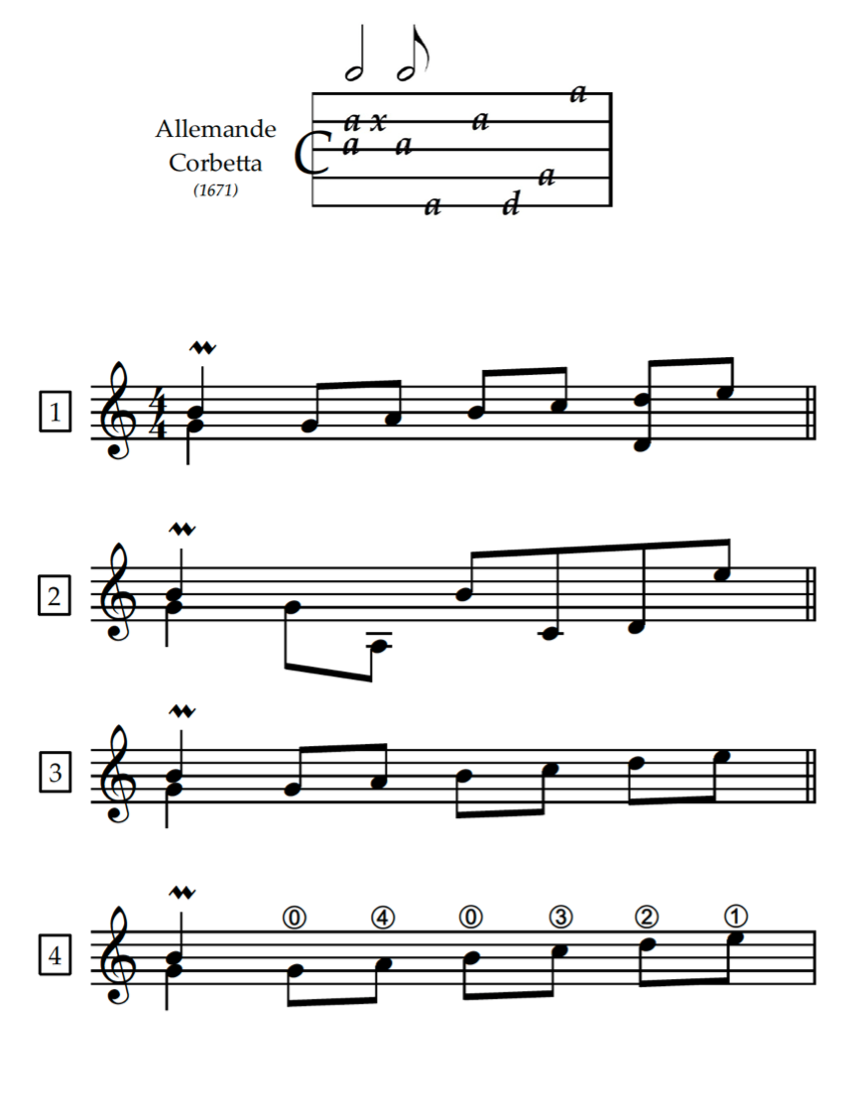
Figure 5: Francesco Corbetta, Allemande, m. 14, from La guitarre royalle dédiée au roy de la Grande Bretagne (Paris: Bonneüil, 1671), 28, with four transcriptions. Transcription 5.2 is by Richard Pinnell, while the others are by the author.
To summarize, the challenges associated with semi re-entrant tuning—including the adaptation of campanelle, the treatment and tonal range of the bass line (which involves transcribing the fifth course in higher or lower octaves), the application of second inversion chords, particularly in cadences, and the selection of pitches (whether higher or lower, or both) from the fourth course—represent some of the most common issues encountered in this tuning system. Although these difficulties are particularly relevant to semi re-entrant tuning, similar considerations should also be applied when analyzing other tuning systems, such as re-entrant or conventional tunings.[34] The present article focuses on tuning challenges; for insights into key selection, ornamentation, rhythmic notation, and the chronology of Visée’s arrangements, see Catherine W. Liddell, “The Guitar, Theorbo, and Lute Works of Robert de Visée: A Study of His Process of Arranging” (Soloist diploma thesis, Schola Cantorum Basiliensis, 1976).
Visée’s Suite in D Minor from Livre de pièces pour la guitare and its transcriptions
One of the most influential musicians of his time, Visée was highly esteemed by both Louis XIV and Louis XV. He performed alongside the finest French musicians of his era, including Marin Marais, François Couperin, Jean-Féry Rebel, and Antoine Forqueray, and his name remained prominent throughout the 18th and 19th centuries.[35] Gérard Rebours, “Robert de Visée’s Corpus: A Stylistic Tutor,” Lute Society of America Quarterly 47:3 (Fall 2012), 7–14. He continues to be the most frequently performed and known baroque guitar composer, as evidenced by the extensive number of transcriptions, arrangements, and recordings of his work. This enduring prominence is particularly notable when compared to other guitarist-composers such as Corbetta, Foscarini, and Bartolotti.
One of Visée’s most notable compositions is his Suite in D Minor, which comprises nine movements: Prelude, Allemande, Courante, Sarabande, Gigue, Gavotte, Bourrée, Menuet, Passacaglia, and a second Menuet. This suite is presented as the first suite on folio 3r (page five) of his Livre de pièces pour la guitare, published in 1686 by Bonneüil. In the preface, Visée remarks, “I believe I have left nothing out of my first guitar book in terms of the advice that can make it easy to understand, so I would not repeat the warnings it contains a second time.”[36] Robert de Visée, Livre de pièces pour la guitare (Paris: Bonneüil, 1686). By “first guitar book,” he refers to Livre de guittarre dédié au roy, published in 1682, where he advises, “Don’t forget an octave on the fourth string, it’s very necessary.” This guidance suggests that semi re-entrant tuning is highly probable for this suite, aligning with the performance practices of French guitarists of that era.
Visée’s Suite in D Minor has been the subject of numerous transcriptions. Visée himself transcribed several movements, such as the Sarabande and Courante, for theorbo in 1716.[37] Robert de Visée, Pièces de théorbe et de luth (Paris: Bellanger; Hurel, 1716), 81. Later, in 1880, Napoléon Coste created his own transcription of selected movements, which was published in Le livre d’or du guitariste.[38] Napoléon Coste, Le livre d’or du guitariste, Op. 52 (Paris, 1880), 3–7. Many esteemed classical guitarists, including Andrés Segovia, Emilio Pujol, Julian Bream, and Karl Scheit, have developed their transcriptions and interpretations of the suite. Despite the existence of numerous transcriptions, only a select few have been published. Among the most notable and widely performed transcriptions are Scheit’s and Pujol’s,[39] Karl Scheit, ed., Suite d-Moll (Vienna: Universal Edition, 2016) and Emilio Pujol, ed., Petite suite en ré mineur (Paris: Esching, 1980). along with the one in Robert Strizich’s comprehensive work, The Complete Guitar Works of Robert de Visée.[40] Robert Strizich, ed.. The Complete Guitar Works of Robert de Visée: A New Transcription and Translation of the Complete Music and Text in Visée’s Livre de Guittarre (1682) and Livre de Pièces Pour La Guittarre (1686), and a Transcription of Visée’s Guitar Music Found Only in Manuscript Sources. Saint-Nicolas, Québec: Doberman-Yppan, 2008. Strizich’s “literal transcription”[41] Fierens, “Transcribing for Classical Guitar:,” 8–10. was praised by Gérard Rebours as a “highly accurate transcription for the classical guitar.”[42] Gérard Rebours, “Documents sur Robert de Visée,” 2002, http://g.rebours.free.fr/articles/visee-for-web-2020.pdf. Another noteworthy contribution is Thomas Königs’ transcription, which adopts a unique approach compared to others, particularly in his handling of the fourth course and his effort to maintain the original left-hand position.[43] Thomas Königs, ed., “Suite in d aus ‘Livre de pièces pour la guittarre’ (1686),” 1996, http://www.thomaskoenigs.de/freedownloads.htm.
Many transcriptions follow a similar system for employing six-four chords in cadences and campanelles. However, notable differences arise in the treatment of the fifth and fourth courses, particularly regarding octave placement, which varies depending on the musical context. Visée’s Prelude begins on the first course and then progresses to the fourth and fifth courses to introduce a secondary voice (see Figure 6). Although this secondary voice is played on the lower courses, it harmonically functions as a third below the primary melody. A critical issue that arises in the second measure is whether to retain the original natural left-hand position with a lower secondary voice or to preserve the original interval between the melody and the secondary voice.
This issue is further complicated by the decision of whether the fourth and fifth courses should be transcribed as bass elements or integrated into the melodic texture. For instance, Pujol’s transcription maintains the harmonic interval between the voices, necessitating adjustments to the left-hand fingering. Conversely, Königs preserves the original left-hand position, resulting in a lower secondary voice. From the third measure onward, Pujol’s transcription demonstrates inconsistency; while the fourth and fifth courses are transcribed at their original pitch in the second bar, they are transcribed an octave lower in the third bar. Pujol’s approach to the transcription of the fourth and fifth courses, similar to other transcribers such as Scheit, fluctuates based on contextual demands. For example, after the third bar, Pujol predominantly transcribes the fifth and fourth courses in a lower octave, though he occasionally employs higher octaves or a combination of octaves for the fourth course.
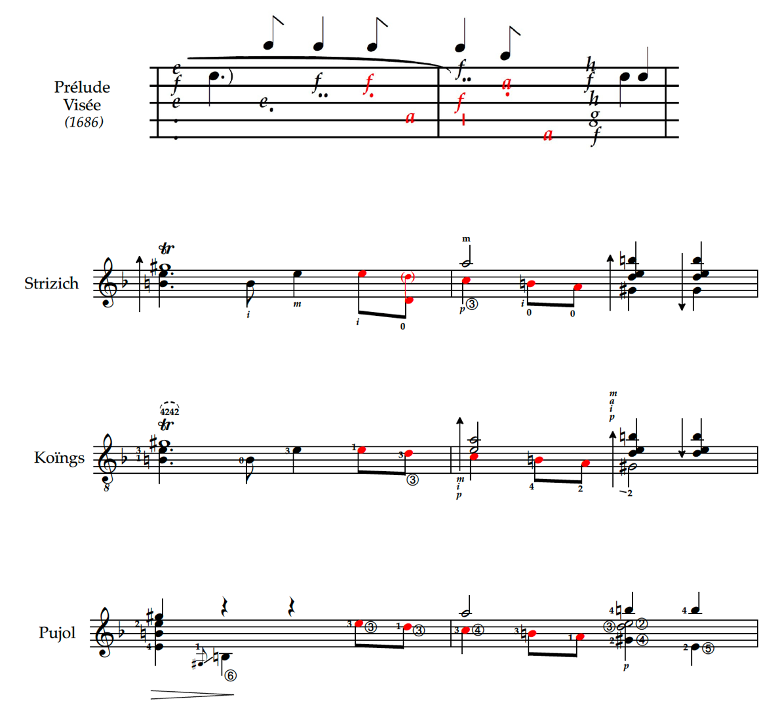
Figure 6: Robert de Visée, Prélude from Suite in D Minor (Livre de pièces pour la guitare), mm. 3–4, with three transcriptions.
Strizich’s transcription offers a highly precise representation of tuning, ornaments, and strummed chords. However, it requires retuning the fifth string of the classical guitar an octave higher, similar to the baroque guitar.[44] Strizich, ed., The Complete Guitar Works of Robert de Visée, iii–iv. While this method produces a sound closely resembling that of the baroque guitar, it is seldom employed, particularly in educational settings, due to the practical difficulties associated with altering and tuning the fifth course. In this article, Strizich’s version is employed as a urtext of Visée’s tablature to aid in the reading and interpretation of the original tablature.
Many classical guitar transcriptions fail to accurately replicate essential aspects of the baroque guitar, such as ornaments or strummed chords. Even when composers indicate strummed chords, modern transcriptions often render these elements imprecisely. A common notational practice omits open strings, yet performers historically incorporated them to enrich harmony, resonance, and sustain.[45] Tyler, A Guide to Playing the Baroque Guitar, 12. An exception to this is Strizich’s transcription, which is distinguished by its accurate representation of strummed chords, faithfully capturing the batterie (strummed) style characteristic of the period.
Another transcription method, which differs significantly from those discussed in this section, seeks to emulate baroque tuning on the classical guitar. This method requires retuning the third string to F-sharp and applying a capo on the fifth fret. These adjustments shift the third interval from between the third and second strings to between the fourth and third strings. Additionally, the use of a capo on the fifth fret effectively transforms the second through sixth strings into the equivalent of the first through fifth strings without the capo. This configuration also produces a high A4 on the first string, which is advantageous for playing campanelles (see Figure 7). A similar approach, which has been employed for several decades in the transcription of lute music, involves shifting the third interval to between the fourth and third strings while using a capo on the third fret, thereby achieving a renaissance G lute tuning on the guitar (G2-C3-F4-A3-D4-G4).[46] The Lute Society, “Lute Tuning,” accessed August 24, 2024, https://www.lutesociety.org/pages/lute-tuning.
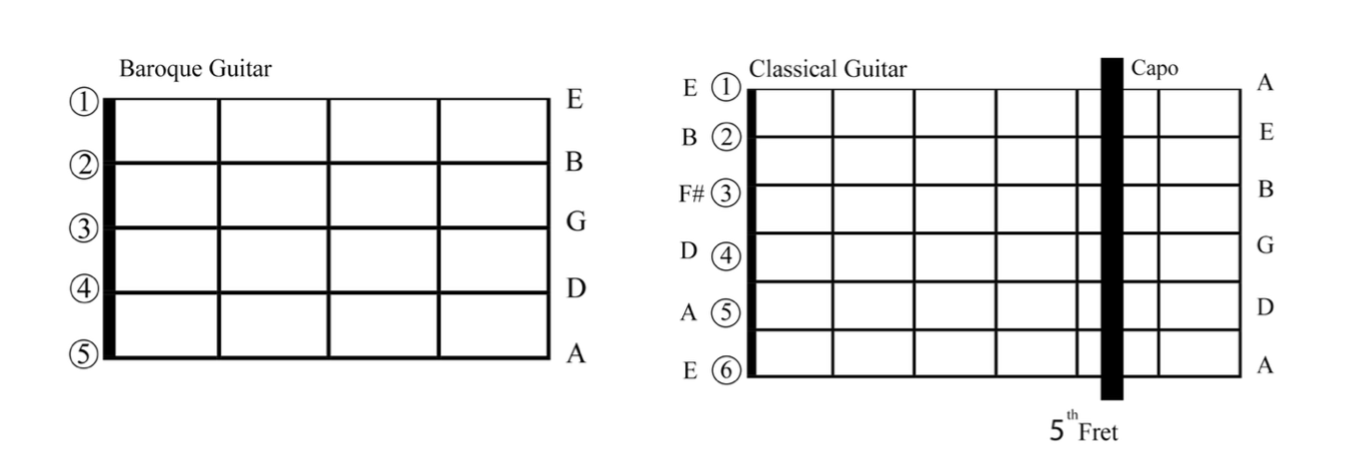
Figure 7: One possible tuning for the transcription of Robert de Visée’s music.[47] UniGuitar, “Transcribing Early Music for Classical Guitar”, posted on November 21, 2021, YouTube video, 11:58, https://www.youtube.com/watch?v=qd7AlBeqd3c.
The methodologies and approaches to transcription vary remarkably, with some prioritizing playability on the classical guitar and others aiming for the utmost fidelity to the original composition. Each has its own strengths and weaknesses, and each is the product of the historical context in which it was created. Judgments about transcription are often influenced by modern perspectives. Howard Mayer Brown has cautioned that our contemporary views of what sounds “best,” “correct,” or “most musical” may not accurately reflect historical practices.[48] Cited in Hall, Baroque Guitar Stringing, 4. This insight is particularly important when evaluating how composers like Johann Sebastian Bach and Visée approached the transcription and arrangement of their own works.
Potential solutions
Many baroque composers, including J. S. Bach—who is considered a seminal figure for classical guitarists—engaged in the transcription of their own compositions, as well as those of other composers for various instruments. This practice has been the subject of extensive scholarly analysis, particularly concerning Bach’s methods of transcription. Such studies have significantly contributed to the advancement of transcription techniques for the classical guitar.[49] Scott Workman, “J.S. Bach’s Lute Suite BWV 1006a: A Study in Transcription,” IUSB Graduate Research Journal 1 (2014), https://scholarworks.iu.edu/journals/index.php/iusbgrj/article/view/12760.
In the case of Visée, his transcriptions from baroque guitar to lute or theorbo are particularly illuminating, as these instruments belong to the same family of plucked string instruments. This allows for a clearer understanding of the stylistic and technical nuances of baroque music, enhancing our grasp of historical performance practices. The significance of Visée’s Suite in D Minor is further underscored by his own transcriptions of specific movements, such as the Sarabande and Courante. Originally published in Livre de pièces pour la guitare (1686) and later reissued in Pièces de théorbe et de luth (1716), these pieces offer a valuable opportunity to analyze and compare Visée’s transcription practices. By examining these transcriptions, we gain insights into his interpretative and adaptive methodologies when transitioning compositions from the baroque guitar, shedding light on his approach to reworking and reinterpreting his music for different instruments.
Fourth and Fifth Courses
A prominent observation in Visée’s transcription process is the broader sound range utilized in the version for theorbo. For instance, in the first bar of the Sarabande (see Figure 8), the bass line is transposed an octave lower compared to the baroque guitar version. Similarly, in the second bar, the harmonic interval between the melody and bass expands from a fifth to a twelfth. This adjustment may address the limitations observed in the bass line of the Prelude transcription’s second measure, suggesting that Visée deliberately employed a wider range and lower bass notes when the instrument’s capabilities allowed. It becomes clear that, when possible, Visée chose lower pitches and more distanced voices between the melody and bass line. This approach is also evident in his transcription of the Courante from the same suite in his 1716 book. Visée not only facilitated a more natural left-hand position but also aligned more closely with the stylistic characteristics of the baroque guitar.
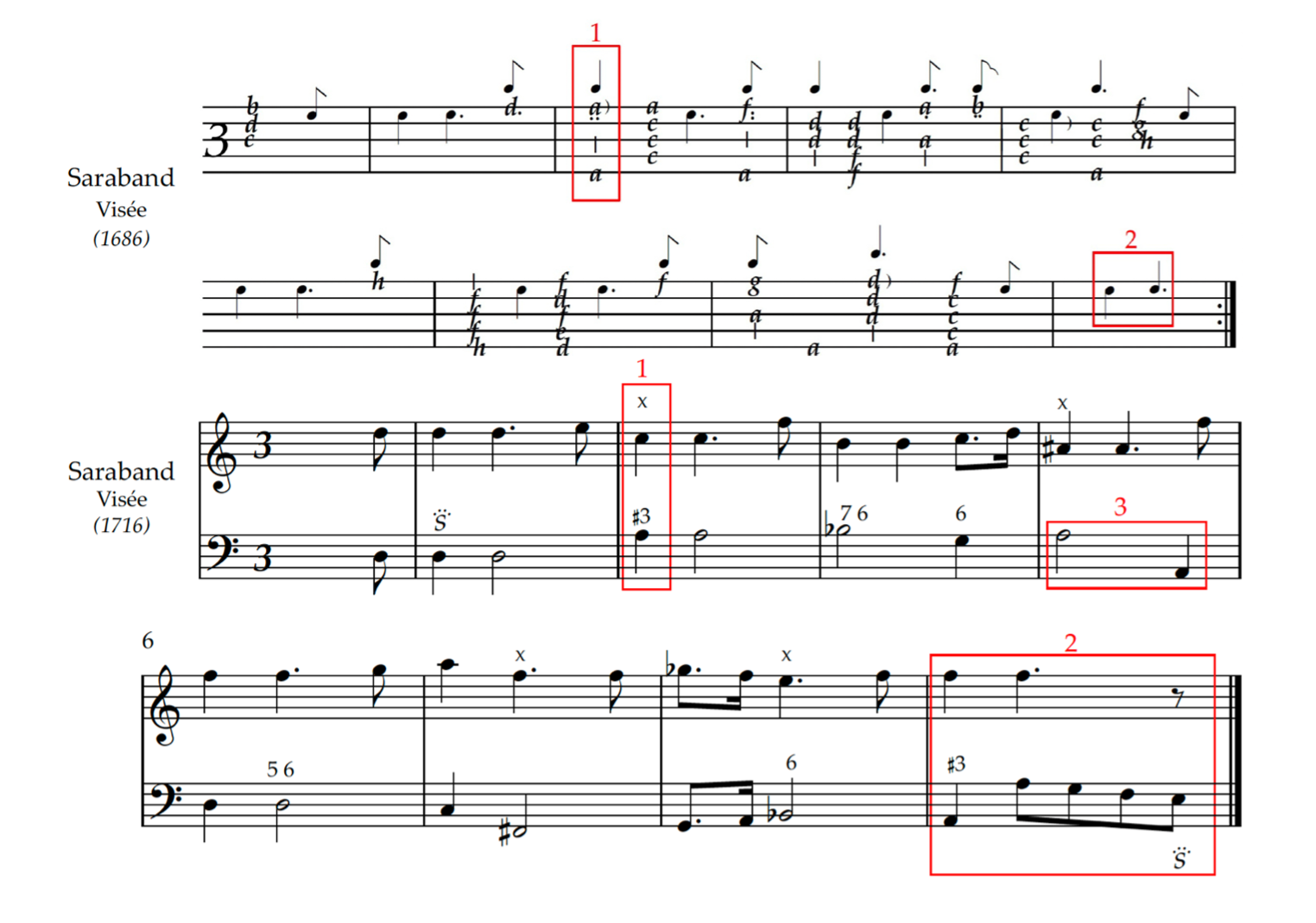
Figure 8: Robert de Visée, Sarabande from Suite in D Minor, from Livre de pièces pour la guitare and Pièces de théorbe et de luth. The passages marked “1” highlight Visée’s use of a wider tessitura, while the passages marked “2” and “3” demonstrate how he manipulates bass motion to enhance cadential resolution.
Regarding the treatment of six-four chords, particularly in cadences, modern transcribers have offered differing interpretative approaches. Eisenhardt advises omitting the fourth course, writing, “Final cadences, for example, which should lead to a chord in root position, often end with the reduced N chord,[50] In alfabeto notation, the “N” chord is an A-flat major chord in second inversion. with the fifth of the chord in the bass (6/4 position). If we avoid playing the fourth course, the chord will be in root position instead and sound more like a true ending.”[51] Eisenhardt, Italian Guitar Music of the Seventeenth Century, 169. Although Eisenhardt suggestion is aimed at performers on the baroque guitar, an alternative approach is recommended by Frederick Noad for classical guitarists that complements the evolving capabilities of the classical guitar and merits consideration in performance practice:
[As it lacks a strong resolution], the second inversion of the concluding G Minor chord would have been considered harmonically unstable in the 17th century. However, the G below the staff that would complete the chord was simply not available on the baroque guitar. Possibly a complete chord on the upper four strings was not considered strong enough; and possibly also the thumb was intended only to strike the upper octave of the pair of strings at the fifth course, omitting the lower D and simply doubling the higher one. But there is no way to know this from the tablature, and on many occasions the selection of only one of the pair of strings would still produce an imperfect chord. What we do know is that Visée was embarrassed by such apparent solecisms in his guitar scores, and wrote that “the instrument itself is the reason.” We also know that when he wrote for the lute with its many extra bass strings, he never included this kind of unsatisfactory cadence. The solution is clearly to add the low G impossible on the baroque guitar, or according to the demands of the piece to eliminate the low D, either solution being in my opinion correct to the intention of the composer if in a sense a change from what he wrote.[52] Frederick M. Noad, ed., The Baroque Guitar (New York: Amsco Publications, 2000), 10.
In his transcription of the measure preceding the Sarabande’s reprise, Visée revoiced what was originally a six-four chord to be in root position. Discovering that Visée avoided using six-four chords when they led to unsatisfactory effects, particularly in cadences, suggests that he was likely constrained by the limited bass range of the baroque guitar.[53] Monica Hall, “Angelo Michele Bartolotti—Prince of the Muses,” 2013, https://monicahall.co.uk/wp-content/uploads/2012/03/bartolotticompleteoct2013.pdf, 79–81. This limitation may also explain why he wrote in the preface to his Livre de pièces pour la guitare: “I beg those who know composition well, and who do not know guitar, to not be scandalized if they find that I sometimes depart from the rules; it is the instrument that requires it, and the ear must be satisfied above all else.”[54] Visée, Livre de pièces pour la guitare, 4.
Visée’s treatment of second inversion chords in cadential passages is also evident in his transcription of the Courante. Visée simply notates the chord in root position during cadences, which clearly supports Noad's argument (see Figure 9).
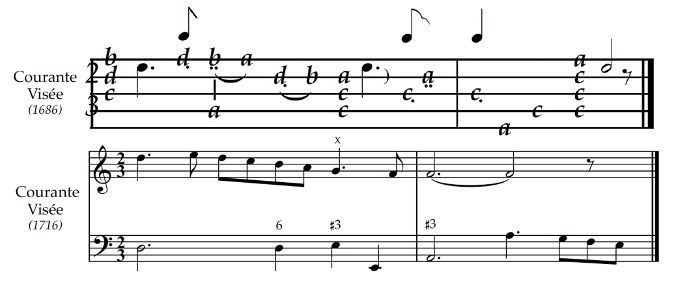
Figure 9: Robert de Visée, Courante from Suite in D Minor, mm. 5–6, from Livre de pièces pour la guitare and Pièces de théorbe et de luth.
An additional consideration is the effect of strumming chords on the baroque guitar. On a baroque guitar without bourdons, inversions are nearly inaudible.[55] Tyler and Sparks, The Guitar and Its Music, 40. Even with bourdons, the chords typically produce nearly inversion-free block harmonies. “This principle remains relevant for batterie chords in later music and could be applied to classical guitars as well. By strumming with a degree of ‘vagueness,’ particularly in handling the bass strings, the third course can be given greater clarity and volume, emphasizing its role as the keynote.”[56] Arash Ahmadzadeh, “From Sor to Bartolotti: An Interview with Lex Eisenhardt,” LSA Quarterly 58:4 (Winter 2023): 6. This technique does not mean completely omitting the fourth course, but rather suggests a nuanced strumming approach that enhances the overall musical effect.
The use of dissonance, however, including second inversions, depends heavily on the composer’s stylistic preferences and varies significantly from composer to composer. For example, while Visée employs dissonance more sparingly and with greater caution, other baroque guitarist-composers, such as Corbetta, incorporate it more frequently and in a manner that is distinct to their compositional style. This variation in approach is a topic of ongoing debate among scholars, as it highlights the diverse interpretative practices within baroque music.[57] Hall, “Francesco Corbetta,” 100, https://monicahall.co.uk/wp-content/uploads/2018/03/corbetta-section-iv.pdf.
An examination of Visée’s transcription of the Courante movement reveals that the fourth and fifth courses of the baroque guitar are primarily intended to serve as bass notes. However, the instrument’s limited bass range presents challenges in crafting an effective bass line. This limitation becomes particularly evident when comparing the guitar version to the same piece transcribed for lute or theorbo, where the issue is effectively mitigated. In Figure 10, one can observe that that Visée’s use of second inversion chords in the 9th and 13th bass notes is constrained by the baroque guitar’s range. Exceptions to this approach do occur, particularly in passages featuring campanelles. As demonstrated in the second measure of the Prelude, there are instances where both the fifth and fourth courses may be intended to function melodically rather than purely as bass notes.
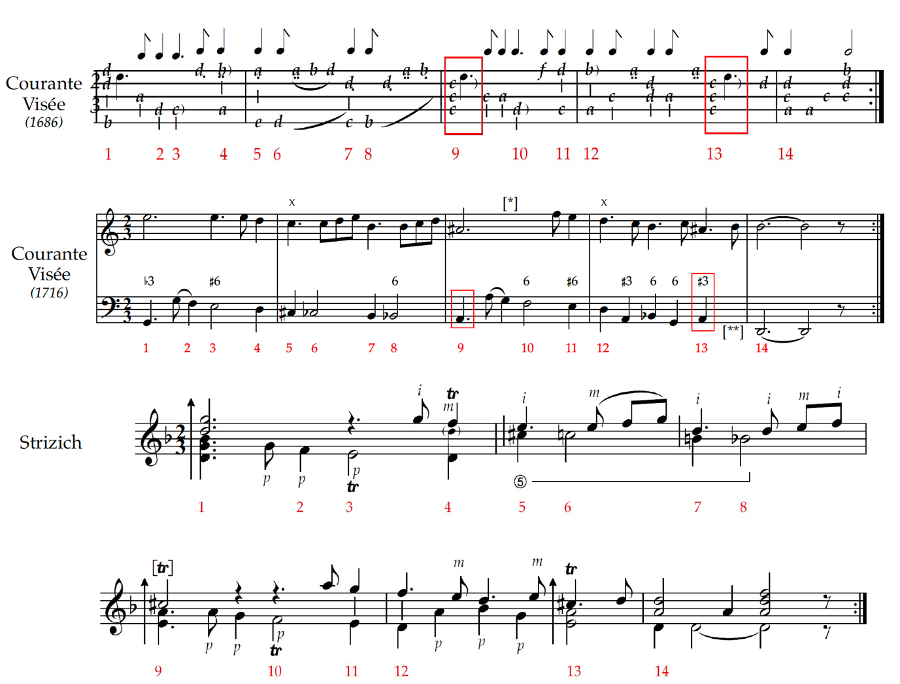
Figure 10: Robert de Visée, Courante from Suite in D Minor, mm. 10–14 from Livre de pièces pour la guitare, Pièces de théorbe et de luth, and in Robert Strizich’s transcription.
Campanelle
Visée adeptly employed various techniques such as campanelles, arpeggios, slurs, and imitation, utilizing the full range of the baroque guitar’s capabilities. However, he exercised notable restraint, deliberately steering clear of the ornate embellishments typical of the Italian style.[58] Rebours, “The Baroque Guitar in France, and Its Two Main Figures.” Despite this, the intrinsic qualities of the baroque guitar sometimes yield micro-campanelle effects in his compositions, whether or not these were intentional. To illustrate, in the Allemande of the Suite in D Minor, measures 19 and 20, the lower-voice campanelles are omitted in many transcriptions (see Figure 11). As Frank Koonce suggests, “On modern guitars, which lack octave tuning, preserving campanelle passages can be challenging. When feasible, such passages often require re-fingering to avoid intervallic leaps of a seventh or ninth.”[59] Frank Koonce, The Baroque Guitar in Spain and the New World (Pacific, MO: Mel Bay, 2006), 19.
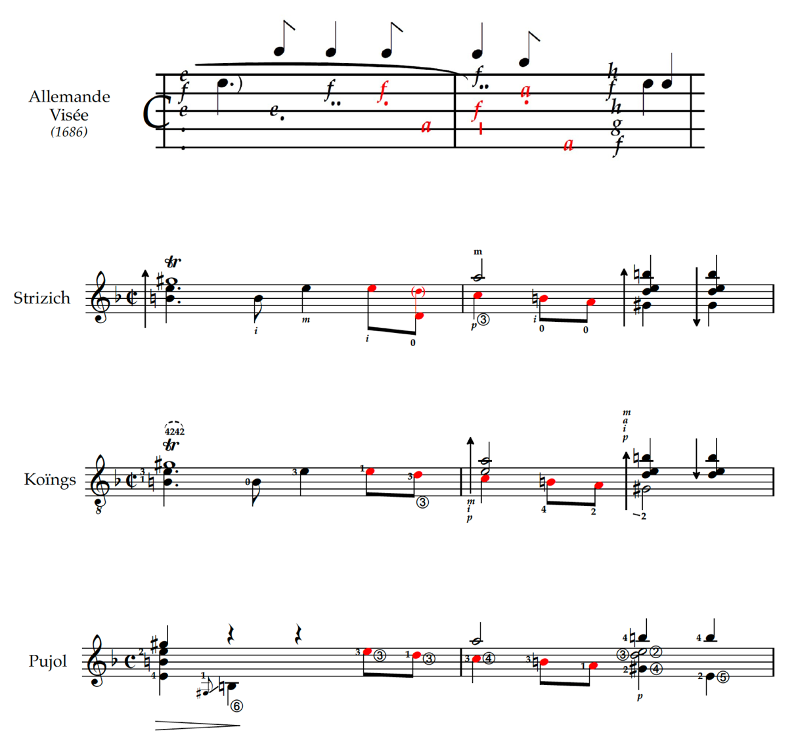
Figure 11: Robert de Visée, Allemande from Suite in D Minor (Livre de pièces pour la guitare), mm. 20–21, with three transcriptions.
Nonetheless, most arrangements and transcriptions of baroque guitar music for classical guitar neglect to retain these campanelles even where possible. In Corbetta’s Suite in A Minor from La guitarre royalle (1671), for example, some campanelles are transcribable but are rarely preserved in modern transcriptions.[60] Allen W. Mathews, ed., “Sarabande ‘La Victoire,’” 2023, https://classicalguitarshed.com/sm-corbetta-sarabande-aminor. As an alternative to campanelles, one might consider employing slurs (les tirées), which was frequently used on the baroque guitar when the scale was too high to be played across several courses, as demonstrated in the final measures of Corbetta’s Suite in A Minor from his 1671 collection (see Figure 12).

Figure 12: Francesco Corbetta, Suite in A Minor, mm. 14–17.
Figure 13 presents the opening section of the Courante from Visée’s Suite in D Minor, transcribed by the author. It is appropriate to briefly discuss several key decisions made during this transcription process, which, though subtle, contribute significantly to preserving both stylistic and harmonic integrity.
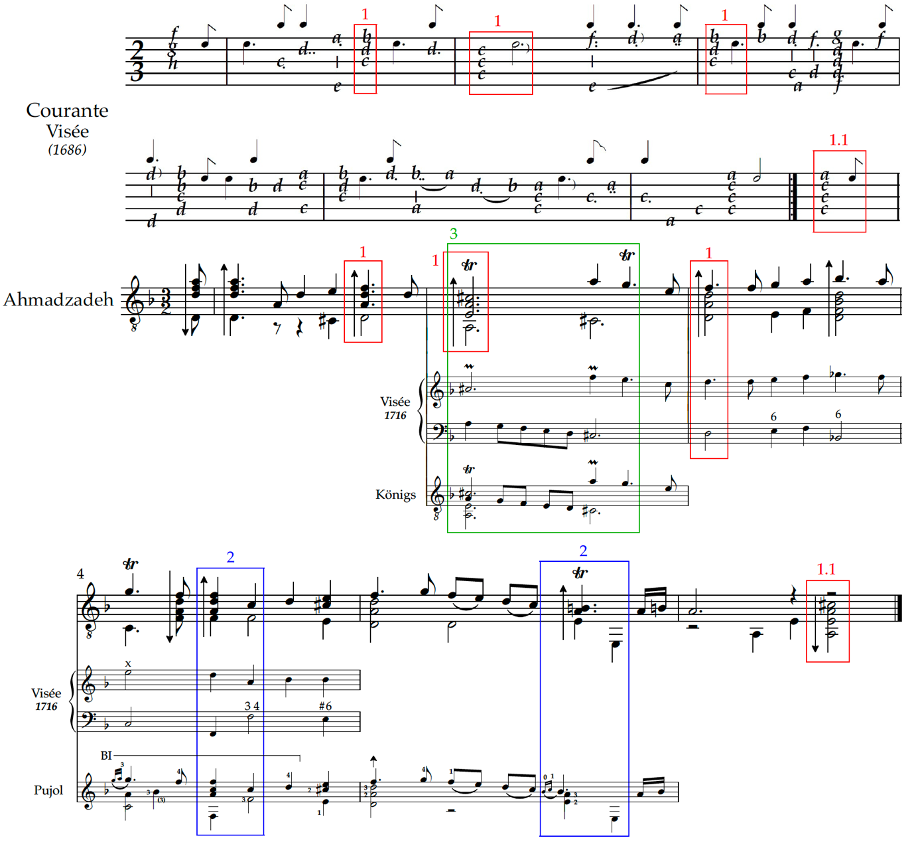
Figure 13: Robert de Visée, Courante from Suite in D Minor (Livre de pièces pour la guitare), mm 1–6, with transcriptions. The passages marked “1” through “3” each highlight a distinct transcription challenge. The passages marked “1” addresses the issues associated with second-inversion chords. Those marked “2” examine the use of an expanded tessitura, while those marked “3” illustrates the implications of incorporating additional notes.
In my transcription, the second-inversion chords have been revoiced into root position. Specifically, while the D Minor chord in the second and third measures may appear to be in second inversion in the 1686 version, it is important to consider that baroque guitar performance practice often involved the natural inclusion of open strings.[61] Tyler, A Guide to Playing the Baroque Guitar, 12. This practice would effectively realize the harmony in root position during performance. A similar treatment is evident in Visée’s own transcription, presented below mine for comparison. Moreover, because this second-inversion chord functions as a cadential tonic, it is musically justified—and, arguably, necessary—to resolve it into root position in order to achieve a satisfactory harmonic closure (see Figure 13).
As discussed earlier, the classical guitar’s extended range allows for adjustments to the bass line, clarifying harmonic motion—an approach Visée himself employed in his transcriptions. In this instance, in measure 6, I followed the solution proposed by both Visée and Pujol, incorporating an octave displacement in the bass. However, this approach was not applied in measure 4, based on two main considerations. The first is that introducing a lower F would logically require the addition of both a C and another F to execute the passage as a batterie. However, such additions risk overcomplicating the harmony—an issue frequently encountered in transcription, as noted by Eisenhardt.[62] Ahmadzadeh, “From Sor to Bartolotti,” 6. Secondly, although Visée includes a low F in his theorbo transcription, it is important to recognize that his arrangement was intended not solely for theorbo but also for harpsichord, basso continuo, violin, and viol—contexts where the batterie effect is less relevant. Since this transcription is intended for classical guitar, both F notes have been retained in the same pitch register to preserve the stylistic clarity of the passage. Nevertheless, lowering the second F by an octave remains a valid alternative if the performer chooses to omit the batterie.
In the cadential octave leap in measure 5 and 6, the transcriber may exercise greater freedom, as such gestures are common. Utilizing the sixth string here would be particularly effective, allowing the performer to fully support the bass movement. In the same measures, both Königs and Pujol added a descending melodic line, which also appears in Visée’s 1716 transcription. However, this passage is not present in the original baroque guitar score. The transcription presented here remains faithful to the baroque guitar version and omits this additional descent. Given that alternative versions are not available for every piece, the decision was made to rely exclusively on the baroque guitar source in this instance. While additional versions can certainly enrich a transcription when appropriate, the 1716 version was intentionally set aside to maintain focus on a more common and challenging context—evaluating whether the transcription remains aligned with Visée’s original intentions.
Conclusion
In transcribing his compositions for both the lute and theorbo, Visée thoughtfully adapted harmonic voicings and octave placements to suit the unique characteristics of each instrument, ensuring both playability and musical integrity.[63] Liddell, “The Guitar, Theorbo, and Lute Works of Robert de Visée,” 40. A similar approach is evident in J.S. Bach’s work, as he did not simply transpose his compositions for different instruments but made deliberate modifications to accommodate their unique characteristics.[64] Frank Koonce, “Playing Bach on the Guitar,” 2013, https://www.stringsbymail.com/articles/playing-bach-on-the-guitar-by-frank-koonce-strings-by-mail/. Instead of attempting to make the classical guitar imitate the baroque guitar—a largely impractical effort, given that the baroque guitar has not yet been fully integrated into classical guitar pedagogy—one might consider how to utilize the modern classical guitar’s capabilities while remaining faithful to the composer’s original methodology. Adjustments such as raising the fifth string by an octave, using a capo on the fifth fret, or avoiding the use of the sixth string altogether are likely not methods that Visée would have employed if he was transcribing his works for the classical guitar today.
The process of transcribing music from one instrument to another is subjective, and the choices made by the transcriber can expressively impact the final outcome. In the case of Visée, however, we are fortunate to have transcriptions made by the composer himself, which provide valuable insight into his approach and allow for more informed decision-making in contemporary transcriptions. In addressing the challenges of transcription, particularly concerning semi re-entrant tuning, the following considerations are noteworthy:
- Second inversions, particularly in cadential passages, should be avoided when they lead to unsatisfactory results. An exception to this guideline might be if one can strum in a way that introduces sufficient ambiguity regarding the chord’s actual position.
- Campanella passages, which are characteristic of baroque guitar music, pose significant challenges on the classical guitar. Attempts to replicate these passages often lead to awkward left-hand positions that compromise the stylistic integrity of the original music (see Figure 5d). In such cases, slurs may serve as a practical alternative to preserve the fluidity and elegance intended by the composer.
- The fifth and fourth strings should generally be transcribed an octave lower to maintain a clear and coherent bass line, except in cases involving campanella passages or other situations where the fourth and fifth courses are intended to be part of the melody, in which case the transcriber’s discretion is required.
The application of historically informed transcription practices to the works of Baroque guitar composers—notably the case study of Robert de Visée explored in this paper—offers modern classical guitarists a means of engaging with this repertoire that is both contextually sensitive and artistically enriching. By cultivating a nuanced understanding of key idiomatic features such as tunings, campanellas, and batterie chords—not merely as ornamental gestures but as integral structural elements—transcribers can make informed decisions that preserve the stylistic integrity of the Baroque guitar idiom. While such adaptations inevitably involve a degree of reinterpretation, they also have the potential to expand the technical and pedagogical resources of the modern classical guitar, contributing a valuable and historically grounded body of repertoire.
[1] Gérard Rebours, “Guitar, Vihuela, Lute, Archlute & Theorbo,” Les cahiers de la guitare 29 (January 1989), revised 2020, http://g.rebours.free.fr/articles/tableau-chronologique-engl.pdf.
[2] Eléna Ivanova, “De la guitare baroque a la guitare moderne: Instruments, notations et enjeux de l’arrangement de pièces baroques sur la guitare moderne (Gaspar Sanz, Robert de Visée)” (Master’s thesis, Sorbonne University, 2022), 85–90.
[3] James Tyler, A Guide to Playing the Baroque Guitar (Bloomington: Indiana University Press, 2011), viii.
[4] For detailed discussions on the baroque guitar’s tuning, notation, and performance practice, see especially Gary Boye, “Performing Seventeenth-Century Italian Guitar Music: The Question of an Appropriate Stringing,” in Performance on Lute, Guitar, and Vihuela: Historical Practice and Modern Interpretation, ed. Victor Anand Coelho (Cambridge: Cambridge University Press, 2005), 180–195; Lex Eisenhardt, Italian Guitar Music of the Seventeenth Century: Battuto and Pizzicato (Rochester: University of Rochester Press, 2015); Monica Hall, Baroque Guitar Stringing: A Survey of the Evidence (Guildford: Lute Society, 2010); Sylvia Murphy, “The Tuning of the Five-Course Guitar,” The Galpin Society Journal 23 (August 1970): 49–63, https://doi.org/10.2307/842063; and James Tyler, A Guide to Playing the Baroque Guitar (Bloomington: Indiana University Press, 2011).
[5] Tariq Harb, “The Unlimited Guitar: Arranging Bach and Britten as Means to Repertoire Expansion” (PhD diss., University of Toronto, 2014), 22, https://tspace.library.utoronto.ca/bitstream/1807/68434/7/Harb_Tariq_201411_DMA_thesis.pdf.
[6] Carlo Guillermo Fierens, “Transcribing for Classical Guitar: History and Examples from Literature, with Three Essays from Different Styles and Instruments” (DM thesis, Indiana University, 2019), 9–15, https://hdl.handle.net/2022/23005.
[7] Baroque guitar chord symbols. See
Gary R. Boye, “Corbetta 1639,” Nicholas Erneston Music Library, Appalachian State University, accessed March 24, 2025, https://music.library.appstate.edu/guitar/corbetta-1639.
[8] Monica Hall, “Francesco Corbetta—The Best of All,” 2020, https://monicahall.co.uk/wp-content/uploads/2020/07/corbetta-section-i-2020-p.1-161revised.pdf, 30.
[9] Gideon Brettler, “Revisiting the Music-Printing Market in Seventeenth-Century Italy and the Peculiar Case of Pietro Millioni’s Guitar Books,” Journal of Musicology 39:1 (Winter 2022): 1–34, https://doi.org/10.1525/jm.2022.39.1.1.
[10] In this paper, scientific pitch notation is employed to designate octaves.
[11] Craig H. Russell, “Radical Innovations, Social Revolution, and the Baroque Guitar,” in The Cambridge Companion to the Guitar, ed. Victor Coelho (Cambridge: Cambridge University Press, 2003), 156–58.
[12] Thomas F. Heck, Harvey Turnbull, Paul Sparks, James Tyler, Tony Bacon, Oleg V. Timofeyev, and Gerhard Kubik, “Guitar,” Grove Music Online, 2001, https://doi.org/10.1093/gmo/9781561592630.article.43006.
[13] Gaspar Sanz, Instrucción de música sobre la guitarra española, vol. 1 (Zaragoza: Por los herederos de Diego Dormer, 1674), f. 8r. Translated in Eisenhardt, Italian Guitar Music of the Seventeenth Century, 143.
[14] Scholars have debated the interpretation of Sanz’s tuning instructions due to ambiguities in his language. For instance, Monica Hall has argued for the presence of three distinct tunings, while others, like James Tyler and Lex Eisenhardt, have offered differing views on the number and nature of these tunings.
[15] Monica Hall, “The Stringing of the 5-Course Guitar,” 2012, https://monicahall2.files.wordpress.com/2012/03/stringing2012.pdf.
[16] Nicolas Derosier, Les principes de la guitarre (Amsterdam: Antoine Pointel, 1689), 4.
[17] Michael A. Bane, introduction to Pièces de guitairre, à battre et à pinser, by François Martin (Web Library of Seventeenth-Century Music, 2020), https://doi.org/10.53610/LNUR3890.
[18] Robert de Visée, Livre de guittarre dédié au roy (Paris: Bonneüil, 1682), 6. All French-to-English translations in this article, including those of Robert de Visée, are by the author.
[19] Eisenhardt suggests that Corbetta significantly shaped the French baroque guitar style with his La guitarre royalle (1671) (Italian Guitar Music of the Seventeenth Century, 41). In contrast, Gérard Rebours argues that Corbetta should not be considered a French guitarist, and credits Robert de Visée with creating the distinctly French style by removing Italian and Spanish influences (“The Baroque Guitar in France, and Its Two Main Figures: Robert de Visée & François Campion,” Michaelsteiner Konferenzeberichte 66 [2013], http://g.rebours.free.fr/articles/baroque-guitar-in-france-2.pdf). Eisenhardt offers a more nuanced perspective, pointing out that Visée was influenced by the Italian-born Lully, while Corbetta’s style integrated both French and Italian elements.
[20] Lex Eisenhardt, “Robert de Visée and the French Tuning,” 2023, https://lexeisenhardt.com/file/Visée's_tuning.pdf.
[21] Lex Eisenhardt, “A String of Confusion,” n.d., https://lexeisenhardt.com/file/A_String_of_Confusion.pdf.
[22] Monica Hall, “Francesco Corbetta,” 152.
[23] Hall, Baroque Guitar Stringing, Murphy, “The Tuning of the Five-Course Guitar,” Tyler, A Guide to Playing the Baroque Guitar, and James Tyler, The Early Guitar: A History and Handbook (London: Oxford University Press, 1980).
[24] Lex Eisenhardt, “The Guitar in the Sixteen-Seventies: Baroque Guitar Stringing for the Works of Francesco Corbetta and Gaspar Sanz, 2021,” https://www.lexeisenhardt.com/file/The_guitar_in_the_1670s.pdf.
[25] Frederick Neumann, “The Use of Baroque Treatises on Musical Performance,” Music and Letters 48:4 (October 1967): 315–24, https://doi.org/10.1093/ml/XLVIII.4.315
[26] Alon Schab, A Performer’s Guide to Transcribing, Editing, and Arranging Early Music (New York: Oxford University Press, 2022), 33.
[27] Tyler, A Guide to Playing the Baroque Guitar, 3.
[28] The Metropolitan Museum of Art, “Guitar, Attributed to Matteo Sellas (German, active Italy, ca. 1630–50),” last modified 2024, https://www.metmuseum.org/art/collection/search/503385.
[29] Lex Eisenhardt, “Campanelle in Seventeenth-Century Guitar Music, Bells and Riddles,” 2018, https://www.lexeisenhardt.com/file/Campanelle.pdf.
[30] For a brief clarification regarding French tablature, see Tyler, A Guide to Playing the Baroque Guitar, 4.
[31] James Tyler and Paul Sparks, The Guitar and Its Music: From the Renaissance to the Classical Era (Oxford: Oxford University Press, 2002), 70.
[32] Hannu Annala and Heiki Mätlik, Handbook of Guitar and Lute Composers (Pacific, MO: Mel Bay, 2007), 18.
[33] Richard T. Pinnell, Francesco Corbetta and the Baroque Guitar, Vol. 2 (Ann Arbor, MI: UMI Research Press, 1980), 233.
[34] The present article focuses on tuning challenges; for insights into key selection, ornamentation, rhythmic notation, and the chronology of Visée’s arrangements, see Catherine W. Liddell, “The Guitar, Theorbo, and Lute Works of Robert de Visée: A Study of His Process of Arranging” (Soloist diploma thesis, Schola Cantorum Basiliensis, 1976).
[35] Gérard Rebours, “Robert de Visée’s Corpus: A Stylistic Tutor,” Lute Society of America Quarterly 47:3 (Fall 2012), 7–14.
[36] Robert de Visée, Livre de pièces pour la guitare (Paris: Bonneüil, 1686).
[37] Robert de Visée, Pièces de théorbe et de luth (Paris: Bellanger; Hurel, 1716), 81.
[38] Napoléon Coste, Le livre d’or du guitariste, Op. 52 (Paris, 1880), 3–7.
[39] Karl Scheit, ed., Suite d-Moll (Vienna: Universal Edition, 2016) and Emilio Pujol, ed., Petite suite en ré mineur (Paris: Esching, 1980).
[40] Robert Strizich, ed.. The Complete Guitar Works of Robert de Visée: A New Transcription and Translation of the Complete Music and Text in Visée’s Livre de Guittarre (1682) and Livre de Pièces Pour La Guittarre (1686), and a Transcription of Visée’s Guitar Music Found Only in Manuscript Sources. Saint-Nicolas, Québec: Doberman-Yppan, 2008.
[41] Fierens, “Transcribing for Classical Guitar:,” 8–10.
[42] Gérard Rebours, “Documents sur Robert de Visée,” 2002, http://g.rebours.free.fr/articles/visee-for-web-2020.pdf.
[43] Thomas Königs, ed., “Suite in d aus ‘Livre de pièces pour la guittarre’ (1686),” 1996, http://www.thomaskoenigs.de/freedownloads.htm.
[44] Strizich, ed., The Complete Guitar Works of Robert de Visée, iii–iv.
[45] Tyler, A Guide to Playing the Baroque Guitar, 12.
[46] The Lute Society, “Lute Tuning,” accessed August 24, 2024, https://www.lutesociety.org/pages/lute-tuning.
[47] UniGuitar, “Transcribing Early Music for Classical Guitar”, posted on November 21, 2021, YouTube video, 11:58, https://www.youtube.com/watch?v=qd7AlBeqd3c.
[48] Cited in Hall, Baroque Guitar Stringing, 4.
[49] Scott Workman, “J.S. Bach’s Lute Suite BWV 1006a: A Study in Transcription,” IUSB Graduate Research Journal 1 (2014), https://scholarworks.iu.edu/journals/index.php/iusbgrj/article/view/12760.
[50] In alfabeto notation, the “N” chord is an A-flat major chord in second inversion.
[51] Eisenhardt, Italian Guitar Music of the Seventeenth Century, 169.
[52] Frederick M. Noad, ed., The Baroque Guitar (New York: Amsco Publications, 2000), 10.
[53] Monica Hall, “Angelo Michele Bartolotti—Prince of the Muses,” 2013, https://monicahall.co.uk/wp-content/uploads/2012/03/bartolotticompleteoct2013.pdf, 79–81.
[54] Visée, Livre de pièces pour la guitare, 4.
[55] Tyler and Sparks, The Guitar and Its Music, 40.
[56] Arash Ahmadzadeh, “From Sor to Bartolotti: An Interview with Lex Eisenhardt,” LSA Quarterly 58:4 (Winter 2023): 6.
[57] Hall, “Francesco Corbetta,” 100, https://monicahall.co.uk/wp-content/uploads/2018/03/corbetta-section-iv.pdf.
[58] Rebours, “The Baroque Guitar in France, and Its Two Main Figures.”
[59] Frank Koonce, The Baroque Guitar in Spain and the New World (Pacific, MO: Mel Bay, 2006), 19.
[60] Allen W. Mathews, ed., “Sarabande ‘La Victoire,’” 2023, https://classicalguitarshed.com/sm-corbetta-sarabande-aminor.
[61] Tyler, A Guide to Playing the Baroque Guitar, 12.
[62] Ahmadzadeh, “From Sor to Bartolotti,” 6.
[63] Liddell, “The Guitar, Theorbo, and Lute Works of Robert de Visée,” 40.
[64] Frank Koonce, “Playing Bach on the Guitar,” 2013, https://www.stringsbymail.com/articles/playing-bach-on-the-guitar-by-frank-koonce-strings-by-mail/.


 Copyright © The College Music Society. All Rights Reserved.