
Abstract
This article explores both musical and extra-musical aspects of seven representative pieces. Their themes include Fibich’s “love confession” to Aněžka, the union of their two hearts, an evening together on the island of Žofin in the Moldau (better known as Fibich’s “Poème”), a fast train ride, and miniature portraits of Aněžka’s eyelashes, eyebrows, and nose!
During his lifetime and in the years immediately following his death, Czech composer Zdeněk Fibich (1850–1900) was considered on a par with the more familiar Czech masters Bedřich Smetana (1824–1884) and Antonín Dvořák (1841–1904). Admired for his melodic gift and dramatic appeal, Fibich was even considered by one musicologist as the “son” in the Czech trinity of composers, with Smetana labelled the “Father” and Dvořák the “Holy Spirit!”[1] William Ritter, Národní listy (Prague, 8 April 1896); repr. Artuš Rektorys, ed., Zdeněk Fibich: Sborník dokumentů a studií [Zdeněk Fibich: A Collection of Documents and Studies], Prague: Orbis (1951–2): 189–90. Despite such auspicious esteem, Fibich’s star faded quickly, primarily for one reason: although some of his compositions were based on Czech themes and possessed Czech characteristics, his training, interests and musical style were cosmopolitan and highly diverse.[2] “Cosmopolitan,” in the sense of internationalism rather than nationalism, is how several scholars defined Fibich in a volume of articles published in 2010. See Zdeněk Fibich as a Central European Composer at the End of the Nineteenth Century: Special Issue of Musicologica Olomucensia 12 (December 2010). Fibich was born at the beginning of the Czech National Movement, at a time when Czechs were favoring music not only in their language but also based on Czech themes and containing internal characteristics they identified as being uniquely Czech.[3] Michael Beckerman listed common Czech traits in music. They include: 1) First beat accent (related to speech and folk song); 2) Syncopated rhythms (often related to characteristic dances); 3) Lyrical passages, often as a trio in a dancelike scherzo; 4) Harmonic movement outlining triads a major third apart; 5) Two-part writing involving parallel thirds and sixths; 6) Oscillation between parallel major and minor modes; 7) Use of modes with lowered sevenths and raised fourths; 8) Avoidance of counterpoint; and 9) Use of melodic cells which repeat a fifth above. Since all these characteristics can be found in non-Czech music, Beckermann suggests that intent (title, program, etc.) is as important as content in defining what is Czech. “In Search of Czechness in Music,” 19th-Century Music 10:1 (Summer 1986): 64, https://www.jstor.org/stable/746749. Moreover, the more progressive music of Josef Suk (1874–1935), Leoš Janáček (1854–1928), and Bohuslav Martinů (1890–1959) in the twentieth century overshadowed Fibich’s relative conservatism.
Fibich wrote in a variety of musical genres. His three-part melodrama Hippodamia, based on rather gory stories from Greek mythology, was “ambitious and effective” and an instant success.[4] John Tyrrell and Judith A. Mabary, “Fibich, Zdeněk,” Grove Music Online, 2001, https://doi.org/10.1093/gmo/9781561592630.article.09590. Fibich composed three symphonies and six tone poems for orchestra; his 1873 tone poem Záboj, Slavoj a Luděk [Záboj, Slavoj and Luděk], based on a Czech legend, served as an inspiration for Smetana’s Má Vlást, and his Toman a lesní panna [Toman and the Wood Nymph] (1874-75) may have influenced Dvořák’s tone poems of 1896–97. Fibich was also the first composer to replace the scherzo in a sonata cycle with a polka—a dance that originated in nineteenth-century Bohemia—in his String Quartet in A Major (1874), a practice followed by both Smetana and Dvořák.
Fibich’s compositions also include a large amount of idiomatic and accessible piano music, most notably a massive set of 376 pieces composed between the years 1892–99 that he entitled Nálady, dojmy a upomínky [Moods, Impressions and Reminders]. The cycle, which contains the musical outpouring of a respected composer in the final decade of his life, can be viewed as a compendium of the composer’s style, since within brief piano pieces we become familiar with the full range of Fibich’s musical language through intertextuality and self-quotation. Moreover, when we apply musicologist Zdeněk Nejedlý’s findings to the composition, we learn about the rich inner life of a fascinating composer and artist and his embodied experiences of music within a tour de force programmatic collection.
Smetana, Dvořák, and Fibich were all members of the Umělecká Beseda, or Artists Club, an organization based in Prague where composers, visual artists, and writers enjoyed a free exchange of ideas. Stylistically, Smetana’s and Fibich’s music grew out of the New German School, whose models were Wagner and Liszt. This is evidenced in the incorporation of programs, leitmotivs, and extended tonality. Both Smetana and Fibich, however, used these features as a means to a non-Germanic end, especially Smetana, whose themes and styles of music were Czech in nature. Fibich’s themes and styles were at times Czech, but more often he looked to other cultures, histories, and locales. He was inspired by Shakespeare, Schiller, and Byron to name but a few influences. All but one of Smetana’s nine operas are set in Bohemia or based on Czech history or legends. In contrast, only two of Fibich’s surviving eight operas have Czech themes.[5] Jan Smaczny,“The Operas and Melodramas of Zdenĕk Fibich (1850–1900),” Proceedings of the Royal Musical Association 109 (1982–83): 120, https://www.jstor.org/stable/766139.
Born in 1850 in Všeborice, Bohemia, Fibich came from a line of foresters, including his father. He also had musical ties: an aunt’s brother was married to pianist Alexander Dreyshock, whose brother, in turn, was the violinist Raimond Dreyshock in Leipzig. Young Zdeněk’s first piano teacher was his mother. He later studied music and composition in Leipzig, Paris, Mannheim, and Prague. Fibich married Růžena Hanušová in 1873; that same year he took a choral conducting post in Vilnius, Lithuania. Hanušová bore twins, a boy and a girl; the boy died a few hours after birth, and the girl died at age two. Hanušová herself died in 1875, shortly after the couple returned to Prague. Fibich then wed Hanušová’s older sister Betty, a leading contralto who premiered many important Czech operatic roles. However, the marriage, which was never strong to begin with, fell apart, and they eventually divorced in 1895.
In 1886, nine years before the divorce, Fibich began teaching piano to the 18-year-old Anežka Schulzová, but it was not until she returned at the age of 24 to study composition with him that the two fell in love. Schulzová was intelligent, cultured, and spoke several languages. Soon after the beginning of the romance she began to write librettos for three of Fibich’s operas. Fibich and Schulzová’s mutual love was accepted by her parents, even though Fibich was still married at the time. His feelings for Schulzová served as inspiration for many works in the last eight years of his life. The most direct inspiration is contained in the vast piano cycle Moods, Impressions and Reminders. Each piece in the collection is inscribed with a date, but these are not the dates of composition. Instead, the inscriptions indicate the date of the specific mood, impression, or reminder of Anežka that Fibich associated with that movement.
The work was published under four opus numbers: Op. 41, Op. 44, Op. 47, and Op. 57. The first and third sets represent the larger collections, comprising several separate volumes of Moods, Impressions and Reminders. Urbánek and Sons published these character pieces during Fibich’s lifetime without descriptive notes. The entire set is now available online at IMSLP as Moods, Impressions and Souvenirs; however, do not expect to find the inscriptions there.
In 1900, the year of Fibich’s death, a short biography about him was published in German entitled Zdenko Fibich: Eine musikalische Silhouette [Zdenko Fibich: A Musical Silhouette].[6] C. L. Richter [A. Schulzová], Zdenko Fibich: Eine musikalische Silhouette (Prague: F.A. Urbánek, 1900). The author, C. L. Richter, was a pseudonym for none other than Anežka Schulzová. In the book, she briefly discusses Moods, Impressions and Reminders with admiration, but she makes no mention of them having programmatic content.
In 1925, Zdeněk Nejedlý published his book Zdeňka Fibicha milostný deník [Zdeněk Fibich’s Love Diary], which detailed, for the first time, the unusual and intimate program behind the pieces in the hefty cycle.[7] Zdeněk Nejedlý, Zdeňka Fibicha milostný deník: Nálady, dojmy a upomínky [Zdeněk Fibich’s Love Diary: Moods, Impressions and Reminders] (Prague: Melantrich, 1925). Nejedlý is a controversial figure in Czech musicology, both because of his intense criticisms of Dvořák and his role as Minister of Culture and Education of the Communist Party. For a recent study of Nejedlý, see Michal Kopeček, “Czech Communist Intellectuals and the ‘National Road to Socialism’: Zdeněk Nejedlý and Karel Kosík, 1945–1968” in Ideological Storms: Intellectuals, Dictators, and the Totalitarian Temptation, ed. Vladimir Tismaneanu and Bogdan C. Iacob (Budapest: Central European University Press, 2019), 345–90. Not long after the composer’s death, Schulzová had shown Fibich’s personal copies of Moods, Impressions and Reminders to Nejedlý.[8] Nejedlý, Zdeňka Fibicha milostný deník, 25. In these private scores Fibich included programmatic notes—sometimes complete, sometimes cryptic—for many of the pieces in the set. Clearly Schulzová, in sharing these volumes with Nejedlý, wanted to go public with the program of the work.
Schulzová’s revelations became the basis of Nejedlý’s book, which adds programmatic notes to most of the pieces in Moods, Impressions and Reminders. Some have full programs that run throughout the piece. In other cases, Schulzová fleshed out the programs for Nejedlý, who in turn added yet more details. His failure to separate the three different sources taints his book: the reader does not know which ideas are whose. When Nejedlý decided to publish the book, he gave several reasons for revealing the meaning of the pieces:
In order to calm everyone’s conscience in case an obstacle prevents me from receiving this duty, I come with this work in this jubilee year of Fibich, in order to repay my debt to the master in the most urgent and personal way.[9] Nejedlý, Zdeňka Fibicha milostný deník, 19. All translations from Czech are by the author.
Deciphering Moods, Impressions and Reminders will allow us to properly understand the artistic character of Fibich’s entire work in the last decade of his life and therefore has great artistic-historical and stylistic significance.[10] Nejedlý, Zdeňka Fibicha milostný deník, 23.
It is known that Fibich, after his 40th year, ignited a fierce love for Anežka Schulzová, so fierce that in its heat he broke almost all ties that had hitherto connected him to the world, both as a human and as an artist.[11] Nejedlý, Zdeňka Fibicha milostný deník, 13.
Previous research into the collection is mostly in Czech. Both Jaroslav Jiránek and Vladislav Hudec wrote Czech-language biographies of Fibich (in 1963 and 1975 respectively).[12] Jaroslav Jiránek, Zdeněk Fibich (Prague: Státní hudební vydavatelství, 1963); Vladislav Hudec, Zdeněk Fibich (Prague: Státní pedagogické nakladatelství, 1971). Both include chapters on Moods, Impressions and Reminders that connect the Fibich-Schulzová-Nejedlý program to various pieces in the cycle. Vít Žižka’s 2007 dissertation “Nálady, dojmy a upomínky: Klavirní cyclus Zdeňka Fibicha” [Moods Impressions and Reminders: A Piano Cycle byZdeněk Fibich.] discusses program and presents Roman numeral analyses for several of the pieces. In 2016, Jiří Kopecký wrote an article “Pro koho skládal Zdeněk Fibich Nálady, dojmy a upomínky?” [For Whom Did Zdeněk Fibich Compose Moods Impressions and Reminders?].[13] Jiří Kopecký, “Pro koho skládal Zdeněk Fibich Nálady dojmy a upomínky?” [For Whom did Zdeněk Fibich Compose Moods, Impressions and Reminders?] Opus musicum 3 (2016): 37–51. He concludes that although the pieces were primarily a source of communication between the composer and Schulzová, they were also a repository of motives for other works; moreover, their publication was a valuable source of income for Fibich.[14] Vít Žižka, “Nálady, dojmy a upomínky: klavirní cyklus Zdeňka Fibicha” [Moods, Impressions and Reminders: A Piano Cycle by Zdeněk Fibich]. (PhD diss., Jíhočeská Univerzita v Českých Budějovicích [Southern Bohemian University in České Budějovice], 2007). By contrast, Jiří Špilauer’s 2018 dissertation “Zdeněk Fibich – Nálady, dojmy a upomínky” makes it a point to ignore the program and analyzes the pieces as absolute music with special attention to form.[15] Jiří Špilauer “Zdeněk Fibich – Nálady, dojmy a upomínky.” (PhD diss., Univerzita Karlova [Charles University], 2018).
The only significant essay in English is a chapter by Gerald Abraham entitled “An Erotic Diary for Piano” (1968).[16] Gerald Abraham, Slavonic and Romantic Music (New York: St. Martin’s Press, 1968), 70–82. It is a survey of most of the collection and presents the polemics involved with the program supplied by Nejedlý. In Sarah Murphy‘s 2009 dissertation “Czech Piano Music from Smetana to Janáček: Style, Development and Significance,” the author presents a substantive chapter on Josef Jan Forester and Zdeněk Fibich.[17] Sarah Murphy, “Czech Piano Music from Smetana to Janáček: Style, Development and Significance,” (PhD diss., Cardiff University, 2009). She compares Fibich with Forester and also with Hugo Wolf. Thirteen pages are dedicated to drama, program and decadence in Moods, Impressions and Reminders.
There is one complete recording of Moods, Impressions and Reminders on twelve compact discs by pianist Marián Lapšanský on the Supraphon label.[18] Zdeněk Fibich, Moods, Impressions and Reminiscences, Marián Lapšanský, piano, Supraphon SU 0189-2 131 etc.,1996–1997, 12 compact discs. There are two other recordings of individual pieces from the set: one with 20 pieces from the first opus by William Howard on Chandos, and the other with 19 pieces from the first and final opuses by Radoslav Kvapil on Regis.[19] Zdeněk Fibich, Moods, Impressions and Souvenirs, William Howard, piano, Chandos 9361, 1995, compact disc. Zdeněk Fibich Piano Music, Radoslav Kvapil, piano, Regis 1221, 1993, compact disc.
This article combines Czech and English sources in order to give a multifaceted view of the cycle. It also returns to the original Nejedlý monograph as its primary source. The reader will also find new analyses of compositions within the cycle and greater analytic detail of the second opus. We will focus on the first two of the four opuses: Op. 41, because it is arguably the finest, and Op. 44, because of the unique way the pieces are presented.
Before I discuss the programs, however, it is important to note what the composer meant by the tripartite title. According to Nejedlý:
“Moods” are his immediate experiences of certain facts, actions, and people such as the mood of the evening, the pain of the night, the journey together, the portrait of a person, etc. “Impressions” are the most erotic part of the work, they are musical poems about Anežka Schulzová as a woman, about her eyes, hair, hands, neck, etc. “Reminders” [also translated as “Remembrances,” “Reminiscences,” and “Souvenirs”] are additionally composed poems about precious moments, seen and felt only then from the distance of time back to the past. They are the compositions that are most closely related to his new life.[20] Nejedlý, Zdeňka Fibicha milostný deník, 123.
The individual pieces of Moods, Impressions and Reminders range from a single line to several pages in length. They are pianistic and vary greatly in texture. Fibich’s piano pieces are often compared to those of Schumann, even though they clearly belong to a new generation. Schumann’s musical hallmarks present in Fibich’s music include expressive lyricism, literary and programmatic influences, focus on character pieces, and a rich harmonic language. Other influences include the aforementioned traits of Liszt and Wagner in harmony and leitmotifs. Some pieces are monothematic, as they are built on a single motive.
Despite Fibich’s roots in the New German School and his Schumannesque leanings, the pieces of Moods, Impressions and Reminders are not Germanic: they are mostly about Czech people, Czech locales, and Czech dances. Numbers 135 and 251 are marked “A la Polka,” No. 365 is “Quasi Polka” and No. 263 clearly possesses the cross-accents of a Czech furiant. Fibich’s frequent use of pedal points is also a feature in the music of Czech composers Vitězslav Novák and Josef Suk.[21] John K. Novak, “Josef Suk’s Non-Obstinate Ostinato Movements: A Study of Harmony and Style,” College Music Symposium 43 (2003): 86–104, https://www.jstor.org/stable/40374472. Throughout the cycle, Fibich quotes many works both Czech and foreign, including The Bartered Bride, The Mastersingers of Nuremberg, The Huguenots, and the Blue Danube Waltz. The quotes from Fibich’s own music include the operas The Tempest and Hedy, his second and third symphonies, and his piano quintet. The self-references work both ways: some are quotes from finished compositions, while others are sketches for compositions that Fibich was working on at the time.
Fibich was not the only composer to dedicate music to a real or desired extra-marital lover. Fibich’s compatriot, Leoš Janáček was a married composer who was deeply inspired to compose by Kamila Stösslová, a married woman who was 38 years younger than him. Although their relationship was platonic, the two were often together, to the chagrin of Janáček’s wife. Moreover, they corresponded in more than 700 letters. These letters became the inspiration for his second string quartet, “Intimate Letters,” composed in the last year of the composer’s life. The quartet represents real and imagined events in their relationship. For example, the third movement is a lullaby for a child that Stösslová never bore Janáček.[22] John Tyrrell, Janáček: Years of a Life Volume 2 (1914-1928): Tsar of the Forests (London: Faber and Faber, 2007), 866. Another example comes from the Austrian expressionist composer Alban Berg (1885–1935), who had a physical, clandestine affair with Hanna Fuchs, who was 11 years his junior. His Lyric Suite (1925–6) for string quartet has come to be understood as a paean to that affair via hidden musical motives and themes in the work.[23] George Perle, Style and Idea in the Lyric Suite of Alban Berg (New York: Pendragon Press, 1995).
Opus 41, which we will call Series 1, contains one volume of Moods, two volumes of Impressions, and one volume of Reminders, totaling 161 pieces. The collection is numbered in two ways: individually for each volume, and continuously from the first piece to the last. For example, the Moods volume begins with piece number 1 and ends with number 44. Impressions I, from the same series but a different volume, begins with number 1 and ends with number 41. However, at the same time, the pieces of this volume are also numbered from 45 to 85 in continuation of the previous volume. In this article, I use continuous numbering to avoid confusion.
The Moods of Series 1 date from around 1894. Since the manuscript for the first part of this collection was damaged, there are no existing programs for numbers 1 through 15.[24] Nejedlý, Zdeňka Fibicha milostný deník, 128. No. 19 is a self-portrait. No. 20 is entitled “Jealousy (a study for his opera Hedy)”; No. 25, “How he pained Anežka”; and No. 26, “Plea for Forgiveness.” No. 30, “She Dreams,” contains an ostinato. Numbers 38–44 each portray Anežka in different colored dresses including white, black, green, pale blue, blue, brown, and purple. The brown dress is the one she wore on July 1, 1892, the day Zdeněk confessed his love to her (and the programmatic note of an important piece to be found in Reminders).
The Impressions of Series 1 (in two volumes) were the earliest to be composed. They are an attempt to depict in sound various parts of Schulzová’s body, starting in general from the head downwards. Jaroslav Jiránek wrote:
It is the focus of the work, because it is a musical poem about Anežka Schulzová as a woman, and this the most erotic part of the whole cycle. And let’s add—even the most original, because the composer tried to capture with music the most gracious gift of nature, which represents the female body and its charms. In other words, in a very similar way, the art of painting and sculpture attempted a female nude here, but by purely musical means.[25] Jiránek, Zdeněk Fibich, 107.
The impressions of Schulzová’s body are scrupulously detailed and begin with the features of her head. Thus, we hear her head (No. 46), forehead (47), brain (a fugue!) (48), nerves (49), temples (50), her hair (51), her stroking her hair (52), her mouth (53, which contains motives that are employed in many pieces, most importantly the middle movement of the third symphony), tongue (54), teeth (55), eyes (56), eyelashes (57), eyebrows (58), nose (59), dimples (61), the down on her cheeks (62), chin (63), ears (64), neck[26] The meaning of No. 65 is obscure as only a few letters or initials appear on the page. (66), a mark on her neck (67), and another mark on neck (68). Next comes the section dealing with the features of her arm and hands: shoulders (69), underarms (70), arm (71), elbow (72) knuckles (73), hand (74), palm (75), fingers (76), and fingernails (77). This is followed by seven pieces about her breasts. To indicate these, Fibich only wrote the letter ň, which Nejedlý believed stood for ňadra [breasts].
Let us examine the above Impressions, starting with No. 57, Schulzová’s eyelashes. Note the brushed texture of the right hand. This impression conceivably both looks and sounds like eyelashes (Example 1). The figuration here is not unlike something that Smetana might have conceived. However, it is even more comparable to the texture of Schumann’s character piece “Papillons” from Carnaval, Op. 9.
Example 1. Impression No. 57 (Anežka’s Eyelashes)
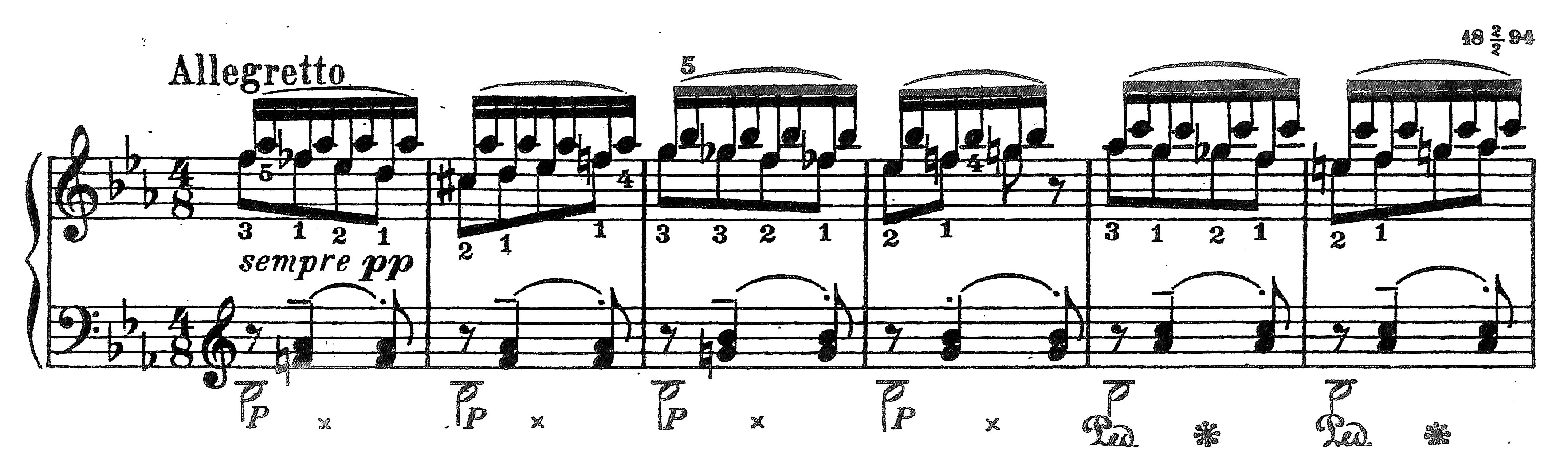
Next come Schulzová’s eyebrows (58), in which one also visually and aurally perceives the two arches of the brows in a mere eight-measure piece (Example 2).
Example 2. Impression No. 58 (Anežka’s Eyebrows)
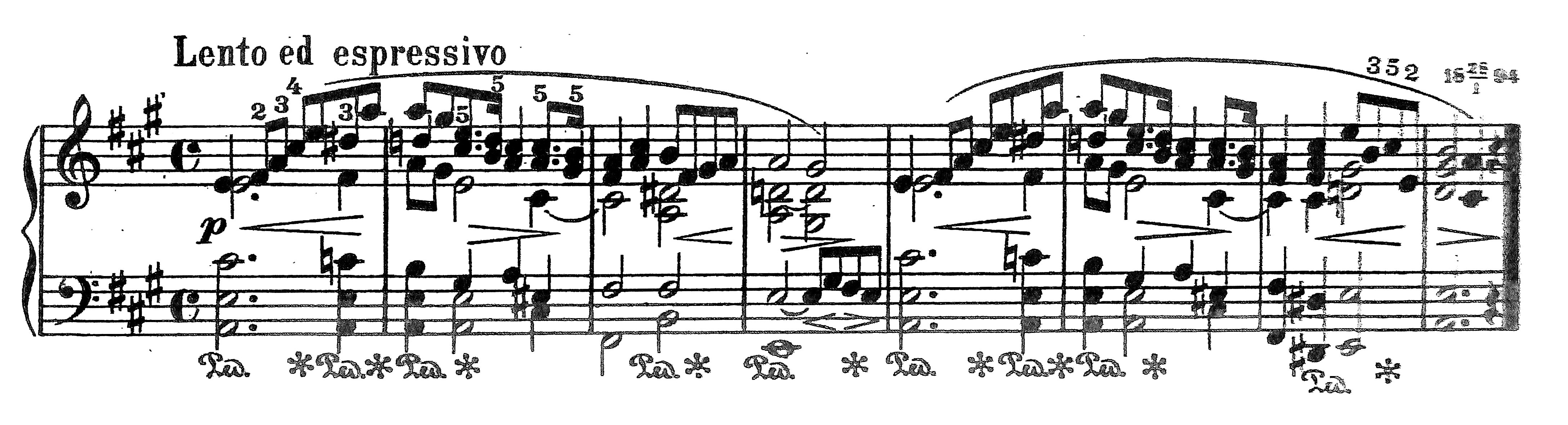
Afterwards comes her nose (59). Here, the form of the nose appendage is not apparent, yet the music’s gentle rising and falling seem to give the impression of breathing, in one of the loveliest of the Impression pieces (Example 3).
Example 3. Impression No. 59 (Anežka’s Nose)
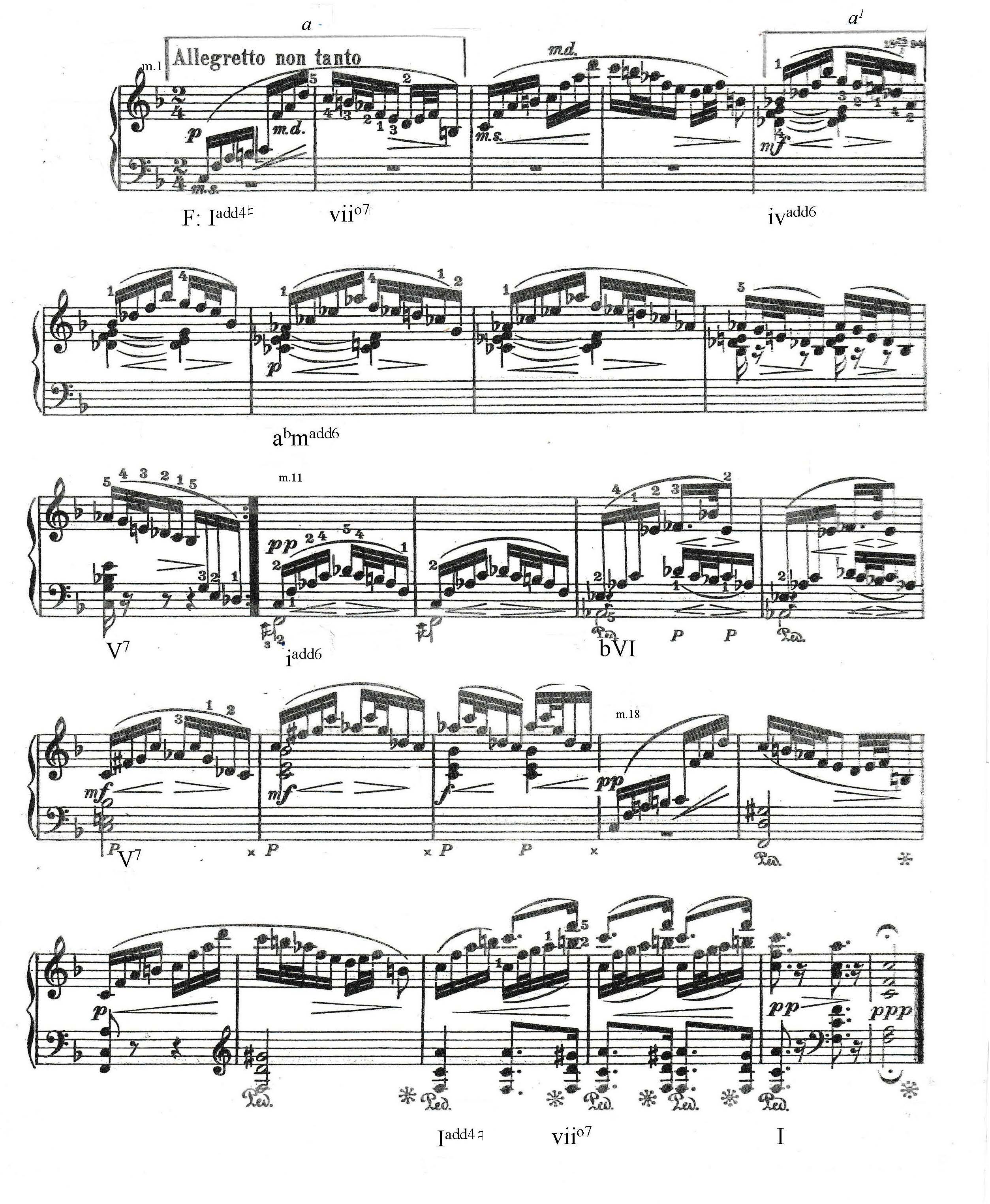
We shall analyze this piece in its entirety, as it serves as an example of Fibich’s use of form, motive, and harmony throughout the collection. The piece is in F Major and in rounded binary form. It is based on one motive, a, which begins monophonically, although it clearly arpeggiates identifiable harmonies, beginning with a tonic chord with an added augmented fourth, B-natural. (The F/B tritone is also fundamental to this piece.) This harmony alternates twice with an arpeggiated viio7. In measure 5, a1 (taken from the middle of a) moves to minor iv, a B-flat Minor chord with an added sixth. Here the motive becomes harmonically supported in the left hand for the first time. In measure 7, this motive moves to the distant harmony of A-flat Minor with an added sixth. Fibich returns to the opening key through a dominant seventh chord in measure 10.
The second half of the “nose” composition begins in measure 11, not in F Major, but in F Minor with an added sixth. Two measures later, the motive moves to A-flat with a prominent flat sixth degree (F-flat). Three measures of C dominant seventh with an augmented fourth (measure 15) lead to the rounding of the form in measure 18. The return differs only in the addition of an F pedal and supporting harmonies. The four-measure codetta features an F Major chord with an added augmented fourth (B-natural) as in the opening; however, the B-natural is now harmonized by a viio7 chord over a tonic pedal. In conclusion, economy of motives, added-note and diminished harmonies, chromatic mediant relationships (from F Major to A-flat Minor is a doubly chromatic mediant relationship), and pedal tones are elements of this composition that are also characteristic of Fibich’s style in general. They can also be seen as growing out of the style of Schumann.
In the second volume of Series 1’s Impressions, the Love Diary begins with Schulzová’s heart (86), followed by 17 pieces about her body in general, several of which have no indicated program. They are followed by pieces about her legs (104–16), knees (107), toes (thematically related to the finger pieces) (108), and toenails (113). Near the end of this volume is No. 123, “A./Z.: The Union of Two Hearts.”
The remaining pieces in Series 1 consist of the Reminders, which look back at events that Fibich treasured. They commemorate the anniversaries of important events, which is why they contain recurring leitmotifs in these pieces. The first (126) is “Anežka’s Birthday,” subtitled “Teaching Counterpoint.” The third (128) is “How We Walked Together for the First Time (March 24th, 1892).” The fifth (130) is the first presentation of the important “Love Confession (July 1st, 1892),” ending with a question and answer (Example 4).
Example 4. Reminder No. 130 (Love Confession)
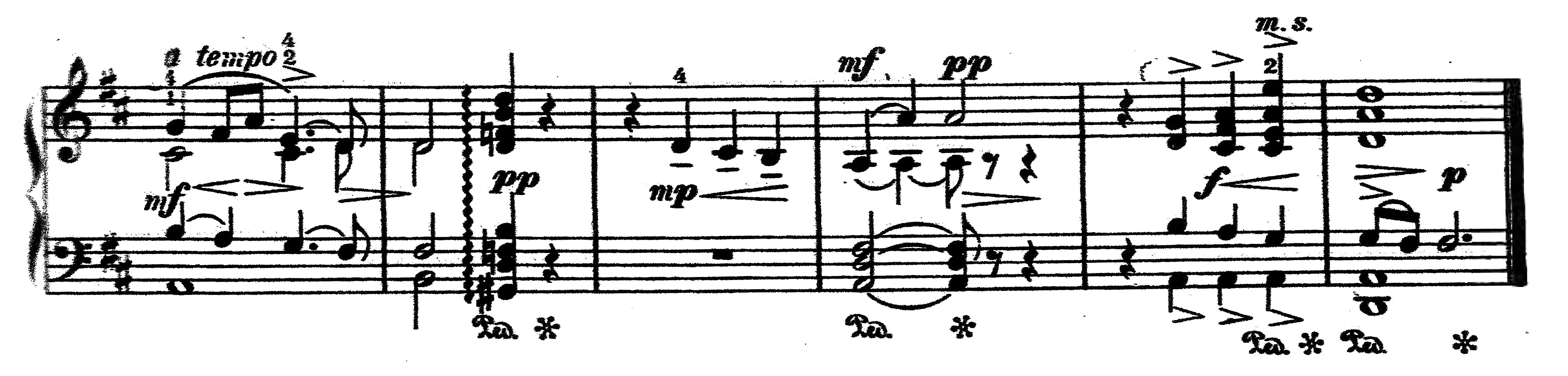
Let us look at the various incarnations of the Love Confession motive. In the above-mentioned fifth Reminder, the question and answer occur in the last four measures of the piece. The question is in the soprano voice, while the answer occurs in the penultimate measure in the tenor. Fibich never explains exactly what the question and answer are, but given the programmatic note, we could expect that Zdeněk is asking Anežka if she loves him, and she replies affirmatively.[27] Žižka, “Nálady, dojmy a upomínky,” 35.
The Love Confession motive is found also at the end of Mood No. 36 (February 22, 1894). Here the question and answer are both repeated due to the strict canonic texture of the piece (Example 5). In his dissertation, Vít Žižka notes
The characteristic, generally optimistic motif of the confession of love is heard only at the very end, in the last four measures. By far the largest part of this composition is occupied by completely different music, expressing Fibich’s doubts, fears, and even anxiety about the revelation of his emotions that he is undergoing and, of course, about the result of the question itself. As Z. Nejedlý pointed out, this is more about the “prayer of the soul” (Nejedlý 1948: 144) than anything else.[28] Žížka, “Nálady, dojmy a upomínky,” 35.
Example 5. Mood No. 30 (Our Compliance)
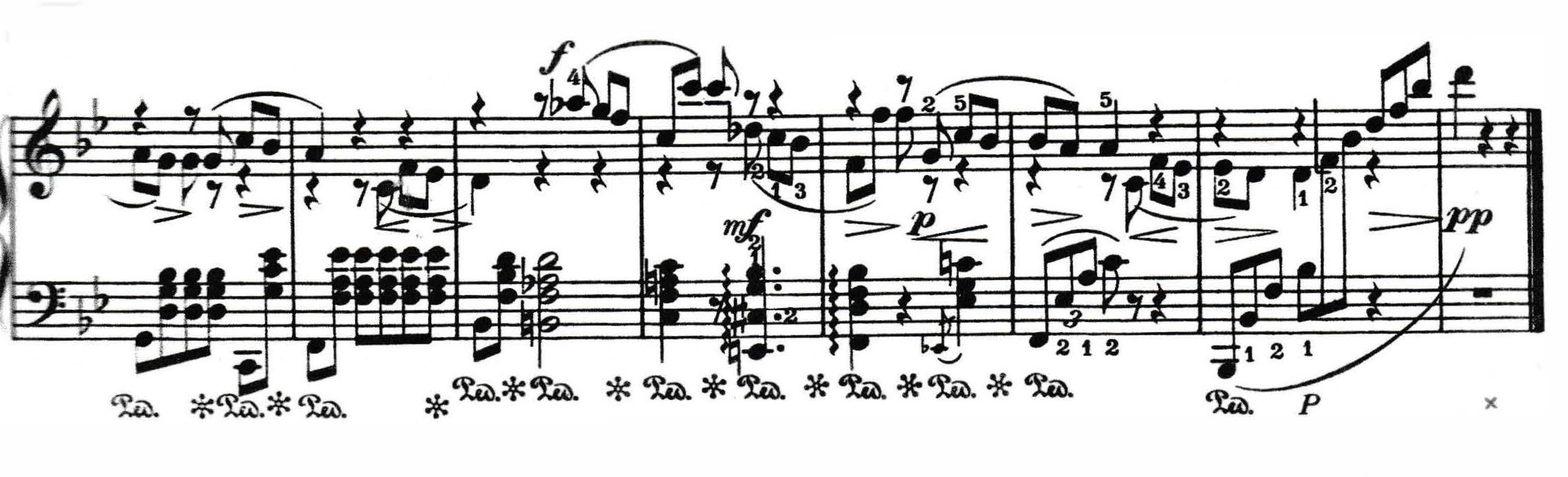
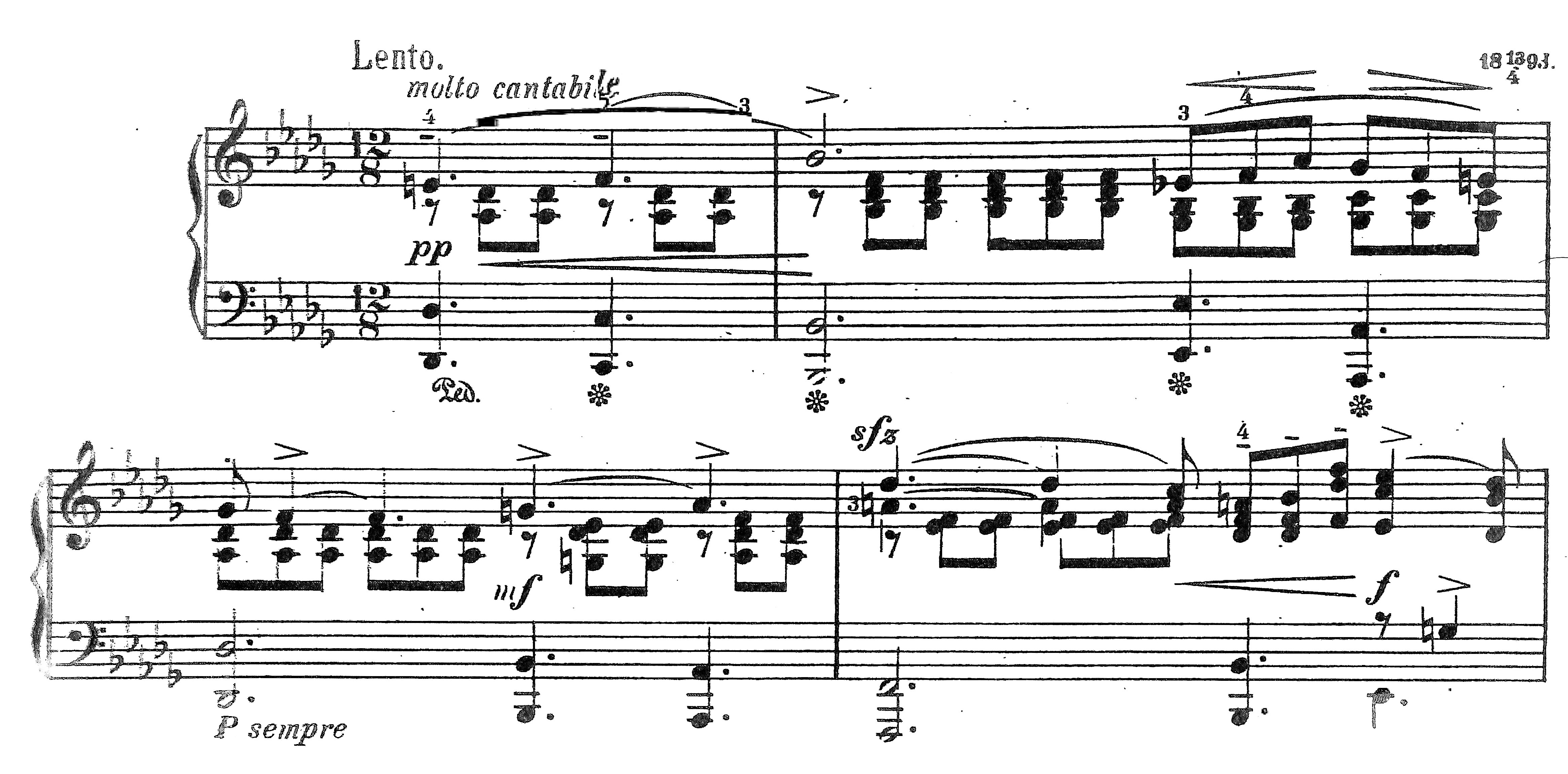
Series 1 is also the home to Fibich’s most famous composition: No. 139, the Lento molto cantabile “Evenings in Žofín,” which is dated 4/13/1893. Žofin is a wooded island in the Moldau where the Schulz family lived. In twelve measures, Fibich creates a haunting and emotional composition with a beautiful melody and compelling harmonies. Fibich reuses “Evenings in Žofin” in other pieces of the piano cycle, and also on a grand scale in his successful symphonic idyll At Twilight (1896). After his death, Jan Kubelík adapted the piece for violin and piano (or orchestra) and re-named it Poème. The opening of the original piece is seen in Example 6.
Example 6. Reminder No. 139 (Evenings in Žofin)
Czech musicologist Jaroslav Jiránek wrote of Fibich’s collection: “It must have been a pleasure to try the seemingly impossible and to really test the extreme programmability, or if you like, the picturesqueness of music.”[29] Jiránek, Zdeněk Fibich, 164. The programs are certainly compelling and can add to the experience of interpreting or listening to the music. However, other musicologists and critics complained that the narratives of Nejedlý’s book are not only inaccurate, but inappropriate for the eyes of the public, as they were seen as solicitous and erotic. They held that the stories in the pieces were private and intended for Zdeněk’s and Anežka’s eyes only. After Vladimír Helfert read Fibich’s series of compositions about Anežka’s physical features, he wrote that “Even with this conviction, I don't want to believe that Fibich would sink so low into such triviality and timidity, that his decadence could be so deep.”[30] Kopecký, “Pro koho skládal Zdeněk Fibich Nálady dojmy a upomínky?” 38. In a letter from Leoš Janáček to his own love interest Kamila Stösslová, we read “Why did Anežka and Fibich live like two dry slabs? This is not possible! Why didn’t Fibich sing of her as a woman? He went beyond the sanctity of womanhood and played with her big toe!”[31] Kopecký, “Pro koho skládal Zdeněk Fibich Nálady dojmy a upomínky?” 38.
While this musical anatomy portion of Moods, Impressions and Reminders is indeed unusual, is it as erotic as even Nejedlý claims it to be? Nejedlý’s book is often translated as Zdeněk Fibich’s Erotic Diary. Although it is intimate, it never suggests sexual activity. There is much devotion, adoration, intimacy, and obvious obsession, but no sex.
The second series of Moods, Impressions and Reminders, op. 44, is in an altogether different format. Fibich entitled it Novella; it tells the story of a vacation that he, Schulzová, and her father took together in Karlovy Vary (Carlsbad), a famous spa town in northern Bohemia. The 33 pieces are not divided into Moods, Impressions and Reminders, but rather are grouped into seven sections: a foreword, an introduction, four chapters (one for each day of the trip), and an epilogue.
I purchased Series 2 bound in one volume from an online seller in the U.K. He told me the copy had belonged to the late English scholar of Czech music John Tyrrell. The volume contains handwritten pencil notes in Czech cursive for each piece; these align with the information in Nejedlý’s book but are more detailed. Although the handwriting is Czech, it is probably not Nejedlý’s, since his was famously small, and this handwriting is quite generous. Did Nejedlý somewhere write more detail than he put in his book, or did a different previous owner of my score embellish the stories further? We shall take into consideration this detail since it is insightful and pairs well with the music.
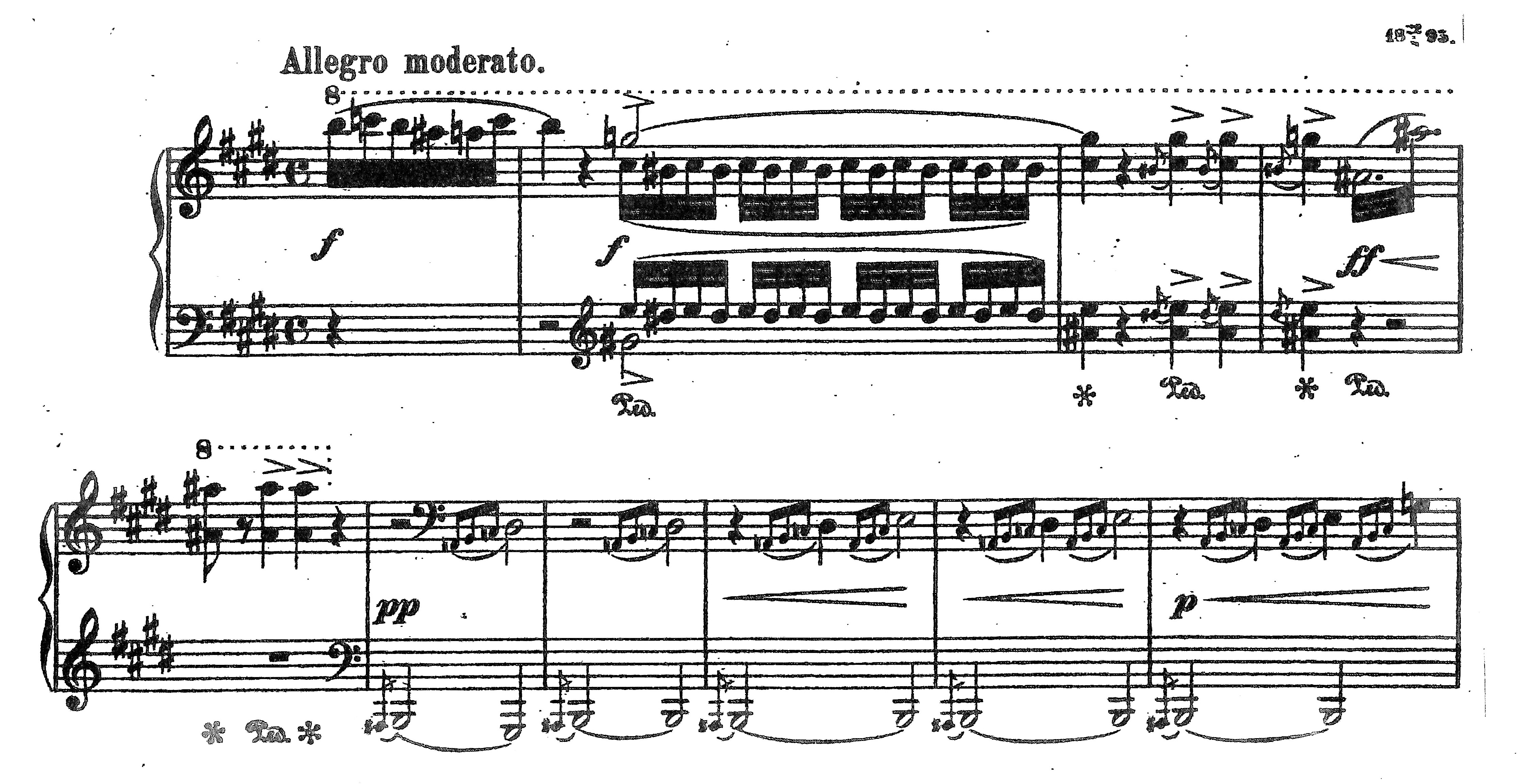
The Novella’s “Foreword” (172) represents Fibich going alone to the Alps. The following piece, “Introduction,” evokes “memories from a distance.” The third piece (174) is Fibich’s train trip from Haldstadt in the Alps to Karlovy Vary in Bohemia via Prague, and is musically quite descriptive: “After 20 days, the ride from Prague to Carlsbad…The train whistle…The train station bell…The engine breathes… It sets in motion…” (Example 7). The style here is quite modern, not typical of either Schumann or Smetana. It is a dissonant impression of the whistle, the bell, and the roar of the train.
Example 7. Novella No. 137 (Fibich’s Trip)
The story of the third piece continues: “Soon, happiness, satisfaction that he is going . . . Later, a joyful mood . . . A greeting with the fanfare motive from Hedy. I have you again” (Example 8).
Example 8. Novella No. 137 (Fibich’s Train Trip: Fanfare from opera Hedy)
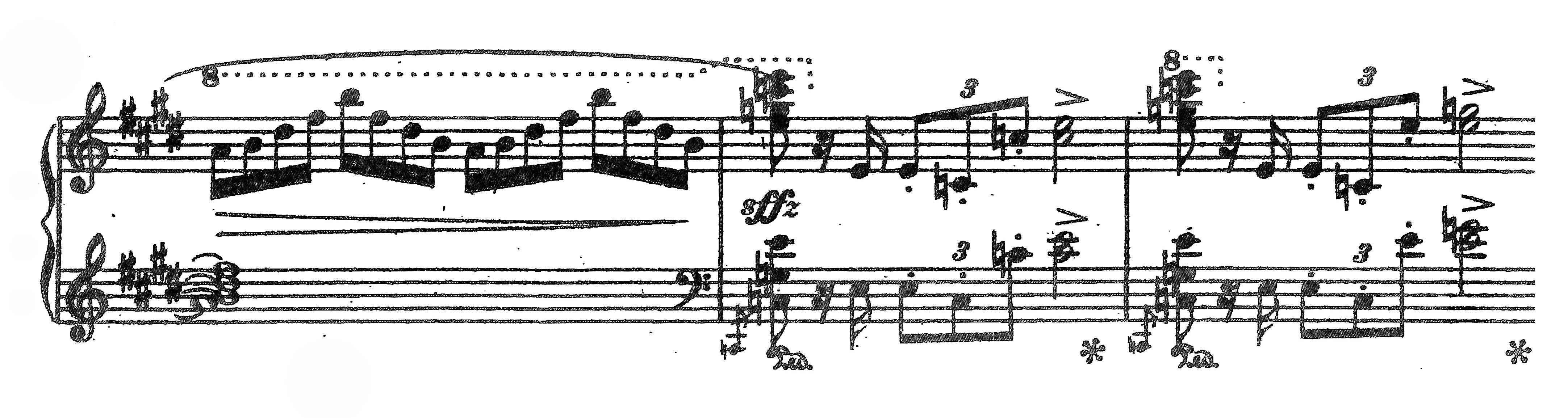
The next four entries portray a coach ride from the train station, the couple’s first meeting (“burning with impatience to see her”), a walk through the lively bustle at the spa, a stroll through nature, and then a quiet afternoon together. The eighth piece (179) is “A trip to Holzplatz [a nearby town] . . . We are all going, even Schulz [Anežka’s father]. . . Freely, they stop often…Pleasant twilight.” This heartfelt composition is distinguished by arpeggios in the right hand throughout.
The pieces which follow describe in detail the time Fibich spent together with Anežka in the second through fourth days. There are more walks in the city and in the forest. The latter seem to have impressed Fibich more, as much of his youth was spent in the forest. He is beside himself with joy during the days spent with Anežka and is sad whenever he anticipates their farewell.
Chapter 4 contains some of the best music of the Novella. The 25th piece (196) is an evocative impression of a light rainstorm, again in a modern style. The notes for the 26th piece (197) are as follows: “In the rain by coach . . . Limping horse . . . The stamping of a carriage horse, stumbling every so often.” The 32nd piece (203) contains a sad good-bye: “Anežka looks painful . . . The train rumbles and disappears. Fibich is alone like [Don] Juan from Hedy.” The 33rd and final entry is marked “Epilogue” (204): “On the third day after their leaving, Fibich leaves for Prague . . . In Prague a social visit . . . On fire to leave . . . Motive from No. 3 as when he was going to the Karlovy Vary spa . . . He doesn’t want to be alone . . . Motive of togetherness from No. 27 . . . Goal together from No. 169 (to work on operas).”
The third series of Moods, Impressions and Reminders, op. 47, is nearly as long as the first series, as it contains 148 pieces. It comprises a total of 10 volumes: Four volumes of Moods, four of Impressions, and two of Reminders. These were all composed in the years 1895 and 1896. Nejedlý finds these compositions especially meritorious due to their emotional and artistic maturity.[32] Nejedlý, Zdeňka Fibicha milostný deník, 234. Abraham disagrees, writing, “There is less spontaneous emotion; the pieces lack focus and sense of occasion.”[33] Abraham, Slavonic and Romantic Music, 80. I do not find this series to be notably weaker than the previous two. This series contains much commentary on the love affair, more adoring litanies of Anežka’s physiology, and quotes from Fibich’s operas.
Within the third series, the first volume of Moods, No. 207 is “He longs for her very much,” and No. 210 is “He receives a beautiful letter from Anežka.” Anežka again becomes a fashion plate for many dresses, scarves, stockings, garters, and more. To begin the first volume of Impressions, Fibich composed ten compositions about her toes. In the two Reminders volumes, he looks back to the first time he kissed her hand (333) and the first time he saw her (341). The latter contains a striking varied quote from “Evenings in Žofín,” as well as a quote from the July 1, 1892 “Love Confession.” No. 351 also savors and varies the “Love Confession” motive.
The fourth series, Op. 57, was composed between the years 1896 and 1899. It comprises 24 entries in just one volume, with no divisions of the separate categories of Moods, Impressions and Reminders. Many pieces are not dated, and Fibich never got to proofread the set. Nonetheless, certain pieces are adventurous in harmony, such as No. 364. Also, No. 358 is the longest composition in the entire cycle: a set of 14 variations that were a gift for Anežka’s birthday on March 24th, 1897.
We have noted in Moods, Impressions and Reminders that Fibich was not interested in Czech nationalism with portrayals of Czech legends or history. Rather, he composed unique musical impressions of Czech persons, places, and activities. We have seen the cycle as a compendium of Fibich’s musical style, including its relationship to the styles of Robert Schumann and Bedřich Smetana. Additionally, Fibich often used the cycle as a thinking pad for his other compositions. Above all, Moods, Impressions and Reminders is a devotional diary of a man deeply in love. It is Fibich’s music at its most intimate and vulnerable expression.
[1] William Ritter, Národní listy (Prague, 8 April 1896); repr. Artuš Rektorys, ed., Zdeněk Fibich: Sborník dokumentů a studií [Zdeněk Fibich: A Collection of Documents and Studies], Prague: Orbis (1951–2): 189–90.
[2] “Cosmopolitan,” in the sense of internationalism rather than nationalism, is how several scholars defined Fibich in a volume of articles published in 2010. See Zdeněk Fibich as a Central European Composer at the End of the Nineteenth Century: Special Issue of Musicologica Olomucensia 12 (December 2010).
[3] Michael Beckerman listed common Czech traits in music. They include: 1) First beat accent (related to speech and folk song); 2) Syncopated rhythms (often related to characteristic dances); 3) Lyrical passages, often as a trio in a dancelike scherzo; 4) Harmonic movement outlining triads a major third apart; 5) Two-part writing involving parallel thirds and sixths; 6) Oscillation between parallel major and minor modes; 7) Use of modes with lowered sevenths and raised fourths; 8) Avoidance of counterpoint; and 9) Use of melodic cells which repeat a fifth above. Since all these characteristics can be found in non-Czech music, Beckermann suggests that intent (title, program, etc.) is as important as content in defining what is Czech. “In Search of Czechness in Music,” 19th-Century Music 10:1 (Summer 1986): 64, https://www.jstor.org/stable/746749.
[4] John Tyrrell and Judith A. Mabary, “Fibich, Zdeněk,” Grove Music Online, 2001, https://doi.org/10.1093/gmo/9781561592630.article.09590.
[5] Jan Smaczny,“The Operas and Melodramas of Zdenĕk Fibich (1850–1900),” Proceedings of the Royal Musical Association 109 (1982–83): 120, https://www.jstor.org/stable/766139.
[6] C. L. Richter [A. Schulzová], Zdenko Fibich: Eine musikalische Silhouette (Prague: F.A. Urbánek, 1900).
[7] Zdeněk Nejedlý, Zdeňka Fibicha milostný deník: Nálady, dojmy a upomínky [Zdeněk Fibich’s Love Diary: Moods, Impressions and Reminders] (Prague: Melantrich, 1925). Nejedlý is a controversial figure in Czech musicology, both because of his intense criticisms of Dvořák and his role as Minister of Culture and Education of the Communist Party. For a recent study of Nejedlý, see Michal Kopeček, “Czech Communist Intellectuals and the ‘National Road to Socialism’: Zdeněk Nejedlý and Karel Kosík, 1945–1968” in Ideological Storms: Intellectuals, Dictators, and the Totalitarian Temptation, ed. Vladimir Tismaneanu and Bogdan C. Iacob (Budapest: Central European University Press, 2019), 345–90.
[8] Nejedlý, Zdeňka Fibicha milostný deník, 25.
[9] Nejedlý, Zdeňka Fibicha milostný deník, 19. All translations from Czech are by the author.
[10] Nejedlý, Zdeňka Fibicha milostný deník, 23.
[11] Nejedlý, Zdeňka Fibicha milostný deník, 13.
[12] Jaroslav Jiránek, Zdeněk Fibich (Prague: Státní hudební vydavatelství, 1963); Vladislav Hudec, Zdeněk Fibich (Prague: Státní pedagogické nakladatelství, 1971).
[13] Jiří Kopecký, “Pro koho skládal Zdeněk Fibich Nálady dojmy a upomínky?” [For Whom did Zdeněk Fibich Compose Moods, Impressions and Reminders?] Opus musicum 3 (2016): 37–51.
[14] Vít Žižka, “Nálady, dojmy a upomínky: klavirní cyklus Zdeňka Fibicha” [Moods, Impressions and Reminders: A Piano Cycle by Zdeněk Fibich]. (PhD diss., Jíhočeská Univerzita v Českých Budějovicích [Southern Bohemian University in České Budějovice], 2007).
[15] Jiří Špilauer “Zdeněk Fibich – Nálady, dojmy a upomínky.” (PhD diss., Univerzita Karlova [Charles University], 2018).
[16] Gerald Abraham, Slavonic and Romantic Music (New York: St. Martin’s Press, 1968), 70–82.
[17] Sarah Murphy, “Czech Piano Music from Smetana to Janáček: Style, Development and Significance,” (PhD diss., Cardiff University, 2009).
[18] Zdeněk Fibich, Moods, Impressions and Reminiscences, Marián Lapšanský, piano, Supraphon SU 0189-2 131 etc.,1996–1997, 12 compact discs.
[19] Zdeněk Fibich, Moods, Impressions and Souvenirs, William Howard, piano, Chandos 9361, 1995, compact disc. Zdeněk Fibich Piano Music, Radoslav Kvapil, piano, Regis 1221, 1993, compact disc.
[20] Nejedlý, Zdeňka Fibicha milostný deník, 123.
[21] John K. Novak, “Josef Suk’s Non-Obstinate Ostinato Movements: A Study of Harmony and Style,” College Music Symposium 43 (2003): 86–104, https://www.jstor.org/stable/40374472.
[22] John Tyrrell, Janáček: Years of a Life Volume 2 (1914-1928): Tsar of the Forests (London: Faber and Faber, 2007), 866.
[23] George Perle, Style and Idea in the Lyric Suite of Alban Berg (New York: Pendragon Press, 1995).
[24] Nejedlý, Zdeňka Fibicha milostný deník, 128.
[25] Jiránek, Zdeněk Fibich, 107.
[26] The meaning of No. 65 is obscure as only a few letters or initials appear on the page.
[27] Žižka, “Nálady, dojmy a upomínky,” 35.
[28] Žížka, “Nálady, dojmy a upomínky,” 35.
[29] Jiránek, Zdeněk Fibich, 164.
[30] Kopecký, “Pro koho skládal Zdeněk Fibich Nálady dojmy a upomínky?” 38.
[31] Kopecký, “Pro koho skládal Zdeněk Fibich Nálady dojmy a upomínky?” 38.
[32] Nejedlý, Zdeňka Fibicha milostný deník, 234.
[33] Abraham, Slavonic and Romantic Music, 80.
References
- Slavonic and Romantic Music. New York: St. Martin’s Press, 1968.
- “In Search of Czechness in Music.” 19th-Century Music 10:1 (Summer 1986): 61–73. https://www.jstor.org/stable/746749.
- Moods, Impressions and Reminiscences, Marián Lapšanský, piano, Supraphon SU 0189-2 131 etc., 1996–1997. 12 compact discs.
- Moods, Impressions and Souvenirs, William Howard, piano. Chandos 9361, 1995, Compact disc.
- Piano Music. Radoslav Kvapil, piano. Regis 1221, 1993, Compact disc.
- Zdeněk Fibich. Prague: Státní pedagogické nakladatelství, 1971.
- Zdeněk Fibich. Prague, Státní hudební vydavatelství, 1963.
- “Czech Communist Intellectuals and the ‘National Road to Socialism’: Zdeněk Nejedlý and Karel Kosík, 1945–1968.” In Vladimir Tismaneanu and Bogdan C. Iacob, eds., Ideological Storms: Intellectuals, Dictators, and the Totalitarian Temptation, 345–90. Budapest: Central European University Press, 2019.
- “Pro koho skládal Zdeněk Fibich Nalády dojmy a upomínky?” [For Whom did Zdeněk Fibich Compose Moods, Impressions and Reminders?] Opus musicum 3 (2016): 37-51.
- “Czech Piano Music from Smetana to Janáček: Style, Development and Significance.” PhD diss., Cardiff University, 2009.
- Zdeňka Fibicha milostný deník: Nálady, dojmy a upomínky [Zdeněk Fibich’s Love diary: Moods, Impressions and Reminders]. Prague: Melantrich, 1925.
- “Josef Suk’s Non-Obstinate Ostinato Movements: A Study of Harmony and Style.” College Music Symposium 43 (2003): 86–104. https://www.jstor.org/stable/40374472.
- Style and Idea in the Lyric Suite of Alban Berg. New York: Pendragon Press, 1995.
- Zdenko Fibich: Eine musikalische Silhouette. Prague. F.A. Urbanek, 1900.
- Národní listy (Prague, 8 April 1896). Reprinted in Zdeněk Fibich: sborník dokumentů a studií [Zdeněk Fibich: A Collection of Documents and Studies], ed. Artuš. Rektorys. 189–90. Prague: Orbis, 1951-2.
- “The Operas and Melodramas of Zdenĕk Fibich (1850-1900).” Proceedings of the Royal Musical Association 109 (1982–1983): 119–33. https://www.jstor.org/stable/766139.
- “Zdeněk Fibich – Nálady, dojmy a upomínky.” PhD diss., Univerzita Karlova [Charles University], 2018.
- Janáček: Years of a Life Volume 2 (1914-1928: Tsar of the Forests. London: Faber and Faber, 2007.
- “Fibich, Zdeněk.” Grove Music Online. 2001. 10.1093/gmo/9781561592630.article.09590.
- Zdeněk Fibich as a Central European Composer at the End of the Nineteenth Century. Special edition of Musicologica Olomucensia 12 (December 2010).
- “Nalády, dojmy a upomínky: klavirní cyklus Zdeňka Fibicha” [Moods, Impressions and Reminders: A Piano Cycle by Zdeněk Fibich]. PhD diss., Jíhočeská Univerzita v Českých Budějovicích [Southern Bohemian University in České Budějovice], 2007.


 Copyright © The College Music Society. All Rights Reserved.