
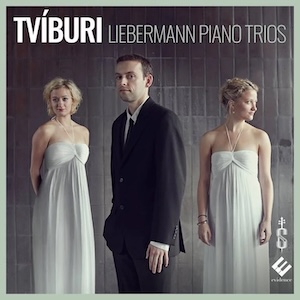
Tvíburi. Liebermann Piano Trios. 2025. Evidence Classics. CD and MP3 download, 6 tracks, (44:26). €9
Danish ensemble Tvíburi (pianist Jakob Alsgaard Bahr and twin sisters violinist Karen Johanne Pedersen and cellist Kirstine Elise Pedersen) has released an exemplary recording of the complete piano trios of American composer Lowell Liebermann. Besides Liebermann’s first trio (op. 32, 1990) and second trio (op. 77, 2001), the album includes the world-premiere recording of his Piano Trio No. 3 (op. 92, 2012). These three chamber works showcase Liebermann’s best compositional traits: lyricism, dynamic and textural contrasts, formal cohesiveness, and a distinctive harmonic language. The compositions also exhibit stylistic variety, all realized with Tvíburi’s ensemble chemistry and compelling interpretation.
The Piano Trio No. 1 opens playfully with an alluring melody in the violin around a tonal center of E, soon answered by the cello. As in many of his other compositions, Liebermann uses skillful motivic development. For example, the descending triplet from the opening appears later in a faster tempo and a stronger dynamic, such as at 02:59 and 07:43 (track 1). Besides motivic development, the piece constantly transforms through shifting harmonies and tempos, throughout which Tvíburi does a wonderful job of transitioning different sections organically while maintaining temporal fluidity and a balanced voicing.
The Piano Trio No. 2 opens with loud ostinato-like chords in the piano that evoke Frankenstein’s lumbering footsteps. Pianist Jakob Alsgaard Bahr plays these chords with powerful sonority and a sustained touch. Together with Karen Johanne Pedersen and Kirstine Elise Pedersen’s weighty and rigorous attacks, the beginning completely differentiates itself from the dreamy atmosphere of the first piano trio. Particularly remarkable is how the twins shift colors and articulations at the beginning of the Adagio (track 3), in which the distant chant-like melody becomes closer and more expressive the third time it appears. They play without any vibrato in a subdued dynamic the first two times, and with a real singing tone the last time. While the classic recording of the piece, Chamber Music of Lowell Liebermann (Andrew Cooperstock, Andrés Dîaz, and William Terwilliger, 2004), emphasizes the last notes of the first two phrases, the twin string players of Tvíburi taper the phrases and let the notes vanish. Tvíburi demonstrates technical brilliance in the Allegro (track 4) through their clear execution of the fast-running notes, while bringing back previous musical characters and colors whenever the music calls for them.
Like the second trio, Liebermann’s Piano Trio No. 3 is also full of clear contrasts. In sections containing many fermatas and much rubato, Tvíburi performs with natural phrasings and subtle nuances of timing. The stops and silences form an intrinsic part of the first movement, and Tvíburi interprets them with a suitable amount of time, never losing tension. Liebermann titles the last movement “They’re Coming…” (track 6), a largely dark and rhythmically relentless movement intertwined with moments of lyricism. Towards the end of the movement, a clever counterpoint appears together with polyrhythms (03:03, track 6), in which Jakob Alsgaard Bahr makes full use of the written articulations. Although the movement is filled with rhythmic drive and percussive sound, whenever a melody in unison appears in high registers — either between the two hands of the piano or between the violin and the cello — Tvíburi really plays the melody with a vibrant and singing sound and lets it soar above the texture.
Tvíburi’s recording of Lowell Liebermann’s complete piano trios highlights the ensemble’s outstanding musicianship in both interpretation and technical precision. Whether in moments of serene lyricism or frenetic intensity, Tvíburi proves itself a trio of remarkable collaboration and artistry. This album serves as more than an illuminating introduction to Liebermann’s complete piano trios to date — it affirms the power of chamber music when performed with such musical insight.


 Copyright © The College Music Society. All Rights Reserved.