
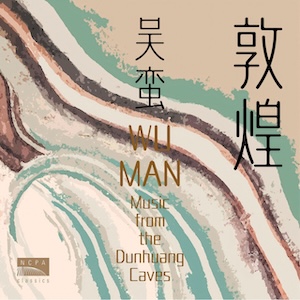
Wu Man. Music from the Dunhuang Caves. 2024. NCPA Classics. MP3 download, 32 tracks (59:00).
In December 2024, the National Centre for the Performing Arts (NCPA Classics) released Music from the Dunhuang Caves, a new musical exploration by the pipa player Wu Man. This album traces its origins to a moment three years earlier: in 2021, while filming the documentary Great Dunhuang for China Central Television, Wu Man — viewing the ancient manuscripts and mural-adorned walls of the Mogao Caves in Dunhuang, China — felt inspired to research the music from the era of the cave murals, which were painted from the fourth to the fourteenth centuries AD. What followed was a three-year research project, including field recordings in Dunhuang, and artistic distillation thereof, culminating in a work that bridges scholarly rigor and living artistry.
At its heart lies the resurrection of 25 pipa scores from the Dunhuang manuscript P.3808 (from AD 933), symbols once deemed an indecipherable “musical cipher.” Wu Man navigated this labyrinth by anchoring her interpretation in Chen Yingshi’s transcriptions, while incorporating new insights from scholars Ye Dong, Xi Zhiguan, Rao Zongyi, and He Changlin. In pieces like “Jiquzi” (“Fast Tune”), she channels Xi Zhiguan’s rhythmic urgency to evoke Tang-dynasty dance intensity; in “You Manquzi” (“Another Slow Tune”), she embraces Ye Dong’s lyrical fluidity. This “polyphonic scholarship” transcends academic debate — it becomes a reconciliation of history through the strings of her pipa.
The core of the album, however, resides in seven original compositions by Wu Man. These are not reconstructions but improvisational dialogues with antiquity. As Wu Man revealed in interviews, collaborating with jazz musicians reshaped her understanding of how music can be made: improvisation was intrinsic to traditional Chinese masters, a truth obscured by modern notation-bound pedagogy. In pieces like “Qing Yu” (“Stone Chime Echoes”), she conjures cavernous reverberations through microtonal bends, sketches flying apsaras’ ribbons with ethereal harmonics, and folds Central Asian tonalities into jazz-inspired spontaneity. This approach resurrects the Tang musicians’ tradition of “playing by the heart’s rhythm” — where scores only hinted at “slow” or “fast,” leaving nuance to the performer’s intuition, a spirit startlingly aligned with contemporary improvisation.
Novel recording techniques contribute to the album’s artistic effect. The producer, William Bradbury, used close-miking techniques to amplify the grit of fingernails on the silk strings of the pipa, and to emphasize the artist’s breath — immersing listeners in the intimacy of the instrument and the player’s body. Meanwhile, reverb engineered to mimic the grottoes’ resonant acoustic transforms solo passages into a conversation with the painted musicians of the caves’ walls. This sonic architecture caters to global audiences seeking “high-definition ethnic timbre” while honoring the Chinese aesthetic of qiyun shengdong (“vital rhythm and breath”) — a testament to Wu Man’s decades of recording “borderless soundscapes” along the Silk Road.
Music from the Dunhuang Caves transcends historical replication by embracing a paradox: all reconstruction is modern creation. Wu Man never claims to “restore” Tang-dynasty music, framing the album instead as “a contemporary homage to ancient scores.” When she strips “Qingbei Le” ("Toast Song”) of the modern pipa’s rapid-fire tremolos, rendering its desert-like expanse through Tang-era “soft plucks and slow sweeps”; when she fractures time with Persian-tinged microtones in “You Quzi” (“Another Tune”) — we hear not just scholarship, but an artist pouring lived experience into historical silence. As she reflected at the album’s launch, “Dunhuang embodies uncertain beauty… We must fill its blanks with our own lives.”
The album redefines the possibilities of traditional music in our time. It proves that true preservation lies not in taxidermy but in reanimation: when scholarship and art resonate, when history and improvisation entwine, Dunhuang’s music ceases to be relic and becomes something else — reverberations of the Tang dynasty, a prelude to the future.


 Copyright © The College Music Society. All Rights Reserved.