
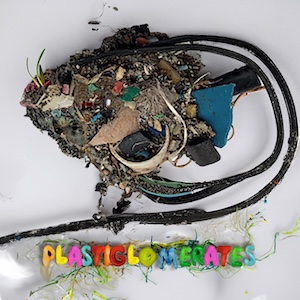
Jess Rowland. Plastiglomerates. 2024. Innova Recordings 370. CD and MP3 download, 12 tracks (31:00). innova.mu. $11.88
Jess Rowland’s Plastiglomerates constructs a sonic landscape intricately composed from the debris of contemporary existence. This half-hour work articulates a complex auditory environment characterized by glitches, distorted vocal elements, fragmented rhythmic structures, and ambient textures. These sonic materials vividly resonate with the conditions of an anthropocentric era marked by substantial human intervention into natural processes.
The title, Plastiglomerates, evokes a recently documented geological phenomenon initially observed on Kamilo Beach in Hawaii, where anthropogenic plastic waste merges with naturally occurring geological substances, including sand, volcanic rock, coral, and seashell fragments. Such hybridized geological forms symbolize the Anthropocene — the epoch defined by pronounced human impact upon Earth’s geology and ecosystems. Kamilo Beach, renowned for its extensive accumulation of debris due to oceanic currents, serves as a tangible manifestation of the ecological crisis, presenting a physical archive of contemporary civilization’s environmental footprint.
In sonic terms, the work embodies these geological composites through an approach aligned with Fredric Jameson’s concept of “postmodern pastiche,” now infused with a compelling ecological dimension. Whereas traditional collage and pastiche derive their efficacy from the discernible tension between disparate, juxtaposed elements, prompting contemplation of their original contexts versus newly constructed meanings, this work complicates such dynamics through its deliberate use of sonic materials conventionally regarded as “noise” or digital “waste.”
Elements such as digital static, distorted commercial audio, glitch-induced rhythms, abrupt sonic interruptions, and manipulated vocalizations initially present themselves as disposable sonic refuse. However, through intentional recombination, these fragments achieve an unstable yet cohesive structure, sonically paralleling the physical processes that generate plastiglomerates.
Rowland’s compositional methodology further parallels the ecological reality of the Great Pacific Garbage Patch, a vast accumulation of marine debris perpetually circulating within the North Pacific Subtropical Gyre. Here, physical waste fragments continuously degrade into microplastics, constituting invisible yet pervasive pollutants. Correspondingly, the auditory fragments within the composition drift, fragment, and recombine, digitally mirroring the incessant flux and recomposition characteristic of global ecological waste cycles.
Listening to Plastiglomerates thus evokes an experience analogous to navigating a turbulent digital ocean, marked by waves of auditory distortion, ambient drone, and fragmented vocal echoes. This sonic journey offers no conventional melodic guidance or definitive resolution; instead, listeners navigate fluctuating currents of coherent rhythm and dissonant rupture. Such auditory disturbances immerse listeners within the tangible textures of sonic waste, compelling acknowledgment of individual and collective complicity within global ecological and digital waste networks.
Through this approach, Rowland reaches beyond the aesthetic confines of postmodern pastiche toward critical explorations of digital materialism and ecological consciousness. Jameson’s characterization of pastiche as symptomatic of late capitalism’s cultural logic — marked by fragmentation, lack of historical depth, and superficial appropriation — finds renewed relevance through this ecological reframing. Here, pastiche articulates an ecological logic wherein all materials, subjected equally to natural forces such as solar radiation and gravity, fragment into more minor constituents, continuously reshaped into hybrid forms. Such a process suggests that the act of categorization and boundary-making may itself be a distinctly human intervention, while pastiche, under these ecological conditions, emerges as a natural state.
Consequently, Plastiglomerates transcends the superficiality critiqued by Jameson, embedding substantial ecological depth beneath its auditory surface. By foregrounding digital materialism, the work reveals the inherent materiality and ecological footprint of digital phenomena. The ostensibly undesirable sounds, far from being contextless cultural signs, manifest as tangible analogs of the environmental and digital pollutants defining our contemporary historical condition.
Plastiglomerates fosters attunement to the Anthropocene not through conventional didacticism, but through immersive engagement with the digital and ecological debris intrinsic to contemporary existence. It compels listeners to question perceived distinctions between value and waste, digital and physical, human and nature. What is conventionally dismissed as unwanted detritus emerges here as an enduring condition of living, profoundly embedded within geological formations and intricately woven into the textures of everyday experience.


 Copyright © The College Music Society. All Rights Reserved.