
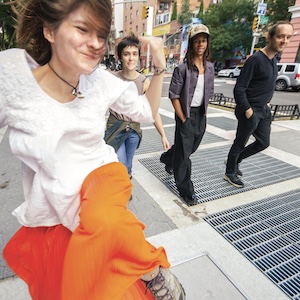
Zoh Amba. Sun. 2025. Smalltown Supersound STS445LP. LP and MP3 download, 9 tracks (43:01). smalltownsupersound.com. $9
Zoh Amba’s latest commercial album, Sun, is an entry in a body of work that has long invigorated fans of spiritually-inflected free jazz. With Caroline Morton on bass, Miguel Marcel Russell on percussion, Lex Korten on piano, and Zoh Amba on tenor saxophone (with a brief foray into guitar) and composition, this quartet has continued Amba’s tradition of pushing the bounds of folk and jazz.
On the first track, “Fruit Gathering,” Amba lays out an auditory map of the experience to come: a fusion of folk melodies (“Taps,” in this instance) with the spiritual longing and outcry of free jazz in the Albert Ayler stream. The quartet of tenor saxophone, bass, percussion, and piano (pared down to a trio on certain tracks such as “At Noon” and “Champa Flower,” in which Amba switches out her tenor saxophone for a guitar) respond to each other with insistence and humor, as in the gradual development of movement generated by the interplay of piano and tenor saxophone on the closing track, “In Heart.” The core of the album’s energy and movement can be found on its central track, “Seaside,” a seven-minute journey that begins with Russell making furtive cymbal forays from silence, gradually gaining companions until the entire combo locks in to a set of loose changes halfway through the piece, with sassy high piano tremolos from Korten, growling melodies made and dropped off in Amba’s tenor sax, and Morton’s sauntering bass drawing crooked lines. The freeness of the sound varies throughout and within tracks — from the extreme sense of being surrounded on all sides evoked in “Forevermore” by bass pedal tones, twittering piano ascensions, and desperate overtone-laden squeals from the tenor sax; to the repetitious sax melodies in “Like the Sun,” cut through with harmonic piano clusters reaching out of a tonal center. The freedom is emphasized by the occasional lineup changes, with acoustic piano switching out for electronic and tenor sax switching out for guitar in “Champa Flower,” as well as the inclusion of pure shaped static floating in the spaces between throughout “At Noon.”
The musicians insist on newness and responsiveness. They included a range of experiences, from joyful abandon to frustrated yearning, balanced by space-making from each member for the full gestation and implementation of individual statements, inevitably influenced by the collective, but not overcome by its communal identity — a generous community interested in its own composition and in looking far outside itself. Amba’s spiritual dedication to this ethos of unbridled expression coupled with insightful communication is evident in her other work, but particularly shines in this distinct group of four.


 Copyright © The College Music Society. All Rights Reserved.