
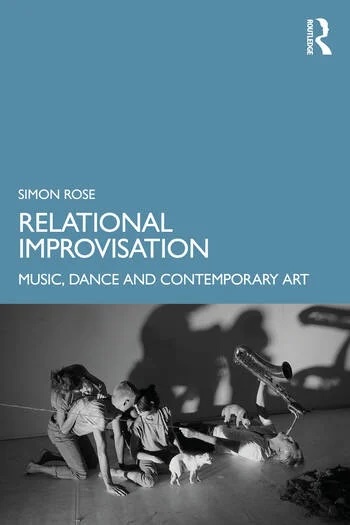
Relational Improvisation: Music, Dance and Contemporary Art. Simon Rose. New York: Routledge, 2024. 262 pp. 19 b&w illustrations, ISBN: 9781032231891. $51.99. (Paperback)
This book explores the idea of improvisation in music, dance, and the visual arts in a series of case studies tracing the creative process. The project reflects the collaborations of author and saxophonist Simon Rose with twelve diverse artists, including visual artists Julie Myers, Lena Czerniawska, and Emese Csornai; choreographers Ingo Reulecke and Barbara Berti; dancer and philosopher Andrew Wass; electronic music composer Adam Pultz Melbye; Korean traditional gayageum player Youjin Sung; sound artists Paul Stapleton, Viola Yip, and Nicola Hein; and daxophone player Kriton Beyer. Using an autoethnographic approach and phenomenological and philosophical concepts, Rose evaluates the roles of improvisation in breaking expressive limits across distinct art forms. Taking into account the influence of real-world factors (like the Covid-19 pandemic), the book offers new perspectives on improvisation within the contexts of interdisciplinary innovation and collaboration in the arts.
Chapter 1 proposes several core dimensions of improvisation. Rose emphasizes three elements: openness, relationality, and interdisciplinarity. Openness is embodied in a performance practice that breaks down preconceptions, relationality emphasizes the role of trust in collective creation, and interdisciplinarity is exemplified in connections to socio-politics, for example where improvisation may take on associations with civil rights and the emancipation of African Americans and other oppressed groups (see Heble 2000, 141-166).
Chapter 2 dissects the nature of performance of improvised music through three auto-ethnographic cases: the first, New Communication, takes place in a World War II bunker in Berlin, combining sound installations with an improvised trio featuring Adam Pultz Melbye, Paul Stapleton, and Rose. By integrating architectural acoustics with interactive systems, the project redefines audience participation, transforming the space itself into an interactive instrument. The second case study, Ozu’s Dream, explores the performative interaction between Rose and the natural Alpine environment, highlighting how the artist’s sound engages in dialogue with the surrounding landscape to create a site-specific musical expression. The third case study, North Sea Night, is a free improvisational music performance by a duo consisting of baritone saxophonist Rose and drummer Steve Noble. Through this performance, Rose demonstrates that the long-standing rapport between musicians is reflected in their understanding of each other’s musical language, rhythm, and improvisational dynamics, enabling them to create coherent and expressive music together without prior rehearsal. In discussing these examples, Rose engages with “Environmental Theatre,” a branch of the New Theater Movement in the 1960s, which aimed to raise audience awareness of the theater by eliminating the distinction between the audience and the actors’ space. Drawing on the work of Richard Scherchner (Schechner 1994) Rose emphasizes that, in the performance of improvised music, the absence of a written score fundamentally changes the role of the performer: the lack of external direction is an invitation to the performer to seize new creative opportunities (37).
Chapters 3 and 4 deepen the understanding of the practice of improvisation through additional examples. Julie Myers’s work Klangfarbe, Neukölln, discussed in Chapter 3, shows how the combination of sound recording and improvisation can capture the soundscape of an urban space. Chapter 4 focuses on improvisation in dance and music and is informed, for example, by Rose’s conversation with Igno Reulecke. Reulecke emphasizes that non-predetermined processes are more efficient and creative than fixed choreographies and argues that shared, open spaces are at the heart of improvisation .
Chapters 5 and 6 explore improvisation as a responsive system shaped by human, technological, and environmental interactions. Chapter 5 introduces a new framework that views improvisation as a dynamic feedback system involving musicians, instruments, space, and audience. In the case of an interaction between a drumstick and a player, for example, Rose suggests that vibrational and tactile feedback form a sound perception loop, and he proposes that combining electroacoustic and acoustic technologies can lead to a deeper understanding of the collaborative nature of improvisation . Chapter 6 focuses on creative transformations during the COVID-19 pandemic resulting, for instance, in the emergence of dance music that is more globally conscious and environmentally sensitive. The project Zone of Acceptance, a dance between humans, non-human animals, and plants, exemplifies how cross-disciplinary improvisation breaks out of the anthropocentric framework, integrating environmental perception and biological rhythms into the process of art generation.
Chapters 7 and 8 examine improvisation as an embodied, co-creative process. In Chapter 7, Rose analyzes dance and music improvisation from a phenomenological perspective as an artistic fusion of presence, time, and co-presence. The similarities between improvisation and phenomenological approaches are explored, for example, by analyzing dance movement exercises such as Barbara Dilley’s Infant Eyes, which emphasizes a perceptual approach of “seeing before naming.” By delaying subjective judgments about space and movement, dancers can engage with the environment and their bodies with an open mindset. Rose argues that this method encourages performers to break free from habitual cognition, transforming ordinary environments, and routine movements into material for improvisation, thereby expanding the possibilities and expressive dimensions of improvisation (126-127). Chapter 8 emphasizes cross-cultural contexts, revealing the transformative potential of traditional musical elements in improvisation through the case of Korean gayageum player Youjin Sung. In discussing a collaborative performance by Rose and Sung featuring the baritone saxophone and gayageum, Rose explores how performers experience each other while engaging in open-ended improvisation.
Chapter 9 looks at musical improvisation as a practice of sympoiesis, which means “making-with” (as opposed to autopoiesis, in which something makes itself) (160-161). Rose suggests that improvisation can become a tool for empowerment in music and drama classrooms by replacing the traditional teacher-student power structure with a communication-centered mode of learning that emphasizes participation, collaboration and discipline permeability, empowering students to take ownership of their expression while blurring the boundaries between different art forms.
Chapter 10 analyzes the relationship between identity construction and sympoiesis in improvised music, examining a collaboration between daxophonist Kriton Beyer and baritone saxophonist Rose. The two musicians display different artistic trajectories: Beyer moved from Greek pop to experimental playing, and Rose moved from rock to free improvisation. Rose revisits concepts such as musical listening and the nature of collaboration, with particular attention to how the natural sounds simulated by the daxophone trigger instinctive empathy in the audience, revealing the ability of improvised music to connect humans with nature and demonstrating the dynamic evolution of musical identity.
Chapters 11 and 12 explore how light and multimedia collaboration expand the artistic language of improvisation beyond sound alone. Chapter 11 explores the multifaceted role of light in music and improvisation through Rose’s practice with Lena Czerniawska, who combines real-time drawing and space; Emese Csornai, who sees light as an independent artistic medium; and Viola Yip, who explores the relationship between light, shadow, and sound Chapter 12 is focused on Roses’s collaboration with Nicola Hein Their project Train, funded by Kulturamt Münster in 2020, is still streamed live on YouTube via Open Broadcasting System using venue cameras and microphones. The live streaming format provides a linear organization of time for the performance, which helps to shape the structure of interaction, improvisation and collaboration.
In general, the book engages in a systematic way with the practical and theoretical value of improvisation in music, dance and theatre, education, and even digital media through a multi-dimensional and interdisciplinary point of view. This book is especially appropriate to art researchers, practitioners of improvisation, art teachers, and readers with interests in interdisciplinary creativity, posthumanist art, or experimental performance and to those interested in relationships between art and society.
References
- 2000. Landing on the Wrong Note: Jazz, Dissonance, and Critical Practice. New York: Routledge.
- Environmental Theatre: An Expanded New Edition Including ‘Six Axioms for Environmental Theatre’. 1994. New York: Applause.


 Copyright © The College Music Society. All Rights Reserved.