
The goals of musicianship coursework include developing skills through action-oriented learning. While most textbooks produced for musicianship courses include skill-building activities, teaching such courses is demanding, especially when students with varying backgrounds and inclinations respond to the same material differently. Embodied learning strategies can provide solutions to this challenge.
The concept of embodiment is rooted in the notion of integration of body and mind. In this respect, embodied cognition affirms that the human mind relies on the physical body in the process of understanding and responding to information (Shapiro and Spaulding 2025). Embodied music cognition is a relatively young field of research that is thriving, and it offers “a paradigm that puts forward the idea that bodily interactions with music significantly affect music cognition” (Leman et al. 2018). The two primary ways the embodied experience of music can be observed are through (a) listening activities and (b) pedagogical systems.
An important precept of embodied cognition and learning holds that any bodily experience directly relates to our interaction with the surrounding environment. Gestures can play a very important role in this type of learning. Beyond their communicative power, gestures can “aid, facilitate, and enhance learning performance” (Brooks et al. 2018). Enactment is another key concept in embodied music cognition, suggesting our “bodily engagement with music arises through active participation, such as synchronizing our steps with a rhythm or coordinating arm and hand movements with the expressive flow of the music” (Leman 2016).
Since cognition is essential for learning, embodied cognition demonstrates its value in improving music teaching success, as evidenced by methods that prioritize bodily experiences in the learning process. The Orff-Keetman approach utilizes body percussion techniques as well as prescribed and improvised activities based on synchronization. The Kodàly method aligns hand gestures with melodic singing and, by tracing melodic structure, supports information processing of musical intervals and melodic formulas (Abril 2011). Dalcroze’s Eurhythmics is a movement-based method encouraging creative expressivity through adaptation of bodily movement to changes in music. Additionally, an important aspect of Dalcroze’s system is improvisation, which is also at the heart of applications of Edwin Gordon’s Music Learning Theory (MLT). MLT can inform and enrich traditional musicianship courses by transferring students’ focus from notation-based to audiation-based learning.
All of these pedagogies adopt action-oriented approaches that include imitation (of the instructor), call-and-response, and responding to a musical structure with a varied or improvised version. The following practices can be used as guidelines to shape in-class activities:
- using the body as a foundation for rhythm;
- phased independence in musicality: progressing from imitation to improvisation;
- audiation before notation;
- non-verbal teaching strategies; and
- instrumental integration in musicianship classes.
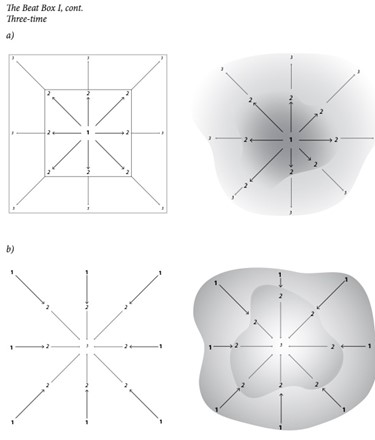
In standard college-level musicianship courses, key concepts and applications of Dalcroze methodology can help students adapt to various rhythmic challenges and develop a sense of “centeredness,” facilitating study of complex rhythmic formations. In rhythmic or melodic singing, utilizing certain movements to demonstrate beats in three-dimensional space can connect traditional singing exercises with rhythmic embodiment. To provide students with a variety of experiences in terms of musicality, placement of the beats may change through these beating patterns. For example, once students understand the downbeat as a place in the chest, if a teacher shows the downbeat as the outmost beat in the pattern, students will feel challenged but also experience improved musical adaptability. Figure 1 displays patterns included in Beatbox (2010), a textbook by Peter Susser that is used at Columbia University.
Figure 1: Embodied beat-following patterns from Beatbox by P. Susser.
Pedagogical applications of Gordon’s MLT also use the body as a reference point for internalizing musical concepts, especially rhythm. For instance, rhythmic solfeggiation in MLT emphasizes the idea of periodicity—our perception of recurring pulses—and roots it in physical experience. Practitioners often employ body tapping as a means of articulating beats and subdivisions, which helps students develop a kinesthetic sense of rhythmic structure that mirrors the bodily foundations of musical time.
Body-centered activities also play a crucial role in supporting audiation, the internal hearing and understanding of music. By engaging with musical forms through movement and improvisation, students can grasp structural elements in a more intuitive way. Once this internalization is achieved, notation can be introduced, not as the source of knowledge, but as a representation of what is already understood through the body and mind. In this sense, notation becomes a coding system for musical information that has already been experienced. This, in turn, allows the instructor to address the issue of notation separately.
Reducing instructional reliance on language can make musicianship courses more concentrated and engaging. As Bremmer et al. (2021) suggest, a bodily-based pedagogy may particularly benefit second-language learners, young children, and students with disabilities. Teaching strategies that rely on movement rather than linguistic explanations—such as proto-notation, scale degrees, using hand gestures to demonstrate contour, or announcing chord functions (e.g., using fingers to show Roman numerals)—can enhance student learning by providing visual and physical anchors for abstract concepts. Learning through movement can also progress much faster than learning based on verbal explanations.
Finally, including students’ principal instruments in theory and musicianship courses helps bridge their experiences in class with their everyday musical practice. When students connect theoretical content directly to their instrument-based practice, the learning process becomes embodied, contextual, and meaningful.
References
- 2011. “Music, Movement and Learning.” In MENC Handbook of Research in Music Learning, edited by Gary McPherson. Oxford University Press.
- 2021. “The Charmed Dyad: Multimodal Music Lessons for Pupils with Severe or Multiple Disabilities.” Research Studies in Music Education, 43 (2): 259–272. 10.1177/1321103x20974802.
- 2018. “The Role of Gesture in Supporting Mental Representations: The Case of Mental Abacus Arithmetic.” Cognitive Science 42 (2): 554–575. 10.1111/cogs.12527.
- 2016. The Expressive Moment: How Interaction (With Music) Shapes Human Empowerment. MIT Press.
- 2018. “What is Embodied Music Cognition?” In Springer Handbook of Systematic Musicology, edited by Rolf Bader. Springer.
- 2025. “Embodied Cognition.” In Stanford Encyclopedia of Philosophy (summer 2025 edition), edited by Edward N. Zalta and Uri Nodelman. Stanford University. https://plato.stanford.edu/archives/sum2025/entries/embodied-cognition/.
- “Beatbox.” Unpublished manuscript, 2010. Department of Music, Columbia University.


 Copyright © The College Music Society. All Rights Reserved.