
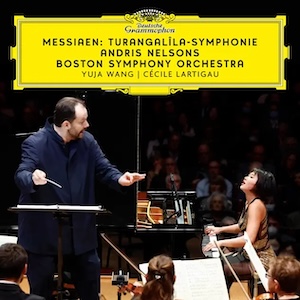
Boston Symphony Orchestra, conducted by Andris Nelsons, with Yuja Wang, Cécile Lartigau. Messiaen: Turangalîla-Symphonie. 2025. Deutsche Grammophon 48670444. CD and MP3 download, 10 tracks (01:15). deutschegrammophon.com. CD $16.50, MP3 $10
Olivier Messiaen’s Turangalîla-Symphonie is an overflowing, exuberant, almost orgiastic work, described by the composer as a “love song, a hymn to joy.” The name comes from the Sanskrit words turaṅga (तुरङ्ग), or “play”, and līlā (लीला), or “love.” Inspired by the mythical love story of Tristan and Isolde that has inspired composers for centuries, Messiaen’s symphony elides the boundaries of divine and orgiastic love, with joy that the composer described as “superhuman, overflowing, blinding, and unlimited.”
The piece originated from a commission by Serge Koussevitzky, who asked Messiaen to write a symphony for any instrumentation, of any length, to be premiered by the Boston Symphony Orchestra (BSO). Messiaen responded with this extravagant, otherworldly 80-minute work for orchestra and two soloists. The symphony was premiered in 1949 by Leonard Bernstein conducting the BSO; now, 76 years later, Deutsche Grammophon has released a new masterful account by Andris Nelsons conducting the BSO.
The piece is structured by three themes. First, we hear the “statue theme” that opens the first movement — oppressive, brutal, forte, and given suitable heft and drama by the brass. Next, we hear the “flower theme,” piano, introduced by two clarinets. Finally, after hearing bits and pieces of the “love theme,” we hear its entirety in the sixth movement.
As is to be expected from Deutsche Grammophon releases, the sound is crisp and clean. Nelsons approaches the first movement (“Introduction”) with a sense of grandeur and monumentality. The “statue theme,” presented first by trombones, and later by full brass, is stark and brutal, evoking the sense of dread that Messiaen intended when describing this section as evoking the “dread of ancient Mexican monuments.” Nelsons interprets the middle section of this movement masterfully, with an unrelenting sense of forward motion and drama. The coda, featuring the return of the “statue theme,” again highlights the full timbral range of the BSO brass section.
The symphony calls for two soloists — ondes martenot (an early electronic instrument, invented in 1928) and piano — and while pianist Yuja Wang excels in brilliant, fortissimo passages, with her granitic sound projecting easily over the orchestra, I often wished for more variety in her color palette. This was especially apparent in the first movement, where her playing sounded monochromatic.
Among the highlights of this recording is ondist Cécile Lartigau’s playing. In Messiaen’s orchestration, the ondes often doubles the first violins at pitch or at the octave, and the solo lines can easily come across as anemic or overly rigid. Lartigau avoids sentimentality, while imbuing the solo lines with the requisite tenderness or ecstasy. Messiaen often indicates that the instrument is to be played “on the ribbon,” indicating that the player should slide, or glissando, from note to note; the instrument comes equipped with both a keyboard and a ribbon, and the player can freely choose which playing method they wish to use. Lartigau chooses her glissandi tastefully, highlighting important moments in her melodic line by sliding into them. This is in contrast to many accounts of the symphony, where the ondist neglects this indication. Lartigau’s tenderness is particularly apparent in the second movement, which juxtaposes astral ondes solos alongside long pedal points in pp brass against rhythmically vibrant ff tutti playing.
Nelsons’s interpretation of the third movement is particularly successful: the movement is constantly imbued with a sense of urgency, and the percussion and woodwinds come to the fore. This is the first of a triad of so-called “Turangalîla movements” — movements which take their rhythmic inspiration from the 120 desitālas, or rhythmic patterns, that appear in the treatise Saṃgītaratnākara, written by the 13th-century Indian theorist Śārṅgadeva. Messiaen’s usage of the desitālas is unrelated to traditional Indian understandings of their functions; he uses a given tāla (ताल) solely according to the particular considerations of the musical sections in which it is employed. Nelsons successfully brings out the percussive, brusque aspects of this movement.
The fourth movement is taken at a brisk tempo, with the crisp piccolo and bassoon duo that opens the movement set in relief against solo piano and percussion. The fifth movement — among the most famous in the symphony — is subtitled “Joy of the Blood and Stars,” and while Nelsons conveyed the overall sentiment of the movement, I often wished for more excitement and drama. Moments sometimes came across as excessively ponderous or “matter of fact,” and the dance rhythms of the movement were often bogged down by excessively heavy brass.
The orchestra particularly shines in the sixth movement, subtitled “Garden of the Sleep of Love.” Here, we hear the first full presentation of the “love theme,” presented by strings doubled by ondes martenot. At this moment in the Tristan myth, Tristan and Isolde are asleep in the garden. As in the second movement, Lartigau is exquisitely tender, and Nelsons manages to simultaneously imply a surreal, dreamlike soundscape in which motion ceases and time stops, while always retaining a gripping, subtle intensity. Messiaen’s masterful orchestration shines in this movement, and the full color palette of the BSO is highlighted. My only criticism lies with Wang: she sometimes takes excessive time at the ends of phrases, or pops out of the texture a bit too much with overly-percussive punctuation, blending insufficiently with the orchestra.
Wang’s approach, however, pays dividends in the seventh movement (the second of the three so-called “Turangalîla movements”), a fully atonal, rhythmic movement inspired by the aforementioned talas of classical Indian music. Here, her percussive approach blends perfectly with the woodwinds and percussion. The movement is unrelenting and brutal, a suitable counterpoint after the tenderness of the sixth movement.
I found the highlight of this recording to the eighth movement, subtitled “The Development of Love.” In the Tristan myth, this is the moment where Tristan and Isolde are trapped in an ever-growing infinite love after consuming a love potion that binds them for eternity. This movement is both glorious and terrifying — it is among the most ecstatic movements of the symphony, with towering, tutti climaxes derived from the musical material of the love theme. Messiaen describes this movement as “Tristan and Yseult transcending Tristan and Yseult.”
Musically, the eighth movement combines all of the themes in the symphony for the first time. First, after an introduction punctuated by tubular bells, we hear the “statue theme” in the brass — stark, hefty, granitic. Next, we hear the flower theme, played by clarinets and ondes. Unusually, this recording allows us to hear the tremolo of the ondes martenot that colors the clarinets’ pp dyads, giving these moments an otherworldly feeling — a detail often omitted from recordings of this work. Similarly, the various two-note motives in the baritone register of the ondes, which are seldom heard in recordings, also pop to the fore in this account of the movement — a credit to the audio engineers.
In the chorale-like, homorhythmic moments of this movement, the brass is round and reverberant, even at a piano dynamic. Nelsons achieves an extraordinary warmth in all three of the movement’s shattering climaxes, with the ondes martenot soaring over the ensemble, supported by a richly warm brass, luscious strings, and punctuated by the gamelan-like texture of piano, percussion, and winds. Rhetorically, Nelsons’s choice of tempi and sense of pacing is particularly effective in this movement. Nonetheless, after the third and final climax, I found that Nelsons could have afforded a greater sense of forward motion: the interpretation gets slightly bogged down toward the end of the movement, becoming rhetorically muddled.
The ninth movement is the third and final one of the “Turangalîla movements,” based on the classical Indian rhythms mentioned earlier. Like the seventh movement, it is unrelenting, percussive, and narratively effective. The tenth and final movement, described by Messiaen as depicting “glory and joy without end,” is among Nelsons’s most convincing accounts in the symphony. He takes an extremely brisk and unrelenting pace, and his sense of drive, drama, and sweep is unmistakable. Nelsons’s instincts here are commendable; so often, this movement loses its power in excessively sluggish and heavy accounts. The final three minutes of the movement are genuinely ecstatic, with the entire orchestra soaring in a homorhythmic, celestial, tutti fff chorale, the timbres of the orchestra exquisitely blended. The final chord of the symphony is given its due time, marked by Messiaen to be sustained “very long.”
Overall, I found Nelsons’s account to be successful. Nelsons generally tends toward transparent textures and toward “soloing out” certain sections of the orchestra, unmistakably delineating foreground from background. His instincts are generally on point, lending cohesion and unity to this massive work. Moreover, his sense of drama and sweep, combined with the virtuosic and impassioned playing of the BSO, conveys the ecstasy, glory, and sheer ambition of a monumental work that overflows with joy and love. Wang is generally successful, albeit monochromatic, but I found a real highlight of this account in Lartigau, who imbued the ondes part with a musicality so often lacking from many recordings of this work. The ondes martenot was described by the composer as being akin to the soaring voice of an angel, and whether at ppp or fff, Lartigau seamlessly integrates the ondes with the orchestra, providing an otherworldly, seraphic, angelic voice from a world beyond.
 Copyright © The College Music Society. All Rights Reserved.