
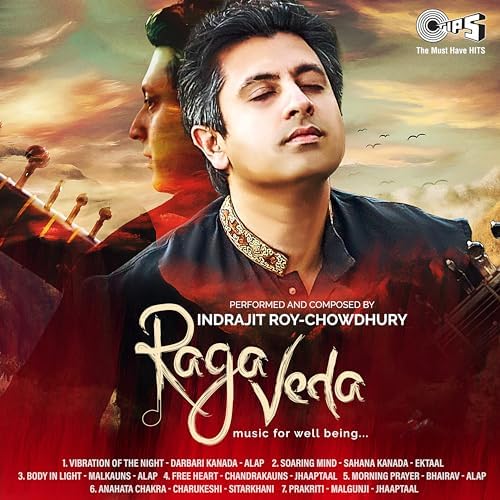
Indrajit Roy-Chowdhury. Raga Veda (Hindustani Classical). 2022, reissued 2024. TIPS India. Streaming audio, 7 tracks (1:07:52). tips.in.
Indrajit Roy-Chowdhury, a prominent New York-based exponent of the esteemed Rampur Senia Gharana, delivers a masterful exploration of Hindustani classical music with Raga Veda. Known for his unique execution of the Beenkar style of sitar playing — an approach deeply rooted in the traditions of the Rudra Veena — Roy-Chowdhury seamlessly combines this aang (style) with a sweet and unique gayaki (vocal-like phrasing). This album offers a compelling journey through both well-established and lesser known ragas, showcasing his nuanced artistry and ability to craft a dynamic set of contrasting moods.
Chowdhury employs a thoughtful sequencing strategy for the structure of the album, pairing a heavier, more solemn raga for the alap (slow introduction) with a lighter, more energetic raga for the gat (section with tabla). This approach is exemplified in the album’s opening raga, “Darbari Kanada.” Here, Roy-Chowdhury’s slow and deliberate exploration of the raga creates a regal and introspective atmosphere. His handling of the jor-jhalla section (the section with a pulse and a fast, hypnotic ending), characterized by subtle meend taans (gliding notes), leads seamlessly into a mesmerizing and climactic conclusion.
The transition to “Sahana Kanada” offers a vivid contrast. Roy-Chowdhury’s lyrical gayaki ang (vocal-like phrasing) shines in the gat, set to a fast ektaal (twelve-beat cycle). This pairing of “Darbari Kanada” and “Sahana Kanada” exemplifies the album’s overarching formula, balancing gravitas with spirited vitality. Roy-Chowdhury’s restrained use of embellishments in “Darbari Kanada” makes the effervescence of “Sahana Kanada” even more striking, demonstrating his ability to evoke a wide spectrum of emotions within a cohesive framework.
A similar structure is applied to the other raga pairings on the album. The combination of “Malkauns” and “Chandrakauns” continues the journey with deep introspection and understated brilliance. Roy-Chowdhury’s treatment of “Malkauns” highlights his impeccable control over slow and deliberate phrasing, while “Chandrakauns” injects a touch of brightness and energy. The next pairing, “Bhairav” and “Charukeshi,” reveals a different dimension of his artistry, blending solemnity and pathos. Throughout these performances, Roy-Chowdhury’s delicate touch and judicious use of taankari (rapid, intricate passages) showcase both technical mastery and profound musicality. The album concludes with a lighter piece, “Malgunji,” which is quite refreshing after the intensity of the preceding ragas. This choice underscores Roy-Chowdhury’s thoughtful curation, giving listeners a graceful conclusion to the immersive experience. The interplay between complex rhythmic cycles and emotive melodic exploration ensures that each piece stands out while contributing to the album’s cohesive narrative.
Indrajit Roy-Chowdhury’s Raga Veda is a testament to his artistry. Through this album, Roy-Chowdhury not only pays homage to his illustrious lineage but also establishes himself as a unique and forward-thinking voice in the music.


 Copyright © The College Music Society. All Rights Reserved.