
Volume 65, No. 1
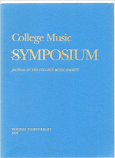
Articles: Scholarship and Research
- Retention and Recruitment of Students of Underrepresented Populations in Music Teacher Education (Part II)
- Professional Quality of Life among Music Faculty in Higher Education
- Musculoskeletal Pain/Discomfort in Collegiate Conductors: Incidence of Injury and Use of Personal and Instructional Prevention Strategies
- Philippe Entremont at 90: A Consideration of His Pedagogy and Artistic Legacy
Forums
- Reevaluating the Paradigm of Music Entrepreneurship in Conservatory-Style Institutions
- Let's Ditch the Expression
- Who Is Teaching What? A Snapshot of Music in General Studies
- Active Learning in the Music School: Seizing the Zeitgeist
- From National Election to National Conference
Performances, Lectures, Lecture-Recitals, Training
- T’filah (The Prayer) by Lera Auerbach. Andrew J. Allen, alto saxophone. September 9, 2024
- Review: T’filah (The Prayer) by Lera Auerbach. Andrew J. Allen, alto saxophone. September 9, 2024
- Concerto for Bassoon and Orchestra (1984) by Sir Andrzej Panufnik. Kennesaw State University Symphony Orchestra, Jeffrey Lyman, bassoon and Nathaniel F. Parker, conductor. September 13, 2023
- Review: Concerto for Bassoon and Orchestra (1984) by Sir Andrzej Panufnik. Kennesaw State University Symphony Orchestra, Jeffrey Lyman, bassoon and Nathaniel F. Parker, conductor. March 7, 2024
Technology and Online Resource Reviews
Book Reviews
- At the Vanguard of Vinyl: A Cultural History of the Long-Playing Record in Jazz. Darren Mueller. Durham: Duke University Press, 2024
- Art Music Activism: Aesthetic and Politics in 1930s New York City. Maria Cristina Fava. Chicago: University of Illinois Press, 2024
- Sounding Latin Music, Hearing the Americas. Jairo Moreno. Chicago: University of Chicago Press, 2023


The College Music Society is dedicated to the advancement of music teaching, learning, scholarship, performance, and creative activity. Rooted in higher education, CMS serves as an inclusive forum for dialogue and collaboration among music professionals across all disciplines and career paths. We support faculty, students, independent scholars, and industry partners by fostering innovation, promoting diversity, and encouraging the exchange of ideas to shape the future of music in society. Through advocacy, professional development, and community engagement, CMS empowers its members to lead and inspire in academic, artistic, and entrepreneurial contexts.
312 East Pine Street | Missoula MT 59802 | USA
Ph: 406.721.9616 | Email: [email protected] | Web:www.music.org
 Copyright © The College Music Society. All Rights Reserved.