
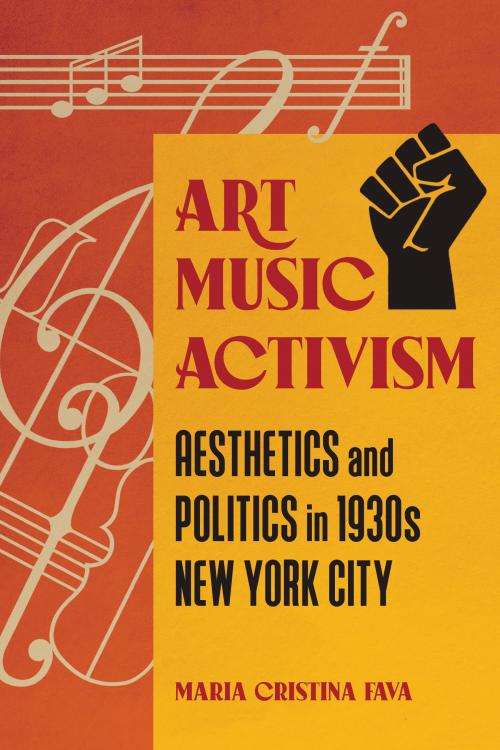
Art Music Activism: Aesthetics and Politics in 1930s New York City. Maria Cristina Fava. Chicago: University of Illinois Press, 2024. 232 pp. 4 b&w photographs and 17 musical examples. ISBN: 9780252056574. $19.95. (Ebook)
In Art Music Activism: Aesthetics and Politics in 1930s New York City, musicologist Maria Cristina Fava presents a thorough historiography of the activities of composers and those involved with theater movements in New York City in the 1930s. Drawing on documentary and archival evidence, Fava highlights the struggles composers faced in aiding a working-class public that was suffering the socio-economic turmoil of the Great Depression and their attempts at communicating left-leaning political ideas and providing a repertoire of music that could serve as praxis for social progress. Fava demonstrates the struggles faced by classically trained composers as they attempted to find appropriate idioms through which to communicate their political ideas, and she shows that although artistic and functional goals often clashed, when a balance could be struck between “experimentation and populist intent,” composers “were able to move audiences toward social change” (2).
Recalling famous works from literature and the fine arts during the Great Depression, such as John Steinbeck’s novel The Grapes of Wrath (1939), Thomas Hart Benton’s mural A Social History of the State of Missouri (1936), or Dorothea Lange’s photograph Migrant Mother (1936), Fava poignantly brings to the reader’s attention that there is not an American art music work that often comes to mind as an analogous, quintessential representation encapsulating the stylistic, aesthetic, and socio-cultural goals of composers of the period. Fava argues that this is due to the fact that members of the Composers’ Collective often fell short of their goal of forging a true proletarian music because young modernist composers saw doing so as a “social necessity” rather than a “genuine belief” (40).
Fava offers assiduous accounts of the efforts of the Composers’ Collective of New York and the American Workers’ Theater Movement and of their complex relationships with private theaters as well as the government-funded New Deal project, Federal Project One of the Works Progress Administration. She traces developments in compositional style in the music of such composers as Henry Cowell, Jacob Schaeffer, Leon Charles, Marc Blitzstein, Janet Barnes, and Charles and Ruth Crawford Seeger and examines these composers’ individual approaches to balancing social relevance with artistic integrity. Detailing an early foray into proletarian music of the period, Fava examines the Worker’s Songbooks and argues that they were ultimately a failure because the modernist compositional approaches they embraced were unfamiliar to trade and factory workers of the day. She analyzes Charles Seeger’s “Onward to Battle,” for example, and highlights that the piece contains awkward meter changes and tonal ambiguity and ends on a dominant (30). She also highlights how the use of Sprechstimme and “anti-lyricism” was jarring for members of the working class and ultimately renders Ruth Crawford Seeger’s “Chinaman, Laundryman” essentially ineffective as a social tool (37).
Additionally, Fava explores the Workers’ Theater Movement and the similar challenges its artists faced in balancing populism and musical experimentation. Building on research by Ilka Saal (2007), Fava explores how the Theater Guild, and The Workers’ Laboratory Theater’s use both “vernacular strategies to maximize political engagement” and agitation and propaganda (“agit-prop”) strategies employed by Russian and German composers (53). Fava highlights failures in these attempts, such as Paul Peters and George Sklar’s musical revue Parade (1935), which was perceived as too overtly political, even gruesome. She also highlights relative successes of the Workers’ Theater Movement, such as Harold Rome’s Pins and Needles (1937), which succeeded in appealing to a working-class audience and which she characterizes as “the perfect realization of this balance between music and content” (53).
Fava then positions Marc Blitzstein’s The Cradle Will Rock as fulfilling the role of “epitomizing the trials, errors, and successes” of composers and cultural institutions of 1930s New York (143). Highlighting the work’s critical reception, Fava draws on Barthe’s theorization of mythology to demonstrate that, although the early public reception of the piece was positive, the meaning of the piece has been mythologized. The work’s “non-staging”, a consequence of the company’s lack of preparation when it was forced at the last minute to find a new venue for the premiere, was lauded as a triumph that “froze the meaning of the original form and created a myth of Cradle as the quintessential expression of the non-realistic theater” (144), rather than positioning it as a culminating triumph in balancing artistic experimentation with accessible, vernacular idioms and conveying a salient political message that brings an “American element to the various streams of German/Soviet agit-prop theatrical practice” (145).
In examining handwritten scores, letters, journals, periodicals and newspapers, Fava provides a thorough account of the composers, advocates, patrons, critics, and audiences involved with these productive organizations of composers while offering insightful commentary on performances and reviews and deducing meaning from offstage interactions and correspondence. The existing discourse surrounding music and politics of the 1930s is extensive, but often focuses on folk music, on experimental music made on the West Coast, or on a single facet of the intersection of art music and politics in New York. Fava presents a holistic account that “considers how the same composers were rather freely moving from musical to theatrical, from federally sponsored to private, or from politically to artistically motivated endeavors” (10).
This book will be useful for researchers or those interested in Western art music as well as in sociology, cultural anthropology, and Depression-era politics. In collaborating toward creating a proletariat American music that was both socially conscious and musically creative, members of the Composers’ Collective of New York and the American Workers’ Theater Movement encountered resistance from outside their organizations as well as within, particularly in attempts to define the most effective means of combining artistic integrity with pragmatic social messages. Often this divide was too difficult to bridge, but the efforts were not fruitless, as works like The Cradle Will Rock illustrate by blending modernist elements with populist ones. Maria Cristina Fava’s erudite efforts at illuminating a musically, socially, and politically complex place and time represent a detailed and valuable addition to the discourse on the subject of activism and art music in 1930s New York.
References
Saal, Ilka. 2007. New Deal Theater: The Vernacular Tradition in American Political Theater. New York: Palgrave Macmillan.


 Copyright © The College Music Society. All Rights Reserved.