
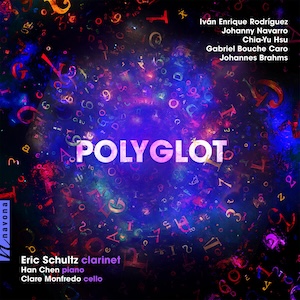
Eric Schultz, with Han Chen and Clare Monfredo. Polyglot. 2024. Navona Records NV6655. MP3 download, 11 tracks (1:07:00). navonarecords.com.
Polyglot juxtaposes vivid contemporary works with Brahms’s well-loved Clarinet Trio to traverse cultural and stylistic identities. With clarinetist Eric Schultz, pianist Han Chen, and cellist Clare Monfredo, the album explores how music portrays ritual, language, dance, and place, becoming a language that communicates facets of human life.
The album opens with Iván Enrique Rodríguez’s Sonata Santera, whose three movements depict Caribbean Santería rituals. The clarinet takes on a wandering, improvisatory quality in the first movement, “Despojo,” while the piano borrows from jazz harmonies, offering a pad both grounded and otherworldly. Chen and Schultz weave in and out nimbly — at times light and conversational, at other times expansive. “Despojo" feels constantly in motion, ending with an air of gravity that contrasts with the dreamlike opening chords. The second movement, “Ofrenda,” expresses nostalgia and unhurried peacefulness. Schultz phrases with ease and fluidity. Chen performs with masterful voicing, drawing the ear towards the most intimate, heart-wrenching sonorities amid contrasting textures. Halfway through, a fluttering clarinet melody evokes flitting spirits. A repeated piano drone grounds the movement and contributes to the sense of nostalgia — perhaps a guiding light for spirits returning home. Unlike the earlier movements, “Bembe” jumps into a driving rhythm and passes percussive sounds between instruments. Chen and Schultz balance rhythmic drive with lyrical episodes that offer room to breathe.
Críptico no. 9: DAVЯTHAN is one of a set of works by Rodríguez that convert text into music, leaving room for interpretation. It features speech-like interjections, which Schultz thoughtfully poses like questions or exclamations, followed by longer statements that meander, linger, and question.
While Críptico translates language to music, Johanny Navarro’s lush Danzón offers an invitation to dance. Chen and Schultz effortlessly exchange flowing melodies. As the piece progresses, Schultz’s performance grows nostalgic, gritty, and passionate, especially near the end, when the clarinet stands briefly alone, like a lonesome voice echoing across cobblestones at night.
The musical imagery continues in Chia-Yu Hsu’s Summer Night in a Deep Valley, a vivid example of how music can craft a sense of place, even through a solo instrument. The clarinet depicts myriad nighttime sounds: repeated tones like echoes, airy rustlings of wind, patterns mimicking birds or a lone flute. Hsu’s piece is a sonic canvas, and Schultz explores the clarinet’s pitch range and extended techniques.
Best experienced with headphones, Gabriel Bouche Caro’s Escenas dares to explore the quietest sounds on both cello and clarinet. At times, delicate tendrils of sound extend from each amid mere textures. Small sound bytes float forward — a moment of increased vibrato here, a breath there. Like Hsu’s piece, Escenas immerses the listener in an abstract landscape through noise.
Thinking about music as speech, dance, and place primes the listener with a rich palette to hear Brahms’s 1891 Clarinet Trio in A minor, op. 114, with fresh ears. In the stormy first movement, waves are palpable in the phrases’ rises and falls. The group takes a gentle approach to the second movement, singing the melodies with a gentle lilt like humming, though not without moments of passion. They do not hold back in the final movements, embracing moments of dance and conversation that hearken back to earlier tracks. Brahms’s chamber music challenges performers to find a sense of lightness and forward motion despite dense piano writing and layered melodies. Yet the trio deftly embraces Brahms’s dichotomy, finding ease in their lines that feel buoyed even through the densest moments.


 Copyright © The College Music Society. All Rights Reserved.