
Volume 62, No. 2
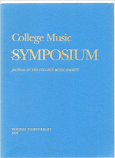
Lisa Urkevich, General Editor
Articles: Scholarship and Research
- Learning to Learn: a Metacognitive Approach to Class Piano Instruction
- Interviews with Music Alumni to Inform Curriculum and Practice: A Case Study
- “Experience is an Identity”: The Collegiate Marching Band and Expressions of Communal Identity
Performances, Lectures, Lecture-Recitals, Training
- Three Songs on the Poetry of Mihai Eminescu by Valentin Mihai Bogdan. Janet Hopkins, mezzo-soprano and Armen Shaomian, piano. Recorded live at the University of South Carolina School of Music Recital Hall on January 23, 2022
- Review: Three Songs on the Poetry of Mihai Eminescu by Valentin Mihai Bogdan. Janet Hopkins, mezzo-soprano and Armen Shaomian, piano. Recorded live at the University of South Carolina School of Music Recital Hall on January 23, 2022
- I’m Glad I’m Not a Tenor Recital. Troy Castle, baritone voice and Pei-I Wang, piano. Twelve pieces by various composers. September 26, 2021. Recital. Kaeuper Hall, Millikin University, Decatur, IL.
- Review: I’m Glad I’m Not a Tenor Recital. Troy Castle, baritone voice and Pei-I Wang, piano. Twelve pieces by various composers. September 26, 2021. Recital. Kaeuper Hall, Millikin University, Decatur, IL.
Technology and Online Resource Reviews
Book Reviews
- Audio-Vision: Sound on Screen, by Michel Chion
- Good Music: What It Is & Who Gets to Decide, by John J. Sheinbaum
- The Cambridge Companion to Women in Music Since 1900, edited by Laura Hamer
- The Female Voice in the Twentieth Century: Material, Symbolic and Aesthetic Dimensions, edited by Serena Facci and Michela Garda
Forums
- “What If? and “Why Not?”: A Reintroduction to CMS Forum
- Prelude: Music Entrepreneurship in Perspective and Remembrances of CMS’s 2010 Summit
- Achieving Faculty Buy-In for Visionary Change in Music Higher Education
- Creating Content for the 21st Century Music Student: Digital Textbook Development in the Foundational Course and Beyond
- The Music-Driven Syllabus: Using Music Notation and Content to Engage Students with the Syllabus
- The Creativity of One: A Core-Course Model for Music Theory
Audio Reviews


The College Music Society is dedicated to the advancement of music teaching, learning, scholarship, performance, and creative activity. Rooted in higher education, CMS serves as an inclusive forum for dialogue and collaboration among music professionals across all disciplines and career paths. We support faculty, students, independent scholars, and industry partners by fostering innovation, promoting diversity, and encouraging the exchange of ideas to shape the future of music in society. Through advocacy, professional development, and community engagement, CMS empowers its members to lead and inspire in academic, artistic, and entrepreneurial contexts.
312 East Pine Street | Missoula MT 59802 | USA
Ph: 406.721.9616 | Email: [email protected] | Web:www.music.org
 Copyright © The College Music Society. All Rights Reserved.