
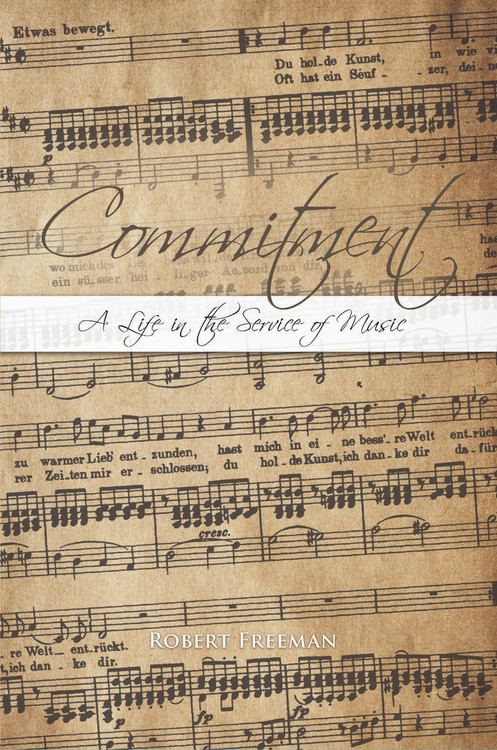
 Commitment: A Life in the Service of Music. Robert Freeman. Edited by Jürgen Thym. Pittsburgh: Dorrance, 2023. 247 pp. $66. 95 color images and figures; 39 b&w images and figures. ISBN: 9798886832563.
Polymath performer, scholar, educator, and administrator Robert Schofield Freeman (1935-2022) is best known for his twenty-four-year tenure as the fourth director of the Eastman School of Music. Freeman also served as Dean of the College of Fine Arts at The University of Texas at Austin and briefly as President of New England Conservatory. His valedictory memoir, Commitment: A Life in the Service of Music is a personal account of his long and consequential life’s journey, written at the instigation of its collaborative editor, Jürgen Thym. (Thym describes his substantial role in the genesis of the book as “an act of midwifery” (xiv).) The narrative, which also includes short testimonials by Lorenzo Candelaria, James Winn, and Wendell Brase, provides a kaleidoscopic overview, not only of his personal relationships and wide-ranging career, but also of the thoughts on music education and the future of classical music that guided his professional life.
Freeman was born into a musical family. His parents were both Eastman graduates—his mother a violinist, and his father a double bass player who performed as principal with the Boston Symphony Orchestra under Serge Koussevitzky. Growing up in suburban Boston, Freeman attended Milton Academy while concurrently studying piano, oboe, chamber music, solfège, and music theory at the Longy School of Music in Cambridge. In 1949 and 1950, he attended Greenwood music camp in the bucolic hills of Cummington, Massachusetts, forming a lasting friendship with Gilbert Kalish, the subject of his late monograph, Gilbert Kalish: American Pianist (Pendragon Press, 2022). Freeman graduated summa cum laude from Harvard in 1957, simultaneously receiving a diploma in piano performance from Longy. He earned his MFA and PhD in musicology at Princeton and spent two years as a Fulbright scholar in Vienna researching and writing his dissertation.
Though his memoir is entitled Commitment, by his own telling Freeman seems not to have found his true calling in either performance or scholarship. A gifted oboist, he was accepted at age fourteen into the Curtis Institute class of Marcel Tabuteau, but was discouraged from attending by a comment from Leonard Bernstein, and by Tabuteau himself (“Why do you want to spend the whole of your life making oboe reeds?” (23-24)). He nevertheless persisted as an oboist, studying with Boston Symphony principal Fernand Gillet and later advancing to the finals of the Munich International Oboe Competition, where he lost to Heinz Holliger.
Freeman was equally gifted as a pianist, performing regularly in recital and as a concerto soloist. In the summer of 1955, he served as assistant to Artur Balsam at Kneisel Hall in Maine, and the following summer studied with Rudolf Serkin at the Marlboro Music Festival in Vermont. Like Tabuteau, Serkin offered to accept him for study at Curtis. Nevertheless, his experience at Marlboro, “practicing twelve hours a day,” convinced him that he “did not really want to be a pianist, for… I did not believe that the results I was attaining truly compensated me for the costs of neglecting other pursuits” (32).
Freeman’s career as a musicologist proved equally problematic. Accepted by Nadia Boulanger for her three-year composition course, he was ultimately dismissed as “not a serious musician but a tourist” after he explained to her that he couldn’t break the terms of a traveling fellowship he had received from Harvard (35). In Vienna on a Fulbright scholarship, he chose to write his doctoral dissertation on the operatic works of Francesco Bartolomeo Conti, but upon discovering that another doctoral candidate had already staked out that territory, he changed his topic to Antonio Caldara’s role as an opera composer in Vienna. The subject bored him.
An accomplished musical generalist, Freeman was teaching at MIT in 1972 when the directorship of the Eastman School came open. “The thought occurred to me… that it would be hard for the Eastman School, my parents’ alma mater, to find a person better qualified for the position than I was,” he wrote (51). “Certainly, there were many better pianists and conductors in the world. And I had never taken the oboe that seriously. I could think of at least a dozen young music scholars in my generation whose work I read with more interest than my own. But it was difficult for me to think of anyone who could do all of those things with the facility that I was able to do them” (51).
At Eastman, Freeman seems to have found his vocation. His vision for the school was one of collaboration, emphasizing the need for faculty to work together as a team, rather than competing for student loyalty or the primacy of their individual subjects. His educational philosophy extended beyond the traditional boundaries of music instruction, advocating for a holistic approach that fosters appreciation for music's role in society. A staunch advocate for Eastman’s urban campus, he resisted efforts to relocate the school to the University of Rochester’s River Campus. His early accomplishments as Director included the renovation and repurposing of existing facilities, and—recognizing the importance of providing comprehensive research facilities to support scholarship—the construction of the new Sibley Music Library. His commitment to the school’s location was coupled with the belief that it should remain integrated with the city’s cultural and civic life. His concerns extended to the impact of suburban malls and the decline of downtown retail on the city’s tax base. The development of the new Student Living Center and the transformation of Gibbs Street into a more pedestrian-friendly area were visible results of his efforts to enhance the campus’s livability and contribute to the revitalization of the surrounding cityscape.
After leaving Eastman, Freeman had a short, disastrous, tenure as President of New England Conservatory—a story that he tells with some bitterness. He ended his career happily in Texas as professor and Dean of Fine Arts at UT Austin.
Reflective, informative, candid, and graciously conversational in tone, Commitment is also at times advocatory, polemical, and pointedly defensive. Though its title is never explained, it gradually becomes clear that Robert Freeman found his life’s vocation, not within narrow, traditional boundaries, but more broadly “in the service of music.” His thoughts will be read with interest by anyone concerned with the health of music, music education and musical institutions in America.


 Copyright © The College Music Society. All Rights Reserved.