
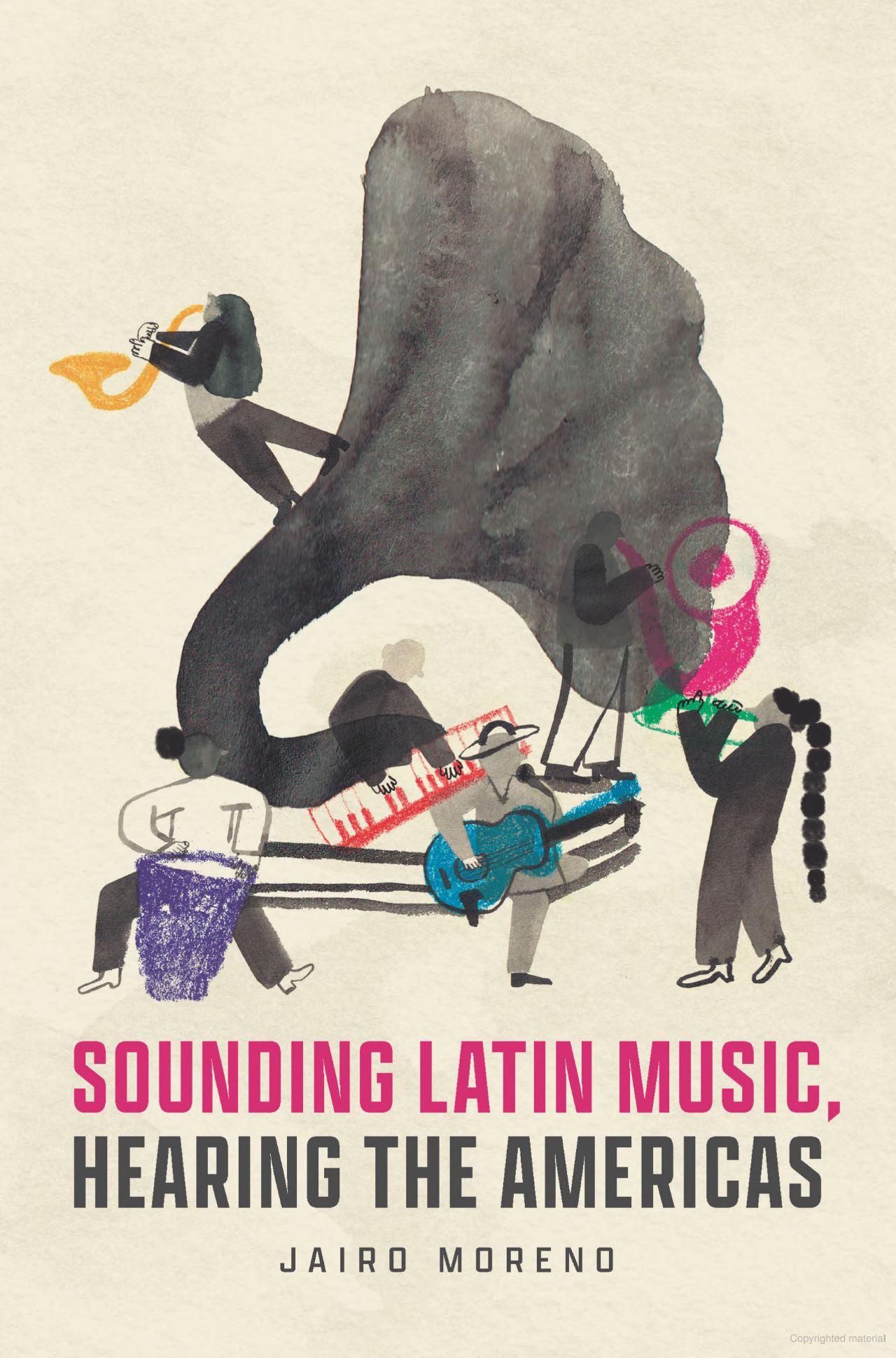
Sounding Latin Music, Hearing the Americas. Jairo Moreno. Chicago: University of Chicago Press, 2023. 364 pp. 10 figures, 16 line drawings, and 2 tables. ISBN: 9780226825687. $35.00. (Paperback)
Sounding Latin Music, Hearing the Americas explores the music-making of Latin American musicians in the United States and its cultural, historical, and political impact. The book examines the concept of “migrant creativity” in music and its role in establishing and shaping identities in the host community while maintaining connections with the homeland. It investigates the interplay between tradition and modernity, with the paradox of unifying and dividing cultures through different perceptions of society, and it examines the role of historical, economic, and sociopolitical values and experiences in Latin music in the Americas.
The author features Latin musicians from various genres, analyzing and tracing the musical shift that occurred over thirty-five years—from the late 1970s to the early decades of the twenty-first century. Moreno discusses how Latin music is perceived and yet not fully comprehended, highlighting divergent understandings and interpretations of its social and political roles. The breadth of sources on which Moreno draws—including newspapers, interviews, and archival and other sound recordings—results in a comprehensive and well-supported analysis.
Although Moreno’s degrees are in music theory, he employs a robust and multidisciplinary approach, combining ethnomusicology, historical analysis, cultural critique, critical theory, and musicological perspectives. The book is intended for scholars, students, and ethnomusicologists, as well as enthusiasts of Latin American studies, cultural studies, musicology, and sociology. It is particularly useful for those interested in understanding the cultural and political implications of Latin American music in the United and the Americas, including the globalization of the music industry. Moreno’s theoretical language can be dense and challenging for some readers. This could have been avoided by simplifying some of the philosophical discussions and adding visual and aural elements, such as pictures, longer and more numerous musical examples, illustrations, and audio samples; these would have made the book more accessible and engaging to a wider readership.
In discussing "Migrant creativity," a central theme of the book, Moreno addresses the impact of music on cultural and political identities, the tension between tradition and modernity, the negotiation of identity in a globalized world, and the role of music as a medium of resistance and innovation. According to Moreno, Migrant creativity “alludes to the fugitive nature of acting creatively, to its capacity to disrupt boundaries and usher in the new by taking a temporary place in an improper space and time” (2). Chapters One and Three highlight these themes when addressing narrative strategies in the work of Panamanian artist Rubén Blades and in Shakira's cosmopolitan music. These themes expose the modernity of the book and demonstrate the author’s knowledge of current trends and musicians.
Moreno also uses “syncopation” in Latin American music as a powerful metaphor for understanding the fragmented and uneven nature of modernity in the Americas. This metaphorical comparison he draws between rhythms and cultures out of sync highlights the temporal displacements and disruptions that characterize modernity and how different regions and communities experience varied cultural paces and customs. “Syncopation” captures the tensions resulting from these experiences, as well as the migratory movements and mobility of Latin American musicians who create hybrid forms of music and artistic expressions that challenge dominant cultural narratives. It also points to political and economic inequalities faced by marginalized musicians left behind in the march toward modernity and underscores the aesthetic and musical innovations arising from these tensions that lead to new forms of musical expression.
Moreno’s book provides a lucid understanding and a close look at how these musicians navigated their cultural identities and political experiences in the United States, exploring a more specific approach than Timothy D. Taylor's Music and Capitalism (2015). Both explore music’s intersections with cultural, sociopolitical, and economic structures, but the two differ in focus and methodology. While Taylor's book takes a broader approach, examining the relationship between music and capitalism across various genres and global contexts, Moreno's book examines Latin American music and its cultural, political, and social contexts, focusing on how Latin American musicians navigate and challenge boundaries in the Americas. Taylor uses a critical theory model, focusing on historical and sociological analysis as commercial music, while Moreno employs an ethnomusicological and multidisciplinary approach. Taylor examines the commercialization of music, the music industry, and the relationship between music and economy, while Moreno focuses on “migrant creativity” and “syncopation,” the impact of music on cultural and political identities, and the tension between tradition and modernity. Taylor's book is suitable for readers interested in the intersections of music and economics, tracing economic forces that forge music-making, as well as the global music industry, while Moreno's book is ideal for those interested in ethnomusicology, Latin American studies, Latinx, and cultural and political implications.
In conclusion, Moreno provides a focused analysis of Latin American music and its cultural and political contexts. Indubitably, Moreno’s book brings to light several key issues and aspects of migration and its impact on the cultural, sociopolitical, and economic environments of such populations. The bibliography alone is a substantial contribution, offering a wide range of resources for future reference. Searching for equity and globalization, many Latin musicians are looking to bring their identities and experiences from their homeland to the “new country,” in this case the United States. Speaking from my personal experience, it is almost impossible to maintain certain aspects of the homeland culture abroad. The music and performances become intersections of the old and new, representing for the artist amalgamations of what they saw with what they see, what they experienced with what they now live, and what they want to express with what they want others to understand. These amalgamations truly represent new cultural and artistic expressions, which influence the host community embracing this metamorphosis. Moreno’s Sounding Latin Music is a much-needed book whose approaches and insights can be transferred and applied to other cultures, such as Arabic, Asian, and African communities, especially as our world increasingly becomes a melting pot of nations.
References
Taylor, Timothy Dean. 2015. Music and Capitalism: A History of the Present. Chicago: University of Chicago Press.


 Copyright © The College Music Society. All Rights Reserved.