
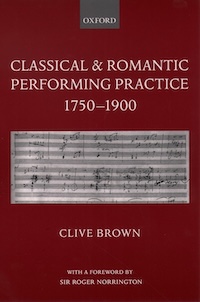
Classical and Romantic Performing Practice, 2nd edition. Clive Brown. New York: Oxford University Press, 2023. 1080 pp. 629 images ISBN: 9780197581629. $74. (Paperback)
This volume is a revised and expanded edition of the 1999 publication Classical and Romantic Performing Practice 1750–1900 and draws on up-to-date research on Classical and Romantic performance practice and practical experimentation through performance. This new edition is a valuable resource for performers, educators and scholars interested in deepening their understanding and application of performance practice of Classical and Romantic music.
As a former member of the Faculty of Music at Oxford University, Professor Emeritus of Applied Musicology at University of Leeds and an active concert violinist, Brown displays his expertise fully in this volume. The plethora of information found in this text is framed thoughtfully within historical and musical contexts, providing a detailed examination of how composers’ intentions and musical notation, as well as performers’ interpretations can inform the ways we approach this music today. The author does not claim comprehensiveness, nor does he provide a set of rules to follow when interpreting Classical and Romantic music, but rather he offers a wonderfully in-depth compilation of information from a large variety of historical sources to help the performer, educator, and/or scholar approach the music in an informed and inspired way, ideally with clearer understanding and more faithful execution of the composer’s original conception.
Brown examines music from the middle of the eighteenth to the start of the twentieth centuries, focusing primarily on the relationship between the composer’s notation and the interpretation and understanding of that notation. Brown outlines three primary objectives for the book: “to focus on key issues that help us to understand the intentions, expectation, or tacit assumptions of late-eighteenth- and nineteenth-century composers, to investigate the extent to which these intentions, expectations and assumptions may be implied or specified by their notation, and… to identify…changing conventions of performance that informed the experience and practice of composers and executants alike” (1).
Brown addresses the impact of factors such as social and political climate, geography/nationality and musical trends on musical notation and interpretation throughout this time, examining the challenges created by constant change and lack of consensus in notational practice and interpretation. He emphasizes that notation was also highly affected by the unique characteristics of the individual composer: whether they were careful, consistent, and diligent in their notation or reliant on the performer’s innate understanding of their musical intention.
Brown deals with a specific musical element (e.g. articulation, tempo, ornamentation) in each chapter. He often addresses these topics through the lens of both theory and practice, giving the reader an opportunity to understand the concepts and increase efficacy of application. He draws from a large variety of sources, including documentary evidence (e.g., treatises, audio recordings, critical reviews of performances, letters, score facsimiles), as well as on study of surviving mechanical instruments and experimentation through his own performance and work with his doctoral students. Throughout the text, Brown provides many comparative musical examples to aid the reader in understanding the material and to foster effective application in performance, instruction, and research. He also provides extensive bibliography for further research and inquiry and offers a companion website (www.oup.com/us/ClassicalandRomanticPerformingPractice), which provides the full original source quotations for translated passages.
This text requires considerable musical knowledge, including familiarity with terminology and concepts from Classical and Romantic music performance practice. It could serve as a valuable reference to upper-level/graduate performance students and professional performers. Additionally, scholars and educators may find its offerings highly beneficial for research or in the classroom, studio, or rehearsal space. Due to the immense amount of information provided, this volume is dense and sometimes laborious to read, but the payoff as a performer, educator, and scholar is well worth the time and effort.
Despite its largely technical focus, the book is also widely relevant to performers and interpreters (instrumentalists, vocalists, conductors) as it is not focused on any one instrument, instrument group, or voice. The exception is Chapter 7, entitled “Articulation and String Bowing.” Brown justifies this bowed-instrument-specific chapter, writing, “String instrument bowing techniques and practices are important not only for understanding string playing in its historical context, but also for their relationship with changing attitudes towards articulation and phrasing in general and are therefore relevant also for performing practices on other instruments” (341).
Brown views notation not as prescriptive, but as a means of indicating intention, a view that sets his approach apart from that of many other texts on performance practice. In the introduction to the book, Brown states (1):
…the only unintended and unenvisaged way to perform the music of the Classical and Romantic periods is to adhere as strictly as possible to the literal meaning of the notation as it has been generally understood since the mid-20th century. The more performers understand about the potential but unspecified implications of notation, the more likely they are to render the music in the spirit of its creators.
From a performance and academic perspective, I believe this text offers access to invaluable information and understanding that can help us to accomplish just that. By emphasizing the performer’s role as an informed interpreter, Brown empowers contemporary musicians to engage more deeply in their study and to cultivate historically informed expressive nuance.


 Copyright © The College Music Society. All Rights Reserved.