
Music departments in small liberal arts colleges are, like most departments, affected by concerns about decreasing student enrollments, how student interests might be shifting, and the purpose of a liberal arts education in general. A unique consequence for mixed instrumental ensembles under these conditions is the increasingly unpredictable enrollment and skill of student musicians, making repertoire selection a particular problem. At Linfield University, I respond to these challenges by collaborating with students to arrange music for the Instrumental Performance Ensemble. From my own early attempts to arrange Bach choral preludes and songs from the Linfield Songbook, to applying for an internal Student-Faculty Collaborative Research Grant to involve composition students in this arranging work, I have demonstrated that this solution supports the music program at our small liberal arts college to be historically and globally inclusive, student-centered, and professionally relevant.
When selecting repertoire, ensemble directors take a variety of parameters into consideration, such as curriculum, mission, available instruments, and musicians’ skill levels. The mission of Linfield University’s Instrumental Performance Ensemble is to serve all instrumentalists at Linfield, including music majors, minors, and non-majors; accordingly, it is a diverse and often-changing group with a wide range of skill levels and ambitions. When I assumed the role of ensemble director in spring 2023, the ensemble had two flutes, two horns, and one oboe. In my attempts to program for this imbalanced group, I had mixed success with open-instrumentation contemporary music, pieces with electronics, and commercially available flex-band pieces. By fall 2024, the group had grown to fifteen members (see Table 1), but it remained challenging to find enough music that fit my desired parameters.
Table 1: Linfield University Instrumental Performance Ensemble, Fall 2024
|
Instrument |
Major |
Minor |
Non-major |
|
2 flutes |
1 |
1 |
|
|
2 clarinets |
2 |
||
|
2 horns |
1 |
1 |
|
|
1 tenor sax |
1 |
||
|
1 bass clarinet |
1 |
||
|
1 piano |
1 |
||
|
1 marimba |
1 |
||
|
5 violins |
2 |
1 |
2 |
|
TOTAL |
3 |
4 |
8 |
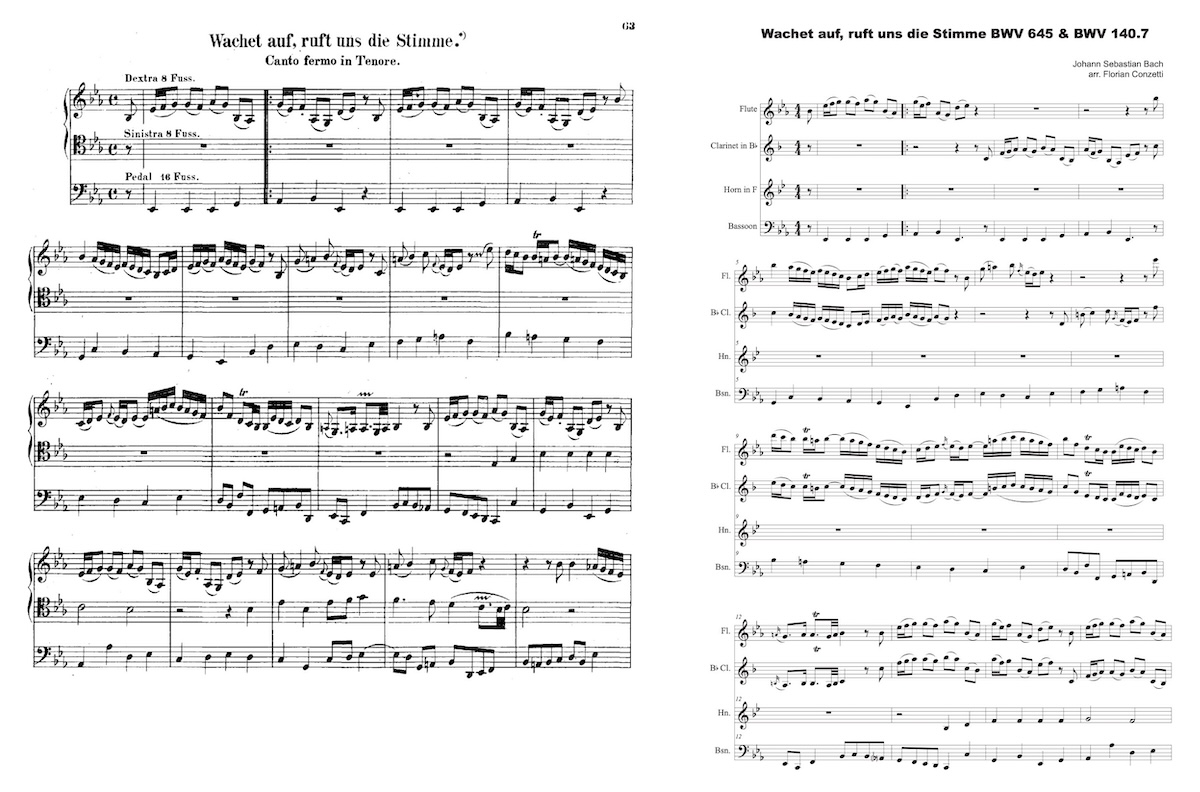
I needed to try other programming alternatives, and one of my first successful attempts was to arrange J. S. Bach’s chorale prelude to “Wachet auf, ruft uns die Stimme,” BWV 645. This piece was useful in several ways: (a) I teach the “Wachet auf” Cantata BWV 140 in my core Western art music survey course, so it made an important connection between performance and academic courses; (b) it was not overly organ-specific in its writing and was about the right length and level of complexity; and (c) it had a unique texture that allowed me to work with—rather than against—the particular mix of instruments in the Instrumental Performance Ensemble that semester. Like a Renaissance-style cantus firmus, the hymn tune in this chorale prelude is in the tenor line, creating an ideal opportunity for the ensemble’s two French horns to play out more and occasionally dominate the ensemble. The superius is comfortably shared by the flutes and clarinets, and the bassus is played by the bassoon (example 1).
Example 1 with Audio 1: Bach: “Wachet auf, ruft uns die Stimme,” BWV 645, mm. 9-15, arranged by Florian Conzetti
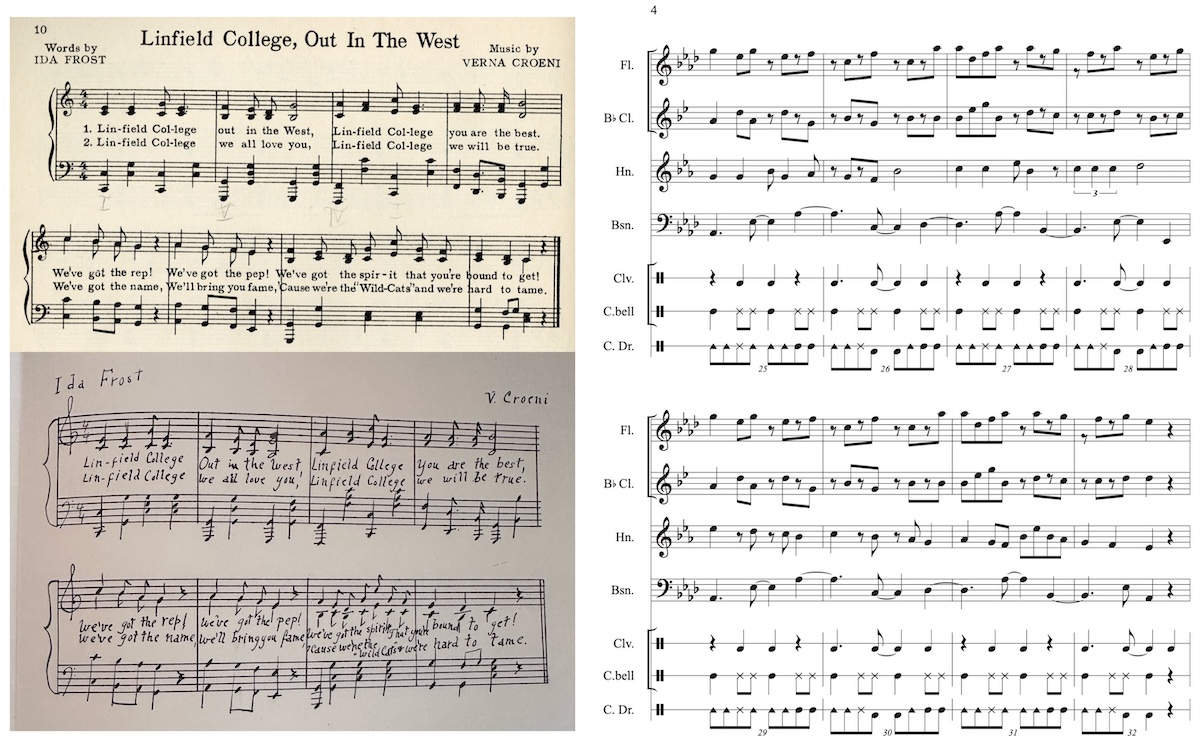
I also arranged songs from the Linfield Songbook, a collection of songs that Linfield music students wrote for glee club competitions in the 1930s. The original handwritten sheet music, competition score sheets, and published editions were helpfully preserved in the Linfield University library archives, making this an attractive historical research project that gave students a sense of belonging to a longer tradition of music making at Linfield. I set these songs in a variety of world music styles, both to make an explicit connection to a world music course I was teaching and to give students in the ensemble a chance to play percussion instruments, which they especially seem to enjoy (example 2).
Example 2 with Audio 2: Croeni/Frost: “Linfield College, Out In The West,” mm. 25-32, arranged by Florian Conzetti
Although the Bach chorale prelude and Linfield Songbook arrangements I made were promising directions for programming, it was only when I secured a Linfield University Student-Faculty Collaborative Research Grant to hire student composition majors to do similar arranging work over the summer that the project became truly student-centered. A critical step in this process was selecting suitable pieces for arrangement. Some pieces I simply assigned, but for others I asked the students to sift through repertoire catalogs, focusing on dances for piano and other lesser-known pieces by familiar composers. We listened to countless delightful Länder, waltzes, polkas, and écossaises, while avoiding sonatas and pieces with overly piano-specific textures. We considered each piece’s (a) suitability for our musicians’ technical skill levels; (b) length, style, and complexity; and (c) potential curricular alignment with academic courses. We also considered student interests and the essential question of whether the arrangement could sound good on its own terms, not merely as a lesser version of the original.
One of our favorite finds was Haydn’s Notturno in F major, Hob.II:28, which was commissioned by the King of Naples in 1788 and originally scored for two lira organizzata (a kind of bagpipe hurdy-gurdy popular in Naples at the time) as solo instruments. Importantly, when Haydn travelled to London in the 1790s to present his music to a most enthusiastic British audience, he re-orchestrated the Notturno for flutes and violins. This was the cue I was looking for—given that Haydn himself had rewritten the piece to suit his needs, we could continue in his spirit and rewrite it again for our available instruments. In addition, the Notturno’s Allegro had a very convenient sonata form for teaching purposes, so I ended up using it in my theory course as well, which students appreciated. (To quote a student’s course evaluation, “I think one of my favorite parts this semester was when we studied the content of the Notturno in F. It helped me understand the piece better when actually performing it.”) Overall, occasional pieces such as country dances and notturnos turned out to be a great source of material for this project, and we found our selection process to be a good reminder of just how much useful music exists once you look past the best-known pieces.
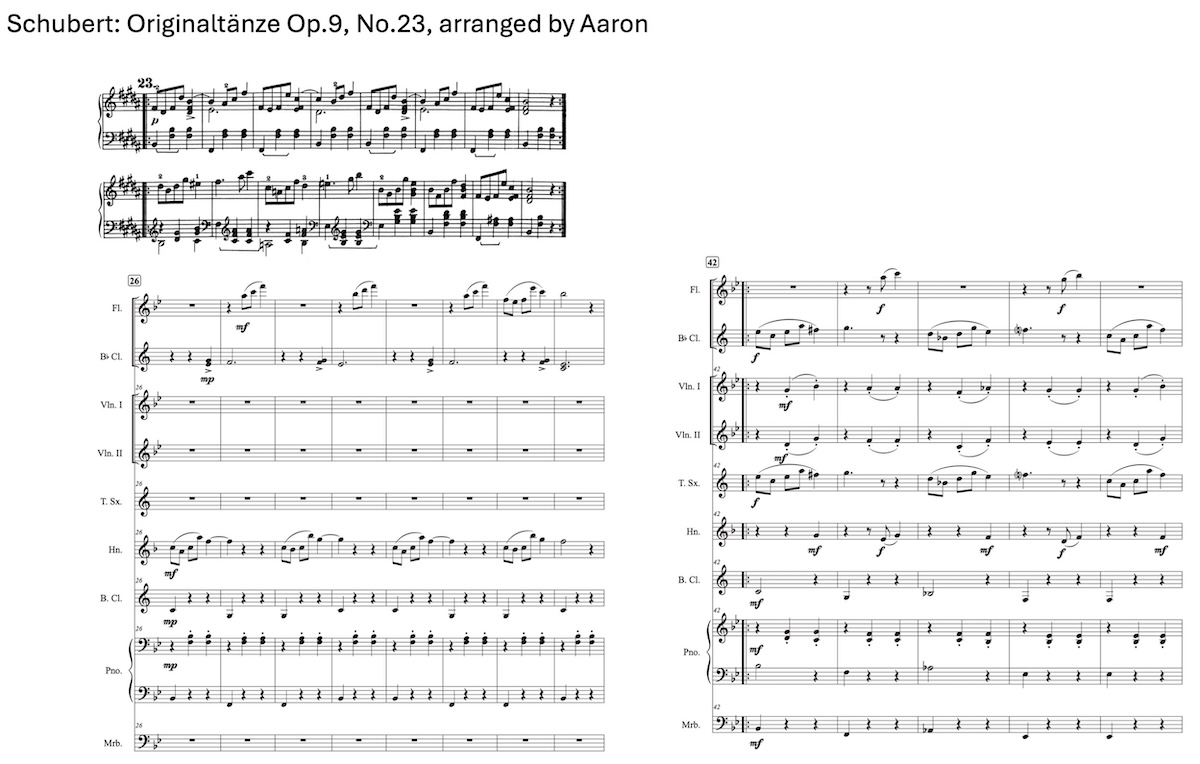
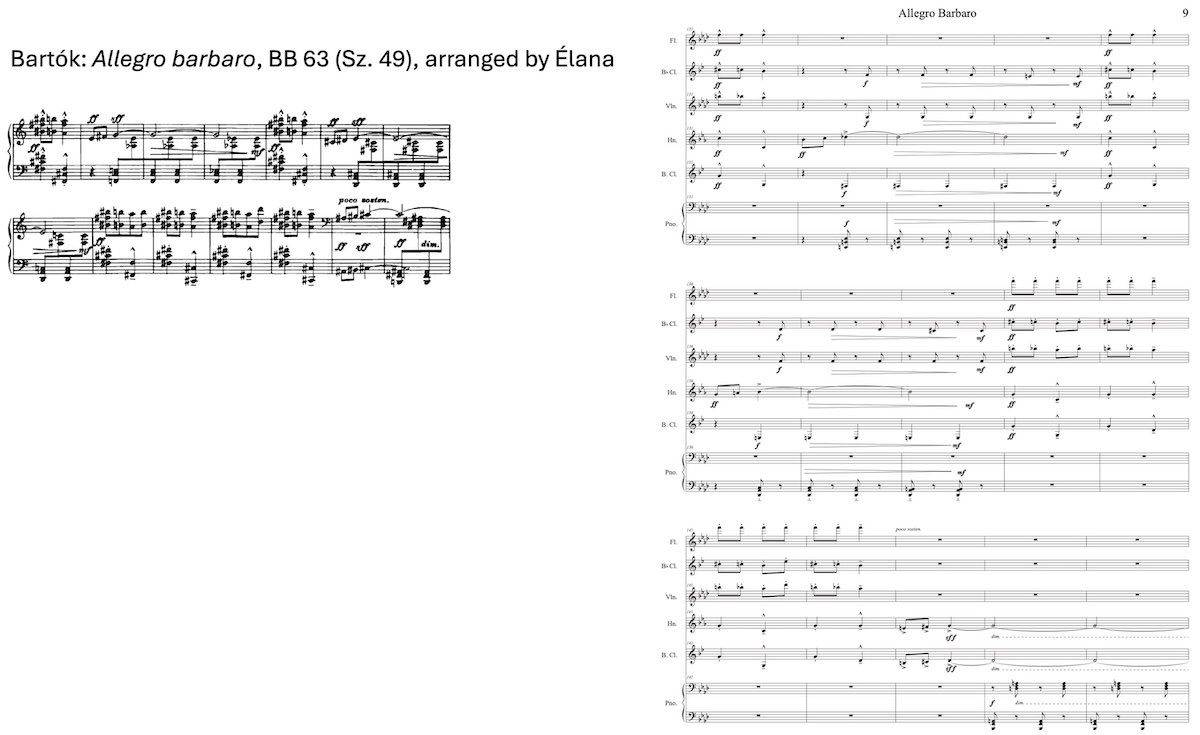
Collaborating with composition students relieved me of some arranging work, but more importantly, it gave students an opportunity to develop their orchestration skills, increase their proficiency with music notation software, and practice meeting expectations of professional arrangers, such as honoring deadlines and producing cleanly edited dynamics, articulations, and parts. Additionally, since the student composers also played in the ensemble, they received feedback from their peers and the gratification of performing the completed arrangements. Examples 3 and 4 show two successful student arrangements from the Instrumental Performance Ensemble Concert of November 18, 2024.[1] For complete concert videos, see: https://www.youtube.com/playlist?list=PLYWm9mZG14KZufVMj-atw3ExbL0Gvm-n7
Example 3 with Audio 3: Schubert: Originaltänze Op. 9, No. 23, mm. 34-46, arranged by Aaron
Example 4 with Audio 4: Bartók: Allegro barbaro, BB 63 (Sz. 49), mm. 131-145, arranged by Élana
With this project, I aimed to carve a developmental path for the Instrumental Performance Ensemble that would allow the music program at our small liberal arts college to be globally and historically inclusive, student-centered, and professionally relevant. Student composers improved their orchestration and software skills, enhanced their professional portfolios, and gained firsthand experience of how, in their future jobs, they could get their music performed outside established commercial channels. Best of all, the project boosted student engagement in the entire ensemble. As one student wrote in their course evaluation, “I had fun playing pieces arranged by friends…it fit with our instrumentation and our sound blended well together.”
[1] For complete concert videos, see: https://www.youtube.com/playlist?list=PLYWm9mZG14KZufVMj-atw3ExbL0Gvm-n7


 Copyright © The College Music Society. All Rights Reserved.